
Samik Roy Choudhury’s ambitious follow-up to Beline turns a crime mystery into a provocative meditation on truth, belief and perception.
All that we see or seem, is but a dream within a dream.
A child disappears. His father, a weary police officer, begins searching for him even as the child’s mother turns to an enigmatic godman for answers. Elsewhere, a Swedish researcher studying shamans and spiritual practices in India, and interviewing the godman, vanishes without a trace. The godman is drawn into the investigation when one of his devotees, a man with a dubious criminal record, becomes a person of interest to the police. And somewhere beneath all this, extra-terrestrial comets plunge into the depths of the ocean. What sounds like the set-up for several different films is, in Maya Satya Bhram, brought together into a strange, increasingly elusive narrative about faith, perception, time and the slippery boundary between truth and illusion. By the time it reaches its philosophical heart, the question is no longer simply who is responsible? It is something more elusive: how certain are we about what we think we know?
And here I must confess to an additional complication in approaching this film. I had championed Roy Choudhury’s previous film, Beline, and reviewed it with something approaching unrestrained enthusiasm. I loved that film, not merely admired it, and that inevitably makes Maya Satya Bhram a more fraught exercise. When a film-maker gives you a film you respond to so deeply, you arrive at the next one carrying not just expectations but a genuine desire for it to measure up to what came before. You want to fall in love again. You want the new film to confirm the promise of the earlier one. Perhaps that is why I found myself both admiring the audacity of Maya Satya Bhram and being more conscious of its imperfections than I might otherwise have been.
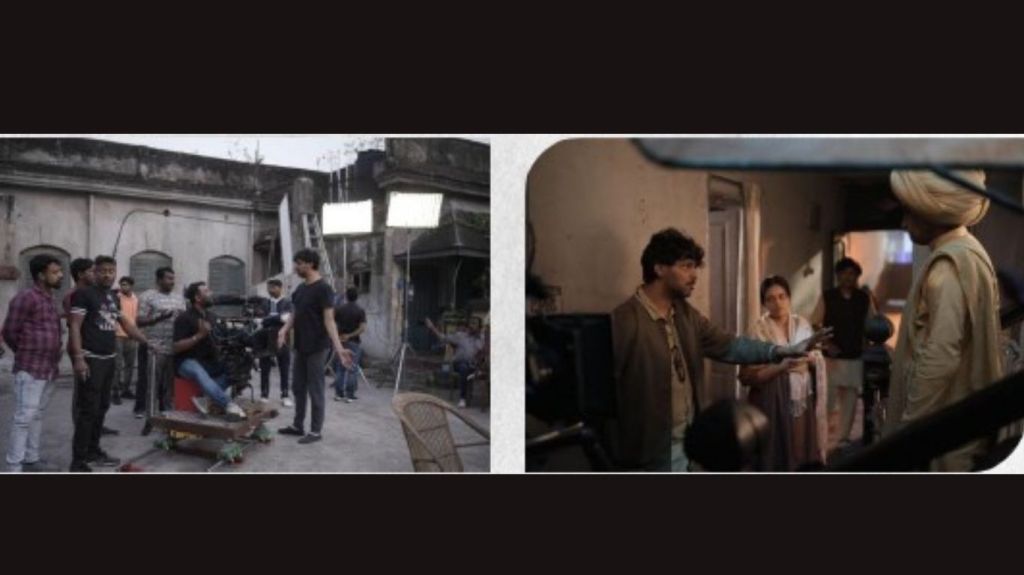
The shift from crime thriller to philosophical inquiry gives the film its distinctive character. The story unfolds around two disappearances. Totoro, the young son of police officer Sanjay Konwar, goes missing, while Sara Nielsen, a Swedish researcher investigating shamans and spiritual practices in India, also disappears. The two cases eventually lead towards Trilokdarshi Baba, an enigmatic spiritual figure whose presence alters the nature of the investigation. What initially appears to be a police procedural gradually acquires the texture of a psychological and metaphysical puzzle.
This is where Maya Satya Bhram becomes most interesting. Roy Choudhury isn’t content to use mysticism simply as atmosphere or to turn the Baba into the familiar cinematic stereotype of the fraudulent godman. Trilokdarshi remains an ambiguous figure, and that ambiguity is crucial. Is he a manipulator, a mystic, a man who has understood something about human psychology, or simply someone onto whom other people project their need for certainty?
The film is at its best when it refuses to answer that question too quickly.
Sara’s encounters with Trilokdarshi introduce the philosophical vocabulary suggested by the title itself. Maya, satya, bhram: illusion, truth, delusion. These aren’t merely decorative concepts added to give a crime story intellectual weight. They become increasingly relevant to the way the narrative is constructed. Memories, testimonies, recordings and competing perceptions keep altering our understanding of events. The viewer is therefore placed in a position not unlike that of the investigator: assembling fragments while knowing that every fragment may itself be unreliable.
The non-linear structure serves this purpose well. Rather than moving obediently from event A to event B, the film circles around its mysteries, disclosing information in pieces and allowing different strands of the narrative to acquire new meanings as they intersect. It is an approach that demands a certain degree of attention from the viewer. At times it works wonderfully; at others, the film seems to be carrying more narrative baggage than it needs.
That is perhaps the central contradiction of Maya Satya Bhram. Its ambition is impressive, but its appetite is sometimes greater than its dramatic requirements. The film wants to be a crime thriller, a psychological drama, a philosophical inquiry, a commentary on contemporary India’s fascination with godmen and a meditation on the instability of perception. It even ventures into science-fiction territory. There is material here for several different films, and Roy Choudhury occasionally allows too much of it onto the screen. Some characters and narrative diversions feel less essential than others, and certain ideas might have acquired greater power had they been left unexplained. Yet the excess is also part of what makes the film unusual. This is not a work afraid of ideas. It would rather risk being overambitious than settle for the familiarity of a conventional thriller.
The godman theme is particularly pertinent. Indian cinema has frequently portrayed spiritual leaders either as frauds exposed by rational protagonists or as repositories of supernatural wisdom. Maya Satya Bhram occupies an uncomfortable middle ground. Trilokdarshi is neither neatly demonized nor sanctified. His followers’ unquestioning faith becomes as significant as the man himself. The film quietly asks why people surrender their uncertainties to individuals who claim to possess answers, and why society is often willing to suspend scrutiny when charisma is dressed in spirituality.
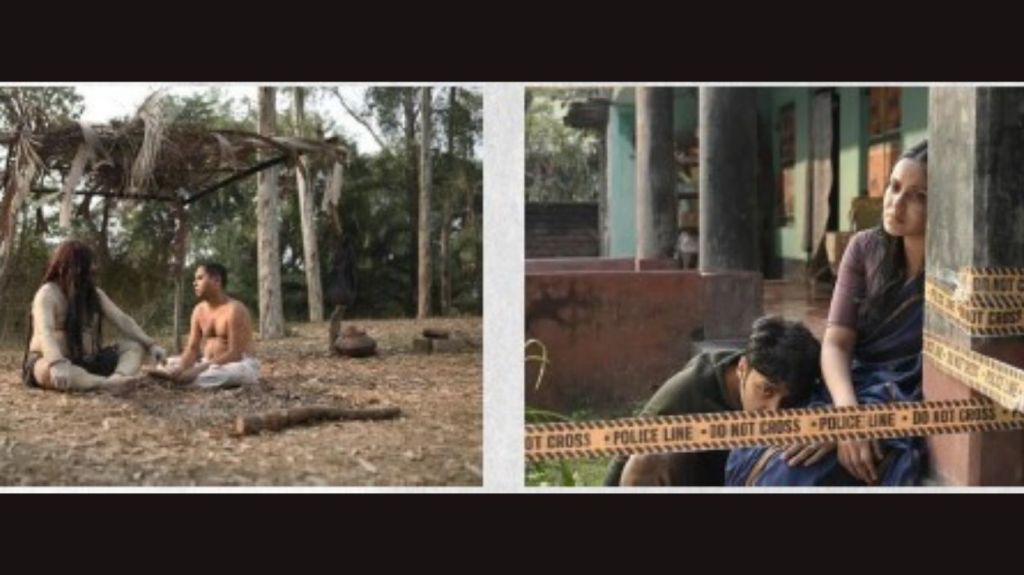
It is in these sequences that the director also finds humour to leaven the grim tale. The reference to Prasen Kana, the criminal devotee, seeking solace for the loss of ‘his Gaddafi’ brings a wry smile. And the antics of the fake conman with whom the young Tilu has his first foray into the world of holy men offer a terrific commentary on both the ecosystem and the contemporary realities of faith. The one shot in which the conman changes from a Hindu sadhu to a Muslim pir simply by removing a fake moustache is brilliantly observed and executed, made all the more telling by its throwaway nature. It is, however, Trilokdarshi who gets the line of the film when he tells the researcher, ‘I am biological.’ I can already hear the titters in the theatre.
Sanat Chattopadhyay understands the value of restraint in playing Trilokdarshi. His performance does not depend entirely on declamatory mysticism; there is something more opaque in his presence, which allows the character to remain difficult to decipher. Soham Majumdar gives the investigation a grounded centre as Sanjay, while Priyanka Sarkar brings an emotional vulnerability to the family dimension of the story. Subhrajit Dutta as Kana Prasen makes quite an impact.
The film’s visual language complements its fractured storytelling. Prosenjit Koley’s cinematography makes effective use of contrasting palettes to distinguish different temporal and narrative layers. The camera can move from the openness of a wider frame to the claustrophobia of tighter compositions, particularly when the investigation enters more psychologically charged territory. The interrogation scene towards the end is among the instances where image and narrative tension work particularly well together.
Sanglap Bhowmik’s editing performs the difficult task of keeping multiple strands in circulation. The fragmented chronology could easily have become confusing for its own sake, but the editing generally maintains forward momentum. The problem is less confusion than accumulation. The film keeps introducing new material when some of its existing material has already generated sufficient dramatic interest.
And yet, for all its unevenness, Maya Satya Bhram lingers because it is asking questions that extend beyond the mechanics of its plot. One of those questions concerns time. Trilokdarshi’s philosophy repeatedly returns to the limitations of our relationship with the past and the future. We carry the past as memory and approach the future as expectation, but neither is available to us in the same way as the present. We want to know what happened, what will happen, who is telling the truth and who is lying. Maya Satya Bhram keeps disturbing that desire for certainty.
The title consequently becomes more than a statement of theme. It becomes a description of the cinematic experience itself. What appears true may prove illusory; what appears irrational may contain another kind of truth; and what we believe we understand may be shaped less by evidence than by our own need to make sense of the world.
Roy Choudhury does not always achieve complete control over this material. The film could certainly have benefited from greater economy, and some of its digressions dilute the force of its strongest ideas. I wish that the lightness of touch evident in some of the film’s finest moments had informed the more overwrought sequences, particularly towards the end. This is perhaps the one reason the film does not hold up for me all the way to the finish. The sections involving Kana Prasen’s obsession with Sara, particularly a sequence in the bathtub, seem out of sync with the film’s overall aesthetic. After a very taut hundred minutes or so, the final stretch loses some of its hold as the narrative becomes increasingly fractured.
However, one cannot but admire the film-maker’s tenacity and his willingness to go out on a limb with some of these elements. Give me a film-maker with this sort of conviction any day, willing to risk dramatic excess in the service of something genuinely intriguing, over one who plays safe and panders to the gallery to create what is at best banal. There is something refreshing about a film-maker willing to let a crime story become strange, philosophical and occasionally unruly.
Perhaps this is also why my response to Maya Satya Bhram remains more complicated than a straightforward thumbs-up or thumbs-down. Beline had made me want to believe in Samik Roy Choudhury as a film-maker. This film doesn’t always give me the same sustained pleasure, but it reinforces something I admired in that earlier work: the refusal to make the safe choice. There is an instinct here to push the material somewhere unexpected, even when the film occasionally pushes too far.
Maya Satya Bhram may not offer the immaculate architecture of a tightly engineered thriller. Instead, it offers something more curious: a mystery in which solving the crime is only one part of the journey. The larger mystery concerns the human compulsion to believe – to believe in godmen, memories, evidence, destiny, appearances and, ultimately, our own version of the truth.
And perhaps that is where the film’s real intrigue lies. The most dangerous illusion may not be that we are being deceived. It may be our conviction that we cannot be.


Leave a Reply