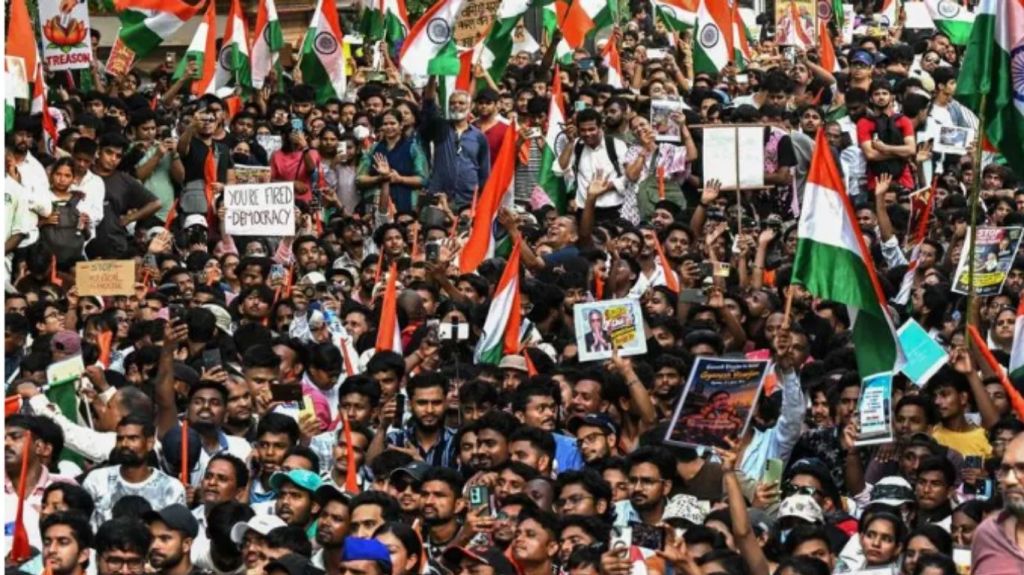
Thirty thousand personnel to contain dissent, while Manipur continues to burn and women are unsafe in the heart of the capital, and a Prime Minister who goes bhajan-clubbing and comes up with a meme-worthy new slogan for the next quarter-century… The state can disperse a gathering. It cannot arrest an argument out of existence. It can detain a protester. It cannot make a troubling question disappear merely by putting the person asking it on a bus. It can silence a street for a day. It cannot command a generation to forget what it has seen.
There is something increasingly Kafkaesque about the Indian state: a world in which those who refuse to answer questions wield the most frightening power, where demanding accountability can make you a suspect, and where the machinery meant to protect citizens is ever more readily deployed to intimidate and contain them. People die and come alive again on electoral rolls, their very existence seemingly subject to the whims of one man carrying out his masters’ bidding, with an impunity that makes a mockery of the democratic process.
The absurdity is not merely that the state can turn a public gathering into a security emergency. It is that, under this strange new logic, the citizen must establish that asking a question is not an act of hostility. The more confidently power proclaims its achievements, the more elaborate the arrangements to shield it from scrutiny. Somewhere along the way, the republic seems to have acquired a surreal new rule: the greater the promise of freedom, the more ruthlessly its exercise is policed.
There are moments when a government inadvertently produces its own political satire. It announces a slogan, rolls out the red carpet, arranges the applause, and then sends an army of policemen to ensure that nobody outside the auditorium asks an inconvenient question.
India has just witnessed a particularly spectacular example.
On 10 October 2026, Delhi was transformed into a fortress ahead of a youth-led protest against the Special Intensive Revision (SIR) of electoral rolls and the Election Commission’s handling of the process. Reports put the deployment at nearly 30,000 security personnel. Thousands were detained, protest leaders were prevented from reaching the protest site, and the capital’s public spaces were subjected to extraordinary restrictions. The authorities cited public-order concerns and the lack of permission for the planned assembly. The protesters, meanwhile, wanted answers about the electoral process and the right to make their objections heard. These are serious questions, deserving serious answers. Instead, the defining image of the day was the sheer scale of the state machinery mobilized against dissent.
Thirty thousand personnel. Let that number sink in.
Not to rescue a city from a natural disaster. Not to evacuate people from a burning neighbourhood. Not to reassure frightened women that they can walk through their own capital without fear. But to manage the possibility that young Indians might gather in public and demand accountability.
One wonders what the government imagines these young people possess. Dangerous weapons? An insurrectionary arsenal? Nuclear codes hidden in their backpacks? Apparently, the threat is more formidable. They possess questions. And questions, it seems, require barricades.
If the state can mobilize 30,000 police and security personnel to contain a protest by the nation’s youth, why does it seem so much harder to mobilize the same urgency, coordination and resolve to make the streets of Delhi safe for women? The question is not whether the two situations require identical deployments. It is whether the state’s formidable capacity is being directed towards the people who need its protection, or primarily towards those whose questions make those in power uncomfortable.
The obscenity of the day went beyond the numbers. Reports and accounts emerging from the protest described young women being beaten and molested, and alleged that elements of the administration and those acting with impunity on the streets had turned intimidation into a weapon against the protesters. If those entrusted with maintaining public order either participate in such cruelty or allow it to happen unchecked, what remains of their duty to protect?
The irony of the date was impossible to miss. 10 October was Mahalaya, the day on which Bengalis invoke Goddess Durga as she begins her journey to earth, with Durga Puja a fortnight away. The prime minister tweeted about the occasion; a senior woman functionary of his party did so too. The imagery of the Goddess, celebrated as the destroyer of evil and the protector of the vulnerable, sat uneasily beside reports of young women being subjected to violence for exercising their democratic right to protest. This is a party that proclaims Beti Bachao, Beti Padhao and promotes schemes such as Ladli Behna in the name of women’s welfare and empowerment. Yet on the streets of the capital, young women protesters were allegedly being subjected to the very cruelty and humiliation that such slogans ought to make unthinkable.
What does the invocation of the Goddess mean when the women who need protection in the here and now are met with intimidation and violence? A tweet invoking Durga is easy. Upholding the dignity and safety of living, breathing women – even when they challenge the government – is the real test.
The Republic’s Most Dangerous Weapon: A Generation That Refuses to Be Intimidated
The remarkable thing about the young protesters is not that they challenged authority. It is that they sought to do so through public protest rather than violence. Their method belongs to a democratic tradition older than most of the institutions now attempting to contain them: assemble, speak, demand answers, refuse to be invisible.
The irony is almost too rich to parody.
In Richard Attenborough’s Gandhi (1982), the Salt Works sequence shows unarmed satyagrahis advancing against armed authority. They are struck down, one after another. They do not retaliate. Their suffering exposes the moral ugliness of the violence being inflicted upon them. The journalist’s closing declaration, ‘India is free today’, captures the extraordinary power of people who refuse to surrender their dignity.
That was a film about a colonial empire confronting a freedom movement. Today’s India is a constitutional republic, and the circumstances are not identical. But the question the sequence leaves behind is disturbingly relevant: what happens to the moral authority of a state when it uses force against people whose demand is to be heard?
The young Indians of today were born into the freedom that the satyagrahis fought for. They should not have to demonstrate that they understand its meaning better than those who govern them. Non-violence is not passivity. Peaceful dissent is not disloyalty. And a government that regards criticism as a threat to its dignity has misunderstood the source of its own legitimacy.
The state can disperse a gathering. It cannot arrest an argument out of existence. It can detain a protester. It cannot make a troubling question disappear merely by putting the person asking it on a bus. It can silence a street for a day. It cannot command a generation to forget what it has seen.
Manipur: The Inconvenient Geography of National Attention
Now consider Manipur.
Ethnic violence erupted there in May 2023. More than three years later, the state continues to experience violence, displacement and an agonizingly incomplete process of rehabilitation. Human Rights Watch reported in September 2026 that the conflict had killed more than 260 people and displaced over 60,000, while renewed violence between Naga and Kuki-Zo communities had added to the crisis. The organization criticized the authorities’ inadequate efforts to protect communities and end the violence.
Three years. Think of the families who have lost homes. The people who remain displaced. The children whose idea of normal life has been shaped by insecurity. The communities still waiting for the basic assurances that a functioning state is supposed to provide.
And then look at Delhi on 10 October. The contrast is not an argument against deploying security forces when genuine threats require them. Nor is it a suggestion that the crises of Manipur and Delhi are interchangeable. It is a question about priorities, political urgency and the allocation of the state’s formidable capacity. Why does the machinery of government appear capable of mobilizing at extraordinary speed when a protest threatens to become politically embarrassing, while the restoration of lasting peace and normal life in Manipur remains such a prolonged and painful challenge?
The government can point to security deployments, meetings, rehabilitation schemes and peace initiatives. Those efforts should be examined fairly. But the test of governance is not the number of meetings held or announcements made. It is whether people are safer, whether justice is delivered and whether citizens can return to ordinary life.
A state should not need a camera crew to discover a crisis. And a crisis should not have to compete with a political event for the government’s attention.
Bhajan Clubbing: When the Soundtrack Is Louder than the Questions
Then there is Delhi’s horrifying question of women’s safety.
On 21 September, a seventeen-year-old girl was gang-raped at Aastha Kunj Park in South Delhi. The case prompted outrage, protests and renewed scrutiny of public safety. The Supreme Court took note of the broader crisis, while Delhi’s chief minister publicly acknowledged the questions raised by recent incidents of sexual violence.
On 25 September, Prime Minister Narendra Modi attended a bhajan-clubbing event in a park in Delhi, joining a devotional music gathering with clapping and a tambourine. There is, of course, nothing inherently wrong with devotional music. A prime minister is entitled to participate in cultural and religious events. Bhajans are not responsible for crimes committed by rapists, and a public appearance at a musical event is not, by itself, proof of indifference.
But politics is also about timing, symbolism and the questions leaders choose to answer. When women are asking whether public spaces are safe, when students are protesting and when a horrific crime has intensified public anxiety, the sight of the country’s most powerful political leader enjoying a carefully packaged cultural moment invites a reasonable question: where is the same visible urgency for the people demanding safety and accountability?
When a young woman has been subjected to an appalling act of violence, and women across the capital are asking whether they can safely inhabit public spaces, the spectacle of the country’s highest political authority at a feel-good cultural event, within days of the crime, makes for a deeply disconcerting contrast. The question is not whether the prime minister should sing a bhajan. It is why the same visible energy and political urgency are not unmistakably present in the task of making women safe.
The phrase ‘bhajan clubbing’ almost writes its own satire. A modern, youthful, social-media-friendly spectacle: devotion meets nightlife, tradition meets trend, the tambourine meets the algorithm. Meanwhile, the less photogenic business of making streets safe, investigating crimes, ensuring accountability and rebuilding public trust continues.
Perhaps a new format is needed. Accountability clubbing, anyone? Citizens bring questions; ministers bring answers. No elaborate lighting required. No choreographed applause. Just a functioning democracy.
The point is not that a prime minister must spend every waking hour responding personally to every crime. It is that leadership requires more than appearances. It requires a credible sense of proportion, a public demonstration that the anxieties of ordinary people command the attention they deserve.
A government cannot manufacture public confidence by staging confidence.
Twenty-five Years of Power. And the Slogan Is Still ‘We Will Do It’?
On 7 October, Narendra Modi marked twenty-five years as the head of a government, beginning with his tenure as Gujarat chief minister and continuing with his years as prime minister. The occasion brought a new slogan: ‘We will do it.’ The stated ambitions included making India a developed country by 2047 and advancing its economic and technological standing.
Twenty-five years in positions of executive leadership is a substantial period. It is enough time to have acquired a formidable vocabulary of achievement, experience and national ambition. And yet the slogan is ‘We will do it’.
Do what, exactly? Build a developed nation? Certainly. Expand opportunity? Absolutely. Improve public services, protect women, restore peace in conflict-affected regions, strengthen institutions and ensure that every eligible citizen can exercise the right to vote? These would be worthy ambitions.
But after a quarter-century at the head of governments, one might reasonably expect the celebratory presentation to include an equally serious reckoning with what remains unfinished. Instead, the future is once again arriving in the form of a slogan.
‘We will do it’ has the reassuring rhythm of a school assembly. Everyone repeats it, the hall fills with enthusiasm, and for a moment the task seems almost complete. But a country is not developed by collective chanting. A democracy is not strengthened by the volume of applause at an anniversary event. It is strengthened by institutions that can withstand scrutiny, police forces that protect citizens rather than intimidate peaceful critics, and public officials who answer uncomfortable questions without treating them as acts of hostility.
After twenty-five years, the most revealing question is not whether the government can promise another ambitious future. It is whether citizens can ask what happened to the promises of the past. That, too, should be part of the anniversary celebrations. Perhaps even the main event.
Not surprisingly, the internet did what the machinery of political messaging had apparently not anticipated: it turned the slogan into a joke at the expense of those who had coined it. ‘We will do it’ became meme material, its reassuring promise acquiring a decidedly different meaning in the context of the controversy over electoral rolls and the Election Commission’s handling of the process.
One version of the joke posed a question that was funny precisely because it was so uncomfortable: Who rigs the elections? The answer came back: We will do it. A declaration of national ambition becomes an insinuation about electoral manipulation; a promise of achievement becomes a taunt about accountability. The meme is not proof that elections have been rigged. Nor does its circulation establish the truth of the allegations surrounding the electoral process. Its significance lies elsewhere: in the speed with which an official slogan can be appropriated, inverted and made to express a public suspicion that the authorities have not adequately addressed.
This is the peculiar blindness of political power in the age of social media. Those who devise the slogan imagine a nation applauding a promise. Citizens hear the words against the backdrop of their own anxieties and turn them into satire. The government sees a campaign message; the public sees a punchline. And the more strenuously power insists on controlling the narrative, the more readily the internet finds a way to wrest it away.
The Government’s Real Problem Is Not the Protest
The absurdity of the current moment lies in the contrast between the scale of the state’s response and the nature of the challenge it faces.
A generation is asking questions about electoral integrity. Citizens are asking for safety. Families in Manipur are waiting for normality and justice. Across these different circumstances, the demands are not identical, but they converge on a common expectation: that power should answer to the people it governs.
The authorities can argue that protests must comply with the law, that public order matters and that electoral-roll revisions are administrative exercises intended to improve accuracy. Those claims deserve examination. Public order is a legitimate responsibility. So is the protection of the right to peaceful assembly. The existence of one obligation does not erase the other.
The real measure of democratic confidence is not whether a government can prevent a demonstration from taking place. It is whether it can tolerate the questions that would have been asked there.
There is a particular kind of political comedy in a government celebrating its achievements while treating the public as a security threat. The same state that asks young people to help build a developed India appears alarmed when those young people exercise the most basic habits of citizenship.
Apparently, Gen Z is welcome as an audience, a workforce, a demographic and a hashtag. As citizens demanding answers? The welcome becomes considerably less enthusiastic. That is a strange way to cultivate national confidence.
‘India Is Free Today’
Return, finally, to the Salt Works.
The satyagrahis in Gandhi do not win because they possess superior force. They expose the limits of force. Their courage turns a demonstration of authority into a spectacle of its moral failure. The journalist’s words resonate because freedom is revealed not as a gift bestowed by rulers, but as a claim asserted by people who refuse to be reduced to subjects.
India today is not British India. The government is elected, the constitutional framework is different, and the circumstances must be judged on their own facts. But independence was never meant to be a licence for the powerful to become insulated from criticism. The republic was built on the premise that authority must be accountable.
A government may retain office, control the administrative machinery and command a vast security apparatus. Its legal authority is not automatically erased by a controversial decision or an excessive police deployment. But moral authority is a more demanding currency. It depends on restraint, fairness, responsiveness and public trust.
When peaceful dissent is met with mass detention and a city is prepared as though questions themselves were a security emergency, that trust is placed at risk. When a state remains unable to offer lasting security to people living through prolonged conflict, the deficit becomes more serious. When women ask whether their capital is safe and the public sees a greater abundance of spectacle than answers, the gap between political performance and lived experience widens. And when a leader marks twenty-five years in power with yet another promise of what ‘we will do’, citizens are entitled to ask what has already been done – and for whom.
The young people on the streets are not asking to be granted freedom by a benevolent government. They are asking that the freedoms of a republic be taken seriously. That is why the Salt Works sequence matters. It reminds us that the moral stature of a government is not measured by the number of people it can control, but by the dignity it allows them to retain.
Perhaps the most uncomfortable question for those in power is also the simplest: If a government is confident of its mandate, its record and the integrity of its institutions, why should peaceful questions frighten it? Thirty thousand personnel can secure roads, seal intersections and prevent a gathering. They cannot provide an answer to that question.
The prime minister can offer a thousand slogans. None can substitute for public trust. And the young can be detained, dispersed and told to go home. But they have already made their point. India is not free because its rulers say so. India is free when its people can question their rulers without being treated as enemies.
The journalist in Gandhi declared, ‘India is free today.’ The question facing us now is whether those who govern this free India remember what that freedom was meant to mean. And whether they have the courage to let its young citizens remind them.


Leave a Reply