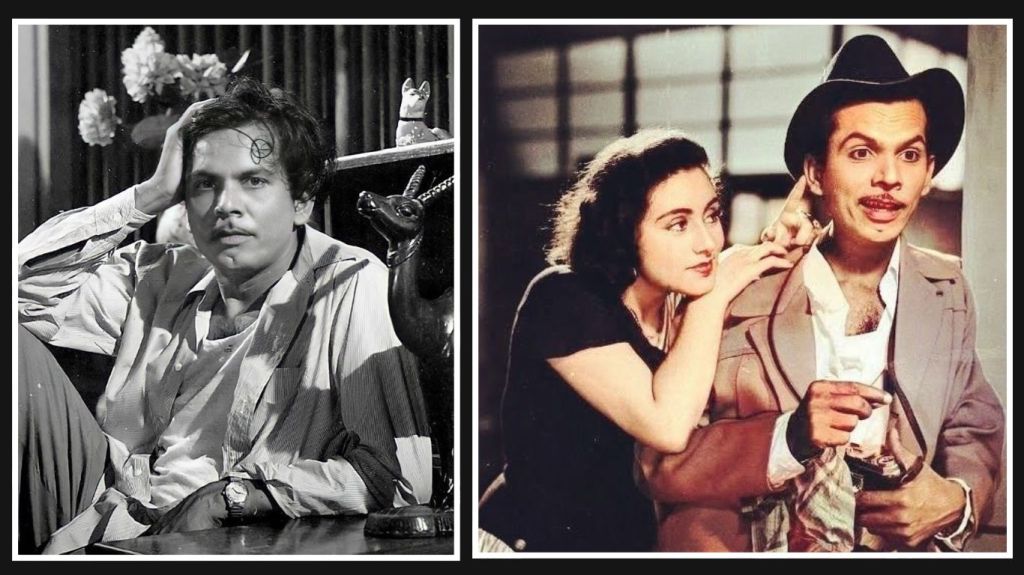
Johnny Walker brought a rare warmth and humanity to Hindi-film comedy. A hundred years after his birth, his drunks, hustlers, servants and streetwise dreamers remain memorable not for the jokes alone, but for the dignity, vulnerability and sheer affection with which he inhabited them. His was a comedy of character, timing and unmistakable grace.
There was something almost disarming about Johnny Walker. In a Hindi film comedy landscape that could often be broad, noisy and relentlessly physical, he was the gentleman clown: raffish without being vulgar, a little tipsy without being threatening, and perpetually caught somewhere between mischief and innocence. His distinctive face, with its prominent cleft chin, was instantly recognizable, as was his peculiar vocal flourish, half chuckle and half hiccup, which could announce him before he had even appeared on screen.
A hundred years after his birth, Johnny Walker remains one of Hindi cinema’s most distinctive comic actors, not least because he was never merely a comedian. He was a character actor who happened to specialize in making people laugh, and his characters came with a remarkably well-defined social identity. Drunks, taxi drivers, servants, bootleggers, small-time crooks, street-smart hangers-on, touts and assorted inhabitants of Bombay’s working-class underbelly populated his films. Yet he rarely played these men with the contempt that the label ‘lowlife’ might imply. They might be opportunistic, foolish, cowardly or morally dubious, but they were almost invariably human. Walker had the unusual ability to make a character ridiculous without making him contemptible.
Born Badruddin Jamaluddin Kazi in 1926, he came to films by way of the streets of Bombay. He had worked as a BEST bus conductor, entertaining passengers with mimicry and comic routines. Balraj Sahni is generally credited with noticing his talent and recommending him to Guru Dutt, who cast him in Baazi (1951). The story goes that Guru Dutt gave him the name Johnny Walker after the whisky brand, recognizing his gift for playing the drunk. The irony was that Walker was famously not a drinker. He would nevertheless spend much of his career giving Hindi cinema some of its most memorable screen drunks. The drunk, in Walker’s hands, was never simply drunk. He could be boastful, philosophical, flirtatious, cowardly or unexpectedly shrewd. The bottle was less a prop than a passport into a particular social world. Walker understood the psychology of the man who wanted everyone to believe he was perfectly in control while making it obvious that he wasn’t.
His early association with Guru Dutt was crucial in establishing the Walker persona. Baazi, Aar-Paar (1954), Mr. & Mrs. 55 (1955), C.I.D. (1956) and Pyaasa (1957) placed him in a Bombay of taxis, bars, pavements, policemen, gangsters, clerks and small-time hustlers. This was the city at street level, and Walker seemed to belong to it instinctively.
In C.I.D., his comic presence fits naturally into the film’s noir-ish urban landscape. In Aar-Paar and Mr. & Mrs. 55, he is part of the bustling social fabric of Guru Dutt’s Bombay. He could slip into a scene without announcing that ‘the comedian’ had arrived. That was important. The comedy emerged from the character and his circumstances rather than from a rupture in the narrative.
This was particularly evident in Pyaasa. In the midst of Guru Dutt’s melancholy portrait of an unsuccessful poet and a society indifferent to art, Walker’s Abdul Sattar provides some of the film’s warmth and humour. His famous ‘Sar Jo Tera Chakraye’ sequence is comic, but it is not an intrusion. Walker’s masseur is part of the same world as Vijay; his earthy humour provides relief without diminishing the film’s sadness. Indeed, the affection with which he plays Sattar gives the comedy an emotional dimension. Walker was exceptionally good at this balancing act. He could enter a serious film and lighten its mood without reducing its seriousness.
Then there is Madhumati (1958), where his drunken performance in ‘Jungle Mein Mor Nacha’ remains one of the great comic set pieces of Hindi cinema. Bimal Roy’s film is atmospheric, romantic and faintly sinister, yet Walker’s appearance does not destroy its mood. He creates a complete little portrait of drunken self-importance: the man who imagines himself charming and in command while the audience can see exactly how far gone he is. The song also illustrates another of Walker’s strengths: his comic performances were often inseparable from music. ‘Sar Jo Tera Chakraye’ and ‘Jungle Mein Mor Nacha’ are not simply songs inserted for comic relief; they are character pieces. The actor’s gestures, voice, movement and timing are integral to their identity.
Timing, indeed, was the foundation of Walker’s craft. He knew the value of a pause, the slightly delayed response, the sideways glance. He could let a line hang for a beat before completing it, or allow his expression to contradict what he was saying. The cleft chin became part of this punctuation. It was recognizable enough to become a trademark, but he used it as part of a larger vocabulary of hesitation, surprise, mock bravado and bemusement.
This is what distinguished him from the generation of comedians who would follow. Mehmood’s emergence in the late 1950s and 1960s altered the grammar of Hindi-film comedy. He was bigger, louder, more physical and more overtly performative. He could take over a scene with his body, voice, dialects and manic energy. His comic personas – from servants and drivers to South Indian stereotypes and assorted eccentrics – were often built around exuberant physical transformation.
Walker represented a different register. Where Mehmood could explode into a scene, Walker could insinuate himself into it. Where Mehmood’s body was often the joke’s principal instrument, Walker relied more heavily on voice, face, gesture and character detail. Mehmood increasingly became a comic star who could command a film; Walker remained, for the most part, the consummate supporting player. It would be simplistic to regard one as better than the other. The difference is more revealing than any hierarchy. Mehmood belonged to a cinema in which comedy was becoming increasingly extroverted. Walker belonged to an earlier tradition in which the comedian was woven into the dramatic fabric of the film.
And Walker’s characters had something else that set them apart: dignity. His men were often poor. They were frequently on the wrong side of the law, or at least close enough to it to be nervous about policemen. They lied, drank, hustled and boasted. But Walker did not play them as inherently inferior to the respectable people around them. His comedy came from their attempts to negotiate a world larger and more powerful than themselves. The lowlife figure in Walker’s cinema is therefore not simply a butt of jokes. He is a survivor.
That quality is particularly important when revisiting 1950s Hindi cinema. The period was full of films negotiating the contradictions of a newly independent, rapidly urbanizing India. The city promised freedom and opportunity but also anonymity, poverty and moral ambiguity. Heroes could be displaced, unemployed or morally conflicted; villains could inhabit respectable spaces; and the comedian could be the man who understood the street better than anyone else.
Walker gave that man a face. His social range was considerable. He could be the drunk who had seen better days, the servant who knew more than he let on, the petty hustler forever trying to make a quick buck, the driver or streetwise acquaintance who possessed useful information, or the hanger-on who attached himself to people more powerful than himself. The circumstances changed, but Walker supplied each character with a recognisable inner life. That is why his comic acting has aged better than many of the jokes around him. The jokes may belong to their time. The characters do not.
There was also a generosity in his screen persona. Even when the character was trying to con somebody, there was usually a suggestion that he was himself barely managing to survive. His cowardice could be funny because it was recognizably human. His bravado was funny because it concealed vulnerability. His drunkenness was funny because it was performance as much as intoxication.
This may explain why ‘gentleman comedian’ is such an apt description of Walker. Not because his characters were always gentlemen, but because his comic temperament was. He did not need cruelty, humiliation or sheer volume to produce laughter. He could be raffish without becoming vulgar and mischievous without becoming menacing.
His filmography through the 1950s and 1960s is a reminder of how deeply embedded he was in mainstream Hindi cinema. Some roles were little more than a handful of scenes, but Walker had the rare ability to make them feel like the outline of a whole life. That was the character actor in him. He understood that a supporting role need not carry the plot to carry the texture of a film.
In retrospect, this may be his most important contribution to Hindi-film comedy. He helped establish the comedian not simply as a dispenser of jokes but as a chronicler of the social margins. He gave the working-class and underworld characters of popular cinema a comic vocabulary that was affectionate without being sentimental. His men might be ridiculous, but they were rarely disposable.
And then, almost imperceptibly, the cinema changed. As the 1960s gave way to the 1970s, the Hindi film hero grew more muscular, action became more central, and comedy increasingly occupied its own elaborate set pieces. The comic actor was expected to compete for attention rather than quietly enrich the narrative. Mehmood had already pointed towards this transformation; later comedians would take it much further. Johnny Walker’s particular kind of understatement began to seem like a relic. But watching him now, the opposite impression can emerge. He does not seem restrained because he lacks energy. He seems restrained because he possesses control. The little pause before the line. The suspicious glance. The slight swagger. The sudden retreat. The half-smile. The thuddi. He knew precisely how much was enough.
Perhaps that is why his centenary is worth marking not simply with nostalgia but with a reassessment of his craft. Johnny Walker was one of the architects of Hindi cinema’s comic language. He demonstrated that comedy could coexist with tragedy, that a supporting actor could leave an indelible mark without hijacking a film, and that characters from the margins could be funny without being dehumanized. He was the man who could be drunk without being dangerous, dishonest without being sinister, foolish without being stupid.
Above all, he was a comedian who seemed to like his characters. That affection is what survives. Long after individual jokes have lost their sting, Johnny Walker’s face, voice, walk and thuddi remain instantly recognisable. In an age of increasingly elaborate comic performances, there is something almost radical about the economy of his work. He walked into the frame, inhabited a character, found the joke, and walked out again. Usually, that was enough.
The Songs That Remain
That economy found another, particularly memorable expression in his songs. Johnny Walker’s great comic songs are worth revisiting not merely for the laughter they provoke but for the little characters they create. Each song gives him a different social identity, a different rhythm, even a different relationship with the world around him.
In Madhumati (1958), ‘Jungle Mein Mor Nacha Kisi Ne Na Dekha’ is pure, unabashed fun. The supposedly outdoor setting has the unmistakable artificiality of a studio set, but that hardly matters. Salil Chowdhury gives the song a buoyant, almost intoxicating quality, and Johnny Walker proceeds to make the most of it. He clambers up a tree, tumbles down, staggers about and takes mock umbrage at the world’s disapproval of his drinking. There is no great sophistication to the situation, nor does there need to be. Walker’s physical comedy, the sprightly tune and Shailendra’s playful lyrics combine to produce one of those sequences that seem to exist simply for the pleasure of watching a performer having a wonderful time.
‘Ae Dil Hai Mushkil’ from C.I.D. (1956) reveals another side of him. This is not really a comic song, though Johnny Walker is at its centre. His character, Master, is a petty thief negotiating the unforgiving streets of Bombay, and the song has an oddly bleak undercurrent. The city is vast, impersonal and indifferent; Master moves through it with a mixture of resignation and streetwise resourcefulness. Sometimes he walks, sometimes he manages to hitch a ride in a Victoria, accompanied by his practical, spirited girlfriend, played by Kumkum. She is terrific here: vivacious, feisty and entirely unimpressed by her man’s tendency towards self-pity. Walker, meanwhile, is vulnerable beneath the bravado. It is a reminder that his comic characters could carry melancholy without announcing it.
Then there is ‘Jaane Kahan Mera Jigar Gaya Ji’ from Mr. & Mrs. 55 (1955). The setting is wonderfully mundane: an office, lunchtime, a mildly bemused chowkidar keeping an eye on the proceedings. Johnny Walker is in flirtatious pursuit of Yasmin, played by the lovely, dimpled Kumkum, and the conceit is that he has somehow misplaced his heart. One can almost imagine him searching everywhere for it – beneath a desk, inside a filing cabinet, perhaps somewhere in the office files. The song’s charm lies in its sheer lightness. There is no grand romance here, only the endearing awkwardness of a man determined to turn his infatuation into an event.
‘Arre Na Na Na Tauba Tauba’ from Aar-Paar (1954) has a similar sense of mischief. The idea of Johnny Walker attempting to woo his lady in a zoo is funny enough before he does anything at all. But it is the combination of O.P. Nayyar’s music, the playful lyrics and Walker’s comic persistence that makes the sequence so irresistible. He asks, with all the vulnerability of a man in love, whether she has been losing sleep over him; her response is wonderfully deflating: she hasn’t, because she isn’t ill. There is also a lovely bit of cinema history tucked into the song: Walker and Noor, who played opposite him and was Shakila’s sister, reportedly fell in love while making Aar-Paar and subsequently married. Life, in this case, seems to have been rather more romantic than the film.
And then there is ‘Sar Jo Tera Chakraye’ from Pyaasa (1957), perhaps the definitive Johnny Walker song. As Abdul Sattar, the neighbourhood tel-maalishwala, Walker is both clown and commentator, moving through the city offering head massages, advice and whatever other services might earn him a few annas. The performance is gloriously irreverent, but never mean-spirited. There is a childlike quality to his exuberance, a sense that he is genuinely delighted by his own little universe. S.D. Burman’s composition is perfectly matched to him, full of playful turns and unexpected accents; even the rhythmic possibilities of the champi become part of the musical joke. Walker doesn’t merely perform the song. He inhabits it. In a film otherwise steeped in disillusionment, loneliness and social cynicism, Abdul Sattar provides a burst of human warmth. He is funny, but he is also decent; a small man in a harsh world who has retained the capacity to enjoy himself.
That, ultimately, is what makes Johnny Walker’s comic songs so enduring. The laughter is rarely at the expense of his characters. Even when they are drunk, foolish, petty or hopelessly romantic, Walker gives them enough affection to make us laugh with them rather than simply at them.


Leave a Reply