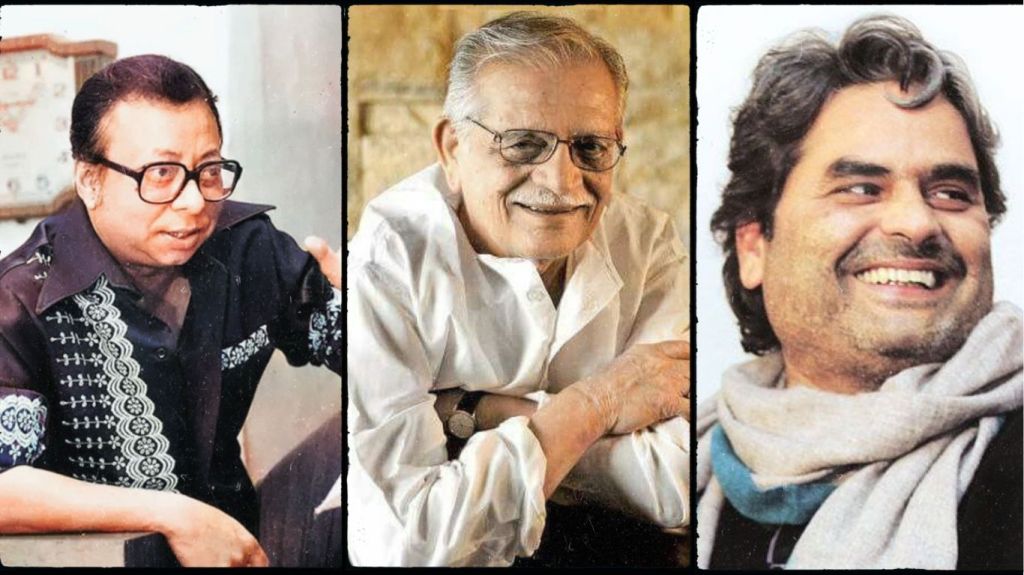
In a culture where children’s entertainment too often comes with a lesson attached, Gulzar has spent decades creating worlds of wit, wonder and delightful nonsense. From ‘Masterji ki aa gayi chitthi’ and ‘Lakdi ki kaathi’ to ‘Jungle jungle baat chali hai’, a celebration of Gulzar, Pancham and Vishal Bhardwaj’s rare gift for entering a child’s world without ever talking down to them. The songs, stories and playful imagination that have delighted generations.
***
‘Writing for children is as easy as describing the history of the Byzantium in three words,’ said Mo Willems, American writer, animator, voice actor, and author of children’s books. It’s a thought that Gulzar will endorse wholeheartedly. In his series of books, titled Samay Post, Gulzar says, ‘It’s while trying to teach children that one realizes what all we have to learn from them. Only when you read these books with children will you understand who the teacher is and who the student.’
It’s nothing short of a national shame that a country as vast as India, with an aeons-old tradition of storytelling, has little to show when it comes to writing for children. Popular culture, barring Bengali, is almost bereft of this genre. Generations have grown up on imported fairytales – Snow White, Little Red Riding Hood, Cinderella, The Jungle Book. Films and songs for children can literally be counted on one’s fingertips (and what is there is preachy and aimed at educating children to be better human beings, reminding one of what author Beverly Cleary said: ‘As a child, I disliked books in which children learned to be better children’).
The one exception in this arid landscape, someone who has ploughed a lonely furrow in this genre is Gulzar. Time and again he has created a magical world for children, through his films, songs and other non-film writing. A world that children can relate to, that does not talk down to them, that makes them laugh and look at the world with the wonder of their imagination. In this he has found willing collaborators like R.D. Burman and Vishal Bhardwaj, who share his vision and almost childlike glee and innocence in crafting these young worlds.
‘I feel it is important for a writer to observe children, love them and indulge them,’ Gulzar says. ‘Only then can you write about or for children. The books we have for children are not suitable for them. They tend to be preachy. That is the greatness of Sukumar Ray and his Abol Tabol. In India there are only three languages at this stage which has worthwhile writers for children – Bangla, Marathi and Malayalam. There are no good original writers for children in Urdu, Hindi or Punjabi. You have the same translations of the Mahabharata and the Ramayana. But there is hardly any contemporary writing. And few film-makers in Hindi cinema get the world of children right.’
Humko mann ki shakti dena, Guddi (1971)
A film song that became a school hymn across the country, this is typical of what Gulzar brings to the table. For one, it is a prayer song that dispenses with a god entity altogether. Instead, it calls for developing confidence in one’s own self (‘khud pe hausla rahein’) and contemplation – the line ‘Doosron ki jai se pahle khud ko jai karein’ is a mantra that we could all adhere to. And much before ‘inclusiveness’ and ‘tolerance’ became such maligned buzzwords, the song spoke of these virtues simply and eloquently. What makes the song resonate is the impish humour that marks it filming. As Gulzar says, ‘It’s a prayer song, so the words could not be frivolous. Hrishi-da (Hrishikesh Mukherjee), however, had a great sense of humour, and you see it in the way it is shot.’ Apparent in the expressions the children – including Guddi (Jaya Bachchan), who is as usual late to the assembly – make, so typical of children who are often bored with these assembly routines. And given that Guddi is a die-hard Dharmendra fan, the line ‘Saath de to dharam ka, chale toh dharam par’ is Gulzar at his meta-best.
Sa re ke sa re ga ma ko le kar, Parichay (1972)
A shining example of the poet’s mastery over the medium, this is Gulzar giving us the seven notes of music in words, with everyday motifs – Sa (savera, morning), Re (reshmi kirnein), Dha (dhoop), and so on. But there are also aspects of the story playing in this song. Consider, for example: ‘Papa nahin hain dhaani si didi, didi ke saath hain saare.’ Those who know their music will latch on to ‘pa’, ‘dha’ and ‘ni’ as part of the seven notes. But the line also implies that the children here don’t have a father (papa nahin hain), and it is their ‘dhaani si’ sister who is with them. The word ‘dhaani’ is open to interpretation here. It could refer to the light-green sari Jaya Bachchan is wearing in the first part of the song. It could also mean, a very Bengali connotation, someone of a short stature (Jaya Bachchan), and/or, given her character’s snappy attitude towards the new teacher in the early parts of the film, short-tempered. R.D. Burman’s innate understanding of music that will appeal to children enhances the overall experience of the song.
Masterji ki aa gayi chitthi, Kitaab (1977)
Based on a story by Samaresh Basu, this is a rare Hindi film for children and adolescents that speaks to them in their language, without condescension. Nothing epitomizes this better than this almost anthemic song. No child growing up in the 1980s will ever forget the refrain ‘VIP underwear banyan’ – so typical of what children pick up from the world around them. Gulzar says, ‘Have you ever seen a class when the teacher is absent? That’s what I have tried to replicate here. And thanks to Pancham’s (R.D. Burman) genius, using desks to get the rhythm the children create, it comes alive. Pancham’s sense of humour and his understanding of a child’s world were amazing. He was a child at heart and that shows in his compositions for children with me.’
A great admirer of Sukumar Ray and his nonsense verses, Gulzar’s words in this song are classic examples of this genre, with cats eating zarda-paan, mosquitoes with moustaches, and blushing cheetahs in ghunghats, all emerging from a letter. Then there’s the delightful play of words between agar-batti and magar-batti, which segues into another inspired line: ‘Agarbatti kachhua chap, aag pe baitha paani taap’. Or ‘English bolay matlab Hindi / If agar is hain but par what matlab kya / English mein algebra chhan’. Just read that line closely: if (agar), is (hain), but (par), what (kya), and you get an inkling of the writer’s understanding of a child’s psyche. All of this made delightful with the musical refrain ‘dhin-taka-taka-dhin’ and the reference to the ad, ‘VIP underwear banyan’.
Lakdi ki kaathi, Masoom (1983)
A perennial classic which takes off from a child’s earliest plaything, a wooden horse. ‘Children going tak-bak-tak-bak, chal meray ghorey, chal chal chal is something all of us have seen. When they do that, they actually imagine a horse but at the same time they know that it is not real. They are aware of that. Every child plays a role of a doctor and a teacher in some point of their life,’ says Gulzar.
‘Lakdi ki kaathi’ is a triumphant amalgamation of nonsense verse with imaginative wordplay. ‘You must remember that children have a vivid imagination, an infinite capacity to create their own language, and as a writer you have to take that into account,’ says Gulzar. ‘You have to give them images they can relate to, that are fun to imagine. You can see a child reacting to “ghore ki dum pe jo maara hathora”.’
That is what this song does with words like ‘Ghoda pahuncha chowk mein, chowk mein tha naayi, ghode ji ki naayi ne hazamat jo banayi’. Try translating that for meaning. But when you enter a child’s mind-space, it makes complete sense. There’s also Gulzar drawing upon his memories of Delhi with ‘Ghoda tha ghamandi, pahuncha Sabzi Mandi’ and ‘Chalta hai Mehrauli mein, ghoda apna Arbi hain’. However, the references are not just a lyricist’s whimsy. They flow organically from the screenplay, the fact that the film is set in Delhi.
THE VISHAL BHARDWAJ COLLABORATIONS
If there’s been one partnership after Gulzar-R.D. Burman that has yielded a treasure trove of content for children, it is the one between Gulzar and Vishal Bhardwaj. Interestingly enough, a majority of these originated in the television space, in what are Hindi dubbed versions of English and other-language series that aired on Doordarshan.
Vishal says, ‘Gulzar Sa’ab was part of a creative committee at the Children’s Film Society when Jaya Bachchan was chairperson. The CFS was importing a lot of content at the time. I had very little work in films, and there were no options other than Doordarshan. We used to sit down every fortnight to record a song. It was quite an enjoyable experience. The visuals were given. We had to create around that. They could not be re-edited. We could only redub. I used to watch the visuals, muting the sound, latched on to the tempo and put it on the metronome. It was a challenge to create an original song in the same tempo for existing visuals.’
These TV gigs include the alliterative ‘Tap tap topi topi’ with phrases like ‘ulat-palat galat-salat taain’ and ‘ghugli jhinak jhaain’ in Alice in Wonderland (Vishal would use the refrain again in the song ‘Tippa’ in Rangoon). Or the title song of Sindbad Jahaazi, ‘Agar magar doley naiyya’, the title song of Guchhe (‘Kahani le lo’) and the cute dinosaur in Dana Danasur, recreated from Denver: The Last Dinosaur, with Gulzar giving the dinosaur a lovable spin of his own as ‘Danasur’, ‘chhipkali ka naana, chhipkali ka sasur’, likening its shape to musical instruments, a tanpura and a manjira.
Vishal agrees with Gulzar-ji, that ‘as a society we are insensitive towards our kids. The programmes telecast on television are usually dubbed from foreign languages. We don’t make original content. It’s a sad state of affairs. Only a handful of people, like Gulzar Sa’ab, devote themselves to creating for children. He has kept the child in him alive. It is such a beautiful thing. He is so evolved and at the same time so young at heart. It is remarkable how the three dimensions – the past, present and future – run parallel in him. He speaks in their language.’
Jungle jungle baat chali hain (The Jungle Book)
Among the first of the Gulzar-Vishal collaborations, this is also probably the most enduring of them all when it comes to their work for children. Only Gulzar could have conjured up the ‘chaddi’ in a song and make it so evocative. He confides that officials in the Children Film Society had some issues with the word in a song for children and suggested he replace it with something like a lungi till Jaya Bhaduri put her put down. Thirty years later, the very idea of a lungi seems preposterous. ‘The song also became part of the Republic Day parade in some state, Madhya Pradesh, if I am not mistaken,’ says Vishal. ‘Even now, I keep coming across people in their forties who say how much the song was part of their childhood.’
He continues, ‘Somebody else was supposed to do the song. But the composer did not have the time. The song had to be recorded in two days. I had worked with Gulzar Sa’ab on the TV series Daane Anaar Ke (the title track ‘Kissa hai kahani hai paheli hai’). There were no mobile phone those days. I had an arrangement with a STD communication centre which would keep a log of any calls that came for me. I checked with him three-four times a day. One day, he told me that there was a call from Gulzar Sa’ab. I still remember the number – 6461500. I called him and he asked me over to his house. There was a song that we had to work on and record the day-after. I went over. He asked me play him a tune. I had composed almost all his poems in a book. One poem had the words “Gussa gussa gussa” – he had personified anger in it. There was another that personified sorrow. I hummed the one I had composed for “Gussa”. And he loved it. In thirty minutes we had cracked “Chaddi pehen ke”.’
The rest is history.
The funniest story to emerge from the song also comes from Vishal. And it has to do with poet Bashir Badr narrating how he had come across the RSS playing the song at one of its shakha parades. Somebody had obviously mistaken the chaddi and the flower for the organization’s khakee shorts and the lotus, respectively, and appropriated the song!
O papa, Billu Aur Pillu
This was the Hindi version of Tom and Jerry, not the TV series, but Tom and Jerry: The Film, directed by Phil Roman, the first theatrical feature-length animated film starring the cat-and-mouse pair, who were given dialogues and songs. The story traces the adventures of an eight-year-old girl who is looking for her father. Pavan Jha, a veritable encyclopaedia on Gulzar who also hosts a dedicated website on the poet, says, ‘The film had songs like “Ek sikandar pahle tha”, “Hum to pakke gubday hain” and the title song “Bil bil billu ki pillu se ladaai”.’ But the one that both Vishal and Gulzar bring my attention to is ‘O Papa’. Vishal says, ‘Normally, children’s songs tend to have a maternal connect. But here the situation provided Gulzar Sa’ab the opportunity to come up with a heartfelt song that speaks about a daughter missing her father.’ The imagery is vintage Gulzar:
O papa, tum pukaro
Main tumhare paas hoon
Papa, aaj main bahot udaas hoon
Papa, hum rainbow pe jhumenge
Papa, aaj hum chand choomenge
O Daddy, tum pukaro
Main tumhare paas hoon
Daddy, aaj main bahot udaas hoon
Baarishon mein Papa yaad aate hain
Bijliya dikhate hain, darate hain
Papa, tum badey kharab ho
Laal book mein aapki hidayate
Neeli copy mein meri shikayate
Papa, aao ab hisaab do
‘Panga’ and Chhutii’: Makdee (2002)
For his debut directorial venture – something that too came about following Gulzar’s advice that if he wanted to make his kind of music in the industry, he had to make his kind of films – Vishal chose a film for children. Gulzar wrote the songs. In ‘Panga’, he nails the world of the feisty young protagonist with words that others may not even imagine in a song for children: ‘O paapad wale, panga na le / thappad bajega / Ungli daba ke angutha bana dungi / chakle pe belu toh papad bana doongi’. There are also philosophical insights to life coming from a character who lives by her wits and knows her way around: ‘asli bhi, nakli bhi, farzi bhi / thenga se, malik hu marzi ki / thode shi shidhi, thodi si ghunni…’
Like R.D. Burman, Vishal too brings his own sensibilities to his compositions for children. Gulzar says, ‘If in “Lakdi ki kaathi”, the phrase “tak-bak tak-bak” is quintessentially Pancham and his Bangla roots, with Vishal, it is the same. Look at how he incorporates “taun taun” in “Panga”. It comes from his lived experience.’
Vishal laughs at the memory. ‘One thing I have realised working with Gulzar Sa’ab is that, apart from keeping your inner child alive, for something to work for children there has to be something out-of-the-box compositionally too, some hook, something almost nonsensical, for want of a better word. The “taun-taun” that Gulzar Sa’ab mentions is something I created from my memory – how as kids we would tease our friends using that phrase. And he caught on to that and led from it. Similarly, for “Chhutti”, you might remember wedding bands playing a certain tune (hums the tune) – I hummed it to him with the phrase “Kisi pipdi mein kela bandmaster”. It was very catchy and it became the refrain around which he draped the words “Hain kitabon se kutti, chhuti hain”. You have to find the connect with children. It is not something you can design, it comes spontaneously.’
This idiosyncratic element is apparent in the way Makdee is shot and the children are portrayed. It led Vishal to part ways with the Children’s Film Society which was initially supposed to produce the film. Refusing to spoon-feed children like most films of the Society do, he decided to produce the film himself, becoming only the second composer in the industry after Salil Chowdhury to produce films. ‘I refuse to treats kids like idiots. In Makdee, children are treated as mature people,’ he said in an interview at the time of the film’s release. No wonder that in Gulzar he found his soulmate.
The other song in the film, “Chhutti”, celebrates the joy of a holiday, throwing away books, and a school-going child’s perennial wish for a day off. Gulzar’s words capture the world of a child finding any reason to stay away from school. Note how he brings the entire week into the child’s ambit, culminating with the impish line ‘Monday ko Sunday ki chhutti hai’:
Chhutti hai chhutti hai
Ghanti bajao pape
Basta uthao pape
Basta uthao bhago re
Hai kitabon se kutti kutti hai
Somvaar susti mein kat-ta hai
Mangal ko mood kaha banta hai
Boodh ki chinta mein veer ki phikar
Shukar ka tamboo shanni ke ghar
Monday ko sunday ki chutti hai
Asmani Chhatri and Tesoo: The Blue Umbrella (2005)
Vishal returned to the genre and the world of children with his adaptation of Ruskin Bond’s story. ‘Asmani chhatri’ is a child’s loving ode to her beautiful blue umbrella – notice how ingeniously Gulzar describes it: ‘ambar ka tukda toda, lakdi ka hatta joda, haath mein apna asmaan hai. Slicing off a piece of the sky, sticking a wedge of wood to it, carrying a fragment of the heaven in her hand, likening the umbrella to a udan khatola, its swaying in the breeze to a hindola, a swing. Speaking to me, Gulzar underlines the word ‘hatta’: ‘It is a very culture-specific word. A lathi or danda would not do here.’ Close your eyes and listen to the words. You can’t help marvel at the personification of an umbrella. Vishal’s compositional acumen – the refrain ‘kukuri kukiri ku’ – adds to the song’s hummability quotient.
[https://www.youtube.com/watch?v=LQuuH5bGrT8]
In the film’s other song, ‘Tesoo’, the poet and the composer bring to life a childhood memory, providing, in the words of Pavan Jha, a bridge between the old and the new. The Tesoo-Jhanjhi legend from the Mahabharata is popular in parts of north India, particularly the region stretching from Braj to Bundelkhand. Not so long ago, during the five-day period leading from Dussehra to Sharad Purnima, children went around collecting donations with a Tesoo-Jhanjhi effigy, singing the lines: ‘Tesoo agar kare, Tesoo magar kare, Tesoo leke hi tarey, Tesoo mera yahin khada, mange rahi hain dahi vadaa / dahi badey mein banni, laao seth athanni.’
Gulzar and Vishal introduce the ritual to a new generation, taking off from the words traditionally used during the festivities: ‘Mera Tesoo yahin ada, khane ko maange dahi vada.’ And in a fashion we have come to expect of Gulzar, he goes on to create a string of surreal images, reminiscent of Sukumar Ray: ‘Mendhak bole khari khari, naayi ki muchhe hari hari, gaay ki puchh pe dhaan uga, gaay ne kisi ki muchh chari, abhi muchh badi ki naayi bada’. Again, try to translate this for sense. But seen through the eyes of a child, the imagery is irresistible.
The Lost Gems: Ek dafa ek jungle mein (Sadma, 1983); Dum kata (Dum Kata, 2007); Asmaan ke paar (Rockford, 1999)
Gulzar’s many creations for children in films include the Kamal Haasan-Ilayaraja song ‘Ek dafa ek jungle mein’ from Sadma, where the actor is narrating the tale of the blue jackal to a childlike Sridevi. As the words unfold, you can almost imagine the presence of a master raconteur sitting by a fireside, mesmerizing children with his stories.
Of a different hue is the song from Rockford, whose words highlight another aspect of writing for children that Gulzar articulates. ‘Their language evolves with age, till they become adults. When you write for a five-year-old, the language is different from when you write for a nine-year-old.’ And in ‘Asmaan ke paar’, Gulzar evokes the twilight zone of the teenage years, with their uncertainties, their hopes, with the world beyond the heavens calling out to them.
A special mention needs to be made of the song ‘Dum kata’ from the eponymous children’s film, directed by Amol Palekar. The film was a major box-office disaster, which buried in its wake a gem by Gulzar, a song that is a personal favourite with him too. As he says, ‘There is no aspect of a tail that I have not addressed in the song.’ This is Gulzar at his whackiest, eulogizing a variety of tails:
Patang udey toh patang ke pichhe
Lambi latke poonch
Cycle par mushkil hai bhaiyya
Chain mein atke poonch
Gori Aishwarya ke sar pe
Chunri laage poonch…
Shero jaise chalna, oonchi karke poonch
Mome laga ke rakhna, seedhi karke poonch…
Itrati hain dekh gilhari
Gole ghumake poonch ko
Pahalwan ungli se jaise
Bal deta hain moonch ko…
Conclusion
This is only a small sample of Gulzar’s work for children. There’s a whole world of his books – written for his daughter, Meghna, his grandson Samay, translations of Tagore’s poetry for children, translations of world and Indian classics like Pinocchio, Aladdin, Alibaba and Goopy Gyne Bagha Byne, his work for the special children’s NGO Arushi and many others. But these deserve a separate feature of their own, vast as they are.
There’s one test that any writing for children has to pass. ‘Apart from the fact that it is important for a child to be able to relate to it, it is paramount that writing for kids must appeal to adults as well. That has to happen. It is only then that a child will relate to it,’ says Gulzar. Needless to say, the works of India’s very own Peter Pan hold up to this, appealing to the entire spectrum from age four to eighty and more.


Leave a Reply