On his hundredth birth anniversary a tribute to the actor, the legend, the mannerisms, and the man who turned them all into an art form.
There are stories about Raaj Kumar that sound too perfect to be true.
The white shoes. The immaculate clothes. The imperious walk. The elaborate pauses. The unshakeable confidence. The legendary one-liners. The allegedly devastating put-downs delivered with a straight face. The stories of producers approaching him with trepidation and leaving with something that sounded suspiciously like a Raaj Kumar dialogue.
And then there was ‘Jaani’. For years, nobody quite knew whether ‘Jaani’ was a character, a catchphrase, a term of endearment, an affectation or simply another piece of the Raaj Kumar mythology. Film-maker K.C. Bokadia recalled that Raaj Kumar’s dog was named Jaani, and that he consequently got into the habit of calling almost everyone by the same name. It is an oddly mundane explanation for one of the most recognizable verbal signatures in Hindi cinema, and perhaps that is what makes it so appealing. What eventually became a part of the Raaj Kumar persona may have begun as nothing more than a personal habit.
But that was the peculiar thing about Raaj Kumar. Everything about him seemed to acquire a theatrical dimension, whether he intended it to or not. The voice, the clothes, the white shoes, the pauses, the sarcasm, the faintly amused expression of a man who appeared to be perpetually several steps ahead of everyone else – all of it became part of a persona that was as recognizable as any character he played. Even the stories about his temperament became part of the mythology. Raaj Kumar did not simply have a personality; over time, he turned that personality into a screen presence so distinctive that audiences often went to see him precisely for the pleasure of watching him be Raaj Kumar.
That achievement is considerable, but it also created a problem. The more indelible the persona became, the easier it was to overlook the actor who had created it.
The Man Who Never Entered a Scene Quietly
Watch Raaj Kumar in his prime and it is difficult to imagine him entering a scene unnoticed. He did not have to raise his voice or make a dramatic gesture to announce himself. The way he stood, the slight elevation of the chin, the measured turn of the head and the deliberate pause before a line could alter the balance of a scene. He had an instinctive understanding of the camera and, more importantly, of the audience’s anticipation of what he was going to do next.
His dialogue delivery was central to this. Raaj Kumar understood Hindi and Urdu as sound as much as language. He gave words weight by allowing them time to land, stretching a phrase when another actor might have hurried through it and using silence almost as punctuation. An ordinary sentence, in his mouth, could acquire an oddly ceremonial quality. A threat could sound like an observation; sarcasm could resemble a compliment; flirtation could carry the hauteur of a royal proclamation.
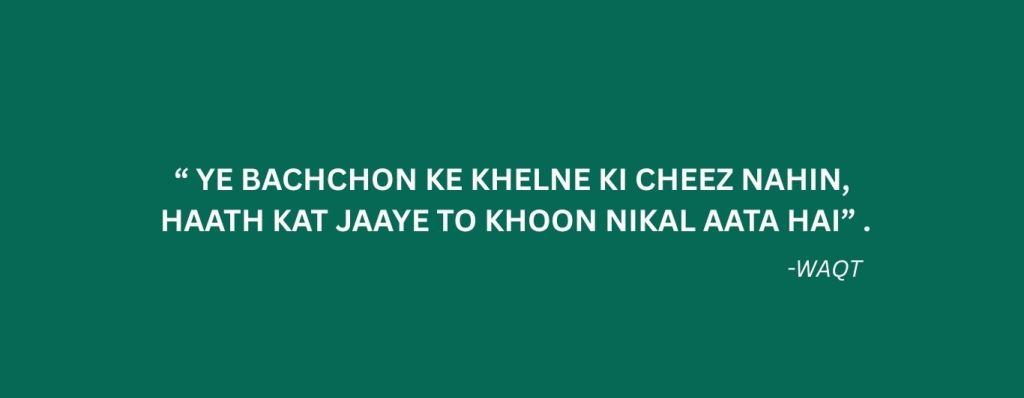
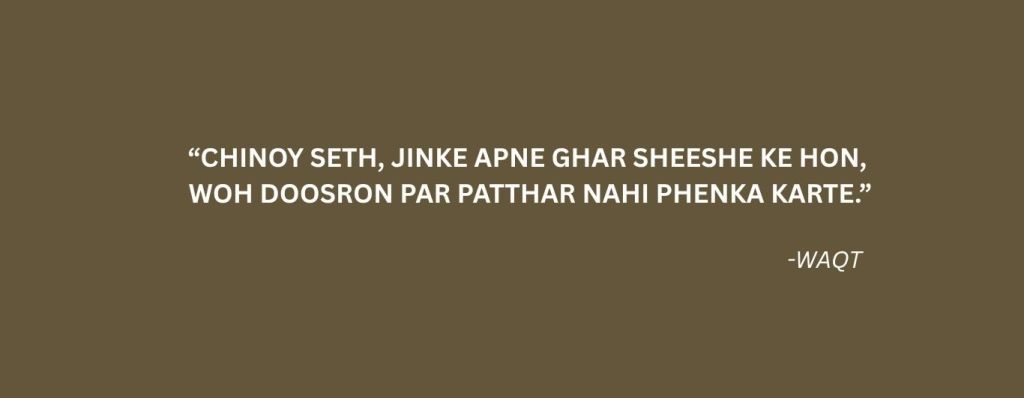
The famous ‘Chinoy Seth’ exchange in Waqt is perhaps the clearest example of how perfectly his personality and his acting could coincide. Raja is a wealthy, self-assured man who enjoys his position and knows exactly how much space he occupies in a room. Raaj Kumar did not have to construct a separate theatrical language for him. The clothes, the bearing, the confidence and the voice all belong to the character, but they are also unmistakably Raaj Kumar. What could have been merely mannerism becomes characterization because the two fit each other so precisely. That was the secret of his most successful performances. His persona worked best when it was not imposed upon the character but found something in the character that could accommodate it.
The extraordinary thing about Raaj Kumar’s stardom was that it did not depend on his disappearing into a role. In fact, he often did the opposite. His characters entered the world of Raaj Kumar. Yet this was not necessarily a failure of acting. Hindi cinema has always had actors who built their careers around a recognizable persona, and Raaj Kumar carried that tradition to an unusually stylized extreme.
The white shoes, for instance, were more than an eccentric detail. They were an expression of the importance he attached to appearance. There was something almost old-fashioned about his insistence on being perfectly turned out, and it suited the aristocratic quality he brought to many of his roles. Even when the character was not wealthy or powerful, Raaj Kumar rarely seemed physically ordinary. His body language suggested that he had already decided how the world ought to regard him.
The danger, of course, was that the persona could become more important than the part. Once audiences knew what a Raaj Kumar performance was expected to contain, film-makers could begin writing for those expectations. Dialogue would be fashioned as a vehicle for his delivery rather than emerging naturally from the character. The pauses could become predictable, the raised eyebrow obligatory, the baritone an end in itself. What had once seemed like an actor’s distinctive vocabulary could gradually harden into a formula.
That is why revisiting his earlier work is so revealing. It reminds us that before Raaj Kumar became a phenomenon of mannerism and dialogue, he had already shown himself capable of something considerably more difficult: restraint.
Before ‘Jaani’ There Was an Actor
Born Kulbhushan Pandit in 1926, Raaj Kumar worked as a police officer in Bombay before entering films. His early career in the 1950s was not built on the flamboyant persona that would later define him. Recognition came with Mother India in 1957, and over the following decades he established himself as one of Hindi cinema’s most distinctive stars.
But his best work cannot be reduced to the image that eventually surrounded him. In Mother India, as Shamu, he has very little of the swagger that would become his trademark. His character is a man broken by circumstance, and the performance derives its force from the quietness of that devastation. Nargis remains the emotional centre of the film, but Raaj Kumar understands that his character’s tragedy does not require him to compete with her. His physical decline and emotional defeat are allowed to register without theatrical insistence.
Something similar can be seen in Dil Ek Mandir, where he plays Ram, a man confronting the knowledge that he is dying. The premise could easily have encouraged melodrama, but Raaj Kumar keeps much of the performance contained. Jealousy, love, resignation and the awareness of approaching death coexist in his face without constantly being converted into declarations. It is one of those performances that becomes more interesting when viewed without the mythology of the later Raaj Kumar super-star persona hanging over it.
His performance in Paigham, opposite Dilip Kumar, is equally instructive. He does not attempt to match Dilip Kumar by adopting his vocabulary of psychological realism, nor does he retreat into the flamboyance that would later become his calling card. He holds his ground by understanding his own authority as a performer. The confidence is already there, but it is still in the service of the character.
This distinction matters because it tells us something about Raaj Kumar that the jokes and anecdotes often conceal. He was not simply an actor who happened to possess a spectacular voice. He had an acute sense of emotional temperature. He knew when a scene required him to dominate it and when it required him to let the scene breathe.
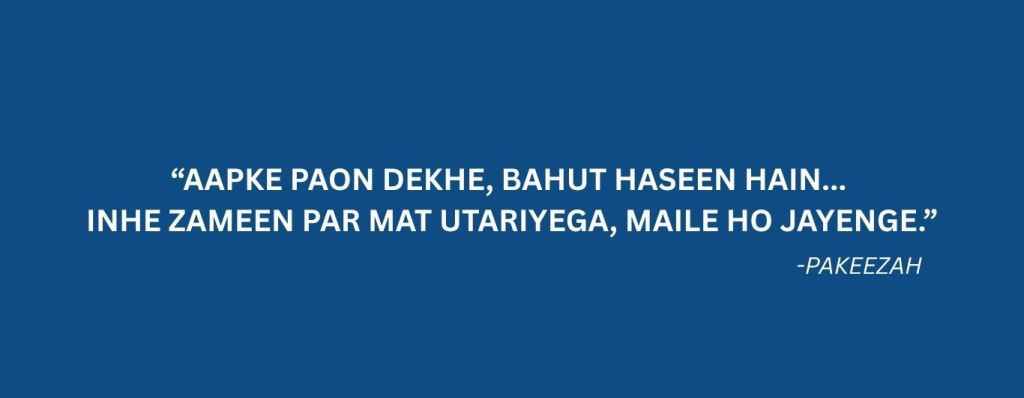
If Waqt represents Raaj Kumar’s persona at its most perfectly integrated, Pakeezah demonstrates how much he could accomplish with comparatively little screen time. As Salim, he enters the film almost like a figure from another world, and the railway-compartment encounter with Meena Kumari’s Sahibjaan has become one of Hindi cinema’s most celebrated examples of romantic dialogue.
The famous compliment about her feet works because Raaj Kumar does not play it as a conventional flirtation. His voice carries admiration without vulgarity, and his manner gives the exchange an almost old-world elegance. The line has become famous, but what is often forgotten is how much depends on the performance surrounding it: the restraint, the confidence and the knowledge that saying less can sometimes make a romantic gesture more powerful.
This was one of the paradoxes of Raaj Kumar. He could be extravagantly stylized without necessarily being excessive. His performance in Heer Raanjha, where the entire film unfolds in verse, brings another dimension to that quality. As Raanjha, he inhabits the heightened language of the film rather than resisting it. The result is lyrical rather than merely theatrical. The voice that could sound intimidating in one film becomes an instrument of longing in another.
The Eccentric
The mythology around Raaj Kumar has always been difficult to separate from the man himself. There are stories about his vanity, his sarcasm, his temper and his refusal to behave according to the conventions of the film industry. Some of these stories have been repeated so often that they have acquired the status of folklore. His son Puru Raaj Kumar has suggested that several of the stories were industry inventions that his father simply chose not to deny. That may be as revealing as the stories themselves. Whether every anecdote is literally true matters less than the larger phenomenon: Raaj Kumar had become one of those stars whose off-screen personality was itself entertainment.
Raaj Kumar understood the value of mystique. At a time when the Hindi film star was increasingly becoming a public commodity, he maintained a distance that made him seem almost self-contained. He did not appear desperate to be liked. He could be abrasive, eccentric or deliberately provocative, and the mythology around him only grew.
The trouble is that mythology can flatten an actor just as effectively as it can elevate one. Once the audience begins to expect the famous pause, the raised eyebrow and the killer line, it becomes difficult to see the quieter work underneath. Consequently, in Raaj Kumar’s later career, the persona and the performance became almost impossible to separate. While it gave the audience a lot to whistle about, it also degenerated into self-parody.
The distinction is not simply between ‘good’ and ‘bad’ Raaj Kumar. It is between films in which the persona reveals something about the character and films in which the character becomes an excuse for the persona. When directors and writers understood the difference, he could be magnificent. When they did not, the performance could seem like an elaborate demonstration of Raaj Kumar-ness.
That is particularly evident in some of his later work, where the familiar gestures and dialogue delivery became almost ritualized. Yet even there, dismissing him as a caricature would be unfair. His late career also contained performances in which his theatricality was entirely appropriate to the material.
Saudagar is a good example. Reunited with Dilip Kumar after thirty-two years, Raaj Kumar plays Vishwanath, a man whose pride, honour and old wounds have hardened over time. The grandeur of the performance belongs to the character as much as to the actor. He does not try to suppress his theatrical instincts; instead, he uses them to convey a man who has spent years turning his emotional wounds into an armour of dignity.
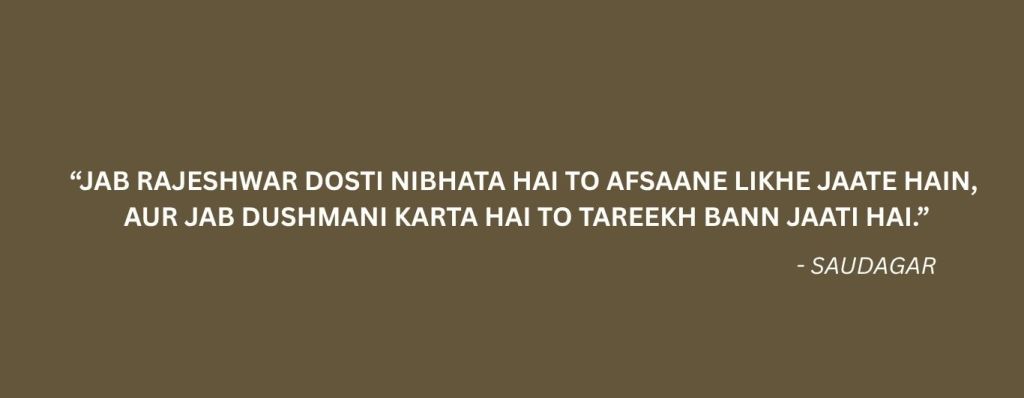
That is why the film works as a meeting between two very different kinds of star. Dilip Kumar’s restraint (though there are large segments in the film where the thespian seems hell-bent in out-Raaj-Kumar-ing Raaj Kumar) and Raaj Kumar’s theatricality are not competing for the same territory. Each brings the weight of his own screen history to the confrontation.
The Best of Raaj Kumar: When the Persona Served the Actor
Looking back at Raaj Kumar’s finest performances, what emerges is not a neat division between the ‘serious actor’ and the ‘stylized star’. The two were always connected. His greatness lay in the moments when his distinctive persona gave the character an additional dimension rather than overwhelming it. Even at the risk of repeating from a foregoing section, it is worthwhile going over some of his standout performances.
In Mother India (1957), Shamu is perhaps the clearest reminder of how far he had travelled as an actor before the mythology took over. There is vulnerability in the performance, and a physical helplessness that sits in sharp contrast to the imperious figure audiences would later associate with Raaj Kumar. The performance is all the more effective because he understands that this is Nargis’s film and does not attempt to claim it.
Paigham (1959), with Dilip Kumar, shows an actor acquiring authority without resorting to mannerism. Ram Lal is grounded and recognizable, and Raaj Kumar’s confidence feels earned rather than imposed. He can stand opposite one of Hindi cinema’s greatest actors without trying to become a second Dilip Kumar.
Waqt (1965) is something else altogether. Here, the persona is not an obstacle; it is the character. Raju’s wealth, sophistication, confidence and flamboyance provide the perfect setting for Raaj Kumar’s particular gifts. The clothes, the posture, the pauses and the celebrated dialogue delivery all become part of the characterisation. His ‘Chinoy Seth’ dialogue is not merely Raaj Kumar showing off. It is Raaj Kumar finding the ideal role for the star he had become.
Hamraaz (1967) allows him to combine that authority with romance and suspense. His voice and physical presence become part of the film’s atmosphere. As Captain Rajesh, he combines romantic charm with an element of ambiguity that suits the mystery surrounding the character. The performance is less about disappearing into realism than about sustaining a mood, and Raaj Kumar was particularly good at that. While Heer Raanjha (1970) uses his voice and bearing in an entirely different register. Playing Raanjha in verse requires a heightened performance, and Raaj Kumar understands that heightened acting does not necessarily mean loud acting. There is tenderness beneath the formal delivery.
In Lal Patthar (1971), he moves into darker territory as Raja Gyan Shankar, using his aristocratic bearing to suggest a man accustomed to power and control. The performance is more menacing precisely because he does not have to manufacture menace. His presence already carries it.
And then there is Pakeezah (1972), where he achieves one of his most memorable romantic performances with relatively little screen time. Salim is an idealized figure in the film’s dreamlike universe, and Raaj Kumar’s elegance allows the character to remain part of that fantasy. The railway-compartment sequence has become iconic, but the larger achievement is the atmosphere he creates around Sahibjaan. He makes romance feel possible without making it commonplace.
Saudagar (1991) demonstrates that age had not diminished his ability to use theatricality meaningfully. As Vishwanath, he carries pride and resentment like physical burdens. The reunion with Dilip Kumar works because both actors bring decades of accumulated star history to the screen, but Raaj Kumar remains entirely himself.
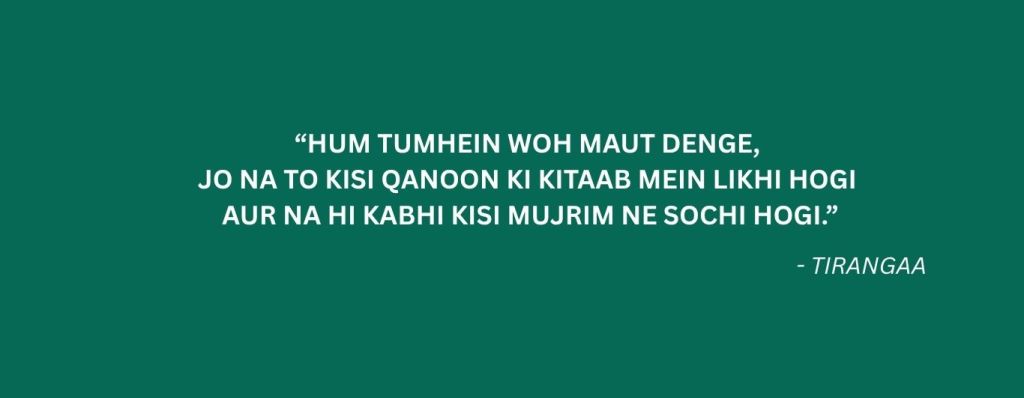
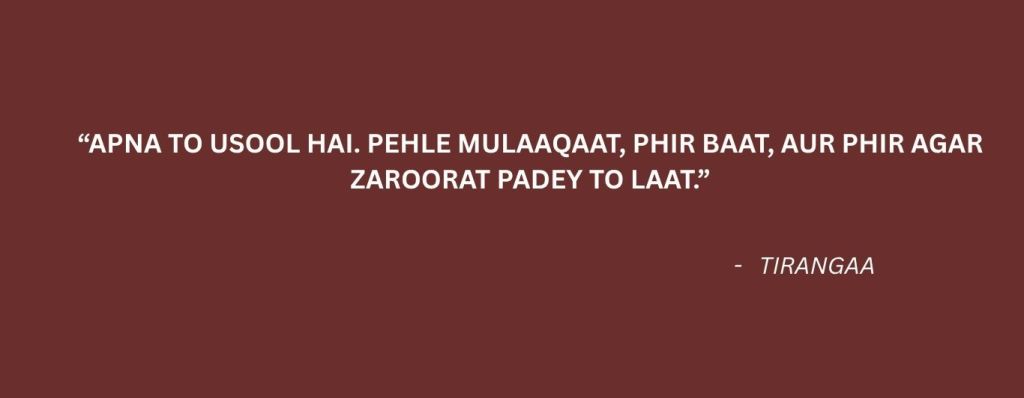
By the time of Tirangaa (1993), subtlety was no longer the point. As Brigadier Suryadev Singh, he embraces the late Raaj Kumar persona almost without apology. The military bearing, the patriotic declarations, the threats and metaphors, the pauses and the unmistakable voice are all exaggerated. Yet the film belongs to a period in which audiences were coming to see exactly that. They wanted Raaj Kumar to be Raaj Kumar, and he knew how to give them what they had come for.
Bringing Together the Actor, Persona, and Caricature Like No One Else
Perhaps that is the fairest way to assess Raaj Kumar. He was an actor who gradually became a persona and then, in the later stages of his career, sometimes became a caricature of that persona. But the caricature should not obscure the actor who preceded it, nor the performances in which the two identities existed in perfect balance.
His particular achievement was to make stardom itself an acting style. He understood that a star could bring not only a face or a voice to a role but an entire mythology. The challenge was always to ensure that the mythology remained useful to the character. When it did, Raaj Kumar could be extraordinarily compelling; when it did not, the performance became a display of familiar tricks.
That is also why his work remains so much fun to revisit. He could be pompous without quite being ridiculous, romantic without becoming ordinary, threatening without raising his voice and comic without appearing to ask for the laugh. His voice could turn a line into an event, but his better performances remind us that the voice was only one part of the instrument.
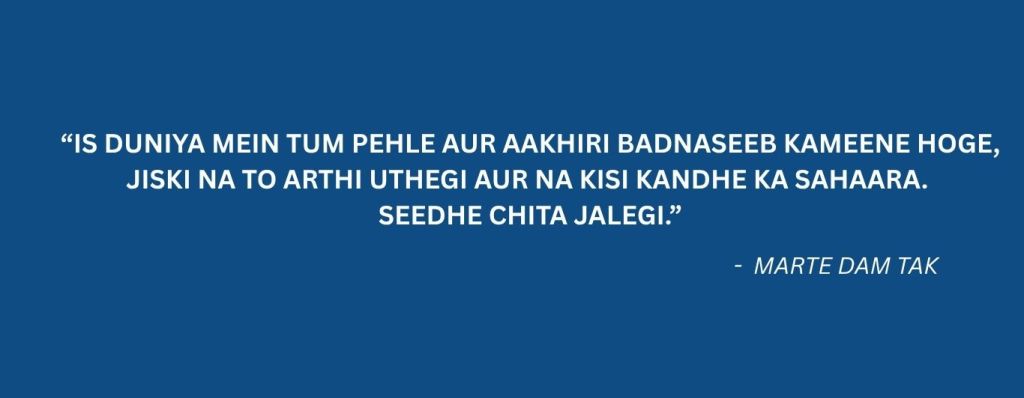
Raaj Kumar was never going to be an actor who disappeared completely into his characters. That was not his ambition, and perhaps not even his idea of what a film star should be. He wanted the audience to recognize him, to anticipate him and, eventually, to remember him.
They did. The white shoes, the raised eyebrow, the immaculate clothes, the pauses, the sarcasm, the voice, the ‘Jaani’, all became inseparable from the name. But beneath that elaborate construction was an actor who could be restrained, vulnerable, romantic, menacing and deeply affecting when he chose to be.
The fireworks were real. So was the actor who knew how to control them. And that may be the most interesting thing about Raaj Kumar: that for all the mythology surrounding him, his finest performances are often the ones in which the mythology does not disappear but quietly becomes part of the character.
Nobody quite did it like him. He knew voice. He knew timing. He knew stillness. He knew the value of an entrance. He knew how to hold a close-up. And, most importantly, he knew his own instrument. The tragedy of his legacy is that his instrument became so recognizable that audiences sometimes stopped listening to the music and started waiting for the next catchphrase.
But go back. Watch Mother India. Watch Heer Raanjha. Watch Pakeezah. Watch Waqt. Then watch Saudagar. Then, for sheer joy, watch Tirangaa. You will see a career in miniature. The actor. The star. The romantic. The tragic hero. The aristocrat. The eccentric. The legend. And finally, the man who had become so completely Raaj Kumar that nobody else could possibly have played Raaj Kumar.
That may be the greatest compliment cinema can give an actor. He did not disappear into the movies. The movies became part of his mythology.
Somewhere, in the afterlife of Hindi cinema, he is probably still standing in immaculate white shoes, turning slowly towards the camera, raising one eyebrow and waiting for the room to become quiet. Then, after a suitably long pause: ‘Jaani…’
And the theatre erupts in whistles.


Leave a Reply