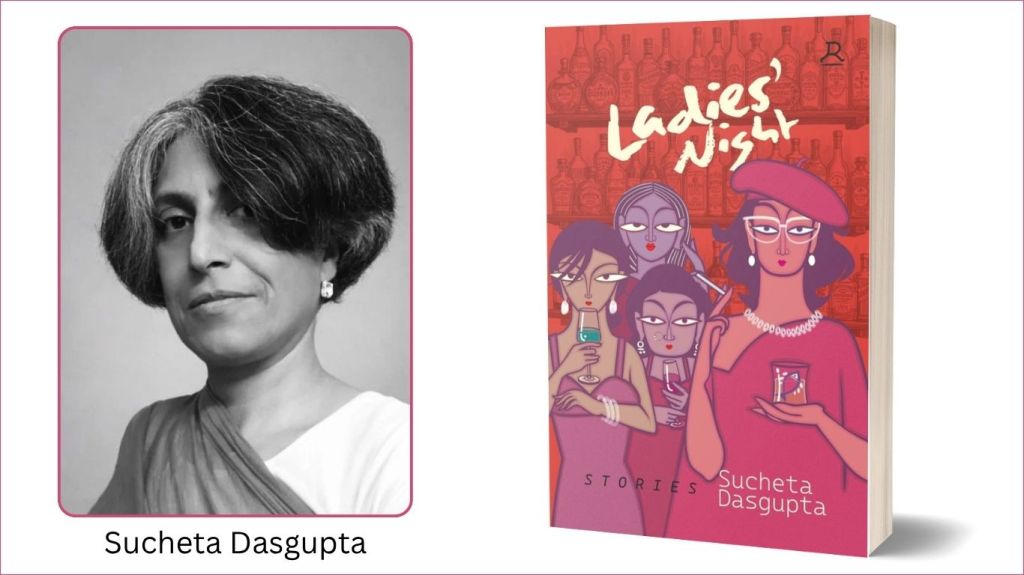
Sucheta Dasgupta’s Ladies’ Night is an ambitious debut that transcends genre to explore memory, identity, desire and the limitless possibilities of storytelling.
There’s a quietly radical edge to Sucheta Dasgupta’s Ladies’ Night: Stories that makes reading it a one-of-its-kind experience. At first glance, its premise appears deceptively simple: four women gather at a bar, drinks are poured, conversation begins, and stories emerge. Yet this convivial setting is merely the threshold to a collection that constantly unsettles expectations. The stories refuse to remain confined within familiar literary boundaries, moving effortlessly between realism and fantasy, memoir and myth, speculative fiction and psychological exploration. Dasgupta’s debut is less a collection of short stories than a carefully orchestrated conversation about memory, identity, desire and the many ways women make sense of the worlds they inhabit.
The frame narrative is one of the book’s greatest strengths. The storytellers – known not by conventional names but by distinctive identities such as White Lady, Bubbly, Gaunt and Obnoxious – gradually become characters in their own right. Their interruptions, disagreements, interpretations and occasional teasing create the feeling that the reader is sitting unobtrusively at the next table, overhearing a conversation that grows richer with every drink. The stories are not isolated performances but responses to one another, creating an organic rhythm that binds eighteen remarkably diverse narratives into a coherent whole.
Dasgupta’s imagination is strikingly uninhibited. She is unafraid to place folklore beside artificial intelligence, historical memory beside surreal comedy, or philosophical speculation beside domestic intimacy. Yet what prevents the collection from becoming merely clever is its emotional grounding. However far the stories wander into allegory or fantasy, they remain anchored in recognizable human anxieties: the longing to be understood, the burden of family expectations, the ambiguities of love, and the difficult process of claiming one’s own voice.
Perhaps the finest quality of the writing is its willingness to trust the reader. These are not stories that explain themselves exhaustively or tie up every loose end. Dasgupta frequently leaves suggestive spaces that invite interpretation rather than dictate it. For some readers this may prove demanding, but it is also what gives the collection its unusual afterlife. Many stories linger in the mind precisely because they resist immediate resolution, encouraging reflection long after the final page has been turned. Which is where the publisher, Running Head Books, and the brilliant people behind it, Chitra Viraraghavan and Krishna Shastri Devulapalli, need to be commended. In this day and age of dumbing down, it takes a lot of courage and an unerring belief in good writing to back something that asks for intellectual engagement.
The prose itself deserves special mention. Dasgupta possesses an unusually visual imagination, capable of transforming abstract emotion into memorable images. Landscapes shimmer with unexpected colour, dreams assume physical shape, and ordinary experiences acquire an almost mythical resonance. In one particularly beautiful passage from ‘The Courtesan’s Bed’, love becomes both revelation and transformation: ‘Love had gifted her with sight. She could see. And the Sun rose in the court of the courtesan and on Earth … in the first Dawn.’ It is writing that embraces metaphor without becoming ornamental, allowing poetic language to deepen rather than obscure emotional meaning.
This richness is equally evident in the collection’s speculative excursions. ‘How the Computer Married the Ball’ could easily have become an exercise in intellectual display, but Dasgupta transforms its playful premise into an engaging meditation on consciousness, creativity and emotion. The story moves effortlessly from computer science to philosophy, from satire to romance, without losing its narrative momentum. Elsewhere, mythological motifs, ghost stories and science fiction are employed not as genre exercises but as imaginative tools for examining human relationships. The result is a collection whose variety never feels arbitrary because each experiment ultimately circles back to questions of identity, belonging and moral choice.
Several stories stand out for the emotional precision with which they capture relationship dynamics. The refusal to simplify emotional realities gives the book much of its quiet power. The strongest stories in the collection, ‘Her Mother’s Daddy’ and ‘Mihir’, among them, achieve something deceptively difficult: they move us deeply without leaning on sentimentality or melodrama. More intriguing still is the way these seemingly disparate stories cohere beneath the title Ladies’ Night , which gradually acquires a resonance far richer than its first, deceptively casual suggestion. The stories work because Dasgupta has an acute ear for conversation and an equally keen understanding of silence. Often what remains unsaid carries as much weight as the dialogue itself.
One of the pleasures of reading this collection is discovering how comfortably the author inhabits different narrative registers. A story may begin in everyday reality before drifting into fable, speculative fiction or dreamscape without ever seeming contrived, while stories rooted in recognizable social realities retain an almost magical luminosity through the author’s distinctive imagery.
Equally impressive is Dasgupta’s command of atmosphere. Whether she is evoking Kolkata’s streets, conjuring imagined worlds, or exploring the inner landscapes of memory, she writes with a sensuous attention to detail that makes every setting feel inhabited rather than merely described. A passage describing an imagined landscape begins with the unforgettable image of ‘a bristling bottle-green ball of sun’ kissing ‘a lone purple cloud lost in the salmon sky’, before expanding into a world where vehicles graze like animals across a meadow. Such passages reveal a writer whose imagination is exuberant but carefully controlled, capable of surprising the reader without sacrificing coherence.
What is particularly refreshing is the author’s refusal to flatten experience into easy conclusions. Contemporary fiction often feels compelled to announce its moral position with unmistakable clarity. Dasgupta resists that temptation. Her characters frequently contradict themselves, change their minds, make questionable decisions and remain gloriously unresolved. The stories invite empathy without insisting upon agreement. They are curious about people rather than eager to categorize them.
That openness extends to the book’s treatment of women themselves. Although every major narrative is shaped by female experience, the women here are never reduced to symbols or representative figures. They are intellectual and impulsive, generous and selfish, courageous and frightened, practical and wildly imaginative. Their individuality is precisely what gives the collection its emotional credibility. Instead of presenting a singular idea of womanhood, Dasgupta celebrates its multiplicity.
There are moments when readers accustomed to conventional short stories may find themselves momentarily disoriented. Some narratives unfold elliptically, some conclude on ambiguous notes, and others ask the reader to bridge conceptual gaps. Yet these qualities are intrinsic to the book’s artistic vision. Ladies’ Night is not interested in offering neatly packaged narratives; it seeks participation rather than passive consumption. The pleasure lies as much in interpretation as in storytelling itself.
For a debut work of fiction, the confidence on display is remarkable. Dasgupta writes with an unmistakably individual voice. Lyrical without being precious, intellectually adventurous without becoming inaccessible, and emotionally resonant without slipping into sentimentality. The collection demonstrates an unusual willingness to take formal and thematic risks, and more often than not those risks are richly rewarded.
In an increasingly homogenized literary landscape, Ladies’ Night: Stories feels genuinely distinctive. It is a book that refuses easy categorization, drawing strength from its eclecticism and from its faith in the intelligence of its readers. Long after individual plot details begin to fade, one remembers the atmosphere of the gathering, the distinctive voices of the four women, and the imaginative expansiveness of the stories they choose to tell. More importantly, one remembers the feeling of having encountered a writer unafraid to follow her imagination wherever it leads.
This is an assured and ambitious debut that announces a significant new fictional voice. Readers looking for straightforward entertainment will certainly find engrossing stories, but those willing to engage more deeply will discover a collection rich in metaphor, emotional insight and philosophical curiosity. Ladies’ Night does not simply entertain; it provokes thought, rewards rereading and leaves behind the unmistakable sense that its stories continue long after the final conversation at the bar has ended.


Leave a Reply