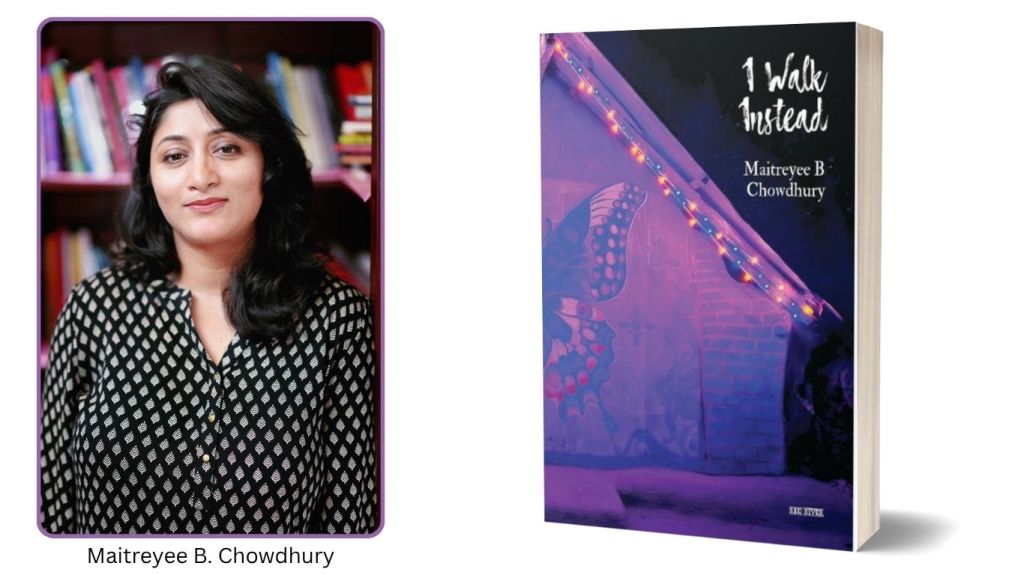
Maitreyee B. Chowdhury’s I Walk Instead is a luminous atlas of memory, desire and belonging
I Walk Instead is a remarkable collection that transforms walking into an act of witnessing, remembering and becoming. Every poem in this beautifully produced volume is a journey through landscapes both external and interior, through cities, forests, rivers, forgotten neighbourhoods, railway stations, villages and coastlines, but equally through love, grief, migration, memory and the endlessly shifting idea of home. The result is one of the most compelling contemporary Indian poetry collections in recent years, a book that rewards slow reading and repeated returns.
Readers familiar with Maitreyee’s work will recognize the restless curiosity that has long animated her writing. As the author of the acclaimed Hungryalists, she has already demonstrated a deep engagement with literary history, language and cultural memory. Her involvement with the Bangalore Poetry Festival has likewise positioned her at the heart of India’s contemporary poetry ecosystem, where she has consistently nurtured conversations across languages, traditions and generations. I Walk Instead feels like the natural flowering of those experiences, a collection written by a poet who has listened deeply to places, people and poems, in the process finding her own distinctive voice.
What makes this collection extraordinary is its visual language. Maitreyee does not merely describe landscapes; she animates them with startling, cinematic imagery that fuses geography with emotion. Her poems unfold like moving paintings where colour, smell, sound and texture constantly intermingle. The ordinary becomes luminous through unexpected juxtapositions.
In ‘Beyond the Mawsmai Falls’, memory itself becomes cartography:
You trace the mountains airily,
and draw into the sky
a temporary map,
where a permanent home once was.
The image is deceptively simple, yet it evokes exile, inheritance and longing in a handful of lines. Home is simultaneously erased and redrawn, existing only in memory’s fragile geography.
Elsewhere, cities become living organisms. Kolkata is not merely remembered; it breathes through taste, smell and desire. In the unforgettable ‘Hatibagan: Sobuj Porda and Almost Kisses’, lovers and the city dissolve into one another:
my hair and yours copulate,
we become Rum and Coke
on the streets of Hatibagan again tonight.
The sensuality here is never ornamental. It emerges organically from place, making intimacy inseparable from the city’s forgotten buses, theatres and streets.
Again and again, Maitreyee demonstrates an extraordinary ability to compress entire emotional worlds into visual moments. In ‘Water-Coloured Afternoon’, an artist, a clay Durga, a stray cat and a collapsing afternoon coexist in perfect equilibrium until the poem concludes with a line that lingers long after reading: ‘Life is just a dream.’
Throughout the collection, colours recur almost as emotional states: purple evenings, blue mercury, crimson flowers, ochre love, grey-green rivers, luminous fungi. These colours do not decorate the poems; they structure their emotional architecture.
The title poem is perhaps the emotional centre of the collection. Beginning with startling physicality – I smell of you and your sperms in me – it moves swiftly into grief, anger, survival and transcendence before arriving at its devastating conclusion:
Too late in the night to forget,
too early to die.
I walk instead.
The final line becomes the book’s governing philosophy. Walking is not merely locomotion; it is resistance, healing, remembrance and continuation.
Nature, too, is rendered with astonishing freshness. In ‘Witchcraft Nights in Mawlynnong’, bioluminescent fungi become celestial beings:
Mycena become pathfinders —
magic buttons, glowing asteroids,
silver Saturn rings, luminous comets.
The scientific and the mythical merge effortlessly, creating a sense of wonder that runs throughout the collection. Similarly, in ‘Along the Bhadra’, the poet observes birds, fish and forests with patient attentiveness, revealing ecological relationships through lyrical precision rather than environmental rhetoric.
Yet, I Walk Instead is never merely a travelogue in verse. Every journey becomes an encounter with people often overlooked by history. The Bihari migrant, the ironing man, street dogs, anonymous lovers, artists, Bauls, transgender women at traffic signals, Adivasi communities, railway workers and forgotten poets all populate these pages. The collection quietly insists that every life carries its own epic. Just consider this poem, ‘Ajay, The Parrot Seller’, whose devastating brilliance drove me to reproduce it here in full:
It is 2020,
Ajay, the fake parrot seller,
sat with five still parrots in his hands,
watching other birds fly back home.
Ajay is on the road to Seikhpura,
a mythical land without disease.
On the road, suddenly a horse —
the roads are blocked with people trying to live,
cars, bullock carts, parrots — and then this horse.
A strange smell surrounds Ajay,
‘Since how long have you been walking,’ I ask.
‘For five nights I have been returning home,
to the graves of my wife, my brother, my father,
I smell of them.’
Ajay senses the question that I did not ask —
‘For the soul,’ he touches his heart —
‘There is no food, no water, no latrines,
everything at home is a long line.’
I walked with Ajay till the end,
from where his home started, and mine ended —
I saw him fall down,
kiss the earth and cry like a child,
‘My land, my land’ soft water on parched land.
Before I left, I had to ask though,
What will you do here?
‘Grow onions, potatoes, garlic and greens,’ he said.
One of the book’s greatest strengths lies in its emotional range. There is desire, but also humour. There is political awareness without didacticism. There is nostalgia that refuses sentimentality. The poems can move from erotic intimacy to social violence within a few pages without ever feeling disjointed because everything is held together by the act of walking, observing and remembering. The collection is also deeply intertextual. References to Jibanananda Das, Binoy Majumdar, Ritwik Ghatak, Sukanta Bhattacharya, Krishna, Baul traditions and countless regional histories appear naturally within the poems, enriching rather than burdening them. Literature, cinema, mythology and lived experience exist on equal footing.
An especially striking feature of this edition is its visual design and the layout that makes reading such a calming experience. A shout-out to the publisher, Red River, and the designer, Dibyajyoti Sarma for a book that’s as much a pleasure to hold and flip through as it is to read. The photographs accompanying the section openers deepen the reader’s immersion into the landscapes being traversed.
Perhaps the most impressive achievement of I Walk Instead is that it expands what travel poetry can be. These are not poems about arriving at destinations but about inhabiting moments. Maitreyee understands that landscapes are inseparable from the people who move through them, and that memory is as geographical as any map.
With I Walk Instead, Maitreyee confirms herself as one of the most distinctive poetic voices writing in English today. She has created a collection that is intimate yet expansive, deeply rooted yet endlessly exploratory. Like the finest books of poetry, I Walk Instead does not simply ask to be read. It invites us to slow down, pay attention, and accompany the poet on her luminous journeys. By the final page, one realizes that the walks were never only through cities and forests. They were always, quietly and beautifully, towards the self.


Leave a Reply