The music of Mamta Ki Chhaon Mein remains a deeply moving farewell from an artist who spent a lifetime defying labels. On Kishore Kumar’s birth anniversary, there can be few more appropriate reminders that his legacy extends far beyond the immortal playback songs that made him a legend; it also resides in works like Mamta Ki Chhaon Mein, where his restless creativity found one last, profoundly touching expression in its songs.
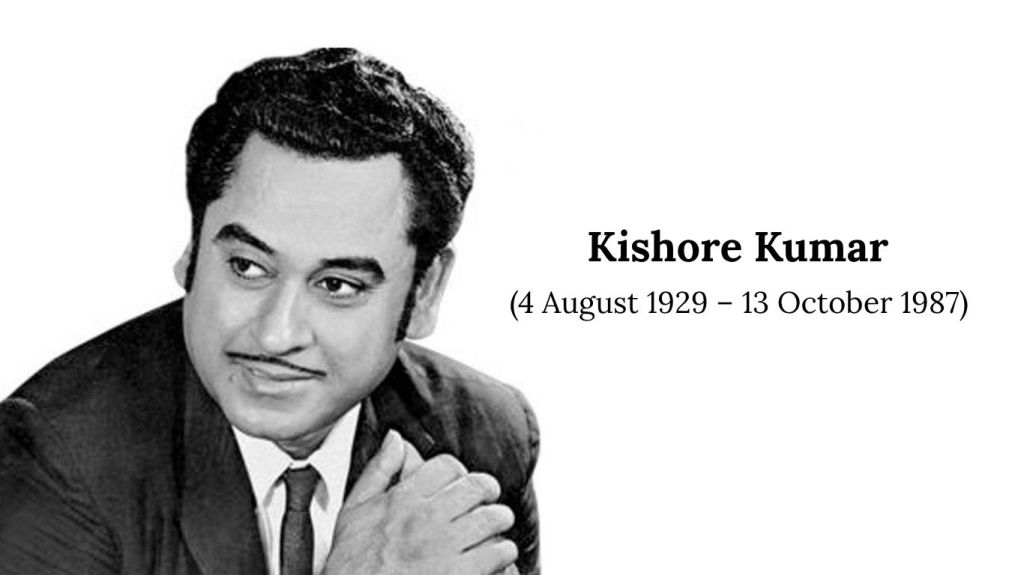
For most listeners, Kishore Kumar’s legacy rests on his extraordinary achievements as a playback singer. Yet his creative ambitions extended far beyond singing. Throughout his career, he repeatedly sought avenues to express himself as a film-maker, writer, actor and composer, often pursuing ideas that sat outside the conventions of mainstream Hindi cinema. His directorial ventures – Door Gagan Ki Chhaon Mein, Door Ka Rahi, Door Vadiyon Mein Kahin, Chalti Ka Naam Zindagi, Badhti Ka Naam Dadhi, Shabash Daddy – may not have enjoyed the enduring popularity of his songs, but they offered a revealing glimpse into an artist determined to chart his own course.
The last of these films, Mamta Ki Chhaon Mein (1989), arrived under tragic circumstances, completed after Kishore’s death by his son Amit Kumar. While the film itself remains a largely forgotten and flawed work, its music tells a very different story. The soundtrack stands among the most rewarding creations of Kishore Kumar the composer and provides one of the finest showcases of Amit Kumar’s versatility as a singer.
The film tells the story of Gauri (Leena Chandavarkar) who brings up her son Niranjan (Amit Kumar) single-handedly. She nurses a secret about Niranjan’s father which forms the crux of the film. Niranjan grows up with the question about his father haunting him all his life. He travels to the nearby town for his higher studies and it is here that he comes in contact with a man (Raj Babbar) who claims to know Gauri and gives Niranjan an unsavoury take on her past. Niranjan confronts his mother but she refuses to divulge her secret, leading to the two falling out. The rest of the film deals with the story of Gauri’s past and Niranjan’s realization that he has been unfair to his mother.
It’s a poor film in every respect but it’s impossible not to feel nostalgic about a film that recreates one of Kishore’s cult crazy songs, ‘Allah Allah … Bhagwan bhagwan’ (Hum Do Daku, 1967). Or one that has what is probably Kishore’s last playback for Rajesh Khanna (who has a cameo in the film), aptly titled ‘Mera geet adhoora hai’. It was reported in the media at the time that the director had wanted Amitabh Bachchan in the role. However, the star was not forthcoming and that affected the relationship between the two. Kishore in fact hinted at this in an interview at the time and named Manmohan Desai as the one responsible for the rift between him and the star whose voice he was.
What stands out about the film close to forty years later are some of Kishore Kumar’s most lovingly crafted songs. He himself sings two gems while Amit Kumar has four numbers which count among his best, including ‘Main ik panchhi matwala re’ (which he had earlier rendered in Door Ka Rahi) and the life-affirming ‘Beeti jaaye’ (the mukhda of which harks back to the antara of one of his hits from Jhumroo, ‘Ge ge ge geli jara Timbuktoo’). The composer in Kishore Kumar could not have asked for a better album to bid adieu.
Few albums provide a more comprehensive showcase of Amit Kumar’s abilities than this. Although it occupies a unique place in the Kumar family legacy, the soundtrack has never received the recognition accorded to other notable albums of the period. That neglect is particularly unfortunate because it contains some of the most impressive singing of Amit’s career.
The album’s history partly explains its fate. Conceived as Kishore Kumar’s final directorial venture, the film endured a long and difficult production journey before eventually reaching audiences with little fanfare. By the time it appeared, changing musical trends and shifting audience tastes had already altered the landscape of Hindi film music. The film also failed to get a proper theatrical release. As a result, the soundtrack never received the attention its quality merited.
What makes Mamta Ki Chhaon Mein so fascinating is the extraordinary range of challenges it presents to its principal singer. Across four very different songs, Amit is required to inhabit contrasting emotional worlds and musical styles. The performances reveal a singer capable of adapting himself completely to the needs of each composition while retaining a distinctive artistic identity.
Main Ek Panchhi Matwala Re
Written and composed by Kishore Kumar, ‘Main ek panchhi matwala re’ is built around the image of a wanderer moving through life without fixed destination or certainty. The song combines melancholy with acceptance, recognizing life’s impermanence without surrendering to despair.
Amit captures this emotional ambiguity beautifully. His voice carries a sense of yearning, yet there is also resilience in the way he approaches the melody. The phrasing remains unhurried throughout, allowing the song’s reflective character to develop naturally. Rather than imposing emotion upon the lyric, he trusts the composition’s inherent strengths, creating a performance of considerable grace and emotional authenticity.
Beeti Jaaye, Jaaye Jaaye Zindagani
Where ‘Main ek panchhi matwala re’ invites contemplation, ‘Beeti jaaye’ bursts forth with unstoppable energy. Built around a driving rhythmic framework, with a hypnotic refrain at its core, the song demands precision, stamina and unwavering concentration from its singer.
Amit responds with remarkable assurance. The rapid lyrical passages are articulated with clarity, while the relentless pace never appears to trouble him. Yet technical proficiency is only part of the achievement. More importantly, he communicates the exhilaration at the heart of the song, transforming what could have become a mere display of virtuosity into an infectious celebration of life’s onward movement.
Andhiyare Rahon Mein
The emotional landscape darkens considerably in ‘Andhiyare rahon mein’. Here, the music explores uncertainty, loneliness and emotional exhaustion, creating one of the most sombre moments in the album.
Amit approaches the song with admirable discipline. Drawing heavily on the richness of his lower register, he conveys vulnerability without lapsing into self-pity. The emotional force of the performance comes from its inwardness. Every phrase seems weighed down by experience, yet the singer never abandons control. The result is a portrayal of despair that feels deeply human and entirely convincing.
Tod Ke Bandhan Saare
The album concludes its exploration of contrasting moods with the semi-classical ‘Tod ke bandhan saare’. Its expansive melodic structure and demanding vocal passages provide Amit with an opportunity to display yet another dimension of his artistry.
He rises to the challenge with confidence and authority. The classical flourishes are handled with fluency, but they never feel like technical exercises. Instead, they contribute directly to the emotional trajectory of the song. Amit combines power with precision, ensuring that the music’s dramatic aspirations remain firmly connected to its emotional core.
Why the Album Endures
By the time Amit Kumar emerged on the Hindi film music scene, the era when a single singer could dominate an entire soundtrack with a string of hit or outstanding songs was largely over. (It would come back in the late 1980s and 1990s, starting with Aashiqui and Maine Pyar Kiya – both releasing around the same time as Mamta Ki Chhaon Mein – but Amit Kumar wasn’t part of the revival.)
Amit, however, was among the few singers of his generation fortunate enough to enjoy that distinction in films like Love Story and Teri Kasam, where he was the principal male voice across highly successful albums. For the most part, however, his career was defined by individual songs scattered across soundtracks that featured a variety of singers, rather than by albums built predominantly around his voice. That is where the importance of Mamta Ki Chhaon Mein lies. This is a rare album of the time where each song is a standout, harking back to the golden era of Hindi film music.
Kishore Kumar leaves an indelible impression with just two songs. The poignant ‘Mera geet adhura hai’, filmed on Rajesh Khanna in a brief appearance, carries an unmistakable sense of farewell, its title acquiring an almost prophetic resonance in light of Kishore’s passing before the film’s completion. His voice, weathered yet remarkably expressive, invests the melody with a quiet resignation rather than overt melancholy, making the song one of the most affecting performances of his final years.
‘Jeevan gadi’, by contrast, is gently philosophical, its lilting movement masking a meditation on life’s ceaseless journey. The metaphor of life as an endless voyage was one to which Kishore Kumar returned repeatedly as a composer, finding expression in songs such as Door Ka Rahi’s ‘Panthi hoon main us path ka’, ‘Mujhe kho jaane do’, the inspiring ‘Jeevan se na haar o jeene wale’ and ‘Chalti chali jaaye zindagi’ (the last rendered by Hemant Kumar). There was something deeply personal in his recurring fascination with the solitary traveller, forever moving forward despite uncertainty, loss or fatigue. Kishore sings with the effortless conversational ease that had become one of his greatest strengths as a mature vocalist, allowing the wisdom embedded in the lyric to emerge without rhetorical flourish.
Together, the two songs form the emotional heart of the soundtrack, reminding listeners that even in the closing chapter of his career, Kishore Kumar remained a singer capable of communicating profound feeling through the simplest of musical means.
It is no mean feat that despite featuring two of Kishore Kumar’s most deeply felt songs ever, it is Amit Kumar who steals the show, with a virtuoso display of versatility. Few soundtracks require a singer to move so convincingly between philosophical reflection, rhythmic exuberance, emotional desolation and semi-classical grandeur. Fewer still find a performer capable of meeting all those demands with equal conviction.
For that reason alone, the album deserves to occupy a far more prominent place in discussions of Amit Kumar’s legacy. It stands not merely as an interesting footnote in Kishore Kumar’s career, but as a compelling demonstration of Amit’s own musical achievements. For listeners willing to venture beyond the familiar hits, it offers one of the clearest portraits of a singer whose artistry was far richer and more varied than popular memory often suggests.
For all its cinematic shortcomings, Mamta Ki Chhaon Mein endures because it represents the final artistic statement of one of Hindi cinema’s most multifaceted talents. As Kishore Kumar’s swan song as composer, director and singer, the film carries a poignancy that transcends its modest ambitions. Its songs bear the imprint of an artist looking back with wisdom and compassion, while simultaneously passing the torch to the next generation through Amit Kumar’s remarkable performances. If the film has faded into obscurity, its music deserves to be remembered, not merely as a posthumous curiosity, but as a fitting farewell to a creative spirit who refused to be defined by any single role.


Leave a Reply