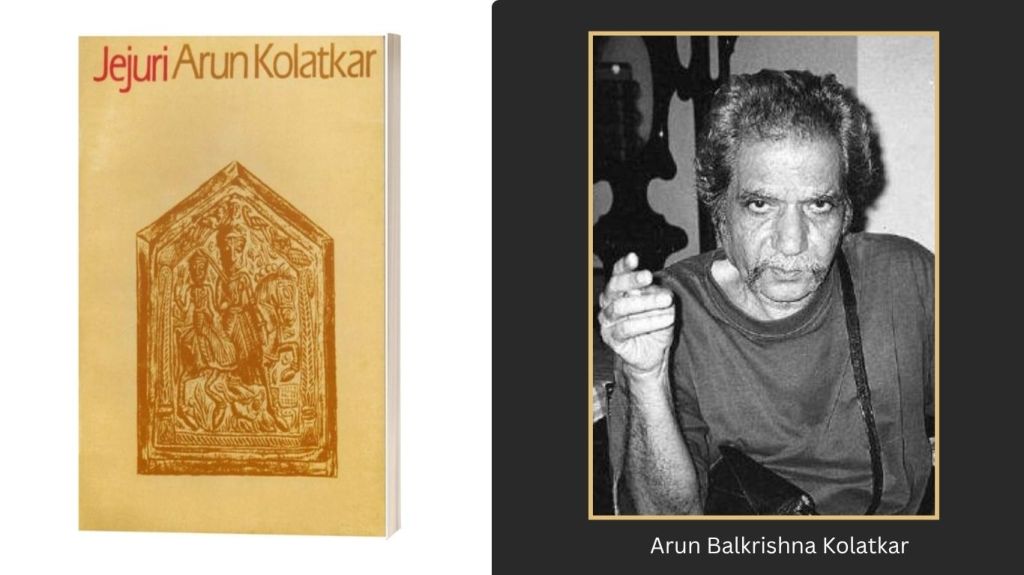
Fifty years on, Arun Kolatkar’s Jejuri endures as a quietly radical work of observation, where faith and doubt, the sacred and the ordinary, coexist in luminous tension, inviting readers to find meaning not in answers but in the act of seeing.
Arun Kolatkar’s Jejuri, first published in 1976, has come to occupy a quietly monumental place in Indian poetry in English. As it marks fifty years, its endurance feels less like a matter of reputation and more like a testament to its peculiar, unassuming power. Neither grandly nationalist nor self-consciously modernist, Jejuri resists easy categorization. It stands instead as a work of radical attentiveness, an exploration of faith, doubt, decay and perception, rendered in a voice so deceptively simple that its depth often reveals itself only over time.
At its surface, Jejuri is a sequence of poems chronicling a visit to the temple town of Jejuri in Maharashtra, a major pilgrimage site dedicated to the god Khandoba. The speaker – detached, observant, sometimes ironic – moves through the landscape, encountering priests, pilgrims, beggars, ruins and relics. Yet the poems do not build towards any conventional spiritual revelation. Instead, Kolatkar offers fragments: moments of encounter that hover between the sacred and the mundane, the seen and the unseen.
As Amit Chaudhuri writes in his introduction to the New York Review of Books edition of the collection: ‘Jejuri is, on its most obvious level (and a very rich level that is, in terms of realism, observation, irony), an account of a man who arrives at the pilgrimage town on a “state transport bus”, in the company of people whose intent is clearly more devotional than his is and has less to do with a seemingly unfathomable curiosity. They seem to, thus, reproach him by their opacity, their inaccessibility, their very presence … The rest of the poem is about the narrator’s idiosyncratic reading of the place; Jejuri, which seems to him a mixture of temples in disrepair, unreliable priests, and legends and religious practices of dubious provenance, nevertheless excites him oddly, though not to worship, but to a state akin to it while also quite unlike it. He leaves later on a train … still, evidently, in a state of confusion over what’s secular and what’s miraculous…’
What makes Jejuri significant is precisely this refusal to impose meaning. In a literary context where Indian writing in English often felt burdened by the need to represent culture, history or identity in coherent terms, Kolatkar sidesteps expectation. His Jejuri is neither a romanticized site of devotion nor a cynical dismissal of belief. It is a place where faith exists alongside dust, neglect, habit, and accident. In poems like ‘The Bus’, ‘The Priest’, or ‘An Old Woman’, Kolatkar captures the texture of lived experience without resolving its contradictions.
Kolatkar’s language is spare, colloquial and unadorned. He avoids the rhetorical flourish that characterized much earlier poetry in English from India, instead drawing on the rhythms of everyday speech. Yet this simplicity is carefully crafted. Each poem is honed to a fine edge, where image and tone carry more weight than overt statement. The result is poetry that feels both accessible and elusive, a rare combination.
Thematically, Jejuri stands at the intersection of belief and scepticism. The speaker is neither a believer nor a debunker; he is an observer who registers both the pull of faith and its fragility. The famous poem ‘An Old Woman’, for instance, presents a beggar who clings to the narrator until he gives her money. The encounter is uncomfortable, almost accusatory, and ends not in moral clarity but in a lingering unease. Is the old woman a figure of exploitation, desperation, or divine test? Kolatkar refuses to say. The poem instead exposes the reader’s own assumptions.
…
She won’t let you go.
You know how old women are.
They stick to you like a burr.
You turn around and face her
with an air of finality.
You want to end the farce.
When you hear her say,
‘What else can an old woman do
on hills as wretched as these?’
…
And you are reduced
to so much small change
in her hand.
Similarly, in ‘The Priest’, the religious figure appears less as a conduit of the divine and more as a weary functionary. The sacred is not denied, but it is refracted through the ordinary, even the shabby. This demystification does not amount to irreverence; rather, it suggests that the sacred, if it exists, must be found within the imperfections of the real world.
Another key aspect of Jejuri is its visual imagination. Kolatkar composes his poems with a painter’s eye. The images are sharp, often cinematic: a bus climbing a hill, a temple in disrepair, a yellowing landscape under the sun. These images accumulate to create a sense of place that is both specific and symbolic. Jejuri becomes more than a physical location; it turns into a site of perception itself, where the act of looking is constantly interrogated.
This focus on perception aligns Jejuri with broader modernist concerns, yet Kolatkar’s approach is distinctly his own. There is no overt fragmentation or obscurity for its own sake. Instead, the poems achieve their complexity through juxtaposition and understatement. The gaps between poems, the silences, are as important as the lines themselves. Readers are invited to connect the dots, to dwell in ambiguity.
The endurance of Jejuri over fifty years can be attributed to this openness. It does not prescribe a single interpretation, nor does it tie itself to a specific historical moment. While deeply rooted in a particular place and culture, it speaks to universal questions: How do we encounter the sacred? What does it mean to see clearly? Can faith coexist with doubt? These questions remain as relevant today as they were in 1976.
Jejuri has influenced generations of poets, both in India and beyond. Its understated style and refusal of grand narratives have opened up new possibilities for writing in English from India. It demonstrated that one could engage deeply with local realities without resorting to exoticism or didacticism. In doing so, it helped redefine what Indian poetry in English could be: intimate, ironic, grounded and yet resonant on a larger scale.
The collection also stands as a subtle critique of institutionalized religion. By focusing on the peripheral – the neglected temple, the transactional priest, the persistent beggar – Kolatkar shifts attention away from doctrinal authority to lived experience. The sacred is not located in grand rituals or theological certainty but in fleeting, often uncomfortable encounters. This perspective feels particularly contemporary in an age where questions of faith and identity are increasingly contested.
Consider the poem, ‘Chaitanya’, for example:
sweet as grapes
are the stone of jejuri
said chaitanya.
he popped a stone
in his mouth
and spat out gods
In the pome, Kolatkar compresses devotion into a startling, irreverent image. Chaitanya’s innocent simile turns literal, collapsing the sacred and the mundane. The act of tasting stones and spitting out gods exposes faith as constructed, even consumable. In a few lines, the poem questions idol worship while retaining a childlike wonder at Jejuri’s charged landscape.
Or the poem, ‘Manohar’:
The door was open.
Manohar thought
it was one more temple.
He looked inside.
Wondering
which god he was going to find.
He quickly turned away
when a wide eyed calf
looked back at him.
It isn’t another temple,
he said,
it’s just a cowshed.
Here, Kolatkar wryly unsettles the sacred-profane divide. Manohar’s expectation of divine revelation collapses into the ordinary gaze of a calf, exposing how holiness is projected rather than inherent. The poem mocks habitual piety, suggesting that divinity may reside in overlooked, living presences rather than in consecrated spaces or anticipated idols.
At the same time, Jejuri resists the temptation to become purely critical. There is a quiet empathy running through the poems, a recognition of human vulnerability. The pilgrims, the priests, the beggars, all are part of the same fragile ecosystem. Even the speaker, with his ironic detachment, is not immune to the pull of the place. This balance between distance and involvement gives the work its emotional depth.
As Kolatkar told an interviewer who asked him if he believed in God: ‘I leave the question alone. I don’t think I have to take a position about God one way or the other.’ Vis-à-vis the religious question, Arvind Mehrotra, who called the poem ‘among the finest single poems written in India in the last forty years’, said, ‘The presiding deity of Jejuri is not Khandoba, but the human eye.’
Fifty years on, Jejuri continues to reward re-reading. Its poems, brief and seemingly straightforward, reveal new layers with each encounter. The collection’s power lies not in dramatic statements but in its ability to linger in the mind, in memory, in the act of seeing itself. It asks readers to slow down, to notice, to question.
In a literary landscape that often values immediacy, abstraction and assertion, Jejuri remains quietly radical. It stands for a poetics of attention, for the possibility of meaning emerging from observation rather than imposition. Its endurance is a reminder that poetry need not be loud to be lasting. Sometimes, it is the most understated voices that echo the longest.


Leave a Reply