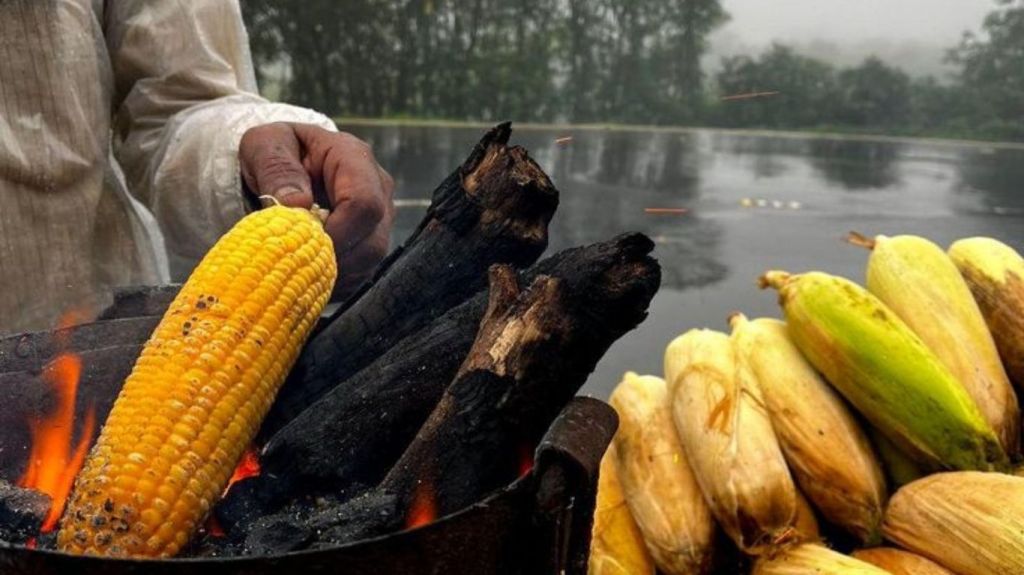
For a few minutes, a roadside bhutta-seller brought back a Sunday in Bokajan, Assam, that had disappeared in the mists of time…
Come the monsoons, Delhi’s roads acquire a familiar seasonal character. The heat recedes a little, the air turns heavy waiting for rain, and at traffic crossings, outside parks and markets, along roadsides and beneath trees, the bhuttawala appears. His little fire glows against the grey of the evening.
The other day, I stopped my car and got out to buy a bhutta. There is something almost ceremonial about watching a bhuttawala prepare it. He takes the corn, holds it over the fire and turns it slowly, patiently, allowing the flame, which he fans, to kiss the kernels. Some pop, some blacken, some acquire that deep roasted brown that tells you it is ready. Then comes the lemon. He cuts it, dips it into salt, and rubs it over the steaming corn. I stood watching him. Lemon and salt, the two finishing touches that transform a simple cob of corn into one of the great pleasures of the monsoon.
And somewhere between the fire and the lemon, between the smoke and the smell of roasted corn, I was no longer standing on a Delhi road. I was in Bokajan. Fifty years ago. A Sunday afternoon.
My father and mother would take my brother and me to the local cinema. The theatre was about thirty minutes away, and we would walk. Today, thirty minutes is barely a distance. Back then, for two children, it was an excursion. My brother and I would walk with our parents, distracted by things that adults no longer notice. The road itself was part of the adventure. There was always something to look at, something to hear, somewhere to wander for a few steps before being called back. We were children, and the world was enormous. But we were not afraid of its enormity. We walked beneath the protective shadow of our parents, secure in the unspoken knowledge that nothing could really happen to us as long as they were beside us.
Perhaps we don’t realize, when we are living such moments, that one day they will become the precious things we carry with us. Childhood has no sense of its own impermanence. We imagine that Sundays will continue forever. That the walk to the cinema will always be possible. That our parents will always walk next to us. That our sibling will always be somewhere close.
But it is not how time works. What has survived is a petrol pump somewhere along that thirty-minute walk. The petrol pump was our halfway point, and perhaps the highlight of the entire outing. There, we would stop for Gold Spot and bhutta. The Gold Spot was cold and orange and fizzy.
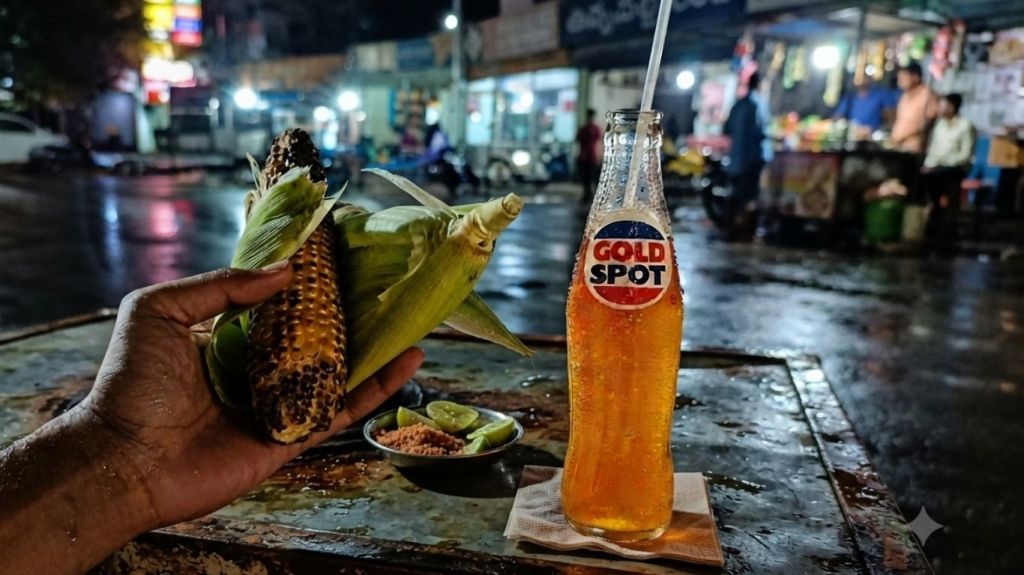
And then there was the bhutta. I don’t remember what it tasted like. I couldn’t tell you whether the corn was particularly sweet, whether it was more charred than it should have been, or how much it cost. But I remember the four of us.
Four people standing together at a petrol pump in Bokajan on a Sunday, on our way to the cinema. I don’t remember which film we went to see. That is one of the strange things about memory. We assume that the important things will be preserved: the title of the film, the actors, the story, the date. Instead, memory chooses its own souvenirs. Perhaps that is what growing older does to us. The world slowly takes away the people and places that made us who we are, but occasionally, without warning, gives us back a fragment. For a few minutes. Just enough to remember. Just enough to hurt. Just enough to be grateful.
My father is gone now. My mother is old. My brother and I live in different cities. The four of us who once walked together towards a cinema in Bokajan have long since been scattered by time and circumstance. And yet, standing at the bhuttawala’s thela, with the smell of charcoal in the air, something happened that I cannot quite explain. For the few minutes that the bhuttawala took to prepare my bhutta, the four of us were together again.
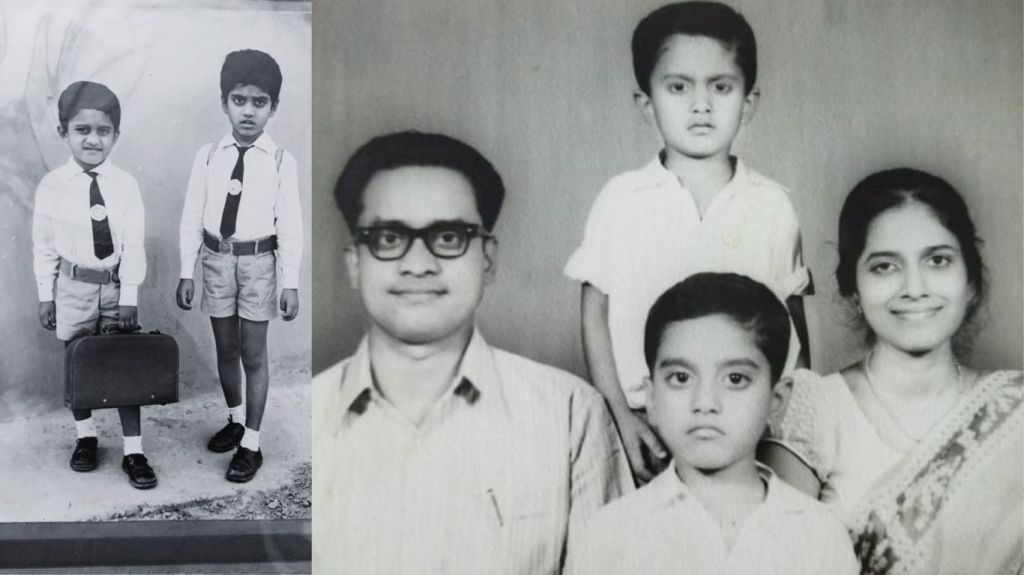
Not literally, of course. But memory does not understand the rules of time. It brought my father back. Not as the person I remember from the end of his life, but as my father on a Sunday afternoon in Bokajan, walking beside his two sons. It brought my mother back, younger and healthier, walking with us. It brought my brother back to that road, to that childhood, to that petrol pump. And it brought me back to the boy I once was. Two children, their hearts open to the world’s wonder, walking beside the two people who made the world feel safe.
The bhuttawala had no idea. He was simply doing his job. He had probably prepared hundreds of bhuttas that week. For him, it was another corn cob, another customer, another twenty rupees. For me, those few minutes were a passage through time.
He handed me the corn. ‘Bees rupaye.’
I paid him and stood there for a moment, holding the bhutta. I would have happily paid much more. Because in those brief moments that the bhuttawala took to prepare the corn, I had lived a priceless memory. He had unknowingly given me something no money could buy: a few minutes with my father, my mother and my brother. A few minutes on a Sunday that had disappeared half a century ago. A few minutes of being that boy again, walking towards the cinema with the whole world ahead of him and his parents beside him.
I took a bite. It tasted good. But it wasn’t the taste I was looking for. The taste of that childhood bhutta has disappeared. Perhaps it was never really the taste of the corn that I remembered. Perhaps it was the petrol pump, the Gold Spot, the walk, the four of us standing together, with a whole Sunday evening still ahead of us.
The rain had begun to fall. I walked back to my car, carrying the half-eaten bhutta. For once, I did not mind the traffic, the noise, the wet roads, or the impatient horns. I carried the bhutta with me.
And, for a little while longer, I carried the four of us.


Leave a comment