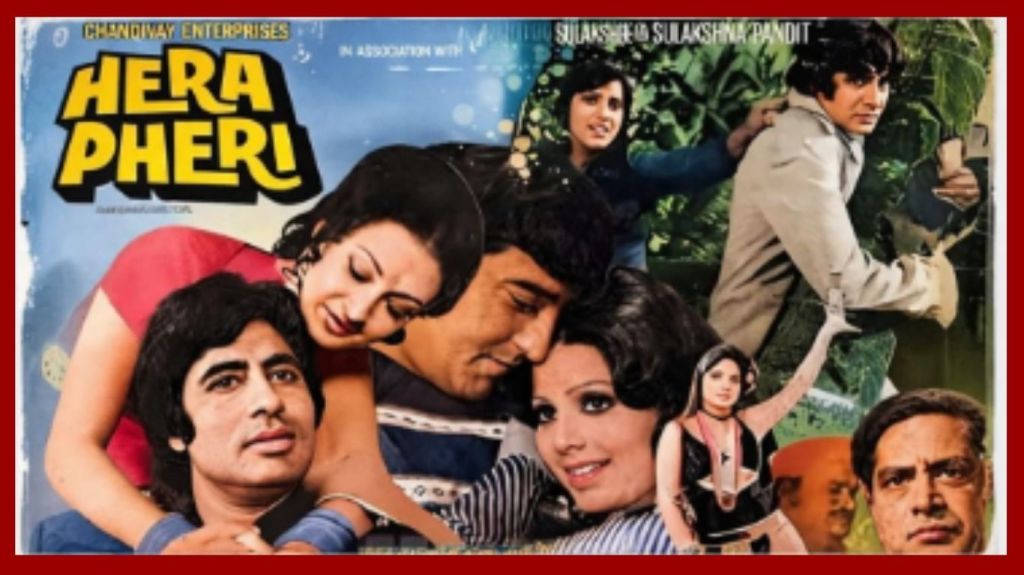
Before Baburao, there were Ajay and Vijay. Before Hera Pheri became a modern comedy franchise, Prakash Mehra’s 1976 original showed just how much chutzpah two stars indulging in elaborate cons could pack into a Hindi film. Fifty years on, Prakash Mehra’s mischievous entertainer remains a wonderfully underappreciated blend of comedy, mystery, action and star chemistry.
Even as a ten-year-old, I knew there was something wrong. I knew that Hindi film heroes and heroines danced. But there was something not quite right about the way Vinod Khanna and Amitabh Bachchan were going about it. For one, there was no song accompanying the sequence. It was, in fact, a rather dramatic scene they were putting across.
I hadn’t heard of Luis Buñuel, and so wasn’t sure whether a perfectly normal commercial film had suddenly taken a turn for the surreal – not that I was aware of the terms ‘commercial cinema’ and ‘surreal’, either, at the time. I did not know of ‘break dance’ (in fact, Michael Jackson would perform it for the first time only five years later, in 1983). Neither had I seen a ‘Nagin’ film yet that could provide context to the way the two stars were swaying onscreen. It was only after three minutes of this ‘dance’ that it dawned on me that Vinod Khanna and Amitabh Bachchan were shifting shape to the rivulets of water running down the screen. It was raining outside.
Right through the 1980s and ‘90s, I spent considerable time at some rather rundown and ramshackle theatres, but this one in Bokajan, Assam, in 1978, is right up there. I have forgotten its name. The film was Hera Pheri. Of course, the screening had to be stopped.
It would be years later, in fact around the time Amitabh Bachchan was taking a sabbatical from cinema after having joined politics, in 1984, that I finally managed to watch it at Uphaar. And I was blown away by the mix of comedy, mystery and action, and by the presence of two of Hindi cinema’s greatest stars. I watched it again a couple of years ago at a plush PVR theatre and was pleasantly surprised at how well the film’s entertainment quotient has held up over the intervening years.
That may be worth emphasizing today because, for an entire generation of viewers, Hera Pheri means something else. The title is now inseparable from the enormously successful comedy franchise that began with Priyadarshan’s Hera Pheri in 2000 and continued with Phir Hera Pheri in 2006. Those films have created their own pop-cultural universe, their characters and dialogue becoming part of everyday Hindi-film vocabulary. Yet there is another Hera Pheri, made nearly a quarter of a century earlier, and when it comes to sheer chutzpah, genre juggling and the pleasure of watching two major stars let themselves loose, the 1976 film beats the later series hollow.
Half a century on, Hera Pheri (1976) remains one of the more curious outliers in Prakash Mehra’s filmography, a film that refuses to sit neatly beside the towering cultural monoliths of Zanjeer and Muqaddar Ka Sikandar, and is perhaps all the more delightful for it. If those films consolidated Mehra’s reputation as a master of brooding drama and star-driven spectacle, Hera Pheri reveals a film-maker in a more playful, mischievous mood, blending genres with a lightness of touch that Hindi cinema has rarely managed with such ease. That it continues to be relatively overlooked says less about its merits and more about how the gravitational pull of the ‘angry young man’ era has shaped our retrospective gaze.
What makes Hera Pheri so distinctive is its tonal balancing act. On the surface, it is a comic caper, full of mistaken identities, sly cons and the kind of situational humour that thrives on timing rather than punchlines. Yet beneath that levity runs a genuinely engaging mystery, one that unfolds with enough intrigue to keep the audience invested beyond the laughs.
Mehra and his writers construct a narrative that never treats comedy and suspense as mutually exclusive modes. Instead, the humour emerges organically from the situations created by the central plot, rather than being grafted on as an interruption. This is a crucial distinction. Too often, Hindi films of the period compartmentalized comedy into detachable sequences. Hera Pheri, by contrast, lets the comedy arise from the very mechanics of its intrigue.
The plot’s central conceit, of two small-time operators navigating a web of deception and crime, offers fertile ground for both tension and farce. The stakes are real enough to sustain a sense of danger, but the characters’ opportunism and quick-wittedness constantly undercut the seriousness. This interplay gives the film its peculiar rhythm: moments of genuine suspense dissolve into laughter, only for the narrative to tighten its grip again. It is a testament to Mehra’s control that the film never feels tonally inconsistent. Instead, it feels nimble, as though it is always one step ahead of the audience’s expectations.
Central to this balancing act is the chemistry between its leading men, Amitabh Bachchan and Vinod Khanna. By 1976, Bachchan was already well on his way to becoming the defining star of the decade, his persona shaped by simmering anger and moral intensity. Khanna, meanwhile, brought a very different energy: cool, self-assured and faintly enigmatic.
In Hera Pheri, it is Khanna who emerges as the more compelling presence, and not by accident. His performance carries a certain ease that suits the film’s tonal shifts; he seems equally at home in moments of humour and suspense, never overplaying either. Bachchan, on the other hand, appears slightly constrained by the film’s demands, his instinctive gravitas occasionally at odds with the lighter register.
This is not to say that Bachchan is ineffective. Far from it. There are flashes of his trademark charisma, particularly in scenes that allow him to play off Khanna or indulge in understated comic beats. But the film belongs, unmistakably, to Khanna. There is a looseness to his performance, a sense that he is enjoying the game the film is playing, and inviting the audience to do the same. It is one of those rare instances in Hindi cinema where a co-star doesn’t just hold his own against Bachchan but arguably eclipses him, not through flamboyance but through sheer tonal compatibility.
The film opens with a wonderfully staged piece of deception. Ajay (Vinod Khanna) is at a roadside ‘hotel’. He has consumed eight bottles of beer and demands another round. When the owner refuses, claiming that the beer is finished, Ajay punches the waiter and threatens to wreck the place. Vijay (Amitabh Bachchan) then appears to intervene, taking on Ajay in a brisk, sharply choreographed fight. Having subdued him, Vijay turns to the frightened owner and, with disarming sophistication, extorts protection money. The joke is that what appears to be a straightforward confrontation between two strangers is, in fact, an elaborate con. The opening titles subsequently reveal that Ajay and Vijay are working together, retrospectively transforming the entire sequence into a carefully rehearsed act.
One of the film’s most memorable sequences – the poker game involving Asrani, Bachchan and Khanna – perfectly encapsulates this dynamic. It is a scene built on tension, deception and escalating absurdity, with each character trying to outwit the others. Asrani, with his impeccable comic timing, injects a layer of unpredictability, his reactions oscillating between bravado and panic (‘This is the limit’ became one of the most memorable dialogues in Asrani’s career). Bachchan plays it relatively straight, his playful intensity lending the game a sense of stakes. But it is Khanna who threads the needle, modulating his performance to match both the humour and the suspense.
The scene unfolds like a miniature film in itself, its rhythm dictated by glances, pauses and the slow revelation of intent. By the time it reaches its payoff, the audience is as invested in the outcome as it is amused by the antics. Running through the sequence is another layer of comedy involving Ram Sethi (a regular with Prakash Mehra’s unit), who plays a perpetually inebriated, seemingly oblivious presence at the casino. His deadpan reactions and apparent inability to grasp what is happening around him provide a recurring comic counterpoint to the elaborate deception being played out in front of him.
Equally striking is the film’s use of music, particularly the song ‘Waqt ki hera pheri hai’, sung by Kishore Kumar and Mahendra Kapoor. In a film already preoccupied with deception and shifting identities, the song becomes an extension of its thematic core. Its lyrics, with their emphasis on the capriciousness of time and fate, echo the narrative’s constant reversals.
But it is the picturization that elevates the song to something truly memorable. Mehra stages it with a sense of dynamism that mirrors the film’s narrative energy, using movement, framing and choreography to create a visual spectacle that is both entertaining and narratively resonant. The interplay between Kishore Kumar’s playful exuberance and Mahendra Kapoor’s more robust, declarative style adds another layer of texture. The dual voices seem to embody the film’s dual impulses, comedy and drama, coexisting within the same space.
On screen, this translates into a sequence that is as much about performance as it is about storytelling. The characters are not merely participating in a song; they are enacting the film’s central theme of shifting roles and hidden motives. It is a reminder of how, at its best, Hindi cinema integrates music into its narrative fabric rather than treating it as an ornamental aside.
Then there is the film’s climax, which delivers a twist that feels both surprising and inevitable. In an era when many films telegraphed their resolutions well in advance, Hera Pheri manages to hold something back, revealing its hand at just the right moment. The twist does not come across as a gimmick; it emerges organically from the narrative, recontextualizing what has come before. This is where the film’s careful construction pays off. The clues are there, embedded within the story, but they are masked by the film’s humour and pacing. When the revelation arrives, it lands with a satisfying clarity, prompting a retrospective appreciation of the film’s design.
What is perhaps most remarkable about Hera Pheri is how effortlessly it achieves all this without announcing its ambitions. There is no sense of self-conscious genre-bending, no attempt to foreground its cleverness. The film simply unfolds, confident in its ability to engage the audience on multiple levels. This lack of pretension is part of its charm. It does not demand to be taken seriously, yet it rewards serious attention.
Its relative neglect in discussions of Prakash Mehra’s oeuvre may also stem from the way we tend to categorize film-makers and stars. Mehra is often remembered as the architect of the Bachchan persona that dominated the 1970s, a film-maker who tapped into the zeitgeist of disillusionment and anger. Within that narrative, a film like Hera Pheri appears as an anomaly, a detour into lighter territory. But this view does the film a disservice. Rather than being an aberration, it reveals another facet of Mehra’s sensibility: his ability to handle tonal complexity, to craft narratives that are both entertaining and intricately structured. This found a fuller exposition in the works of his first AD Rakesh Kumar who fashioned a series of breezy entertainers with Amitabh Bachchan in the years that followed, in particular Khoon Pasina, Mr Natwarlal, Yaarana, and Do Aur Do Paanch.
Similarly, Bachchan’s presence in the film invites comparisons with his more iconic roles, comparisons that inevitably skew perceptions. When viewed on its own terms, Hera Pheri offers a different kind of pleasure, one that is less about star mythology and more about ensemble interplay and narrative ingenuity. In that context, Khanna’s dominance, in what is probably the only full-fledged role that allowed him to showcase his talent for comedy, becomes not a surprise but a logical outcome of the film’s demands.
Fifty years on, Hera Pheri feels remarkably fresh, its blend of comedy and suspense anticipating a mode of storytelling that Hindi cinema would only sporadically revisit. Its humour is rooted in character and situation rather than dated gags, and its mystery retains the ability to engage. The film’s craft – its pacing, its performances, its integration of music – speaks to a level of control that is easy to overlook in a work that wears its intelligence so lightly.
Perhaps its time has come for a reappraisal, not as a footnote in Prakash Mehra’s career but as a film that stands confidently on its own merits. In its playful subversion of genre boundaries, its memorable sequences and its quietly assured storytelling, Hera Pheri offers a reminder that even within the most star-driven eras of Hindi cinema, there were films willing to experiment, to take risks and to simply have fun without sacrificing substance.
And perhaps that is the simplest reason to return to it, fifty years later. Before Hera Pheri became a franchise, it was already a film about the sheer pleasure of pulling off a hera pheri, with two of Hindi cinema’s biggest stars, a film-maker at the height of his powers, and just enough mischief to keep everyone, including the audience, guessing.


Leave a comment