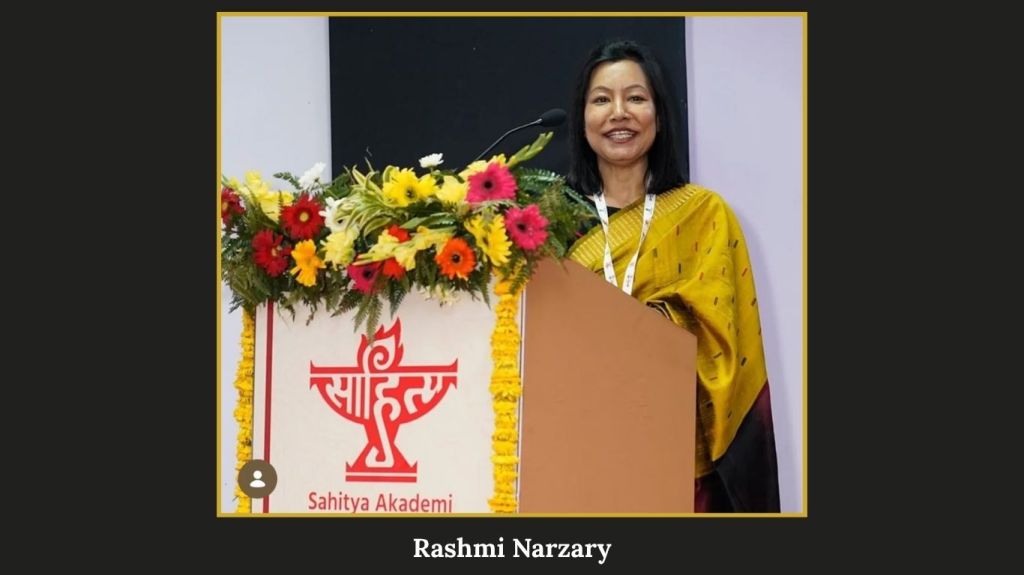
Rashmi Narzary, winner of the Sahitya Akademi Award and the FICCI Award for Best Fiction (The Whistles of the Siphoong, Om Books International), reflects on folklore, oral traditions, indigenous cultures, and the enduring power of storytelling.
Shantanu: From economics and human resource management to literature, your path into writing was anything but conventional. What was the turning point when storytelling ceased to be a passion and became a vocation?
Rashmi: I was often asked why I didn’t take up literature, because I would always be imagining things in my little head since I was a kid, conjuring up big tales from simple experiences. I didn’t have a conscious answer for a long time, but now I realize, not pursuing literature as academics kept my manner of storytelling free of a structured flow, of influences. I always loved to write just the way I talk to someone sitting in front of me … simple, conversational. Perhaps that’s what made my readers relate to my tales. For that simple reason, I gradually began to get invited to mentor children through writing workshops and to read to them from my works, to tell grown-ups how stories could be infused into children’s learning process and would I like to talk to school/college/university faculty on this. That’s when a slow shift from passion to vocation began.
When His Share of Sky received the Sahitya Akademi Award for English children’s literature in 2016, what had begun as a passion quickly evolved into a vocation. As the first – and so far the only – Bodo writer, and only the second writer from Assam, to receive this honour, I found my work attracting growing academic interest. Scholars began undertaking research on my writings, and universities included them in their curricula. And so from passion to vocation, my storytelling has now become a passionate vocation. And do I love it!
Shantanu: You have often drawn upon folklore, legends, oral traditions, and cultural memory in your work. Growing up in Shillong, what were the stories, storytellers, or experiences that first made you aware of the power of oral narratives?
Rashmi: As a little schoolgirl in Shillong, I remember Papa taking us to the District Library on Sunday mornings, driving through roads that ran through trees and hills. I would look out of the Ambassador car’s window and wonder what might be there among those trees. Where were those sounds among the pine trees? And I would start making up little fantasy stories about them and tell these to my friends. And my! The awe with which they listened! Now I know, that awe is called the power of oral narration. I myself experienced that same awe when local people told us about hair-raising mysteries, spirit tales and haunting folklore from the misty crests of Meghalaya’s hills, caves and waterfalls where we often went for small treks, picnics and pine-cone hunting. The power of these oral narratives still holds me in thrall! Therein perhaps the earliest seeds of storytelling were sown in me. So, though I went on to study stuff unrelated to storytelling, I had always been the family’s storyteller. And the joke that runs in the family is: be careful of what you tell her, it’s going to be out there for the world to read!
Shantanu: In Whistles of the Siphoong, there’s the figure who embodies the role of the keeper of collective memory, preserving history through storytelling rather than written records. Do you see your own role as a writer in a similar way, as a bridge between oral traditions and contemporary readers?
Rashmi: Yes, Asidoh Buri, like you mention, is the keeper of everything that makes our people. The Bodo people. She knows all, through time immemorial. And while she preserves and holds all of these, I only draw from what she keeps and chronicles, to share and interpret. And precisely like you say, I do see myself as the bridge because when keepers narrate, they often do so in their own tongue, through the medium of folksongs and rhythmic verses. These narrations require a kind of contemporary interpretation. So, yes, storytellers like us build that bridge to ferry our tales across generations and languages.
Shantanu: Your works consistently celebrate indigenous cultures, particularly those of Assam and the Bodo community, while making them accessible to a wider audience. How do you balance cultural authenticity with the demands of storytelling for readers who may be encountering these worlds for the first time?
Rashmi: I usually go for a prologue that gives an introduction to the indigenous background of the people in reference, but I like to make this introduction feel like a part of the story rather than an academic introductory chapter with straight, bulleted data. In fact, I have tried giving the introduction its own intriguing characters which blend with and become an integral part of the rest of the story. It may sound childish, but the ‘once-upon-a-time’ or ‘in-ancient-times’ kind of opening line by an enigmatic storyteller, who goes on to introduce first-time readers into a hitherto unknown indigenous culture through the form of a story, always worked for me. Like in Whistles of the Siphoong, the introduction to the Bodos is narrated by the albino tale bearer Asidoh Buri, who begins as, ‘Long ago, in the ancient times…’ and goes on to tell where the Bodos came from etc., to Bodosa, child of the Bodo. Asidoh Buri has become a parallel protagonist in Whistles of the Siphoong.
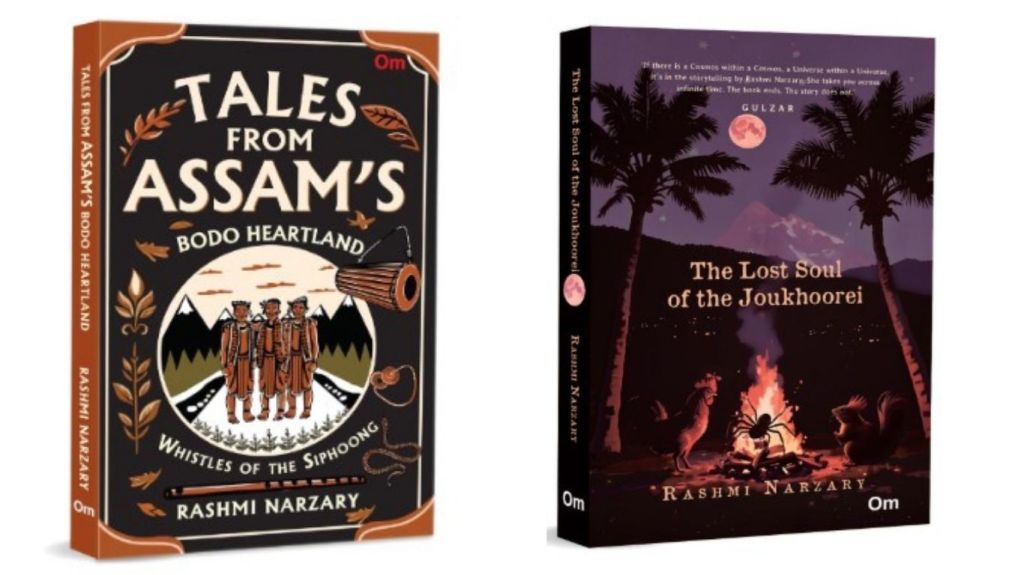
Shantanu: Music, nature, and landscape are almost characters in themselves in Whistles of the Siphoong. How consciously do you use the natural world and cultural symbolsto carry emotional and philosophical meanings in your fiction?
Rashmi: Siphoong, in Bodo, is the flute. So, as the name itself says, Whistles of the Siphoong is all about tunes of the flute which bind the tales in a manner that, at some point, almost becomes sacred. The Bodos are nature worshippers and in the whole ambience of prayer and worship to Bathou, hymns and music are fundamental. I quote Asidoh Buri from her introduction in Whistles of the Siphoong, ‘… (the Bodos) believed that because there can be no life without air and because it is but air that the siphoong breathes and blows through, it is the wand of the Heavens.’ So the connect between the natural world and cultural symbols like the flute happen spontaneously. Bathou (Ba means five, thou means profound) signifies the five elements, and by narrating tales associated with each, I let the tunes of the lute carry universal human emotions through Bodo philosophies in this particular collection of stories.
Shantanu: Both Whistles of the Siphoong and The Lost Soul of the Joukhoorei are steeped in folklore and spirituality, yet they also deal with universal human concerns – friendship, loss, displacement, memory, and belonging. How do you find the balance between the mythical and the deeply human?
Rashmi: If you unleash the human mind, it knows absolutely no limits. Thereby it reaches across the cosmos, tapping into the mythical, mystical, divine and all else. However, being human, it is endowed with feelings and as it reaches across all these spheres and dimensions, it experiences emotions that are sometimes isolated but most often are affected by the emotions of others. Also, a mind that has the capacity to soar high out into the infinity will definitely also have the capacity to descend into the deepest human sensitivity. And thereby, a balance between the mythical and the deeply human is automatically established. I unleash my mind. It does the rest.
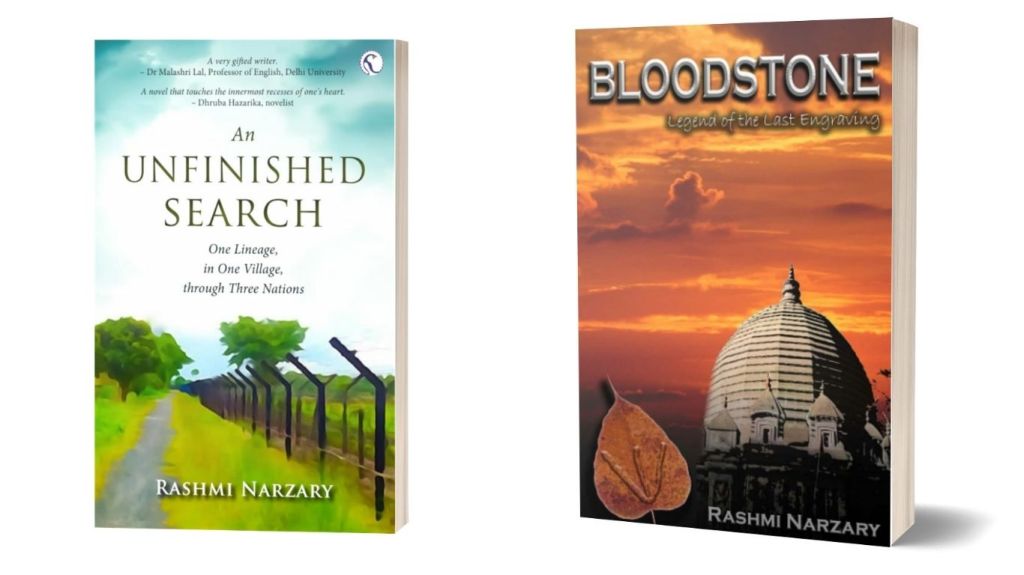
Shantanu: Your debut novel Bloodstone explored the legends surrounding the Kamakhya Temple, while An Unfinished Search addressed the trauma of war, partition and identity. What draws you to these aspects of history and legends, and how do you decide which stories from the past deserve retelling for contemporary readers?
Rashmi: For Bloodstone, it was a kind of mystic allure and awe. I noticed that the Devi’s ‘blood-drenched’ angodak which is distributed with the prasad is actually a piece of any normal red cloth. And yet, physical things that find mention in the legend, like the ancient steps (now mostly unused) cut into rocks and which lead to the shrine, the trickle of water inside the main peeth that is considered the Devi’s yoni deep within the bowels of the hill in a cave, the sacrificial altar, the Saubhagya kund which is the pond, all of these are still there as immortal witness of the stories that unfolded upon the Nilachal hills in times bygone.
For An Unfinished Search, there was this curiosity and sadness that surrounded the nameless graves of a war memorial from my parts of the world. A memorial straddling the border between two nations whose histories are inextricably intertwined. A memorial that is hardly known, yet immersed in immense historical significance. This, I felt, had to reach out to a wider audience. Some stories need to be pulled back from the verge of getting lost and placed before the present generation. Such stories set my imagination soaring, for a retelling.
Shantanu: In The Lost Soul of the Joukhoorei, there is a fascinating interplay between the supernatural and the everyday. Do you think folklore survives because people believe in it literally, or because it carries deeper truths about human experience?
Rashmi: I suppose a bit of both. While the first transports you to the ancient past, evoking the mystery and wonder of an age that once unfolded upon the very ground where you now stand – at once familiar and astonishingly different – the second bears silent testimony to events and lived experiences that, over time, gave birth to folklore and legend. And ultimately, because both relate to universal human emotions, past and present.
Shantanu: Your books are now being taught in universities and researched academically. Has that recognition changed the way you approach writing, or do you still begin each new work with the same instinctive storyteller’s curiosity?
Rashmi: I am a storyteller first, last and in between. The beginning of every story, then as now, fills me with the feeling of a rain-laden cloud, restless to release the imagination brewing and bubbling within. Over the years, my perspective has undoubtedly matured, but the heart of my storytelling remains unchanged – its simplicity and its ability to connect with readers continue to define the way I write.
Shantanu: Looking back from His Share of Sky to your most recent works, what do you think has remained constant in your writing journey, and what has evolved the most, in your voice, your themes, or your understanding of the stories you want to tell?
Rashmi: Nature, rural landscapes, spirit stories, and the universal spectrum of human emotions – along with their intimate connection to the elements – have remained constant in my writing. What has evolved most is my understanding of the stories I wish to tell and my approach to interpreting them, transforming oral traditions into written narratives. And yes, a few insightful and honest readers have observed that my voice has grown more lyrical over the years (Whistles of the Siphoong) and deeper (The Lost Soul of The Jouhkoorei). ‘Rashmi, your stories never have a villain,’ someone said recently. Yeah, they never had.
Shantanu: Tell us something about your writing routine, your approach to writing. And what are the books and authors that have shaped your world-view and your writing. What would be your advice to aspiring writers, vis-à-vis the importance of reading and that of being disciplined as a writer?
Rashmi: Well, I follow no particular routine, though my write-mode works best at night. As for an approach, I don’t really have a well-laid-out flow chart of plots and sequences on paper. That happens in my mind as I go about my usual chores, anytime, anyplace. During these moments, if little day-to-day observations catch my fancy, they find their way into my narration.
Ruskin Bond is my all-time favourite. As a child, the Bill Badger series, Kenneth Grahame, Enid Blyton and fairy tales from all over kept me glued. Over the years I read mysteries, murders, espionage, but my heart always ran back to nature stories; tales of nature spirits, myths and mystic, and legends. Now as I have matured, I know I am at home reading and writing nature.
My advice for aspiring writers is, observe your surroundings. Stories, characters and ideas remain hidden there. And read others. Most importantly, write about what your heart feels, and not about what someone else wrote and became famous for, or what is trendy. O, yes, and have lots of patience and read your drafts over and over again. Every story is a great story; it is the style of narrating that makes all the difference. And just as every craft improves with disciplined practice, so does storytelling. So go on, tell your stories!


Leave a comment