‘Aaye khuku aaye’ is a rare musical conversation where melody and lyric merge into an intimate father-daughter dialogue. Composed by V. Balsara, with words by Pulak Banerjee and voices of Hemanta Mukhopadhyay and Sravanti Majumdar, the song evokes memory, tenderness, and the quiet passage of time with enduring emotional grace.
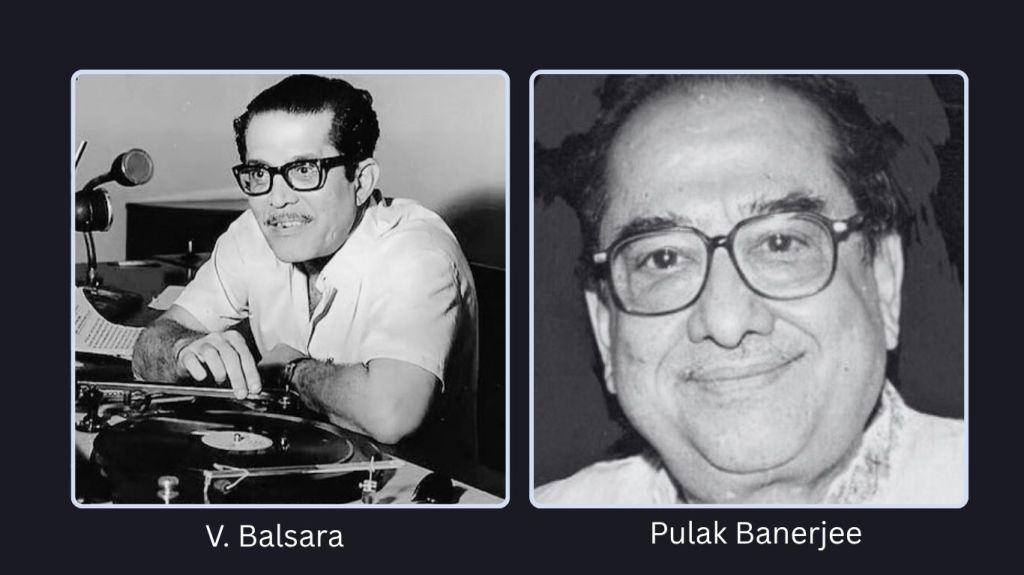
Certain songs captivate with their melody; others endure because of their words. ‘Aaye khuku aaye’ is one of those rare creations where music and lyric breathe into each other so seamlessly that the song becomes less of a performance and more of a conversation, a tender exchange between a father and his daughter, suffused with affection, nostalgia, and an unspoken awareness of time’s passage. Composed by V. Balsara, written by Pulak Banerjee, and sung by Hemanta Mukhopadhyay with Sravanti Majumdar, this piece occupies a very special place in the Bengali musical imagination.
V. Balsara, often called a perfectionist of melody, was known for his mastery over Western instruments like the piano, and for blending them with the soul of Bengali song. His work was not about loud orchestration but about finding the gentlest musical gestures that could illuminate the poetry. In ‘Aaye khuku aaye’, Balsara seems to have distilled the very essence of paternal tenderness into notes. The melody, understated and luminous, gives the song a conversational rhythm, as if a father is responding to his daughter’s pleas softly in a room filled with evening light.
Hemanta Mukhopadhyay’s voice adds to this atmosphere. With his deep baritone, sometimes likened to the shade of an old banyan tree, Hemanta sings here not as a grand romantic hero but as an intimate presence. His rendition carries warmth without excess, the calm authority of a father who both instructs and consoles. The presence of Sravanti, singing a child’s part, brings a fragile innocence, creating a call-and-response dynamic that feels utterly organic.

The Emotional Core of the Lyrics
The lyrics unfold almost like a diary entry – fragments of everyday life, fleeting moods, small rebellions, moments of boredom and delight. Lines like ‘katena shomoy jokhon ar kichute, bondhur telephone e mon boshe na’ (when time refuses to pass, even a friend’s phone call doesn’t help) capture a universal adolescent restlessness. The father figure perceives this and gently intervenes, not with sternness, but with companionship: ‘aaye khuku aaye, aaye re amar sathe gaan geye ja’ (come, my child, sing with me).
The repeated refrain aaye khuku aaye (come, little one) is the heartbeat of the song. It is not a command but a beckoning, filled with love. Each repetition grows into a mantra of reassurance. To a child who feels disconnected from the world, the father offers the act of singing together, of learning new tunes, of sitting at the piano. The message is subtle: art and music can soothe loneliness, create bonds across generations, and act as a refuge in moments when ‘nothing feels good’.
The imagery in the verses is vivid in its ordinariness. The daughter preparing to go out, tying her hair, looking in the mirror, sipping coffee, flipping through poetry books – these could be anyone’s small rituals. Yet they become suffused with meaning because the father sees them, and because in these gestures he imagines echoes of himself: ‘mone hoy babar moto keu bole na’(I feel no one tells me anymore like my father did). The song thus becomes a meditation on recognition, of how much children carry traces of their parents, and how parents, in turn, find themselves reflected in their children.
Music as a Living Presence
What makes the song extraordinary is the way V. Balsara’s music frames these lyrics. The piano runs are not ornamental; they are the very voice of the song’s intimacy. The minimal orchestration ensures that the listener’s attention never strays from the dialogue between father and daughter. The melody is simple, almost conversational, but it is layered with subtle shifts that mirror emotional textures: a gentle lilt when the father invites his daughter to sing, a more wistful undercurrent when he remembers his youth and his daughter’s infancy, a faint sparkle when he imagines going for a walk together through the city.
Hemanta’s phrasing here is masterful. He sings with pauses that feel like listening, leaving space for the daughter’s presence. The baritone does not dominate; it cradles. When Sravanti responds, her light voice sounds almost like a breeze, delicate and momentary. The contrast between the two voices, like shade and sunlight, embodies the generational dialogue.
Resonance beyond the Song
Why does ‘Aaye khuku aaye’ resonate so deeply even decades – it turns fifty in 2026 – after its creation? One reason is that it transcends its immediate context. Though it speaks of a particular father-daughter bond, it appeals to anyone who has felt the comfort of being called back from loneliness by a loving presence. The refrain itself has become a cultural idiom in Bengal, shorthand for affection, a phrase mothers and fathers still hum to their children.
At another level, the song carries a quiet awareness of time. In one of its most poignant moments, the daughter reflects: ‘chhelebelar din fele eshe, shobai amar moto boro hoye jay’ (leaving behind childhood days, everyone grows up like I did). Before this there’s the daughter wishing wistfully that her father would tell her: ‘Aay re amar sathe aay ekhuni, kothao ghure ashi sohor chhere, chhelebelar moto baayna kore, kaaj theke ne na tui amay kere (Come now, come with me, let’s slip away from the city for a while, like you stubbornly did as a child, pull me away from my work for a while). These words never fail to remind me of my son’s efforts to draw me away from my work when he wanted me to spend some time with him.
Here, tenderness is laced with the melancholy of impermanence. The invitation aaye khuku aaye is not only about the present but also about holding on to the past, about recreating childhood moments through memory and song. The act of singing together becomes an act of time-travel, a way to ‘bring back the lost days’.
The Seamlessness of Words and Music
What truly elevates the song is how inseparably the words and the tune are woven. Imagine these lyrics without Balsara’s melody, and they would feel like sweet but fleeting observations. Imagine the tune without Hemanta’s warm voice, and it might feel too light. And without Sravanti, the very sense of longing that permeates the song would go missing. Together, they create something that is not just a song but an experience, like being invited into a living room where father and daughter share an evening, laughter and song dissolving the world’s troubles for a while.
The repetition of aaye khuku aaye works musically as a refrain, but emotionally it works as touchstone. Each time it appears, it gathers new layers: at first playful, then tender, then reflective, finally almost aching in its longing to hold on to fleeting time.
A Song of Everlasting Return
‘Aaye khuku aaye’ is one of those rare songs that feel both deeply personal and universally accessible. It is a father’s gentle counsel, an artist’s subtle homage to domestic life, and a timeless meditation on the flow of days. V. Balsara’s music, Hemanta Mukhopadhyay’s voice in perfect sync with Sravanti’s plangent longing, and Pulak Banerjee’s intimate words all converge into a seamless whole.
The emotional resonance lies in its ability to make us remember: our own fathers’ voices, our own restless afternoons, our own gradual crossings from childhood to adulthood, as also our children’s. It reminds us that music is not only for performance; it is also for conversation, for consolation, for binding together the scattered moments of life. And in that soft, repeated call, aaye khuku aaye,lies an invitation we never outgrow: the call to return, to belong, to be held.


Leave a Reply