Veteran journalist and folklorist Nalin Verma discusses how pandemic isolation led him to fiction, why folk memory remains central to his writing, and how Sacred Unions and Other Stories, published by Om Books International, captures the dignity, humour and vanishing worlds of rural Bihar.
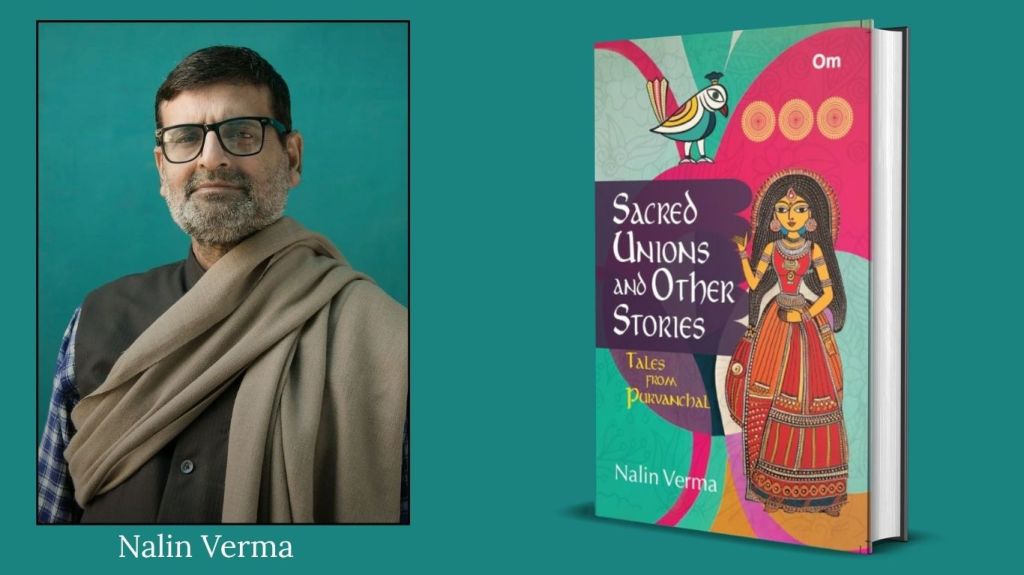
Shantanu: After decades of reporting on politics, society and culture in Bihar, what prompted you to turn to fiction with Sacred Unions and Other Stories? Did fiction allow you to explore aspects of rural life that journalism could not?
Nalin Verma: It was in February–March 2020 when Covid-19 hit our land. I was then working as a faculty member at Lovely Professional University, Jalandhar, Punjab. The university was shut down and curfew was imposed. I, along with many others, was forced to remain confined to my room in a paying guest accommodation outside the university. Moving out and interacting with people are the primary ingredients of journalistic storytelling, which I could not do because of the stringent restrictions on movement and close interaction with people. The long spell of isolation prompted me to give flight to my imagination and write what eventually became Sacred Unions and Other Stories, thanks to you and Om Books International.
And yes, fiction allowed me to explore aspects of rural life in a different way. As a journalist too, I have loved exploring life at the grassroots over the years. In fact, my journalistic experience complemented my experiment with fiction. It was not so much a turn from journalism to fiction as a continuation of the same spirit through a different literary medium.
Shantanu: The stories in this collection are deeply rooted in the landscape and social realities of Purvanchal and Bihar. How much of these narratives emerge from people and incidents you encountered during your years as a journalist?
Nalin Verma: I was born and brought up in a remote village, devoid of roads and electricity but rich in ballad singers, folktale tellers, old trees believed to be inhabited by myriad gods and ghosts, and dotted with ponds and wells, in the Siwan district of north-west Bihar bordering eastern Uttar Pradesh. The region is also known as Purvanchal. I have always treasured these memories, which later became an important ingredient in my life as a journalist as well. As a journalist too, I loved visiting people in rural areas and listening to their stories and conversations. These experiences helped me greatly in shaping the narratives that I write.
Shantanu: Your earlier works focused on folklore and oral traditions, while this book presents original fiction. How do folklore and folk memory continue to shape your storytelling style and imagination?
Nalin Verma: In fact, writing fiction has been my favourite pastime from the very beginning of my life. Working continuously as a journalist for 30 years (1987–2017), I was short of time to fully indulge in this passion. Still, I wrote pieces of fiction that occasionally appeared in the literary sections of The Statesman and The Telegraph. Over the years, I also narrated folktales to entertain my daughters and the children of my colleagues, who loved them.
The Greatest Folk Tales of Bihar, of course, came out in 2019, but I had written those tales one by one over many years. Folk memories have therefore always remained with me and naturally come into play whenever I write fiction. Apart from Sacred Unions and Other Stories, I have written several short stories that were published over the years by the Singapore-based Kitaab and the London-based Folklore Thursday (now defunct), thanks to editors Namrata and Dee Dee Chainey respectively. These stories are very much in the same vein as those collected in Sacred Unions and Other Stories.
Shantanu: In stories such as ‘Kallu and Gulli,’ questions of caste, power, gender and state authority are woven into the narrative. How important was it for you to portray these realities without turning the stories into overt social commentary?
Nalin Verma: It was very important. As a journalist, I am trained to write overt social commentary. But I have noticed that readers often connect more deeply with something narrated in the form of a story, whereas interest in commentaries is usually confined to political leaders, social activists and policymakers. Commentaries carry information value, while stories, if told honestly, establish a deeper connection with people. Commentaries are largely intellectual exercises, whereas stories engage the emotions. ‘Kallu and Gulli’, of course, embodies the interplay of caste, power, gender and state authority. Yet it remains accessible to the general reader.
Shantanu: You have written about political figures like Lalu Prasad Yadav and spiritual figures such as Saint Gorakhnath. What common threads do you see between political history, spiritual traditions and the everyday lives of ordinary villagers?
Nalin Verma: Be it a political figure like Lalu Prasad Yadav or a spiritual figure like Saint Gorakhnath, they derive their sustenance, significance and longevity from ordinary people. Lalu Prasad Yadav is a phenomenal leader, but it is the affection and support he enjoys at the grassroots that made him so. Similarly, a spiritual figure is as great as the faith and trust people repose in him. Ultimately, political history, spiritual traditions and the everyday lives of villagers are deeply interconnected through the hopes, beliefs and aspirations of ordinary people.
Shantanu: Many contemporary writers portray rural India either nostalgically or through a lens of deprivation. Your stories seem to balance hardship with dignity, humour and resilience. How consciously did you work towards this balance?
Nalin Verma: I did not do it consciously or deliberately. With great respect to my fellow contemporary writers, I would like to emphasize that life cannot be captured only through the lens of deprivation or nostalgia. It is not black and white. Perhaps I have the advantage of being an insider to grassroots society, but I have always found a great sense of humour, a strong urge to preserve dignity, and remarkable powers of endurance among people who may appear poor and deprived from a distance.
If a daroga, a symbol of authority in the villages, humiliates an ordinary man or woman, it hurts. If a high-ranking superintendent of police stands by the exploited, it can also create moments of irony and even mirth. Hurt, grief, happiness, wailing and laughter are all integral to human life, whether among ordinary villagers or among the elite in metropolitan cities. For me, portraying this balance did not require any conscious effort. It was simply a reflection of the lives of the people I have lived with.
Shantanu: The women in Sacred Unions and Other Stories are often central to the emotional and moral strength of the narratives. What role did your observations of rural women play in shaping these characters?
Nalin Verma: More than my observations, it was the women of Sacred Unions and Other Stories who guided me in telling their saga of moral strength. When you are honest with your characters, they reveal their stories of courage and endurance. I merely listened to them during the long spell of isolation caused by Covid-19. The credit goes to Shakuntala and Ahilya of Sacred Unions and Other Stories.
Shantanu: Having spent over three decades documenting social change in North India, what transformations in village life have most surprised or concerned you, and how are these reflected in your fiction?
Nalin Verma: What has concerned me most is the fast-vanishing pastoral world, the disappearance of communities that sustained themselves on stories and ballads about local gods, ghosts, ponds, wells, oxen, cattle, birds and old trees. Over the last three decades, roads, electricity and better houses have replaced gravel paths, lanterns, earthen lamps, huts and mud houses in rural areas. These are welcome changes. Yet community life has weakened considerably. This loss is deeply reflected in my fiction. I long for the affection and the stories that once emerged from the trees, ghosts, ponds, oxen and birds that were so abundant when I was growing up in my village.
Shantanu: As someone who has worked extensively to preserve Bihar’s folk tales, do you see fiction as another form of cultural preservation? What aspects of rural culture do you feel are most at risk of disappearing today?
Nalin Verma: Folk tales are, essentially, works of fiction. The great creative minds of their times narrated these tales through memorable characters. Whether it is the Panchatantra of Vishnu Sharma in India, the fairy tales of the Brothers Grimm in Europe, or the Arabian Nights of West Asia, all are grand works of fiction. And yes, my fiction too is an attempt to preserve what has vanished or is vanishing. I hope to continue doing so in my own modest way. Master storyteller Munshi Premchand’s Do Bailon Ki Katha (The Story of Two Oxen, Heera and Moti) is a superlative work of fiction. At the same time, it preserves a world that has largely disappeared: the oxen and the tinkling bells around their necks that once added their own rhythm to village life.
Shantanu: The title story speaks of ‘sacred unions’, but the collection also explores divisions of caste, class, religion and power. In your view, what ultimately binds communities together despite these fault lines?
Nalin Verma: The human being’s intrinsic desire to share both happiness and grief is what ultimately binds communities together. Greed, jealousy, hatred and love have existed in human nature since time immemorial. But so too have the impulses towards togetherness, compassion and coexistence.


Leave a Reply