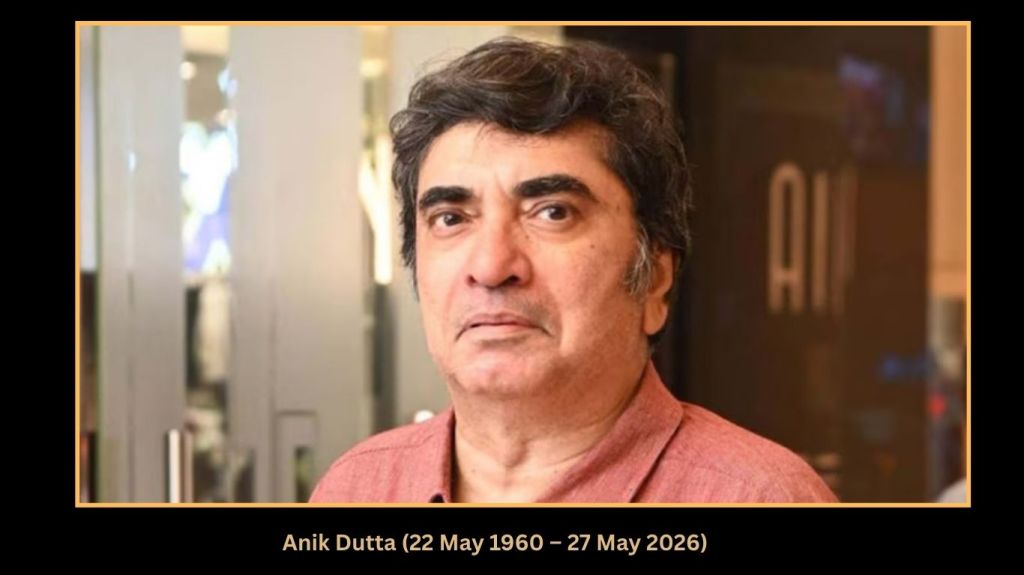
From Bhooter Bhabishyat to Aparajito, Anik Dutta has used humour, nostalgia and satire to chronicle Bengal’s cultural anxieties. Playful yet political, affectionate yet critical, his films preserve memory while challenging conformity, erasure and complacency in contemporary public life.
***
…And how you suffered for your sanity
And how you tried to set them free
They would not listen, they did not know how
Perhaps they’ll listen now
…And when no hope was left in sight
On that starry, starry night
You took your life, as lovers often do
But I could’ve told you, Vincent
This world was never meant for one as beautiful as you
– Don Mclean, ‘Vincent’
***
The Satirist of a Disappearing Bengal
Anik Dutta occupies an unusual place in contemporary Bengali cinema. His films are crowded with ghosts, eccentrics, fading houses, wounded nostalgia and sharp laughter, yet beneath the humour one often senses irritation, loneliness and a deep attachment to a disappearing cultural world. His films are rooted in Bengali middle-class anxieties, hypocrisies, nostalgia and vanities, yet they never lose the warmth of someone who belongs deeply to the world he critiques. It’s a curious space for a film-maker in Bengali cinema to be in: at once playful and wounded, intellectual and accessible, nostalgic and sharply political.
Over the years, Anik Dutta has become one of the rare Bengali directors whose films have generated conversations beyond immediate box-office concerns. Even when uneven, his work possesses a distinct voice. One recognizes an Anik Dutta film almost instantly – the literate humour, the affection for old Calcutta, the mockery of pretension, the references to Bengali cultural memory, the carefully observed eccentrics who populate his stories. Underneath the laughter, however, lies a persistent melancholy, a sense of cultural erosion and personal disappointment.
Yet Dutta’s significance extends beyond aesthetics or even cinema. Over the last decade and a half, he emerged as one of the few Bengali film-makers willing to test the limits of cultural conformity. His relationship with institutions was frequently uneasy. While many directors confined themselves to film-making, Dutta increasingly came to represent a broader tradition of Bengali satire that viewed humour not as escape but as a means of speaking difficult truths. His films repeatedly suggested that memory, dissent and cultural self-examination were inseparable from one another.
The tendency was visible from the beginning of his career. His debut feature, Jadubabur Natni, became mired in difficulties and never reached audiences. Such experiences might have discouraged a less determined film-maker. Instead, they seemed to sharpen Dutta’s understanding of the cultural and political environment in which he was working. The obstacles surrounding his early work would later acquire greater significance as similar tensions resurfaced at various points in his career.
That perhaps explains why Bhooter Bhabishyat became such a phenomenon.
Ghosts as Keepers of Memory
Released in 2012, Bhooter Bhabishyat was not merely a successful comedy; it was a cultural event. Bengali cinema had produced ghost stories before, and comedy had never disappeared from the industry, but Dutta’s film achieved something unusual. It transformed ghosts into custodians of memory. The haunted mansion in the film became a metaphor for old Calcutta itself, layered with history, inhabited by remnants of vanished worlds, threatened by aggressive real-estate modernity.
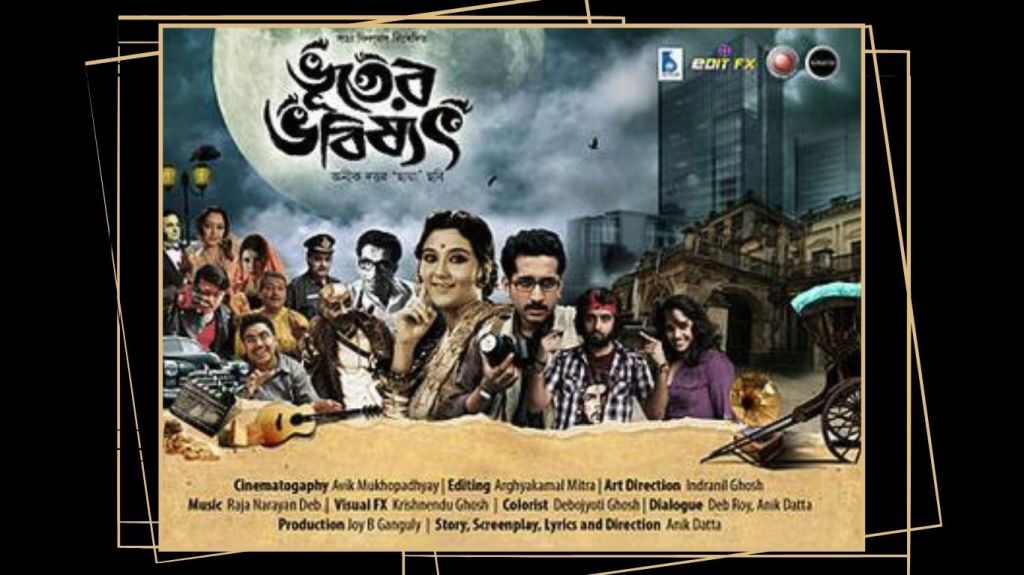
Its brilliance lay in the way it combined farce with social commentary. The ghosts represented different eras and social types, allowing Dutta to create a miniature history of Bengal through humour. The jokes were plentiful, but they were never merely decorative. Beneath the comic surface was a lament for a city losing its texture, its architecture and perhaps even its sense of self.
The film also displayed Dutta’s extraordinary ear for dialogue. Though, paradoxically, the biting satire in the dialogues came as a double-edged sword. The essence was impossible to translate – subtitles would never do justice to its nuances, thus probably ruling out its appeal to a pan-Indian audience. Bengali cinema has always valued language, but Bhooter Bhabishyat revelled in linguistic rhythms. Its exchanges were witty without sounding laboured. Its cultural references were intelligent without becoming exclusionary. The film managed the difficult trick of appealing simultaneously to older audiences steeped in Bengali cultural nostalgia and younger viewers looking for irreverent entertainment.
Much of the film’s cult status comes from this balance. Bhooter Bhabishyat is endlessly quotable because its humour emerges organically from character and situation rather than from manufactured punchlines. Even today, the film retains freshness because its anxieties remain relevant. The fear of homogenization, of heritage being erased in the name of development, has only intensified.
The success of Bhooter Bhabishyat also revealed one of Dutta’s enduring strengths. He understood that satire often works best when it disguises itself as entertainment. Audiences arrived for the comedy and stayed for the commentary. The laughter softened resistance, allowing observations about urban amnesia, cultural insecurity and social pretension to reach viewers who might otherwise have rejected overt polemic. Dutta rarely preached. Instead, he allowed humour to carry the argument.
When Satire Meets Censorship
It was perhaps inevitable that Dutta would revisit this terrain in Bhabishyater Bhoot (2019). The sequel arrived under more turbulent circumstances. The controversy surrounding the film’s release, and the allegations of unofficial suppression, transformed it into something larger than a movie. Suddenly, discussions about censorship, intolerance and political discomfort entered the picture.

The controversy acquired symbolic importance because it seemed to confirm concerns that had long circulated within Bengal’s cultural sphere. A film that had received the necessary clearances found itself at the centre of allegations of unofficial obstruction. The dispute quickly ceased to be only about the merits of a particular film. It became a debate about whether satire and criticism still possessed legitimate space within public culture. Support for Dutta came not only from fellow film-makers and actors but also from audiences who recognized the larger principles involved.
As cinema, Bhabishyater Bhoot lacked the effortless spontaneity of its predecessor. Sequels to cult films often suffer from the burden of expectation, and Dutta’s follow-up occasionally felt more pointed than playful. Yet there was something admirable about its anger. If Bhooter Bhabishyat mourned cultural decay with mischief, Bhabishyater Bhoot carried the sharper edge of disillusionment.
Dutta has always been a political film-maker, though not in the slogan-driven sense. His politics emerge through satire, through observations about bureaucracy, conformity and the shrinking space for dissent. Bhabishyater Bhoot revealed how the director’s comic sensibility could also become a vehicle for frustration. The ghosts in his cinema are not merely supernatural beings; they are witnesses to historical amnesia. What distinguished him from many political film-makers was his refusal to surrender complexity in favour of slogans. Although his sympathies often lay with humanist and progressive traditions, his films displayed scepticism towards institutional power regardless of ideological label. Bureaucratic absurdity, moral compromise and intellectual complacency became recurring targets. The result was a body of work that frequently irritated competing camps while remaining difficult to categorize neatly.
One of Dutta’s most distinctive achievements has been his ability to convert satire into a form of cultural remembrance. His films often function as archives of social anxieties disguised as comedies. Works such as Ashchorjyo Prodeep and Meghnadbodh Rohoshyo examined the moral ambiguities of contemporary Bengali middle-class life, exposing the gap between public virtue and private compromise. Whether addressing the seductive language of development, the ethical fallout of financial scandals or the gradual accommodation of once-radical ideals to everyday pragmatism, Dutta approached these subjects with irony rather than polemic. His worldview was shaped by broadly humanist and progressive concerns, yet he rarely displayed unquestioning loyalty to institutions or party structures. What interested him instead were the ordinary people caught amid larger social transformations and the gradual erosion of the moral unease that once animated Bengali public life.
That tension between nostalgia and irritation runs through much of Dutta’s work.
Beyond Comedy: The Quiet Humanism of Borunbabur Bondhu
Take Borunbabur Bondhu, adapted from Ramapada Chowdhury’s work. The film is quieter than Bhooter Bhabishyat, more introspective and humane. Soumitra Chatterjee’s presence lends it an autumnal grace. Here, Dutta steps away from overt satire and enters the realm of emotional reflection. Borunbabur Bondhu is, among other things, a film about ageing, loneliness and memory. The central friendship becomes a way of examining emotional distance within modern urban life. Dutta resists melodrama; instead, he focuses on small interactions, pauses and emotional undercurrents. The film demonstrates that his strengths are not limited to comic invention. He understands fragility.
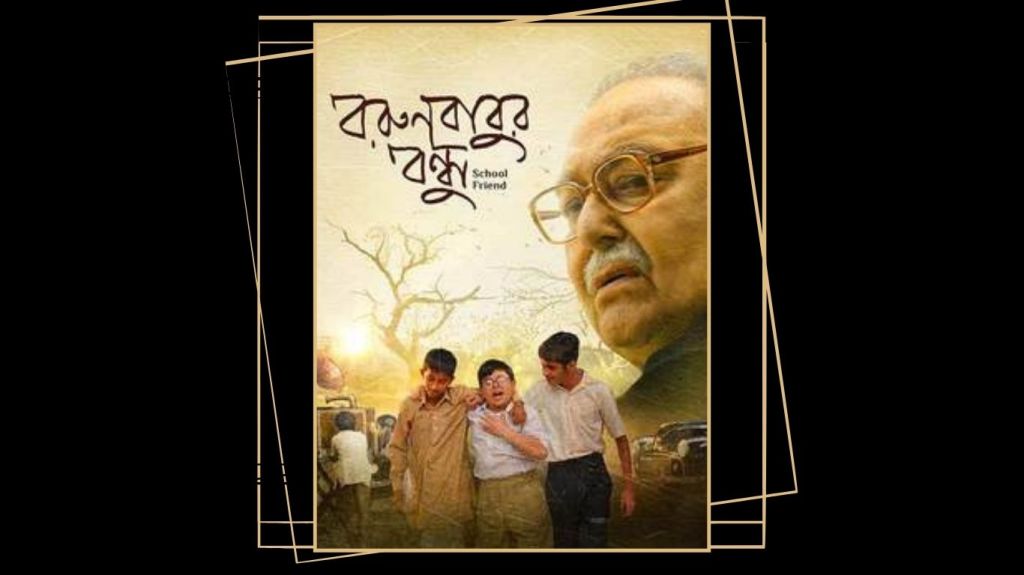
What makes the film especially moving is its recognition of emotional neglect within respectable middle-class existence. Dutta’s cinema often returns to the Bengali bhadralok household, but he rarely romanticizes it. There is affection, certainly, but also awareness of emotional repression, vanity and isolation. Soumitra Chatterjee’s performance elevates Borunbabur Bondhu further. Dutta uses the actor not merely as a performer but as a cultural memory in himself. Watching Soumitra in the film feels like watching an era reflect upon itself.
Wrestling with Ray: The Debate around Aparajito
Then came Aparajito, perhaps Dutta’s most ambitious film. A fictionalized account inspired by Satyajit Ray’s making of Pather Panchali, the film generated immense curiosity. Any attempt to revisit Ray carries enormous risk in Bengal, where admiration for the film-maker often borders on reverence. Dutta approached the material with sincerity and visual care, recreating the atmosphere of the 1950s and the struggles surrounding the making of a masterpiece.
Yet, Aparajito also revealed the dangers of cinematic homage. For some viewers, the film worked as an affectionate tribute to artistic perseverance. For others, albeit in a minority, like me, it felt overly reverential, too conscious of Ray’s mythic stature. The emotional and intellectual complexity of Ray could never be fully contained within homage alone. Part of the difficulty lay in the impossible burden of representation. Ray was not only a film-maker but an institution, a cultural inheritance and an international icon. Any fictionalized retelling risks flattening contradictions in favour of admiration. Dutta’s admiration for Ray is undeniable and deeply felt, but cinema about genius often struggles to capture the mystery of creativity itself.
My take on the film at the time was anything but laudatory. And I was in a hopeless minority as I was heavily trolled by Ray enthusiasts who loved the film. It is the one Anik Dutta film I failed to embrace. His earlier films like Ashchorjyo Prodeep and Meghnadbodh Rohoshyo may have been uneven, flawed, yet there was something about them that broke through the limitations. To me, Aparajito, however, appeared devoid of artistic merit, despite the huge box-office returns. It is possible that my adverse reaction to the film also stemmed from my admiration of the film-maker, and a sense that in the guise of a tribute he too was pandering to that bane of contemporary Bengali cinema: nostalgia.
However, it is also possible to view Aparajito as reflecting some of Dutta’s own concerns. The story of a film-maker struggling against indifference, limited resources and institutional obstacles inevitably carried contemporary echoes. Whether consciously or not, Dutta seemed drawn to a narrative about artistic perseverance in the face of resistance. The film therefore functioned not only as a tribute to Ray but also as a meditation on the conditions under which cinema itself is made. As such, Aparajito deserves attention for the seriousness of its intent. Dutta was attempting to engage with Bengali cinematic history directly rather than merely alluding to it through references. In doing so, he also revealed his own anxieties as a film-maker working within the shadow of giants.
The Burden of Cultural Inheritance
That shadow has haunted Bengali cinema for decades. Directors are expected simultaneously to honour tradition and reinvent it. Dutta’s career can almost be read as an ongoing negotiation with that burden. His films are filled with echoes of older Bengali cultural forms – theatre, literature, adda, old houses, intellectual debates – yet he filters them through contemporary unease.
This is visible again in Joto Kando Kolkatatei. The film embraces detective-fiction nostalgia and comic absurdity while celebrating Kolkata’s eccentric spirit. Dutta clearly delights in genre play, but beneath the entertainment lies his recurring fascination with the city as a character. Kolkata in his films is rarely just a backdrop. It is decaying, argumentative, sentimental, self-important and lovable.
The city’s cultural memory forms the emotional landscape of Dutta’s cinema. He belongs to a generation caught between inherited intellectual traditions and rapidly changing urban realities. His humour often emerges from this collision. Characters cling to old certainties even as the world changes around them. At his best, Dutta captures a specifically Bengali form of comic tragedy: the educated individual who is articulate about civilization but helpless before practical life; the cultured household hiding emotional dysfunction; the nostalgia that becomes both refuge and trap.
The Pitfalls of Irreverence: The Bhabishyater Bhoot Affair
Dutta’s public persona occasionally revealed the same willingness to provoke that characterized his films. His wit was not confined to his films. On occasion, it surfaced in public settings where humour became a vehicle for criticism. One notable instance occurred during the 24th Kolkata International Film Festival in 2018. Speaking at Nandan during the festival, he drew attention to the omnipresent political imagery surrounding an event ostensibly dedicated to cinema. In a remark that quickly became widely discussed, he quipped that cinema perhaps no longer belonged to its makers but to ‘the person whose pictures are splashed all across Nandan and the city’.
The observation was delivered with characteristic humour, yet its implications were unmistakable. Many attendees had noticed the increasingly visible political branding of cultural spaces, but few were prepared to comment on it publicly, particularly from a festival platform itself. The episode demonstrated a quality that repeatedly surfaced in Dutta’s career: an ability to voice uncomfortable observations through irony rather than confrontation.
And he paid a heavy price for it the very next year when Bhabishyater Bhoot opened on 15 February 2019, and in a surreal turn of events, by evening the film was dropped from many theatres and by Saturday had been taken off. I interacted with the film-maker at some length at the time and wrote in Film Companion: ‘It seems something almost straight out of the celebrated opening sentence of Franz Kafka’s The Trial: “Someone must have been spreading lies about Josef K, for without having done anything wrong he was arrested one morning.”’
When I asked him the grounds on which the film has been ‘banned’, Dutta told me, ‘I don’t even know it has been “banned”. There has been no official communication to the effect. Out of the blue we were told that the film was taken off theatres on instructions from higher-ups.’
I further asked him if it could have something to do with his tongue-in-cheek comments alluding to West Bengal Chief Minister Mamata Banerjee at a panel discussion at the 24th Kolkata International Film Festival the previous year. In a panel discussion called ‘Who makes a film: the producer or director’, the film-maker had said, ‘If the venue of the Kolkata film festival is anything to go by, it is the political person whose portraits are plastered all over.’
As the comment generated a furore, the film-maker clarified in his conversation with me, ‘When I walked in through the gates, I saw the Nandan logo designed by Satyajit Ray hemmed in by big flexes with someone’s face, a political leader not related to films. When I went for a panel discussion, I just aired my view in a humorous way. I said if someone comes to Nandan today, he or she might think that there is only one person who makes the films here.’
Since there had been no communication from the chief minister’s office, he told me he could only speculate if his comments at the film festival would have led to his new film being taken off the theatres. ‘I am not aligned for or against any political dispensation, I just voiced what I felt I needed to – at the panel and then in the film,’ he said.
It is a claim on which he cannot be faulted. The film’s most controversial idea made a mockery of Marxist ideology as a former Marxist ideologue, one Mr Das, is seen launching a venture-capital firm called Das Capital. It was much more than a clever gag. It functioned as a sharp epitaph for a political culture that had lost its bearings. With one brilliantly satirical conceit, Anik Dutta distilled years of ideological erosion and compromise. What made it unsettling for those in power was its unmistakable familiarity; audiences recognized the truth embedded in the joke. At the same time, it showed Dutta’s willingness to take on all political hues.
The ‘authorities’ had asked the producers for a special screening of the film before its release, on the ground that its content could be problematic, but the film-makers had refused to do that. The film has been cleared by the Central Board of Film Certification (CBFC) and once that is done, a film does not need any other permission and there is no ground to stop screening it. Dutta told me, ‘This is what makes it all so dangerous. We are undervaluing the system itself. After the film has been cleared by the CBFC, how can anyone take such an arbitrary step? It is a violation of a legal contract and no responses are forthcoming, either from the authorities, the police, the chief minister’s office.’
The Personal Cost of Restlessness
There is also another aspect of Dutta that deserves acknowledgement: his willingness to expose vulnerability beneath public wit. In conversations and public appearances, Dutta has spoken candidly about struggles with anger and depression. Such admissions matter because his public image has often been that of the sharp-tongued satirist, the witty observer capable of dismantling pomposity with humour. But satire frequently emerges from dissatisfaction and emotional intensity. In the last few days, videos of his going ballistic at reporters at a discussion have surfaced. The anger visible in some of his films perhaps reflects not merely political frustration but also deeper personal turbulence.
One senses in Dutta’s cinema an artist perpetually negotiating disappointment: disappointment with cultural decline, with mediocrity, with conformity, with the shrinking of intellectual curiosity. Yet this disappointment also fuelled his creativity. Without that restlessness, his films might have become comfortable exercises in nostalgia. Instead, they retain bite.
That does not mean every film succeeds equally. Dutta can sometimes become overly reliant on references and insider humour. Occasionally, his satire turns self-conscious. Some works feel structurally uneven, as though ideas are competing for attention. But even his failures are recognizably personal. In an era of increasingly anonymous film-making, that individuality matters.
The Ghosts That Refuse to Leave
Anik Dutta’s importance lies not merely in the number of successful films he has made but in the cultural conversation he sustains. He reminds Bengali cinema that humour can still be intelligent, that satire can coexist with affection, that nostalgia need not exclude critique. Most importantly, he understands that memory itself is political.
The ghosts in Bhooter Bhabishyat are memorable not because they frighten us but because they refuse erasure. They insist on occupying space in a city eager to demolish its past. In many ways, Dutta’s entire body of work resembles those ghosts, argumentative, melancholic, funny and stubbornly resistant to forgetting.
Ultimately, Dutta’s career cannot be understood solely through individual films. Taken together, his work forms a sustained engagement with the anxieties of contemporary Bengal: the erosion of memory, the commodification of culture, the fragility of dissent and the uneasy coexistence of nostalgia and modernity. Few film-makers of his generation have returned so persistently to these concerns, or have done so through a blend of affection and exasperation that feels so distinctly Bengali. Few contemporary Bengali film-makers have chronicled the anxieties of the bhadralok imagination with such consistency. Fewer still have managed to make audiences laugh while confronting them with uncomfortable truths.
Anik Dutta remains an imperfect film-maker, but perhaps that is precisely why he remains interesting. His cinema is alive with irritation, affection, nostalgia and contradiction. It argues with itself. It laughs at itself. It mourns even while entertaining. And somewhere within that restless mixture lies the reason his films continue to matter.


Leave a comment