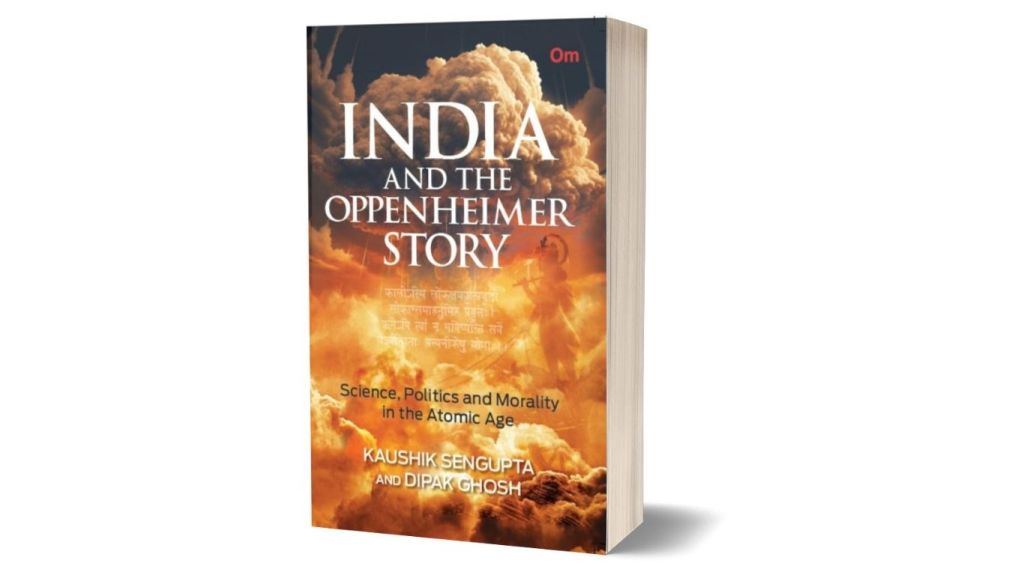
In the recently published India and the Oppenheimer Story (Om Books International), authors Kaushik Sengupta and Dipak Ghosh revisit the atomic age through an Indian lens, examining Oppenheimer’s engagement with the Bhagavad Gita, the politics of nuclear weapons, moral responsibility, and the enduring lessons of the nuclear era. In this conversation with me, Kaushik Sengupta discusses, exploring the intersections of science, ethics, nuclear politics, and Indian philosophy, from the Manhattan Project to India’s own nuclear journey and the dilemmas of the modern technological age.
Shantanu: What drew you to the subject, and if you could provide us with a snapshot of the research that went into the writing, and the actual process of writing this?
Kaushik: As physicists and educators, we have long been fascinated by the Manhattan Project because it sits at the intersection of science, politics, and morality. The development of the atomic bomb was one of the greatest scientific achievements of the twentieth century, but it also raised profound ethical questions that remain relevant today. We were particularly interested in moving beyond simplistic portrayals of Oppenheimer and the Manhattan Project to explore their broader legacy.
The renewed public interest generated by Christopher Nolan’s Oppenheimer convinced us that this was an appropriate moment to revisit the history. We wanted to provide a balanced account that examines not only the science behind the bomb but also its political consequences, moral dilemmas, and continuing relevance in a world that still lives under the shadow of nuclear weapons.
The research involved studying a wide range of sources, including biographies, memoirs, scientific papers, government documents, intelligence records, and modern historical scholarship. We examined not only the Manhattan Project itself but also related subjects such as the German nuclear program, nuclear espionage, the hydrogen bomb, and India’s nuclear journey. We were especially interested in areas where historians continue to debate the evidence, such as Klaus Fuchs’s motivations, Heisenberg’s wartime role, and the relationship between science and political power.
The writing process consisted of bringing these different strands together into a single narrative accessible to general readers. Our goal was not simply to recount historical events but to show how scientific discoveries, political decisions, and ethical questions became intertwined during the atomic age. Throughout, we aimed to balance historical accuracy, scientific clarity, and thoughtful reflection on the lessons that this history continues to hold for the present.
Shantanu: The book frames Oppenheimer’s Bhagavad Gita quotation as more than a dramatic anecdote. What drew you to explore that moment as a serious intellectual and moral connection between India and the atomic age, rather than simply a famous historical quotation?
Kaushik: We were drawn to that moment because it reveals a deeper connection between Indian philosophy and the atomic age. Oppenheimer’s quotation from the Bhagavad Gita was not a dramatic flourish but the expression of ideas he had studied seriously for years. The Gita provided him with a framework for thinking about duty, action, and moral responsibility in the face of immense consequences. By treating the quotation as more than a famous anecdote, the book explores how an ancient Indian text became part of the moral language through which Oppenheimer sought to understand the creation of the atomic bomb. More broadly, it illustrates a central theme of the book: that scientific revolutions are shaped not only by technical achievements but also by the philosophical and ethical traditions through which people interpret them.
Shantanu: One of the book’s strengths is that it treats science, politics, and morality as inseparable. Which historical episode most clearly demonstrates that scientific breakthroughs cannot be understood apart from political power and ethical consequences?
Kaushik: One of the central lessons of the Oppenheimer story is that scientific breakthroughs cannot be separated from their political and ethical consequences. Although the book examines this issue through the development of the atomic bomb, we would point to AI as the contemporary example. AI is a remarkable scientific achievement with enormous potential to benefit humanity, but it is also becoming deeply entangled with questions of power, governance, security, and human values. In that sense, we are living through a moment that bears some resemblance to the early nuclear age.
The history of nuclear weapons teaches us that society often grapples with the implications of transformative technologies only after they have been created. While efforts at nuclear disarmament have been only partially successful, public awareness of the dangers of nuclear war has grown significantly over time. We need a similar conversation about AI today—before its consequences become unmanageable. The challenge is not to halt innovation, but to ensure that technological progress is accompanied by ethical reflection, democratic oversight, and international cooperation. The time to begin that work is now, not after a crisis forces us to act.
Shantanu: You devote significant attention to why Nazi Germany failed to build an atomic bomb. After examining figures such as Heisenberg, von Weizsäcker, and Bothe, what conclusion did you reach: was Germany’s failure primarily scientific, organizational, political, or moral?
Kaushik: Our conclusion is that Germany’s failure was not the result of a single factor but of a combination of scientific, organizational, political, and perhaps moral considerations.
On the scientific side, Werner Heisenberg, the de facto leader of the German nuclear program, never arrived at a correct estimate of the critical mass of uranium-235 required for a bomb. As a result, the project appeared far more difficult and resource-intensive than it actually was. Organizationally, Heisenberg was a brilliant physicist but not an organizer on the scale of J. Robert Oppenheimer. Unlike the Manhattan Project, which united thousands of scientists and engineers around a single urgent objective, the German effort remained fragmented and lacked a sense of urgency.
These scientific and organizational shortcomings had important political consequences. Heisenberg’s calculations probably reinforced the view within the German Army Ordnance Office that an atomic bomb could not be developed within a wartime timeframe, contributing to the decision to deprioritize the project and focus resources elsewhere.
The moral dimension is the most difficult to assess. Historians continue to debate whether Heisenberg merely failed to solve the technical problems before him or whether he consciously avoided pursuing a weapon for Hitler’s regime. The historical record does not permit a definitive answer. What he actually did to advance—or hinder—the German bomb project remains one of the most enduring controversies in the history of twentieth-century science. The book examines this debate in detail and presents the evidence on both sides.
Shantanu: The book revisits the old question of whether Klaus Fuchs was a traitor. Did your research leave you with a more complicated view of espionage in the context of World War II and the early Cold War?
Kaushik: Yes. Our research into the case of Klaus Fuchs revealed just how difficult it can be to draw clear moral boundaries around espionage in periods of extraordinary political and technological upheaval.
There is no doubt that Fuchs committed espionage. By passing critical information about the plutonium bomb to the Soviet Union, he betrayed the trust placed in him by both Britain and the United States and helped accelerate the nuclear arms race. In that sense, he was unquestionably a traitor in the legal and political meaning of the term.
At the same time, Fuchs did not fit the usual image of a spy motivated by money, personal gain, or coercion. He appears to have acted out of a genuine conviction that no single nation should possess a monopoly on such a destructive weapon. He believed that a balance of power would reduce the likelihood of nuclear coercion and ultimately contribute to peace.
Whether one accepts that argument is another matter. But it raises a profound question that remains relevant today: should any superpower have exclusive control over a transformative technology capable of reshaping the world? Our research did not lead me to excuse Fuchs’s actions, but it did leave us with a more nuanced understanding of the motives that can drive espionage and the moral ambiguities that arise when science, national security, and global responsibility collide. These questions, and the competing arguments surrounding Fuchs’s legacy, are explored in much greater detail in the book.
Shantanu: You argue that the hydrogen bomb represented a new stage in the nuclear story. What changed most dramatically after the shift from atomic weapons to thermonuclear weapons: military strategy, international politics, or the ethical burden on scientists?
Kaushik: The transition from atomic bombs to thermonuclear weapons changed military strategy, international politics, and the ethical responsibilities of scientists, but we would argue that the most profound transformation occurred in international politics.
The atomic bombs dropped on Hiroshima and Nagasaki were devastating weapons, yet they were soon eclipsed by thermonuclear devices whose destructive power was measured not in kilotons but in megatons. For the first time in human history, nations possessed the ability not merely to destroy cities but to threaten the survival of entire societies. This reality fundamentally altered the nature of international relations. Concepts such as deterrence, mutually assured destruction, arms control, and nuclear diplomacy became central features of the Cold War.
At the same time, military strategy was transformed. Nuclear weapons were no longer viewed primarily as battlefield tools but as instruments whose principal purpose was to prevent war through the threat of overwhelming retaliation.
The ethical burden on scientists also deepened. Many of the scientists who had supported the atomic bomb as a wartime necessity became deeply troubled by the prospect of weapons thousands of times more powerful. The debates surrounding the hydrogen bomb forced scientists to confront questions not only about what could be built, but also whether certain technologies should be built at all.
The book argues that the hydrogen bomb marked a new stage in the nuclear age because it expanded the consequences of scientific innovation to a planetary scale. After the advent of thermonuclear weapons, the central question was no longer how wars would be fought, but whether humanity could survive them.
Shantanu: The chapter on India’s nuclear program is especially intriguing because it places ahimsa and deterrence side by side. How do you interpret the apparent contradiction between India’s philosophical tradition of non-violence and its decision to become a nuclear-armed state?
Kaushik: At first glance, there appears to be a profound contradiction between India’s tradition of ahimsa and its decision to become a nuclear-armed state. However, the architects of India’s nuclear policy did not generally view these principles as incompatible. They argued that nuclear weapons were not intended for conquest, coercion, or war-fighting, but for deterrence—the prevention of war through the maintenance of a credible defence.
From this perspective, India’s nuclear program was presented as a reluctant response to a difficult strategic environment rather than a rejection of its philosophical heritage. Surrounded by nuclear-armed rivals and facing persistent security challenges, Indian policymakers concluded that unilateral vulnerability was not a viable path to peace.
Whether one accepts that argument is ultimately a matter of judgement. The tension between ahimsa and nuclear deterrence has never been fully resolved, and perhaps it cannot be. Yet that very tension makes the Indian experience so interesting. It illustrates how moral ideals and geopolitical realities often coexist in uneasy balance, forcing nations to navigate between what they aspire to be and what they believe they must do to ensure their survival.
Shantanu: You also highlight overlooked contributors, particularly women in the Manhattan Project. Why was it important for you to restore those stories, and did any individual contribution surprise you during your research?
Kaushik: One of the book’s goals is to broaden our understanding of who actually shaped the atomic age. The history of the Manhattan Project is often told through a small number of famous figures, but it was, in reality, a vast scientific enterprise that depended on the contributions of many people whose stories have received far less attention. Restoring those voices is important not only as a matter of historical fairness but also because it gives us a more accurate picture of how science is done.
During our research, we were struck by the remarkable contributions of women such as Leona Woods Marshall, Chien-Shiung Wu, Maria Goeppert Mayer, and the women ‘computers’ at Los Alamos. Each played an important role in advancing the science that made the Manhattan Project possible. Perhaps the most overlooked figure of all is Lise Meitner. Long before the Manhattan Project began, Meitner was instrumental in explaining the process of nuclear fission itself—the scientific breakthrough on which the entire nuclear age would rest. Although she played a central role, she was not awarded the Nobel Prize for the discovery—an omission many historians of science consider one of the greatest injustices in modern physics history.
The stories of these women remind us that scientific progress is rarely the work of a few celebrated individuals. It is usually the product of many minds working together, some of whom history remembers and many of whom it forgets. One of the book’s aims is to recover some of those forgotten voices and restore them to their rightful place in the story of the atomic age.
Shantanu: The book ends by connecting the nuclear age to today’s technological dilemmas. If Oppenheimer’s generation struggled to create moral frameworks for atomic power, what lessons should today’s scientists and policymakers apply to emerging technologies such as artificial intelligence, genetic engineering, and climate engineering?
Kaushik: We addressed part of this question earlier in our discussion of artificial intelligence. The broader lesson of the atomic age is that scientific breakthroughs do not automatically come with the moral and political frameworks needed to manage them responsibly. Oppenheimer’s generation discovered this only after the atomic bomb had been built.
Today, we face similar challenges with AI, genetic engineering, and climate engineering. Each of these technologies has the potential to benefit humanity enormously, but each also carries risks that could have far-reaching and, in some cases, irreversible consequences if pursued without adequate safeguards.
The lesson is not that innovation should be slowed or feared. Rather, scientific progress must be accompanied by ethical reflection, public debate, and effective governance. Scientists have a responsibility to think carefully about the implications of their work, but policymakers also have a crucial role in creating institutions and regulations that encourage beneficial applications while limiting dangerous ones.
Human ingenuity has repeatedly demonstrated its ability to solve extraordinary problems. The greater challenge is often not scientific capability but the political will to act responsibly before a crisis forces us to do so.
Shantanu: After researching Oppenheimer, the Manhattan Project, Germany’s failed program, and India’s nuclear journey, what changed most in your own understanding of the relationship between scientific genius and moral responsibility?
Kaushik: Perhaps the most important lesson we drew from this research is that scientific genius and moral responsibility cannot be separated. The individuals who shaped the nuclear age were not merely scientists solving technical problems; they were human beings whose discoveries carried profound consequences for society.
At the same time, the book taught us that moral responsibility is rarely borne by scientists alone. Oppenheimer, Heisenberg, Klaus Fuchs, and the architects of India’s nuclear program all operated within larger political and historical forces that shaped their choices. Scientific knowledge may open new possibilities, but governments, institutions, and societies ultimately determine how that knowledge is used.
This realization also raises a difficult question that recurs throughout the book: what gives the moral authority to nations that already possess nuclear weapons to deny nuclear capabilities to others who seek them, at least ostensibly, for peaceful purposes? The issue becomes even more complicated when the existing nuclear powers continue to maintain vast arsenals while urging restraint on others. Such tensions have shaped debates over nuclear proliferation for decades and remain unresolved.
History also suggests that determined nations cannot easily be prevented from acquiring nuclear weapons once they commit themselves to that goal. The United States, the Soviet Union, Britain, France, China, India, Pakistan, and others ultimately succeeded despite formidable technical and political obstacles. In that sense, nuclear proliferation reflects not only a technological challenge but also, at times, a failure of diplomacy and international trust. Lasting solutions are therefore unlikely to come solely from surveillance, sanctions, or coercive measures. More effort must be devoted to diplomatic engagement, confidence-building, arms control, and the creation of international conditions in which nations no longer feel compelled to seek nuclear weapons for their security.
Ideally, no nation should possess nuclear weapons. Yet history has produced a world in which some states retain them while others are asked not to acquire them. Navigating that contradiction is one of the central political and ethical challenges of the nuclear age.
What changed most in our understanding is an appreciation of just how difficult these questions become in practice. History rarely presents clear heroes and villains. Instead, it confronts us with individuals and nations making decisions under conditions of uncertainty, fear, ambition, and geopolitical pressure. The central lesson of the nuclear age is therefore not simply that science requires ethics, but that scientific progress, political power, and moral responsibility are inseparably intertwined.


Leave a Reply