Even legends can falter when time, taste and temperament shift. I explore how iconic film-makers, once masters of the medium, lost their touch – and what their missteps reveal about the fragile art of staying relevant.
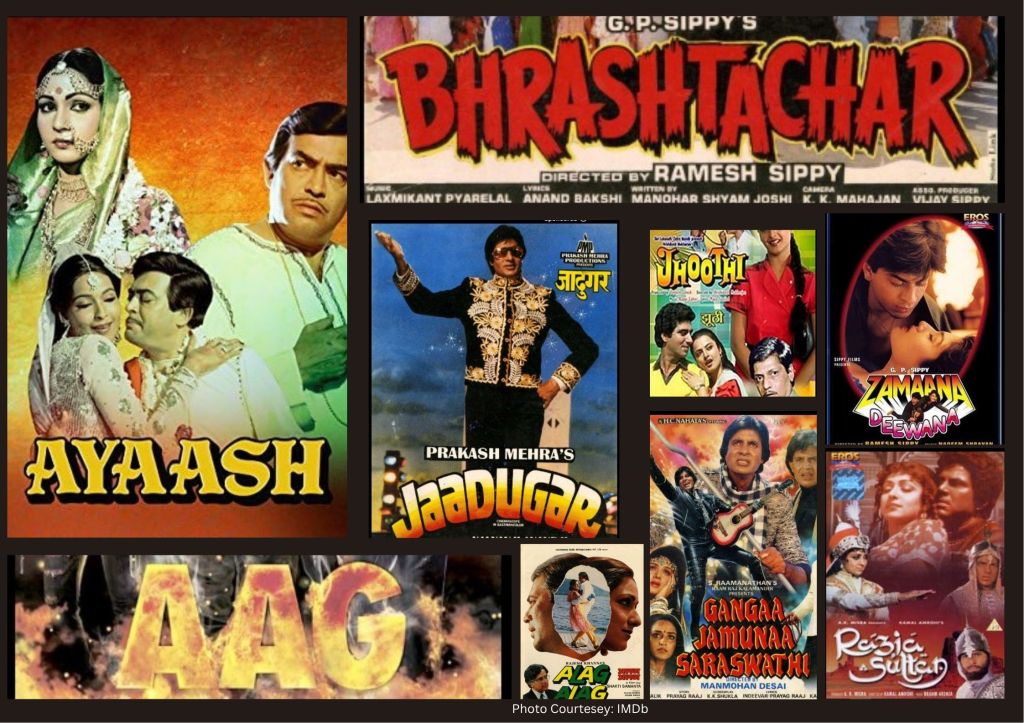
Success in cinema, as in life, is a slippery thing. Few professions are as capricious, as vulnerable to the vagaries of time, taste and temperament, as film-making. Even the most revered names – craftsmen who once seemed to have their finger on the nation’s pulse – have faltered, delivering misfires that leave audiences and critics baffled. What happens when a Kamal Amrohi, after Pakeezah, takes over a decade to come up with a misfire like Razia Sultan? When Ramesh Sippy follows Sholay with Bhrashtachar, or Yash Chopra, the doyen of romance, stumbles with Vijay? Is it an inability to read the changing grammar of cinema? A hubris born of too much success? Or the gnawing insecurity of an artist unsure of his place in a shifting landscape?
Consider Manmohan Desai, once the master of the masala blockbuster, undone by a failing formula in Ganga Jamuna Saraswathi. Or Prakash Mehra, whose magic waned with a single Bachchan collaboration, Jadugar, biting the dust. Basu Chatterjee and Hrishikesh Mukherjee, so attuned to the middle-class ethos of the 1970s, struggled to locate their voice in the louder, glossier 1990s. Shakti Samanta’s later films lacked the verve of his 1960s’ musicals or the emotional heft of his early ’70s melodramas. Nasir Hussain’s final years were a pale shadow of the zany brilliance that marked his films of the 1960s and ’70s, while Ram Gopal Varma, once the poster boy of edgy new Indian cinema, became a self-parody. What accounts for the anatomy of such decline, the elusive alchemy of cinematic relevance, and the perilous journey from genius to mediocrity that haunts even the greatest auteurs?
Kamal Amrohi, Razia Sultan
Kamal Amrohi’s Razia Sultan was a colossal misfire, especially in light of his earlier masterpieces Mahal and Pakeezah. Where those films blended lyrical storytelling with visual poetry, Razia Sultan felt ponderous, archaic and disconnected. Amrohi, known for his ornate dialogue and deliberate pacing, seemed entirely out of sync with a rapidly changing cinematic landscape. The film’s theatrical, almost Shakespearean tone, its stilted Urdu (even now I am unable to understand most of its dialogue), and its slow narrative felt alien to audiences used to the immediacy and emotional accessibility of 1980s cinema. Despite an ambitious scale and striking visuals, the film failed to generate emotional engagement. Casting choices, particularly Dharmendra in blackface as the Abyssinian slave, further alienated viewers.
The tragedy of Razia Sultan lies not just in its failure but in how it exposed a master film-maker’s inability, or unwillingness, to adapt. Amrohi’s uncompromising vision, once his strength, became a liability in a time that demanded reinvention. What makes it doubly sad is that the film’s failure buried its glorious music highlighted by Lata Mangeshkar’s haunting ‘Aye dil-e-naadan’ and two lost gems by Kabban Mirza. No wonder that in the year that heralded Mithun Chakravarty’s ‘Disco Dancer’ avatar, Razia Sultan found no takers.
Shakti Samanta, Ayaash, Awaaz, Alag Alag and Aar Paar
Shakti Samanta owned most of the 1950s and ’60s with musical blockbusters like China Town, Kashmir Ki Kali, An Evening in Paris, before literally making a superstar of Rajesh Khanna with Aradhana, Amar Prem and Kati Patang, His golden era was marked by a deep emotional connect, strong storytelling, melodious music and memorable performances. He started faltering in the mid-’70s with the Rajesh Khanna starrers Mehbooba and Anurodh bombing at the box office. However, these have stood the test of time because of their glorious music. By the time he came to the 1980s, even Amitabh Bachchan could not salvage the fate of The Great Gambler and Barsaat Ki Ek Raat (though its Bengali version Anusandhan, also starring the Big B in the lead was a blockbuster). Again the music was the saving grace of these films.
By the time of Ayaash, Awaaz, Alag Alag and Aar Paar in the mid-1980s, that touch had vanished. These films were narratively weak and stylistically outdated. They failed to resonate with a changing audience that now preferred either the gritty realism of parallel cinema or the masala energy of the new-age entertainers. Samanta seemed trapped in a formula that no longer worked, unable to adapt to evolving tastes. His storytelling lost the freshness it once had, and his musical sense, once impeccable, deserted him. The decline was emblematic of many film-makers of his era – greats who couldn’t read the shift in cinematic language or the mood of the times.
Nasir Hussain, Zamane Ko Dikhana Hai
Nasir Hussain enjoyed an enviable twenty-year run from Tumsa Nahin Dekha in 1957 to Hum Kisise Kum Nahin in 1977, crafting breezy entertainers with memorable music, romantic charm and youthful energy. He was the master of the musical masala masti entertainers. His Yaadon Ki Baaraat was a trendsetter in Hindi cinema.
But the 1980s saw his magic falter, starting with Zamane Ko Dikhana Hai, a glossy yet hollow rehash of earlier successes. The novelty had worn thin – the boy-meets-girl formula and comic subplots felt dated in the face of a changing cinematic landscape dominated by angst, realism and action. Manzil Manzil and Zabardast further revealed a creative fatigue, with recycled plots and uninspired storytelling. Hussain failed to evolve with audience tastes and appeared stuck in a time warp, cling to a template that no longer worked. The once fresh, youthful verve became mechanical, and his knack for storytelling dulled. The decline was as much about the industry’s evolution as it was about his creative stagnation. By the end of the ’80s, he passed on the baton to his son who created box-office history with Qayamat Se Qayamat Tak.
Manmohan Desai, Ganga Jamuna Saraswathi
I still remember the gateman at Savitri cinema asking me why I had spent money to buy tickets for this film. Ganga Jamuna Saraswathi was expected to be a blockbuster given its star cast. Amitabh Bachchan and Mithun Chakraborty were coming together for the first time. However, the film turned out to be a major disappointment both critically and commercially. What went wrong was a mix of outdated storytelling, a lacklustre screenplay and weak direction. Desai’s signature masala style, which worked wonders in the ’70s and early ’80s, felt stale. The plot was convoluted and melodramatic – there is even a sequence where Amitabh Bachchan is giving ‘badan ki garmi’ to save the heroine from freezing to death – failing to connect with a changing audience that was beginning to prefer more grounded narratives. The music by Anu Malik was forgettable, and even Amitabh Bachchan looked weighed down by déjà vu. The failure of Ganga Jamuna Saraswathi signalled that Desai’s formula needed reinvention. He attempted that with Toofan, which his son helmed, but that too failed to resonate, looking like leftovers from another time.
Yash Chopra, Faasle and Vijay
The first indication that Yash Chopra was losing his touch came with Silsila. Despite its casting coup and one of the greatest soundtracks of Hindi cinema, the film tanked, and rightfully so. In an era of Love Story, Ek Duje Ke Liye and Betaab, the romance of Silsila felt like it belonged to another time, not to mention the copout of an ending. Its failure created a crisis of confidence in the film-maker.
This misfire was followed by Faasle, a film so tone-deaf to contemporary sensibilities that it felt stuck in a bygone era. With a hollow script, uninspired performances and antiquated notions of romance and parental authority, Faasle failed to connect with the changing youth audience of the 1980s. Then came Vijay, a misstep of gigantic proportions. Attempting to recreate the magic of Trishul, Vijay ended up a bloated, confused rehash, bogged down by gratuitous violence, sexual titillation, and even a rape sequence that felt jarringly out of place in Chopra’s oeuvre. The film lacked the emotional coherence and narrative focus of its predecessor, instead indulging in melodrama and outdated tropes. Even a strong ensemble cast couldn’t salvage its overwrought execution. Together, these films marked a period of creative drift for Chopra, who seemed temporarily disconnected from the pulse of his audience.
To his credit he bounced back with Chandni towards the end of the 1980s, before hitting yet another bad patch with the failure of Lamhe and Parampara. Though he returned with a bang in Darr, and helped Shah Rukh Khan on his way to superstardom, his successes of the 1990s felt manufactured and lacked the honesty of what he delivered in the 1970s.
Prakash Mehra, Jaadugar
Prakash Mehra, once a titan of 1970s Bollywood and the man behind iconic films like Zanjeer, Muqaddar Ka Sikandar and Laawaris, never recovered from the disastrous Jaadugar. The film, starring his long-time collaborator Amitabh Bachchan, was a critical and commercial failure, marking a jarring contrast to their earlier magic. Audiences rejected its outdated storytelling and theatrical style, signalling that Mehra’s cinematic formula had lost its resonance.
Around the same time, Manmohan Desai’s Toofan, another Bachchan starrer, also flopped, further damaging Bachchan’s already waning box-office pull in the late ’80s. Between these films, the two directors who shaped Bachchan’s stardom in the 1970s almost sounded its death-knell. These failures dealt a double blow, not just to Bachchan’s stardom but to the reputations of directors who had built their careers on his charisma.
Mehra attempted a comeback with Zindagi Ek Juaa in 1992, but it too sank without a trace. He had lost his mojo and the industry had moved on, with new film-makers and stars reshaping Hindi cinema. For Prakash Mehra, once a symbol of blockbuster success, Jaadugar became the turning point that led to a quiet retreat from the limelight, marking the end of an era that had once defined mainstream Bollywood.
Ramesh Sippy, Bhrashtachar and Zamana Deewana
Ramesh Sippy, once celebrated for delivering the iconic Sholay, experienced a baffling career downturn in the decades that followed. After setting a near-impossible benchmark in 1975, Sippy struggled to maintain creative and commercial momentum. Shaan had gone wrong and yet emerged as a cult in later decades. Saagar failed to make the cut despite riding on Kamal Haasan and a glorious score by R.D. Burman. In between he delivered a winner in Shakti, though thematically the film offered nothing new. He pioneered the epic with Buniyaad on television.
However, by the late 1980s he was a pale shadow of his former self. His 1989 film Bhrashtachar was a chaotic blend of political commentary and sensationalism, lacking both narrative coherence and emotional depth. Despite a formidable cast, that had Rekha and Mithun Chakraborty, the film was critically panned and alienated audiences. It also had a gratuitous rape sequence that was in horribly bad taste.
This was followed by Akayla, which, despite the star power of Amitabh Bachchan, failed to make an impact. The film’s dated storytelling and lack of innovation made it feel as if the director had lost interest. Then came Zamana Deewana, a film that tried to ride on the youthful charisma of Shah Rukh Khan (in the same year, the star had Dilwale Dulhaniya Le Jayenge) and Raveena Tandon, but collapsed under its hollow plot and uninspired direction.
Each misfire distanced Sippy further from the zeitgeist of contemporary Hindi cinema. Once at the forefront of cinematic storytelling, he became a relic of the past, a stark reminder of how even legendary film-makers can lose their voice. Sippy’s decline wasn’t just about box-office failures. It marked the slow fade of a visionary unable to reinvent himself for changing times.
Basu Chatterjee, Gudgudee and Countless Others
After pioneering the middle-class film in Rajinigandha, Chhoti Si Baat and Chitchor, Basu Chatterjee sort of lost the plot primarily because he became over-prolific. The occasional bright spots like Khatta Meetha, Swami, Baton Baton Mein, Manzil and Dillagi, could not hide the banalities of most of the films he directed in the late ’70s and early ’80s. It was almost as if he was directing on autopilot mode.
Once hailed as a pioneer of India’s middle cinema, he took a baffling turn with Gudgudee, a film that seemed completely at odds with his earlier sensibilities. Known for his gentle humour, realistic characters and middle-class charm, Chatterjee’s decision to direct a film so steeped in slapstick and borderline vulgarity was disheartening. Gudgudee not only lacked the nuance of his earlier work but also seemed graceless in its depiction of a bumbling small-town married man seduced by a city woman – an idea played for crude laughs rather than character insight.
This wasn’t an isolated misstep either. By the late ’80s and early ’90s, Chatterjee’s output had already begun to show strain. Films like Chakravyuh, Do Ladke Dono Kadke, Lakhon Ki Baat, Sheesha, Manpasand and countless others reflected a gradual decline – competent at best, forgettable at worst. But Gudgudee marked a new low, lacking even the basic coherence or charm his weakest films still managed to retain. It was a stark reminder that even auteurs with once-sharp instincts could lose their way, especially when chasing populist appeal over personal voice. Surprisingly he made a very successful foray into television, directing some of its most iconic shows: Rajani, Darpan, Kakkaji Kahin and Byomkesh Bakshi.
Hrishikesh Mukherjee, Jhoothi and Jhooth Bole Kawwa Kaate
Hrishikesh Mukherjee, once hailed as the master of middle cinema, carved a niche with sensitive, character-driven narratives that balanced art and mainstream appeal. Even films like Satyakam and Alaap, initially underappreciated, later gained critical acclaim and are now considered some of his most profound works, showcasing the depth of Dharmendra and Amitabh Bachchan’s performances. However, by the mid-1980s, Mukherjee seemed to have lost his creative edge. Films like Achha Bura and Namumkin barely made an impact, with the latter not even securing a theatrical release – a far cry from his golden years. Both films deviated from his hallmark style of middle-class morality and gentle humour, exploring darker or more complex themes with Namumkin, a political drama set around Indian immigrants, totally devoid of his usual emotional connect. Critics and viewers alike found these films uneven, lacking the narrative charm that defined Mukherjee’s classics. Their commercial and critical failure marked a downturn in his career, emphasizing the challenge of shifting artistic tone late in a film-maker’s journey.
In Jhoothi, he attempted to recreate the light-hearted charm of Khubsoorat, but the effort felt forced, lacking the wit and emotional resonance of his earlier work. His final directorial venture, Jhooth Bole Kauwa Kaate, was a disappointing swansong, predictable, flat, and stripped of the emotional nuance and layered storytelling that once defined his cinema. It stood in stark contrast to the rich legacy he had built, directing legends from Dilip Kumar to Rajesh Khanna.
Mahesh Bhatt, Misfires Galore
After a rather unremarkable beginning with Vishwasghat and Lahu Ke Do Rang, Mahesh Bhatt announced his arrival with a bang in 1982 with Arth. Over the next decade, he crafted some fine and successful films: Saaransh, Naam, Dil Hai Ke Manta Nahin, Aashiqui, Sadak, Hum Hai Raahi Pyaar Ke (though reports around the time suggested that he was so busy with multiple projects that it was Aamir Khan who actually helmed this one). That is one hell of a roster of box-office success complemented by aesthetic storytelling. Even when his films failed at the box office, like a Kabzaa or a Kaash, there was something visceral that made them watchable. But then the tide turned, possibly because he became over-prolific. There were reports that he was directing four films at a time – over the telephone!
And it showed in the string of films that came a cropper: Najaayaz, Criminal (a laughable remake of the Harrison Ford-Tommy Lee Jones thriller Fugitive), Naaraaz, Dastak and countless others, too many to list. I remember a favourite pastime of the era: whenever a new Mahesh Bhatt film released, friends would gather around to decipher which Hollywood film had undergone a cut-and-paste job. Neither Sridevi and Sanjay Dutt (Gumraah) nor Shah Rukh Khan (Duplicate, Chaahat) could salvage the turkeys he delivered one after the other.
Mahesh Bhatt’s trajectory from arthouse and mainstream darling to assembly-line film-maker is one of Bollywood’s more sobering cautionary tales. After a decade of meaningful cinema that balanced commercial viability with emotional depth, he seemed to lose his grip – on both craft and credibility. The creative spark that once fuelled his best work was eventually smothered by overexposure, overproduction, and what looked increasingly like disinterest. By the time he came out of retirement to direct Sadak 2 – a film so bereft of purpose, coherence or soul – it felt like a grim parody of his own legacy. What was once a voice of introspective realism had become an echo chamber of clichés, marking a tragic decline for a film-maker who once promised, and delivered, so much more.
Ram Gopal Verma, Ram Gopal Verma ki Aag
It will probably always remain in the realms of conjecture: how could a man who directed Satya make Ram Gopal Verma ki Aag, widely regarded as one of the most disastrous films in Indian cinema history, not just for its execution, but for what it represented: the tragic decline of a once-brilliant film-maker. Ram Gopal Verma had reshaped Hindi cinema with Rangeela, Satya and Company, films that brought style, grit and realism into mainstream storytelling. But Aag, a reimagining of the iconic Sholay, was a staggering misfire. It was visually chaotic, narratively hollow, a colossal lapse of taste. Every character, especially Amitabh Bachchan’s villainous Babban – an unforgivable reprise of Amjad Khan’s Gabbar Singh! – felt like a parody, turning reverence into ridicule.
The film wasn’t just a flop; it was a cultural catastrophe, inspiring ridicule rather than reflection. By attempting to ‘reinvent’ Sholay, Verma exposed how far he had drifted from the sharp instincts that once made him formidable. His creative decline had already begun with films like Naach and the unnecessary Shiva remake, but Aag was the point of no return. What followed was a barrage of bizarre ventures that earned him comparisons to Mithun Chakraborty’s B-movie era – not in stardom, but in sheer volume and kitsch. A cautionary tale of ego, misjudgement and cinematic hubris.


Leave a Reply