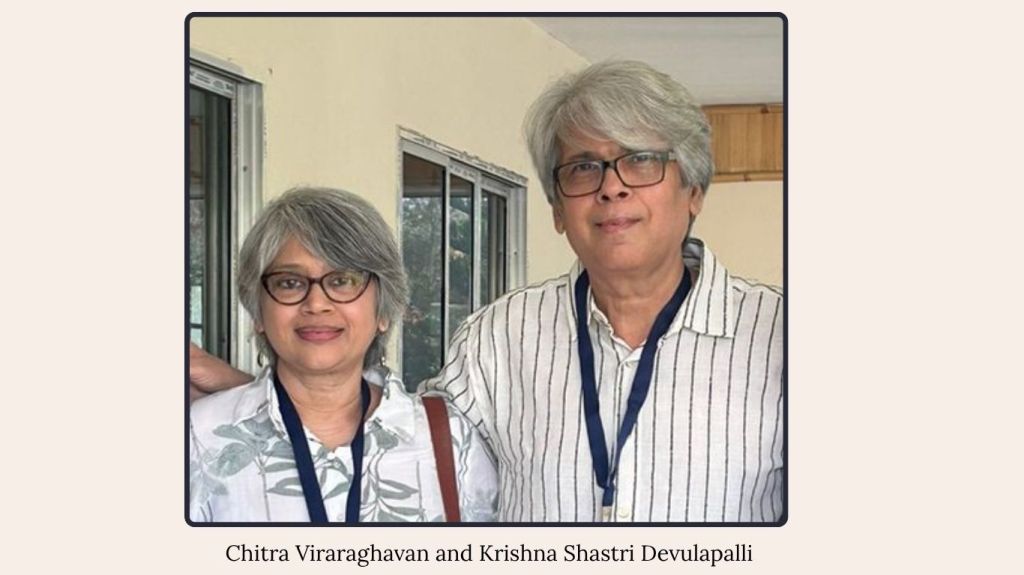
In an increasingly homogenized publishing landscape, where lists often seem driven more by market algorithms than literary conviction, the arrival of an independent press like Running Head (www.runninghead.in) feels both timely and quietly defiant. Founded by writers and long-time collaborators Krishna Shastri Devulapalli and Chitra Viraraghavan, the Chennai-based imprint is built around a simple but deeply felt motto: bringing real writers to real readers, one book at a time. It is a philosophy rooted as much in editorial care as in creative autonomy: a belief that books deserve to be shaped with patience, attention and an almost old-world faith in the writer-editor relationship.
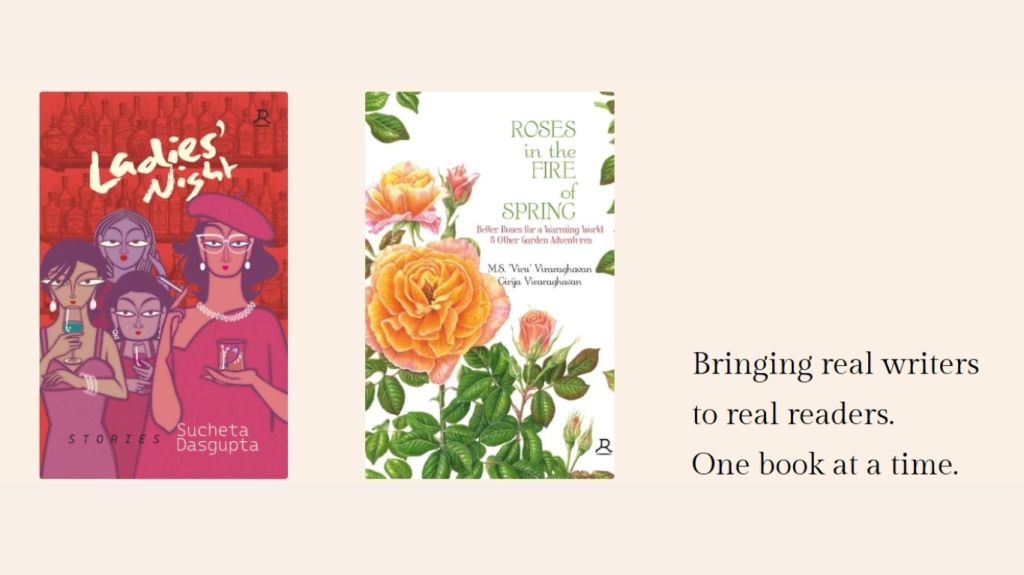
For me, this conversation also carries a personal resonance. Krishna and Chitra are authors whose work I have had the privilege of engaging with over several books during my years as an editor at HarperCollins. What has always stood out about both of them is not merely the distinctiveness of their own writing, but the seriousness with which they approach the idea of books themselves, as experiences and enduring acts of faith between writer and reader. With Running Head, they now bring that sensibility to publishing: intimate, collaborative, fiercely independent and committed to championing voices outside the increasingly standardised rhythms of mainstream trade publishing, as seen with their fascinating new release, Sucheta Dasgupta’s Ladies’ Night.
What prompted the two of you to move from your individual creative practices into building an independent publishing venture?
Krishna: Two reasons, actually. One, the desire to find and nurture deserving writers out there – of whom there are many – and while publishing their work, treat them with the care and passion we sorely missed as writers while being published by some of the biggies. And two, gain control, as writers, of our own intellectual property.
Chitra: Growing up, I envied the famous publisher/editor–writer relationships; how nice it must be to have your work championed by someone, to never worry about getting a book out, only about writing it; seeing how important editors could be in shaping a writer’s work and oeuvre. How peculiarly close these relationships often were, transcending both professional and personal. Writers deserve this.
How do your respective roles, as editors/writers and designer, shape the identity of your publishing house, and where do your visions most strongly converge or diverge?
Krishna: While Chitra and I are vastly different writers, with diverse influences, and write very different kinds of books, working as a team isn’t new to us. Before we both turned novelists, Chitra was an editor, and a writer of children’s textbooks. I was an illustrator/designer/part-time writer. And we teamed up, using our individual skills to produce many, many schoolbooks between the years 2000 and 2014.
I have always found our skills to be complementary. While I see myself essentially as a storyteller, Chitra’s strength lies in her ability to sniff out a good book wherever it may be hiding, in her meticulousness. And she possesses that unique skill – now endangered, as we can all see – of being a devoted, prolific, undeflectable reader of all kinds of books. We are yet to see major conflict as a team. Hoping that will continue.
Chitra: Yes, people have found it odd, us working together. But we have done it for long, and have done it quite well, I think. Strangely, something other than our individual strengths and skills come to play: how we see life and people, what we think is important in terms of the values we would like to represent and champion. The human angle is very important to us not just in work but in an everyday sense.
In a crowded publishing landscape, what gap or need are you hoping your imprint will address?
Krishna: I think the biggies, as they are referred to, have become indistinguishable. Can you honestly tell the difference between a book brought out by one big publishing house from another? I can’t. They do publish good books, but the bad ones they publish are many, and unforgivably bad. Our hope as an indie house is to publish only good books. Not saleable ones, not ones by people who know us, not as a favour, not as buybacks, not out of any kind of pressure. I’m hoping that’s what our imprint will be known for – as one that brings real writers to real readers, one book at a time. That’s our tagline, by the way.
Chitra: There’s no pressure on us in regarding trends and targets. We choose, we publish. It takes the time it does. And lest anyone think we have oodles of cash to burn, no. But what’s a life, what’s a challenge, if you don’t put your money where your mouth is? It’s an experiment that’s worth it for us, as writers, as publishers. If the situation is unsatisfying, mustn’t one try to alter it, if only infinitesimally, even if only for our own sake? Let’s see.
Could you walk us through your collaborative process, from manuscript acquisition to the final designed book?
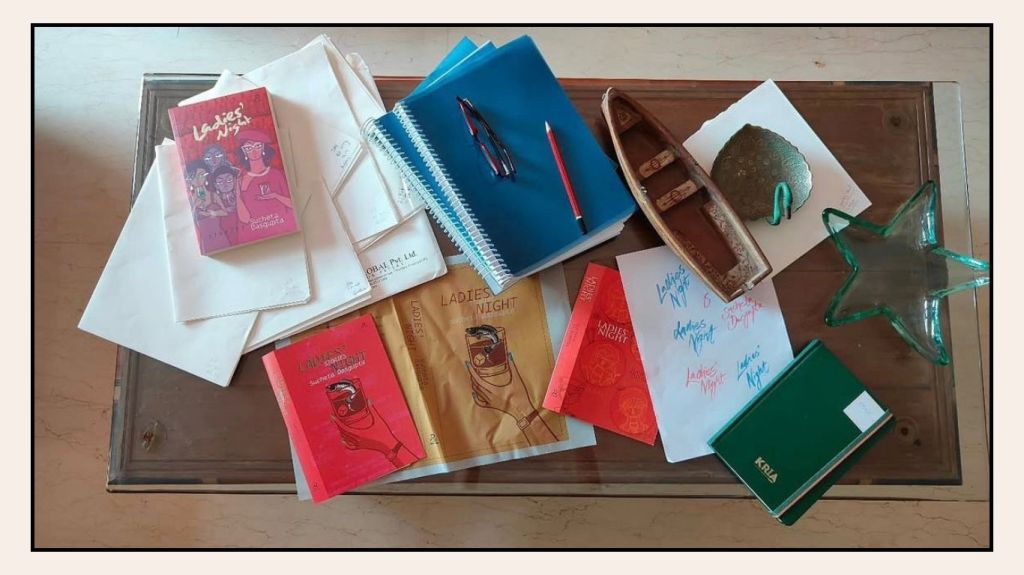
Krishna: It’s a pretty organic thing, Shantanu. Book have come to us in different ways and I’ve seen them evolving in different ways. For instance, Sucheta Dasgupta’s book came to me. I read her stories, loved them and asked Chitra to look at them. Luckily for me, she loved them, too. And, voilà (by which I mean eighteen months or so of hard work), the book got done. Darpan Singh’s forthcoming book came to Chitra and she thought it was very promising. I loved it, too. Hopefully, we’ll have that out soon, too. Design, too, is a seamless collaborative process for us. I kind of take care of the covers, Chitra designs the insides. Chitra does the main editing, I add my two bits. It’s been working thus far.
Chitra: Krishna always underplays his contribution. See the magnificent cover of Ladies’ Night (among all the other covers he’s done). That’s his. And, as for the production, other than the typesetting, which I oversee in terms of design, it’s all what he does. He’s got a very thorough knowledge of printing practices, gained over many, many years. Without his costing, we would be nowhere. The things we both love to do with regard to this department is hunt for the right paper for the right book, for the cover, debate the various aspects and angles of it. It’s collaborative all the way. Sometimes it’s difficult to separate the roles.
What kind of voices, genres, or forms are you most excited to champion through this platform? Will your press address the genres mainstream publishing normally does not – poetry, lit-fic?
Krishna: We are open. We want good stories, well told. I know that sounds pretty basic, but fiction or non-fiction, we are looking for stories that need to be told today. Short stories, we hear, don’t sell. Didn’t stop us from making a book of short stories our first publication. For now, no poetry, I’d think. As for genres, the blurb on Sucheta’s book says ‘genre-confounding’. So genres, in their narrow sense, don’t matter to us.
Chitra: In the future, some children’s books. I would love to publish some poetry…
How do you balance creative ambition with the practical challenges of running an independent press – distribution, marketing, and financial sustainability? Publishers have been posting about rising paper prices making the process even more difficult to sustain. How do you intend to address these challenges?
Krishna: Call us naïve, but we didn’t pay too much attention to that. I think, idealistic though it may sound, the starting point of producing art shouldn’t be marketing. Similarly, too, being in the ‘business’ of supporting art and artists, ironic though it may sound, which is how we see ourselves. This venture is fully self-funded. And as the quote from the movie Field of Dreams says: If you build it, (he/they) will come. Seriously, though, we are finding our way. And we have actually sold an encouraging number of books thanks to the collective credibility of Chitra and myself, as well as Sucheta herself.
Chitra: We’re learning; the funds aren’t endless. We need to be smart in deploying our resources.
Has working as a couple influenced your decision-making or risk-taking in this venture in ways that might differ from a conventional business partnership?
Krishna: It surely has. As partners in real life, we have had the same attitude towards money. That it should be spent on the things that matter. So, as business partners, the one issue that most partners finally war about, money and shares, we won’t. And what other ‘risks’ could there be in a business?
Chitra: It’s not that we haven’t had money worries, being freelancers through our entire career of nearly forty years each (I only had one formal job, for five years, with OUP), and all types of family commitments. But, as people in publishing, I always think two-colour is more fun and challenging than four-colour – it requires more creativity when you have to think things through, when everything isn’t handed to you on a platter, when things are limited; surely those are the risks worth taking and thinking about.
What role does design play in your editorial philosophy: do you see the book as an object, an experience, or both?
Krishna: I think a book has to be seen as an experience. Everything from the font one chooses to which colour dominates the cover design, they either make or mar the experience the writer hopes you will have while reading her book. So, an experience is what it ought to be first and last.
Chitra: Absolutely. In fact, everything, from cover (the portal, so to speak), the editing to the inner book design, should be so seamless that the reader barely knows it exists…
What have been the most unexpected challenges (or rewards) since launching your indie publishing house?
Krishna: Finding the right paper! Dammit, it was the hardest thing to find the kind of paper we wanted (high-bulk, low weight). After running around madly to get it in the small quantity we needed, we serendipitously found it at Sudarshan Graphics. Rewards? The happiness on Sucheta Dasgupta’s face when she saw her book for the first time. We knew we hadn’t let her down.
Chitra: Tramping about on Anderson Street, petitioning various local paper merchants, almost not making it to release time, and then it all came together. It’s going to continue to be paper, I think. And logistics. Figuring out the logistics, how to streamline things, that’s been a challenge. There are also ever-rising production costs.
How do you envision the evolution of your press over the next few years, both creatively and in terms of scale? How many books do you intend to publish in a year and how do you seek to make it a financially viable endeavour?
Krishna: We are taking it one day at a time, one book at a time, Shantanu. A couple of years from now, we’d be genuinely happy if our writers felt we did the best by them. And if we got even one reader for each book get back to us and say, ‘This was the book I was looking for.’ We intend to publish hopefully ten to fifteen books by the end of 2027. And, with our super-slim team of two, a pretty spartan pair willing to work hard without salaries, nor go off on fancy holidays to exotic locations at company’s expense, we should be able to sustain Running Head till then.
Chitra: Oh, yes, fingers crossed.
 Shantanu Ray Chaudhuri
Leave a comment