Satyajit Ray’s supernatural fiction transcends age and genre, crafting an enduring form of horror rooted in suggestion, psychological depth and moral unease. His stories reveal how the unseen and the half-understood can be far more unsettling than explicit fear.
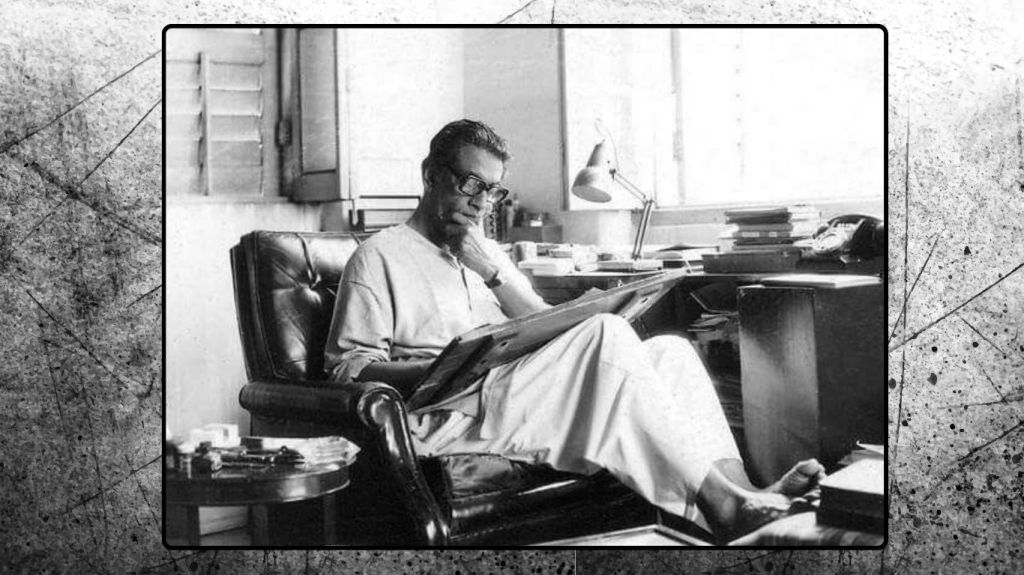
Satyajit Ray is often described as a writer for children and adolescents, but such a description only partially explains his literary achievement. Like many of the greatest authors who have written for younger audiences, Ray never condescended to them. He regarded young readers as possessing an imagination more agile and expansive than that of adults, and therefore more receptive to the strange, the eerie and the inexplicable. This conviction shaped his supernatural fiction in profound ways. His ghost stories and tales of horror are not simplified entertainments; they are layered narratives that engage both the curiosity of the young and the reflective sensibilities of older readers. The result is a body of work that transcends age categories, drawing its strength from psychological depth and narrative precision.
A defining characteristic of Ray’s horror writing is his rejection of explicit violence. While many writers rely on graphic detail to provoke fear, he chose a subtler path. His stories are almost entirely devoid of gore, yet they are often deeply unsettling. The fear they evoke arises not from what is shown, but from what is suggested. Ray understood that the imagination can amplify terror far more effectively than direct description. By allowing readers to infer rather than witness, he created a form of horror that lingers in the mind. Even in his most disturbing stories, the emphasis remains on atmosphere and psychological tension rather than sensory shock.
Although Ray’s engagement with horror in cinema was limited – his adaptation of Tagore’s Monihara being the most notable instance – his literary contributions to the genre are extensive and varied. He wrote close to thirty stories that can be classified as supernatural fiction, and within this body of work he explored a wide range of themes. From metamorphosis and doubles to haunted houses, cursed objects, and spectral visitations, his stories demonstrate both versatility and imaginative daring. What makes this even more remarkable is that he introduced such themes within the framework of literature intended largely for younger readers, without diluting their complexity.
One of the recurring motifs in Ray’s supernatural fiction is transformation. In ‘Khagam’, perhaps his most celebrated horror story, a man who kills a cobra finds himself undergoing a terrifying metamorphosis into a snake. The narrative unfolds over a single night, its tension sustained by the gradual inevitability of the change. The horror is not merely physical; it carries a moral resonance, suggesting a form of retribution that is both intimate and inescapable. A related but distinct exploration of transformation appears in ‘Neel Atanka’, where a traveller forced to spend the night in an abandoned bungalow begins to assume the identity of a long-dead indigo planter. Here, the erosion of identity is as frightening as any physical alteration, and the story is suffused with a sense of historical tragedy.
Ray revisited the idea of transformation in ‘Mriganka Babur Ghotona’, though with a different tonal register. In this story, a mild-mannered clerk develops an increasing identification with primates, suggesting a reversal of evolutionary progress. While the narrative contains elements of humour, it is undercut by a persistent unease. The protagonist’s gradual loss of human identity raises unsettling questions about the nature of evolution and the stability of the self.
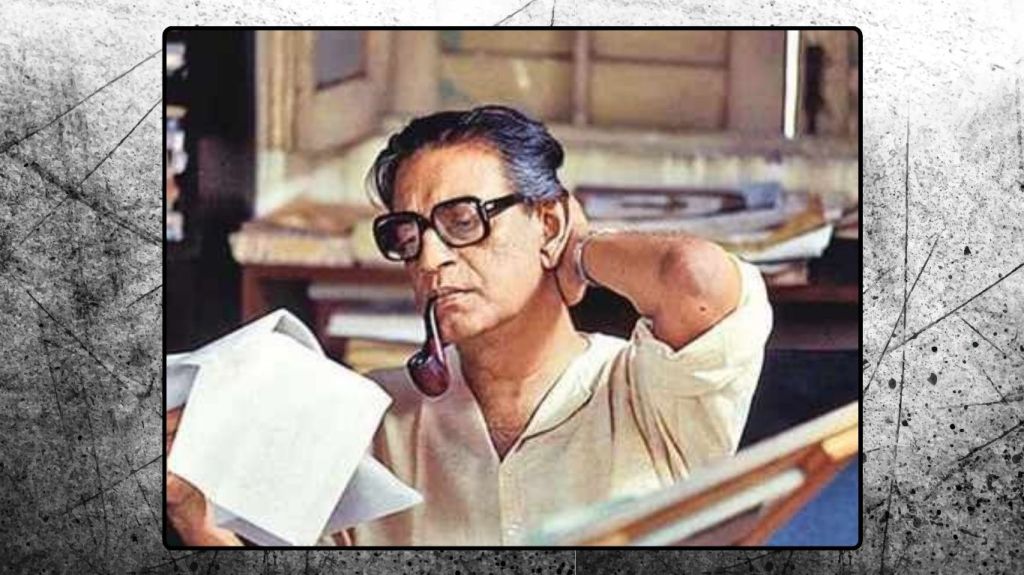
Equally significant is Ray’s engagement with psychological horror, particularly in his use of the doppelgänger motif. ‘Ratan Babu Aar Shei Lokta’ presents a lonely man who encounters another individual identical to him in every respect. What begins as an intriguing coincidence soon becomes a source of deep anxiety. The existence of the double threatens the protagonist’s sense of individuality, leading to a climax that is both shocking and revealing. The story moves beyond conventional supernatural elements into a realm where fear arises from the disintegration of identity.
Another striking example of psychological horror is ‘Mister Shasmal-er Shesh Ratri’. In this narrative, a man spending the night in isolation is confronted by the apparitions of animals he has killed over the course of his life. The story operates on an ambiguous plane: the events can be interpreted either as supernatural visitations or as manifestations of guilt. This ambiguity enhances the story’s power, as it forces the reader to confront the possibility that the most terrifying experiences may originate within the human mind. A similar sense of impending doom characterizes ‘Bishphool’, in which a man discovers that a deadly plant has appeared just outside his window. The simplicity of the premise only heightens its impact, transforming an ordinary situation into one of inescapable fear.
Ray also demonstrated a fascination with objects that carry traces of the past. In ‘Batikbabu’, an eccentric collector gathers seemingly insignificant items, each associated with a violent or tragic history. His ability to perceive the past embedded within these objects turns them into sources of unease. The horror here is not derived from supernatural episodes alone, but from the emotional weight of memory and the persistence of past violence. This theme recurs in ‘Fritz’, where a doll buried in childhood returns in a disturbingly lifelike form, blurring the boundary between memory and reality.
The animation of inanimate objects is further explored in stories such as ‘Bhuto’ and ‘Kutum Katam’. In the former, a ventriloquist’s dummy acquires an unsettling autonomy, while in the latter, a piece of wood shaped like a dog reveals a sinister secret as it appears to come alive. These stories exemplify Ray’s ability to transform the ordinary into the uncanny, drawing on familiar objects to evoke unfamiliar fears.
The haunted house, a staple of the genre, receives a distinctive treatment in Ray’s work. Stories like ‘Anath Babur Bhoy’, ‘Conway Castle-er Pretatma’, ‘Brown Shaheber Baari’, and ‘Dhumalgorer Hunting Lodge’ demonstrate his skill in creating atmosphere and suspense. In each case, the setting is not merely a backdrop but an active presence, shaping the narrative and influencing the characters. The stories often culminate in unexpected twists, reflecting Ray’s mastery of narrative structure.
Many of these elements also appear in the Tarini Khuro stories, where a seasoned raconteur recounts experiences that blend adventure with the supernatural. Through these tales, Ray explores themes of betrayal, revenge and the persistence of the past. Objects come to life, old conflicts resurface, and the boundary between the living and the dead becomes porous. Despite their often playful tone, these stories retain an undercurrent of unease.
Ray’s range extends across various subgenres of horror. ‘Badur Bibhishika’ introduces vampiric elements, ‘Septopus-er Khide’ explores the idea of a carnivorous plant, ‘Brihochonchu’ deals with an extinct bird, and ‘Gagan Chaudhurir Studio’ presents a ghostly presence in an artistic setting. This diversity underscores Ray’s willingness to experiment with different forms of the supernatural, adapting them to his own narrative style.
Underlying this body of work is a philosophical openness to the unknown. Ray maintained a firm belief in science, yet he did not dismiss the possibility of phenomena that lay beyond immediate explanation. This attitude is clearly reflected in his conversations with his biographer Andrew Robinson during the 1980s. When asked about his beliefs, Ray remarked that while not everything could be explained by science at present, much of what seemed mysterious would eventually come within its scope. At the same time, he acknowledged that the process of creative inspiration itself resisted scientific explanation. He even suggested that a certain strain of mysticism might run in his family, noting that an ancestor had been associated with Tantric practices. These remarks reveal a mind that was simultaneously rational and receptive to the possibility of the unknown.
This openness to the supernatural was not merely theoretical; it was informed by experiences and stories that Ray encountered in his own life. During his work on the documentary on Rabindranath Tagore, he came across records of séances conducted at Santiniketan. One such record described an exchange between Tagore and Ray’s father, Sukumar Ray, who had passed away years earlier. In this documented conversation, Tagore asked whether his paintings would be appreciated, to which Sukumar’s spirit reportedly replied that recognition would come first from abroad. Ray did not explicitly endorse the authenticity of such accounts, but he found it noteworthy that Tagore’s paintings did indeed receive early acclaim in Paris. This anecdote reflects the delicate balance in Ray’s thinking: a willingness to consider the possibility of the paranormal without abandoning a rational framework.
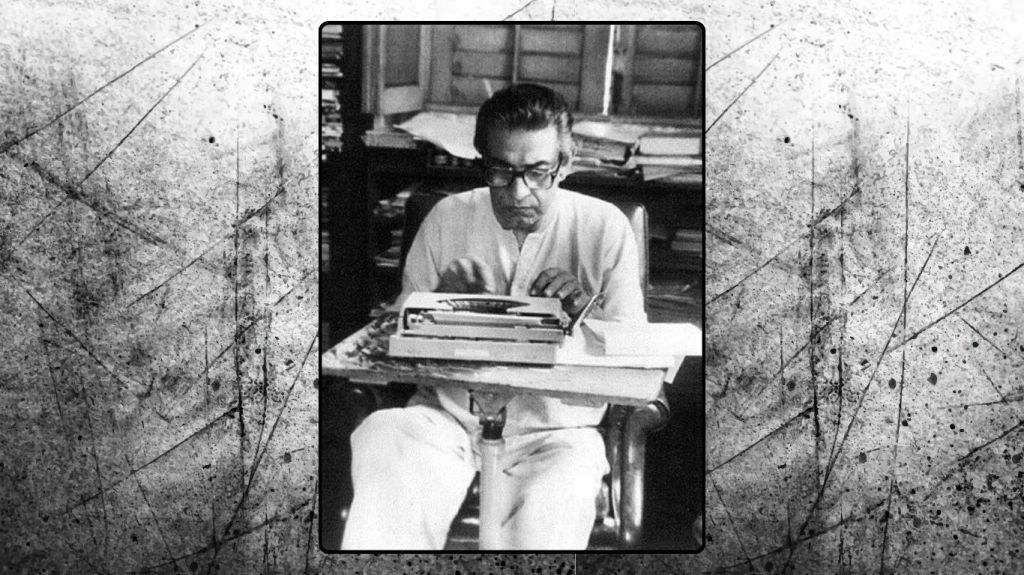
This balance is also evident in his fictional characters. In the Feluda stories ‘Gangtok-e Gondogol’ and ‘Bhuswargo Bhayankar’, séances and spiritualism are treated with cautious curiosity. Feluda himself expresses an openness to the idea of communicating with the dead, while acknowledging the prevalence of fraud in such practices. Similarly, in the world of Professor Shonku, there is a recurring suggestion that phenomena such as telepathy and clairvoyance may one day be explained scientifically. These perspectives mirror Ray’s own, positioning the supernatural not as a rejection of reason but as a frontier for future understanding.
Ultimately, Satyajit Ray’s supernatural fiction stands out for its ability to evoke fear without excess. Through his stories, he demonstrated that horror need not rely on spectacle to be effective. His emphasis on atmosphere, suggestion and psychological complexity resulted in narratives that continue to resonate across generations. By situating his stories at the intersection of rational inquiry and imaginative possibility, he created a distinctive body of work that remains one of the most significant contributions to modern Indian horror literature.
 Shantanu Ray Chaudhuri
Leave a comment