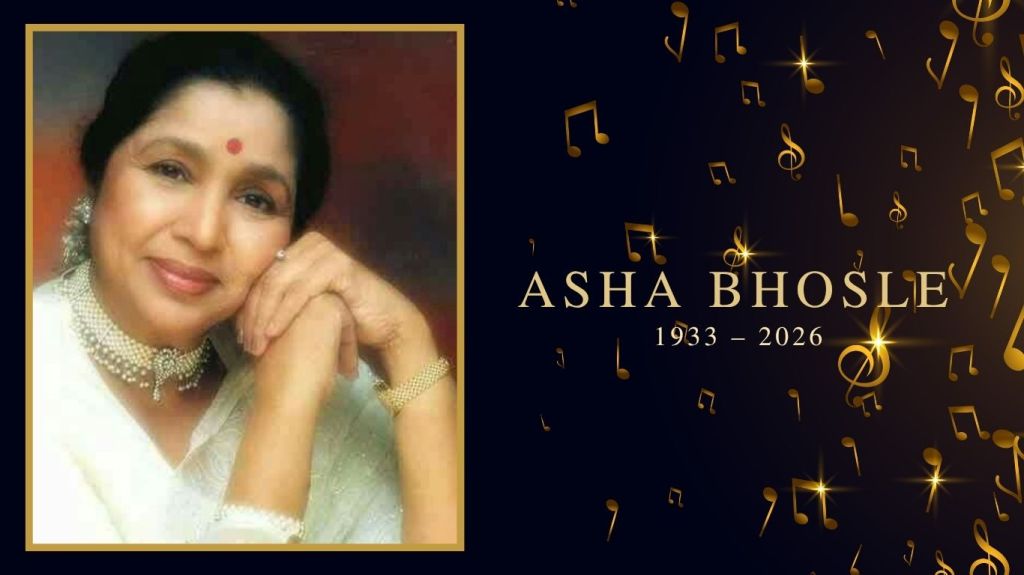
Spanning over seven decades, Asha Bhosle’s voice moved effortlessly across genres, moods and eras, redefining playback singing with its versatility, emotional nuance and restless reinvention, leaving behind a legacy that continues to shape the soundscape of Indian music.
Dil Padosi Hai. It is difficult to say how many odes to Asha Bhosle will pause to acknowledge this remarkable non-film album from 1987, but for me, it remains the work that sealed my conviction of her singularity. By then, of course, I was familiar with the well-circulated highlights of her film career, the canonical songs that populate every ‘greatest hits’ list. But Dil Padosi Hai revealed something deeper, more expansive. Across its fourteen tracks, penned by Gulzar and composed by R.D. Burman, she seemed to stretch effortlessly across moods and idioms: from the dew-fresh, classically inflected serenity of ‘Bheeni bheeni bhor’, which opens the album, to the teasing, sensuous playfulness of ‘Raat Christmas ki thi’, which brings it to a close. In between, her voice appears to traverse an entire spectrum of feeling, as though charting the passage of a day from first light to nightfall. It is in albums like this, away from the demands of cinema, that one encounters Asha Bhosle not just as a voice of songs, but as an artist of boundless imagination: restless, refined and entirely inimitable.
Obituaries of towering cultural figures tend to lean on a familiar vocabulary: ‘the end of an era’, ‘an irreplaceable loss’, ‘the closing of a chapter’, ‘a void that can never be filled’. These phrases, worn smooth by repetition, often feel inadequate, even lazy, when faced with a life as expansive as Asha Bhosle’s. And yet, perhaps this is precisely when clichés return to serve a purpose. When language falters before the scale of a legacy, when the weight of memory exceeds the reach of fresh expression, these well-worn words step in, not as shortcuts, but as collective gestures of recognition. In mourning someone like Asha Bhosle, we fall back on them not out of habit, but because they hold, however imperfectly, the enormity of what has been lost.
Asha Bhosle leaves behind a musical legacy so vast and varied that it resists easy summation. She was not merely one of the defining voices of Indian cinema; she was an artist who continuously reshaped what that voice could be. Across more than seven decades, she sang not just songs, but moods, eras and transformations, moving with ease from the studio systems of the 1950s to the fragmented, globalized soundscape that followed, from Madhubala to Urmila Matondkar, her voice remaining curiously ageless even as the world around it changed. She seemed equally at home in the intimate interiority of a ghazal, the theatrical flourish of a cabaret number, or the sleek textures of late-twentieth-century pop, as though each new idiom were simply another dialect she had always known.
Her story also unfolds alongside that of a country negotiating its own contradictions. In the years after Independence, cultural life bore the imprint of a society pulled between inheritance and aspiration, its sensibilities still in flux. Popular music became one of the more revealing sites of this negotiation. The female playback voice, in particular, carried within it unspoken codes of acceptability and desire – what was sanctioned, what was suppressed, and what quietly persisted beneath the surface. In the crowded soundscape of the 1940s and early 1950s, with singers like Rajkumari, Suraiya, Shamshad Begum and Geeta Dutt vying for prominence, a certain tonal ideal eventually prevailed: one that suggested chasteness, restraint and moral clarity. That ideal found its most definitive expression in Lata Mangeshkar, whose voice came to stand in for a newly consolidated notion of the cinematic heroine.
To arrive in that shadow and yet refuse to be contained by it required not just resilience but imagination of a different order. Drawing from an eclectic listening habit that reached well beyond the subcontinent, she absorbed and reworked influences that ranged from Latin exuberance to Western pop phrasing, gradually shaping a mode of singing that diverged sharply from the dominant template. Over time, what emerged was less an alternative than a counterpoint. Where one voice came to embody decorum and devotional poise, the other suggested something more volatile, yearning, play, even transgression. If one aligned with the visible ideals of its moment, the other seemed to anticipate shifts that had not yet fully arrived.
Born in 1933 in Sangli, Maharashtra, into the illustrious Mangeshkar family, Asha grew up in an environment steeped in music. While her elder sister Lata Mangeshkar quickly rose to become the pre-eminent playback singer of her time, Asha carved her own path, often navigating the industry’s margins before stepping into its centre. Her early years in the film industry were marked by struggle. She was frequently assigned songs that others declined – cabaret numbers, dance tracks, or compositions for secondary characters. But what might have been a limitation became, in time, her greatest strength. Asha embraced every opportunity, bringing sincerity and craft to each performance, investing even the most ostensibly ‘minor’ song with personality and precision. Songs like ‘Ab ke baras’ from Bandini and ‘Raat akeli hai’ from Jewel Thief offer more than enough evidence of the depth, nuance and vivacity she could bring to a composition even when these were not shot on the ‘heroine’.
Her breakthrough came in the 1950s, particularly through her collaboration with composer O.P. Nayyar. Together, they created a distinctive sound that broke away from the prevailing norms of playback singing. Songs like ‘Aaiye meherbaan’ (Howrah Bridge) and ‘Yeh hai reshmi zulfon’ (Mere Sanam) carried a modern, rhythmic vitality that set them apart. Asha’s voice introduced a new sensibility to Hindi film music, one that allowed for flirtation, mischief and urban sophistication, expanding the emotional and social space a female playback voice could occupy. It is a tribute to the genius of both the composer and the singer that a partnership, better known for its lively, peppy rhythms, could also produce something as plangent and suffused with pathos as ‘ Chain se humko _kabhi ‘. Sadly, and perhaps fittingly, it became the swan song of their collaboration.
The mid-1960s offer a particularly vivid snapshot of this expanding range: a philosophical, almost suspended quality in ‘Aagey bhi jaane na tu’ (Waqt), the kinetic daring demanded by Teesri Manzil, and, in the same year, the earthy lilt of ‘Pan khaye saiyan hamaaro’ in Teesri Kasam. Three distinct musical worlds, each inhabited with complete assurance.
If Nayyar helped establish her identity, it was her partnership with R.D. Burman that expanded it exponentially. Their creative synergy produced some of the most memorable songs in Indian cinema. From the infectious energy of ‘Aaja aaja’ (Teesri Manzil) to the haunting introspection of ‘Phir se aaiyo’ (Namkeen) and ‘Mera kuch saamaan’ (Ijaazat), Asha demonstrated a remarkable ability to inhabit vastly different emotional landscapes. With Burman, especially, one senses not just collaboration but a kind of shared curiosity, an eagerness to test how far a song could be stretched without losing its emotional core. Her voice could be sensuous, rebellious, tender, or melancholic, often within the span of a single album. Sample ‘Katra katra’ and ‘Chhoti si kahani se’ from Ijaazat. Or the two unheralded gems in Ratnadeep, ‘Aisa ho toh’ and ‘Mann bahak raha hai’.
Asha Bhosle did not just adapt to genres; she redefined them. She brought a distinctive flair to cabaret songs, lent depth to ghazals, embraced pop and Indi-pop with equal ease, and even ventured into international collaborations. Whether it was the exuberance of ‘Dum maro dum’ (Hare Rama Hare Krishna), the teasing cadence of ‘Piya tu’ (Caravan), or the classical gravitas of her work in films like Umrao Jaan, she pushed the boundaries of playback singing, evolving organically, staying relevant across changing musical landscapes, from the era of black-and-white cinema to the age of digital streaming. What stands out, in retrospect, is not just the range of genres she traversed, but the absence of any visible strain in that traversal; reinvention, for her, never appeared strategic, only instinctive. Even in spaces that mainstream respectability once kept at arm’s length – the nightclub, the cabaret, the countercultural drift of the 1970s – her voice did not merely fit in; it defined their sonic identity.
Her presence extended beyond film music into albums, stage performances and global collaborations, including ventures into pop and fusion that introduced her to new audiences. Long before the current ease with which artists move between formats, she had already begun to treat the non-film album as a space for exploration rather than diversion. At the height of the ghazal boom in the 1980s, she collaborated with Ghulam Ali in Meraj-e-Ghazal. This was followed by Dil Padosi Hai in 1987. This instinct resurfaced memorably in the late 1990s with Jaanam Samjha Karo, a non-film album composed by Leslie Lewis. Its standout track, the light, lilting ‘Raat shabnami’, became an immediate favourite, connecting her with a younger generation.
She continued to seek out unexpected partnerships, whether in the easy rapport she shared with Adnan Sami on ‘Kabhi to nazar milao’, or in more curious crossovers that placed her alongside unlikely collaborators, including Australian cricketer Brett Lee on ‘You are the one for me’ and the Kronos Quartet collaboration, You’ve Stolen My Heart: Songs from R D Burman’s Bollywood, which carried her voice into a different, international listening space without diluting its essential character. At the same time, there were projects that revealed a more contemplative engagement with music: her recordings with Ustad Ali Akbar Khan, later released as Legacy, an album that highlighted Bhosle’s classical prowess, showcasing another side of her vocal versatility, focusing on intense emotional depth and technical precision in classical ragas. Across decades and shifting trends, from the orchestral sweep of earlier film music to disco, private ghazal albums and the rise of Indi-pop, her instinct was rarely to resist change; it was to meet it head-on, often arriving a step ahead of it.

With her passing, an era of Indian music draws to a close. Asha Bhosle was among the last of a generation of playback singers who defined the golden age of Hindi cinema. She helped shape not just an industry but the emotional vocabulary of a nation. And yet, her legacy is not confined to nostalgia. It lives on in the countless songs that continue to resonate across time, in the artists she inspired, and in the very idea of what a playback singer can be. Hers was a voice that could evoke longing, joy, defiance and intimacy, often all at once.
In the end, Asha Bhosle did more than sing. She transformed music into an expression of life in all its complexity, playful and profound, fleeting and eternal. With her departure, the silence she leaves behind is immense, but so too is the echo of her voice, which will continue to be heard for generations to come.
(An edited, shorter version of this was published in Mid-day)
 Shantanu Ray Chaudhuri
Leave a comment