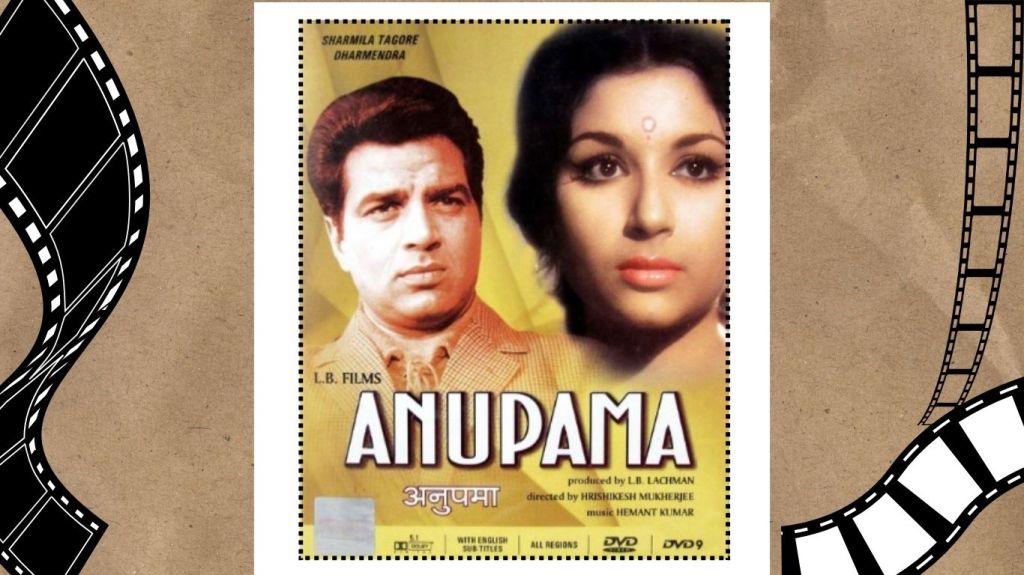
Hindi cinema has always been far more comfortable idealizing love than interrogating it. Mothers are sanctified until they resemble deities; lovers are glorified until desire becomes destiny. Fathers, meanwhile, often arrive as functional presences – authoritarian, distant, or conveniently absent. When cinema does examine paternal cruelty, it usually does so with blunt instruments: anger, violence, melodrama. What it almost never attempts is a quiet excavation of grief: how loss curdles into emotional paralysis, how love, once broken, turns inward and begins to poison those closest to it.
Hrishikesh Mukherjee’s Anupama (1966) belongs to this rarer tradition. It is a film of silences and withheld gestures, of emotional damage that accrues not through spectacle but through neglect. It is also one of the most morally mature films of Hindi cinema’s so-called golden age, refusing easy blame or easy redemption. Though remembered fondly as a romantic classic, Anupama is, at its core, a study of damage – how it is transmitted across generations, how it shapes personality, and how difficult it is to escape without replicating the very structures one seeks to flee.
The film announces its concerns almost immediately. It does not begin with the heroine, Uma, but with a different love story altogether: that of Mohan Sharma (Tarun Bose) and his young bride Aruna (Surekha Pandit). Their marriage is suffused with tenderness, a late-blooming intimacy that seems to have finally settled Mohan into happiness. Kaifi Azmi’s lyrics and Hemant Kumar’s music, carried by Lata Mangeshkar’s ethereal voice in ‘Dheere dheere machal’, imbue these early moments with an aching sense of anticipation, as though joy itself knows how fragile it is.
When Aruna dies during childbirth, the film does not sensationalize the tragedy. There is no operatic grief, no cinematic excess. Instead, we witness something far more unsettling: a man who survives but cannot recover. Mohan’s grief does not explode; it congeals. He returns to work, to routine, to respectability. But something fundamental has ruptured. The child who survives, the daughter who should have embodied continuity, becomes, for him, the physical reminder of irrevocable loss.
This is the emotional fault line on which Anupama is built.
Mohan does not beat his daughter. He does not shout at her. He simply withholds recognition. Sober, he cannot look at her without recoiling. Drunk, he collapses into remorse, showering her with gifts and affection she does not know how to receive. Tarun Bose plays these contradictions with extraordinary restraint. His Mohan is not a tyrant; he is a man incapacitated by grief, oscillating helplessly between guilt and resentment. The question he asks in a drunken stupor, ‘Tera qasoor kya hai?’, is not rhetorical. It is the question he cannot answer, and therefore cannot escape.
It is within this emotional vacuum that Uma grows up.
When Sharmila Tagore appears as the adult Uma, she arrives almost as a negative space. She is present, but barely articulated. She moves softly, speaks rarely, and seems perpetually apologetic for occupying physical and emotional room. Mukherjee allows her no early exposition, no explanatory monologue. Instead, we read her through posture, hesitation, and, most powerfully, through her eyes.
This is one of the great silent performances of Hindi cinema, and it is all the more remarkable because it occurs within a sound film, surrounded by dialogue, music, and social interaction. Sharmila Tagore conveys fear not through trembling but through vigilance. Uma is always alert, always bracing herself for rebuke. Her silences are not empty; they are saturated with history.
What Anupama understands, perhaps better than any Hindi film of its time, is that emotional neglect does not produce rebellion. It produces erasure. Uma has internalized her father’s rejection so thoroughly that she barely recognizes herself as a person entitled to desire. She reads, she writes, she observes nature, but she does not speak. Her muteness is not shyness; it is survival.
The brilliance of Mukherjee’s direction lies in his refusal to explain this condition verbally. He trusts the audience to recognize it. He also trusts Sharmila Tagore to carry the weight of that recognition without ornamentation. Her performance is so internal that it almost risks invisibility, and it is precisely this risk that makes it unforgettable.
Into this quiet world enters Ashok (Dharmendra), a schoolteacher and writer whose most defining quality is not idealism but ethical restraint. Dharmendra, often celebrated for his physicality and masculine charisma, offers here a performance of remarkable stillness. Ashok does not dominate the frame; he occupies it with assurance. His strength is not performative. It is moral.
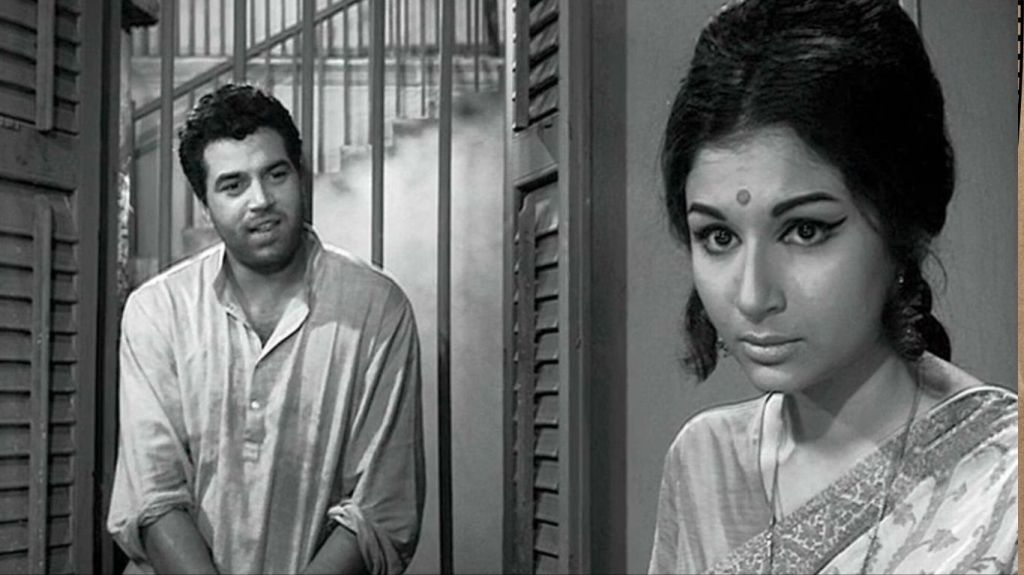
What distinguishes Ashok from the typical romantic hero is his refusal to confuse love with possession. He is drawn to Uma not because she is mysterious, but because she is wounded, and because she listens as attentively as she is listened to. Their relationship unfolds through shared silences, through books exchanged, through glances that do not demand response.
Crucially, Ashok does not attempt to rescue Uma. When others suggest that he elope with her, or force her hand against her father’s wishes, he refuses. His reasoning, articulated in one of Rajinder Singh Bedi’s finest lines, is devastating in its clarity: he does not want to replace a father who imposed his will with a husband who will do the same. Freedom, he insists, is indivisible. A person’s freedom matters as much as a nation’s. In this insistence, Anupama quietly dismantles one of Hindi cinema’s most enduring fantasies: that love alone is emancipatory. Love, the film suggests, can enable freedom, but only if it respects autonomy. Otherwise, it is merely another form of captivity.
The film’s most lyrical articulation of Uma’s inner life arrives, fittingly, not through dialogue but through song. ‘Kuchh dil ne kaha’ is not simply one of the most evocative songs of Hindi cinema; it is the emotional core of Anupama. In Kaifi Azmi’s words, Uma speaks, perhaps for the first time, about the hollowness of appearances, the loneliness masked by material comfort, the quiet despair of being misunderstood. Lata Mangeshkar’s rendition is almost whispered, as though sound itself is tentative. The picturization – mist, wildflowers, early-morning light – creates a space that feels suspended between dream and waking. And then there is Dharmendra, watching. What registers on his face is not desire, but awe. He is witnessing something elemental: the transformation of silence into song.
This moment is crucial because it redefines what expression means in Anupama. Uma does not become articulate by arguing or protesting. She becomes articulate through poetry. Her song is not defiance; it is revelation. It does not confront power; it exposes truth.
Rajinder Singh Bedi’s dialogues throughout the film share this quality. They are stripped of rhetorical flourish, yet loaded with implication. Characters speak as people do in life, haltingly, evasively, sometimes too late. There are no speeches designed to instruct the audience. Meaning emerges through accumulation, through the tension between what is said and what remains unsaid.
Even the film’s secondary characters participate in this moral ecology. Anita (Shashikala), initially all chatter and cheer, gradually learns to listen. Uncle Moses (David), beneath his comic exterior, articulates some of the film’s most humane insights. These figures are not merely functional; they represent alternate ways of inhabiting the world, ways that are noisy, impulsive, affectionate, yet capable of growth.
And then there is Mohan Sharma, the father whose shadow looms over every frame even when he is absent. Tarun Bose’s performance is the film’s emotional backbone. He embodies a man who has mistaken control for responsibility, withdrawal for dignity. His tragedy is not that he loses his daughter, but that he understands, only when it is too late, that love withheld is a form of violence.
The final confrontation between Mohan and Uma is devastating precisely because it refuses melodrama. Uma does not accuse. She states. She speaks not with anger, but with clarity. This clarity – hard-won, fragile, irreversible – is the film’s true climax. It is the sound of a self emerging. As she articulates her desire to leave, there is no rebellion. She bends down to touch his feet as a mark of respect, and when he places his hand on her head, she simply says, ‘Aap ka haath meray sar pe hai. Main jaaun, na?’ (Your hand is on my head. May I leave?) Within the emotional grammar of Anupama, the sequence carries enormous weight. Because it transforms departure into an act of moral permission rather than defiance, making freedom emerge not through rupture or accusation, but through dignity, restraint, forgiveness, and the quiet authority of a self that no longer needs to justify its existence.
Mohan, left behind, can only watch. His breakdown is internal, restrained, absolute. Tarun Bose plays it without appeal for sympathy. The film offers him none, and yet it does not condemn him either. This refusal to judge is one of Mukherjee’s greatest strengths. His characters are not wicked; they are wounded. Their flaws are human, their consequences irrevocable. In the film’s heart-breaking final sequence, as the train leaves, carrying Uma and Ashok away, and we see the gallery of characters – Moses, Ashok’s friend Arun, Annie, Dulari – wave at them, the final shot reveals Mohan too at the platform, hiding away from the others, his tear-stained face bidding a silent farewell. It is one of the great moments of the film for its silent eloquence.
Anupama endures because it understands something fundamental about freedom: that it cannot be gifted, only recognized. That silence can be as destructive as cruelty. That love, to be ethical, must make room for choice.
In Sharmila Tagore’s near-wordless performance, in Dharmendra’s moral steadiness, in Kaifi Azmi’s aching poetry and Hemant Kumar’s melodies, and in Rajinder Singh Bedi’s unsparing dialogues, the film finds a rare harmony. It does not age into nostalgia. It deepens into understanding.
Some films comfort. Anupama listens.
 Shantanu Ray Chaudhuri
Leave a comment