Revisiting a defining Yash Chopra romance – lush with poetry, unforgettable music, and star power – reveals a film that wants to be beautiful but ends up uneven, stained by artifice, where Sahir’s words and Khayyam’s melodies endure even as the melodrama, sentimentality and spectacle strain against time’s sharper gaze
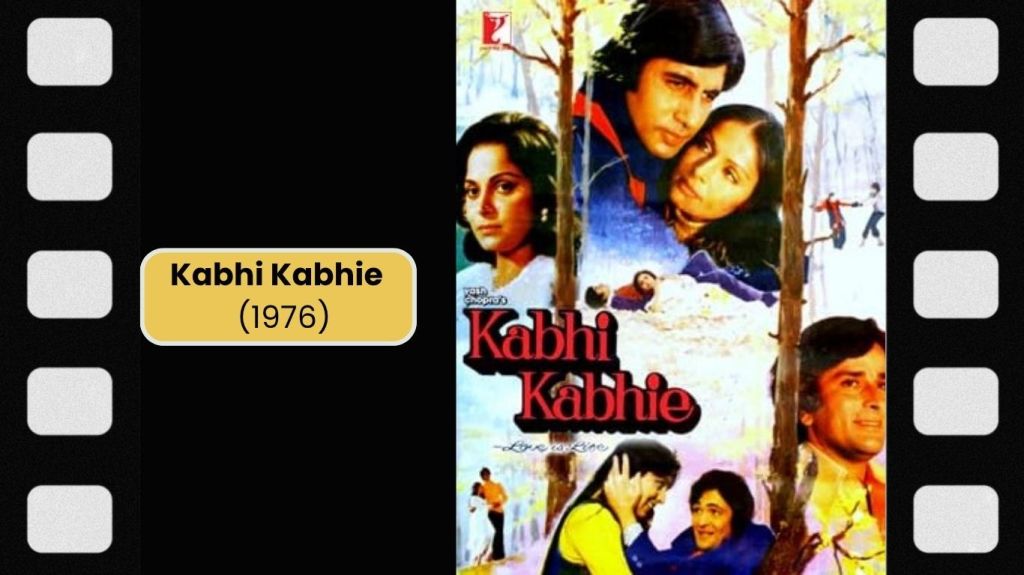
Fifty years after its release, Kabhi Kabhie remains enshrined in Hindi cinema’s collective memory as Yash Chopra’s grand romantic statement, an antidote, as it were, to the brooding angst of the Angry Young Man era. It became one of the year’s biggest hits, and cemented Chopra’s reputation as the high priest of cinematic romance. For many, it still serves as a masterclass in old-school love in an age that now prefers the efficiency of a right swipe.
And yet, revisiting Kabhi Kabhie today is a more complicated experience than nostalgia might allow.
When I first watched it decades ago, I too was swept away by its poetry, its snow-laden landscapes, its aching refrain that love may change form but never fade. On subsequent viewings, however, the gauze began to thin. The film’s emotional architecture, once overwhelming, started to feel constructed, sometimes too carefully constructed. What had seemed tender began, at moments, to feel unabashedly schmaltzy; what had once been romantic occasionally tipped into the unintentionally comic.
And yet, even with its excesses and artifice, Kabhi Kabhie continues to matter.
The context of its making is crucial. Yash Chopra conceived Kabhi Kabhie at a time when Salim–Javed’s scripts were reshaping Hindi cinema with tales of urban rage: Zanjeer, Deewaar, Sholay. Ironically, Amitabh Bachchan, the face of that fury, was cast here as a poet, Amit Malhotra, who begins the film declaiming, ‘Main pal do pal ka shayar hoon.’
The casting was a masterstroke. In 1976, Bachchan was the embodiment of smouldering discontent. To see him soft-spoken, vulnerable, wounded by love rather than by social injustice, was startling. His tall, angular presence, so effective in confrontation, became here an instrument of romantic melancholy. The transformation was not merely cosmetic; it expanded his screen persona. The angry young man revealed that he could also be the wounded romantic.
Opposite him, Raakhee as Pooja is luminous. The camera loves her, and Chopra knows it. Whether framed against Kashmir’s snow or in the warm interiors of marital domesticity, she exudes a quiet radiance. There is a stillness to her performance, a sense of suppressed longing, that gives the film its emotional credibility, even when the writing strains.
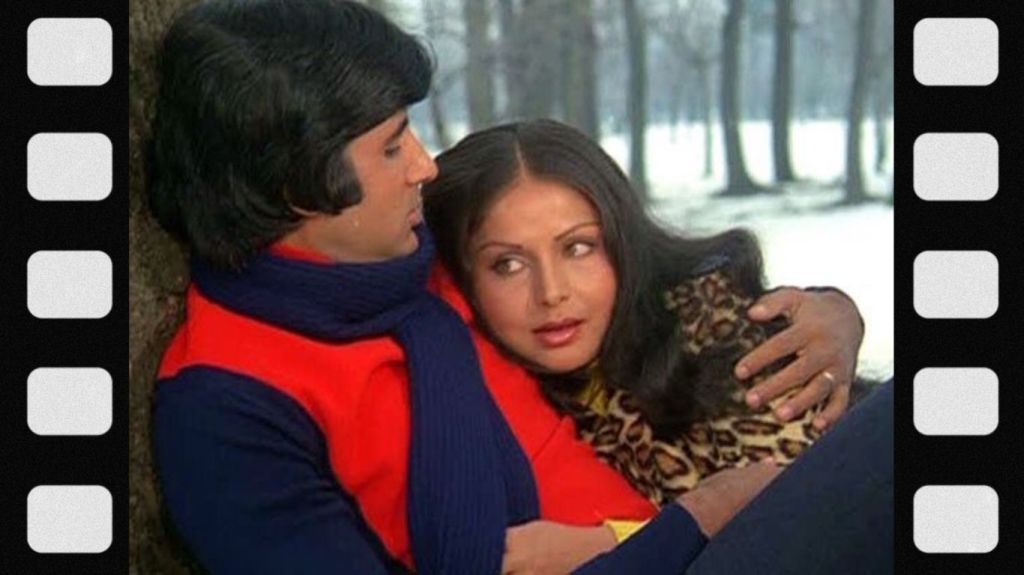
The early Kashmir passages remain among the film’s most evocative stretches. The sight of Amit and Pooja in stolen moments of poetry and promise establishes a love that feels genuine. It is here that Sahir Ludhianvi’s words and Khayyam’s compositions fuse seamlessly with image. ‘Kabhi kabhi mere dil mein khayal aata hai…’ is not just a song; it is the film’s emotional thesis.
If anything in Kabhi Kabhie is beyond reproach, it is the music. And mind you, that’s on the strength of just two or three songs. Khayyam’s score stands apart from the dominant R.D. Burman sound of the period. In fact, it is Mukesh (in probably what is his swan song – he would pass away months after the film’s release) who scores over the dominant voice of the era, Kishore Kumar, who has the film’s three peppy numbers. In the songs rendered by Mukesh and in the Lata Mangeshkar solo, ‘Meray ghar aayi ik nanhi pari’, Khayyam’s score is restrained, classically inflected, and suffused with longing. Sahir’s lyrics, characteristically dignified, never indulgent, lend the film a literary gravitas that few mainstream romances have matched. ‘Kabhi kabhi mere dil mein’ and ‘Main pal do pal ka shayar hoon’ are two of Hindi cinema’s finest creations. The former captures love as memory; the latter, love as transience. They elevate the narrative, often rescuing it from its own excesses.
The remaining songs, particularly those centred on the younger generation – Rishi Kapoor, Neetu Singh, and Naseem – are energetic and tuneful. Yet they belong to a different tonal register. Their youthful buoyancy feels grafted onto a narrative weighted by regret and middle-aged reckoning. The generational echo that Chopra aims for never quite acquires emotional parity. The romance of Vicky and Pinky, despite Rishi Kapoor’s easy charm and Neetu Singh’s vivacity, lacks the aching depth of Amit and Pooja’s unfinished love. On repeat viewings, their track feels more functional than felt.
Where the film grows uneven is in its handling of marital relationships. Shashi Kapoor’s Vijay Khanna is, in many ways, the film’s moral centre. His discovery that his wife once loved Amitabh’s poet is handled with remarkable dignity. The scene in which he gently confronts Amit, suggesting that a man demeans himself by obsessing over a woman’s past when she has shared twenty years and borne his children, is among the film’s finest. Kapoor underplays beautifully, his natural warmth lending the moment emotional maturity. In contrast, Amit’s reaction to learning of his wife Anjali’s premarital child reveals a streak of chauvinism that the film does not interrogate sharply enough. Waheeda Rehman, with characteristic grace, invests Anjali with quiet pain. Her presence dignifies what is otherwise a troubling arc. That she agreed to a relatively subdued role speaks to her generosity as an actor. In her stillness, one glimpses the emotional cost of a society, and a husband, unable to extend to a woman the forgiveness it demands for itself.
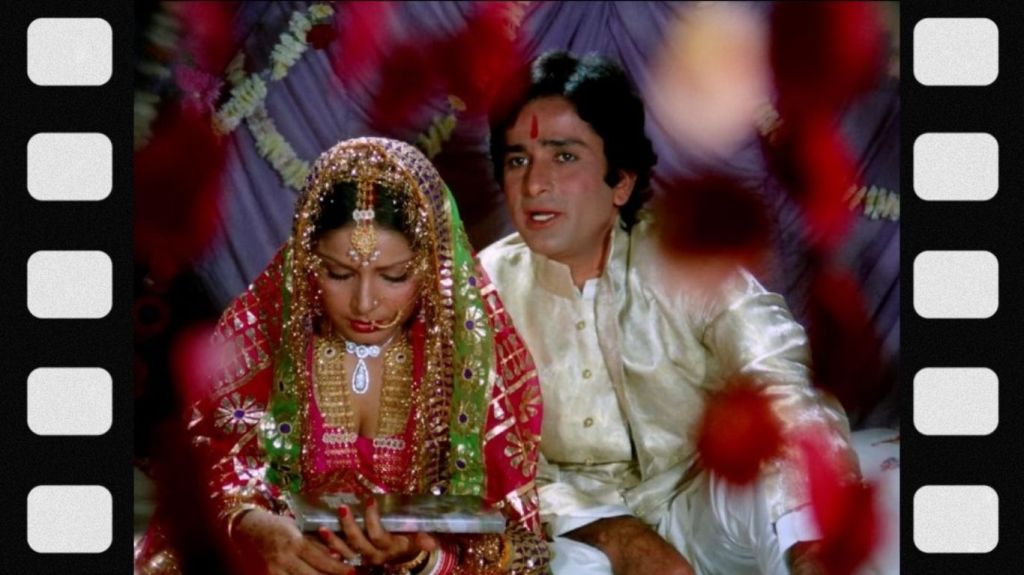
Yet even in these fraught exchanges, Chopra cannot resist melodrama. The emotional beats are underlined, then underlined again. And sometimes, they collapse into absurdity. The much-discussed suhaag-raat scene between Raakhee and Shashi Kapoor is perhaps the most glaring example. Vijay gifting his new bride a book of love poems written by her former lover is meant to signal magnanimity and romantic largeness. Instead, it borders on the ludicrous. The earnest solemnity of the staging, the polite restraint with which all parties navigate this implausible gesture, Raakhee singing ‘Kabhi kabhi mere dil mein’ – what might have seemed noble in 1976 now feels unintentionally comic.
More egregious still is the climactic sequence involving galloping horses, roaring dynamite explosions, forest fires, and a near-suicidal dash into flames. The tonal dissonance is staggering. A film that has spent two hours meditating on memory and compromise suddenly morphs into an action melodrama. Characters chase each other across a quarry site as explosions detonate with suspicious timing. It is spectacle without emotional necessity, and it undermines the fragile intimacy the film has tried to build. This is where the artifice becomes impossible to ignore. Chopra’s cinema has often thrived on heightened emotion, but here the height becomes hysteria.
Much has been written about the ‘honeymoon camp’ atmosphere during the Kashmir schedule. The familial warmth of the unit perhaps seeped into the film’s texture. Yet that very warmth contributes to a sense of insulation. The world of Kabhi Kabhie feels hermetically sealed – its conflicts internal, its landscapes postcard-perfect, its crises ultimately soluble through confession and embrace. Even its treatment of illegitimacy, adoption, and marital betrayal remains curiously bloodless. Pain is expressed, but rarely allowed to wound.
The result is a romance that aspires to profundity but often settles for prettiness.
And yet. Strip away the excess, and what remains is not negligible.
Amitabh Bachchan’s reconfiguration of his star image. Raakhee’s luminous restraint. Shashi Kapoor’s scene of discovery and acceptance. Waheeda Rehman’s quiet dignity. The poetry-infused dialogues – ‘Aapne kabhi apni aankhen dekhi hain? Jahan dekhti hai, ek rishta kayam kar leti hai’, ‘Zindagi chand sawaal aur kuch jawab hi toh bankar rah jaati hai’, ‘Tera haath, haath mein ho agar; toh safar hi asle-hayaat hai; mere har kadam pe hai manzilein; tera pyar gar mere saath hai’ – that remind us of a time when mainstream Hindi cinema dared to be unabashedly literary.
Above all, the music. When Mukesh’s voice soars in ‘Kabhi kabhi mere dil mein’, time seems to pause. The song transcends the film, entering the realm of cultural memory. Even those who find the narrative dated cannot remain untouched by its melody. Perhaps that is the secret of Kabhi Kabhie’s endurance. Not that it is flawless, far from it, but that it captures a particular idea of love that Hindi cinema was uniquely equipped to stage: love as poetry, as sacrifice, as something that survives not in possession but in remembrance.
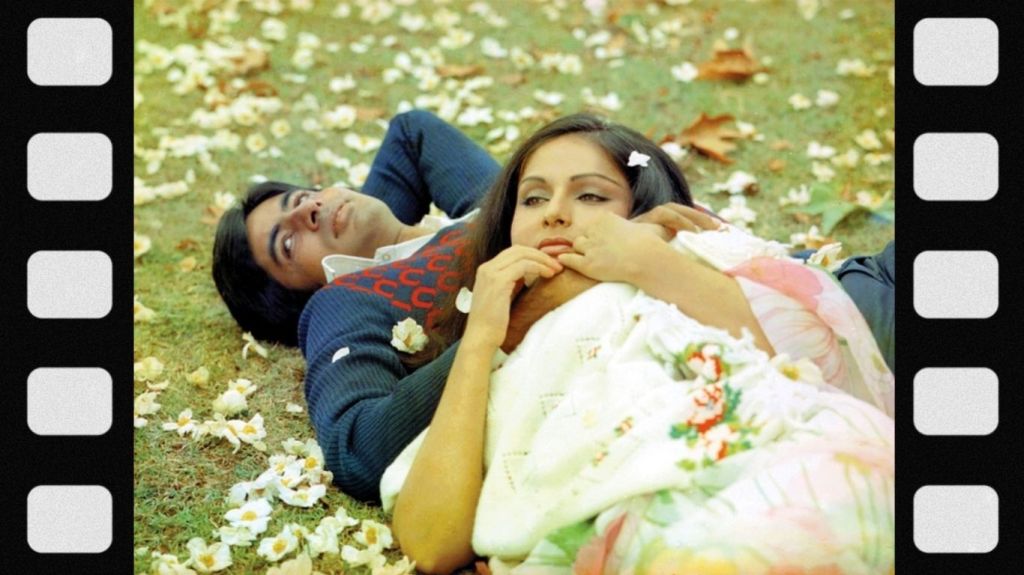
Fifty years on, the film feels less like a seamless classic and more like a beautiful, uneven relic. Its romanticism can seem excessive, its melodrama overwrought, its climaxes absurd. It is not, at least for this viewer, the definitive statement on love that its reputation sometimes suggests. But in its best moments – in a glance across a room, in a husband’s dignified acceptance, in a poet’s resigned smile – it touches something tender and recognizable.
Kabhi Kabhie may not fully withstand the scrutiny of time. Yet its songs still linger. Its snow still glistens. And somewhere, in the space between memory and melody, its poetry continues to echo.
 Shantanu Ray Chaudhuri
Leave a comment