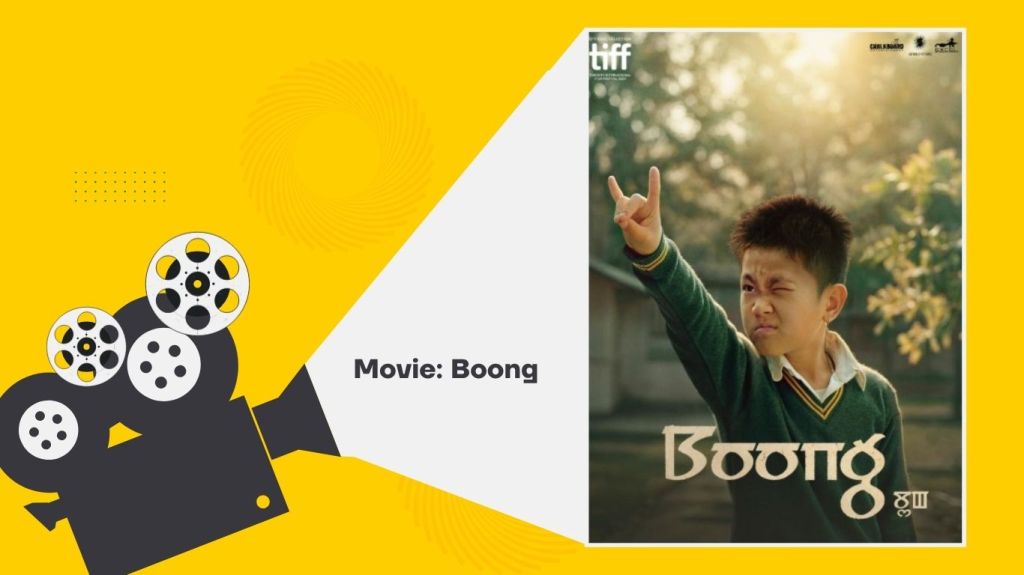
A tender, quietly perceptive coming-of-age tale about childhood mischief, friendship, and the stubborn hope that imagination can change one’s world
Early in Boong, a small moment captures the film’s playful spirit perfectly. A boy emerges from behind a roadside stall with a friend and a slingshot in hand. With surprising precision, he begins firing pellets at the metal letters on the signboard of his school gate. One by one, the letters fall away until the name on the board transforms into something accidentally absurd: ‘Homo Boys School.’ The boy beams with pride at his marksmanship, completely unaware of the unintended joke he has created.
That boy is Boong, played with infectious vitality by Gugun Kipgen. His mischievous energy drives the film that carries his name. Directed by Lakshmipriya Devi, Boong is modest in scale but expansive in feeling. A small film with a quietly generous spirit. Set in Manipur and attentive to the rhythms of everyday life there, it offers a rare cinematic glimpse into a corner of India that mainstream films seldom portray with such intimacy.
Light in touch and warm in tone, Boong unfolds as a modest yet deeply engaging coming-of-age tale. Over the course of its brisk 95 minutes, the film traces the adventures of a boy whose curiosity and stubborn imagination push him into a series of small but meaningful escapades. Rather than leaning on dramatic twists or heightened conflict, the narrative grows out of humour, tenderness and the patient observation of ordinary life.
From the start, the film invites viewers into Boong’s lively inner world. He is the kind of child who seems incapable of leaving things alone. Restless and inventive, he is constantly testing the limits of rules and routines. Yet his mischief never carries the bitterness of rebellion. Instead, it springs from the natural impatience of a child confronted with systems and expectations that appear arbitrary or dull.
One of Boong’s central ambitions is to leave his current school. The institution he attends is modest, and English, though nominally part of the curriculum, seems more ceremonial than practical. During morning assembly, students dutifully chant what they believe to be an English prayer. The words, however, turn out to be the lyrics of Madonna’s Like a Virgin. The scene is quietly hilarious, but it also reveals something about the curious journeys global culture takes as it filters into distant corners of the country, sometimes stripped of its original context.
For Boong, the solution to his predicament is obvious: he must somehow gain admission to an English-medium school. In his imagination, such a place represents prestige, possibility and perhaps a pathway to a bigger world. Determined to escape his current situation, he devises increasingly elaborate plans to get himself expelled. His assault on the school signboard with a slingshot is merely the opening move in this campaign.

Director Lakshmipriya Devi approaches this story with a gentle, observational sensibility. There is no attempt to inflate the narrative into something more dramatic than it needs to be. Instead, the film trusts the emotional weight of small incidents. A prank gone slightly wrong, a conversation overheard, a child’s sudden flash of determination – these fragments accumulate gradually, forming a portrait that feels organic rather than engineered.
This modesty of scale turns out to be the film’s greatest strength. Boong does not chase spectacle or dramatic excess. Instead, it draws the viewer into the textures of everyday life: the rhythms of school routines, the easy companionship of childhood friendships, the subtle tensions within a household trying to make ends meet. What makes the film especially appealing is its unwavering commitment to the child’s point of view. The story rarely strays far from Boong’s perspective, allowing the audience to experience the world through his mixture of confidence and confusion. Adults move in and out of the frame carrying their own worries and responsibilities, but the film does not pause long enough to fully decode their lives. What matters is how Boong interprets them, sometimes correctly, often not.
This decision preserves the logic of childhood, where misunderstandings and imagination often blur into one another. The film never ridicules Boong’s reasoning. Instead, it treats his thought processes with gentle empathy. His conclusions may be flawed, but they are always sincere. Gugun Kipgen’s performance is the film’s emotional anchor, bringing an effortless spontaneity to the role. His Boong is mischievous without becoming irritating, vulnerable without slipping into sentimentality. Much of his charm emerges through small gestures: a conspiratorial grin after a successful prank, the narrowed gaze as he lines up a shot with his slingshot, the sudden slump of his shoulders when an adult authority figure interrupts his plans. Child actors can often feel overly coached in films, but Kipgen’s performance carries a refreshing naturalness. He seems less like someone performing a role and more like a child simply being himself in front of the camera.
The supporting cast contributes quietly to the film’s sense of authenticity. The adults in Boong’s world – parents, teachers, neighbours – are drawn with restraint. They are not exaggerated authority figures but ordinary people negotiating the pressures of daily life. Their concerns hover on the edges of Boong’s adventures, occasionally intersecting with them in ways that reveal the gap between childhood innocence and adult anxieties.
The film’s humour operates in a similarly understated register. Rather than building towards obvious punchlines, the comedy arises naturally from circumstances and misunderstandings. The altered school signboard is amusing not simply because of the accidental wordplay but because Boong remains blissfully unaware of the joke he has created. To him, the episode is merely proof of his excellent aim.
Yet beneath the humour lies a quiet awareness of the broader realities shaping life in Manipur. Economic uncertainty, limited opportunities and the pull of migration hover gently in the background of the story. Many young people from the region eventually leave home in search of education or employment elsewhere in India or abroad. The film does not treat these issues as explicit themes. Instead, they appear as subtle undercurrents, felt rather than explained. In this sense, Boong captures something essential about growing up in places where the horizon of possibility often seems to lie elsewhere.
At the same time, the film offers a portrait of Manipur that feels refreshingly removed from the narratives through which the region is frequently represented in national discourse. Rather than focusing on conflict or crisis, the camera lingers on ordinary moments: children walking to school, neighbours chatting outside small shops, families navigating the routines of everyday life. These glimpses accumulate into a portrait of a community rarely seen on screen with such warmth and normalcy. The effect is quietly powerful. By focusing on the ordinary, the film reminds viewers that the everyday life of a place can reveal far more about it than the headlines that usually define it.
Boong’s own family embodies this fragile equilibrium. The adults around him carry burdens that remain largely invisible to children: worries about work, finances and the uncertain future. While Boong spends his days plotting elaborate schemes and dreaming about a better school, the grown-ups around him are preoccupied with responsibilities he cannot yet comprehend. What is remarkable is how the film acknowledges these undercurrents without allowing them to overwhelm its tone. The narrative remains buoyant, sustained by the vitality and imagination of childhood. Boong may not fully grasp the complexities of the world around him, but his restless energy becomes a kind of quiet defiance against its limitations.
Visually, the film embraces simplicity. The camera observes rather than dramatizes. It pays patient attention to the textures of everyday life: narrow streets, modest houses, roadside tea stalls and the unhurried rhythms of a small town. There is no attempt to romanticize these surroundings, yet the images possess a quiet dignity. For many viewers, the landscapes of Manipur, so rarely seen in mainstream Indian cinema, will feel both fresh and revelatory.
The film’s pacing is another strength. At just under 100 minutes, it moves with an easy economy that keeps the narrative focused. Scenes are concise, and the storytelling avoids the digressions that often burden longer films. This restraint allows the emotional beats to register with clarity. Equally effective is the portrayal of childhood friendship. Boong and his companions share a world built on secret plans, rumours and half-understood ideas. Their conversations wander through fragments of gossip, speculation and fantasy. The interactions feel loose and natural, as though the camera has simply been allowed to observe children being themselves.
Ultimately, the film draws its emotional strength from its portrait of childhood hope. Boong believes, with the fierce conviction that only children possess, that cleverness and persistence can reshape his circumstances. Adults watching the film may recognize the limitations of that belief. Yet the story never dismisses his optimism. Instead, it treats that hope as a form of courage in itself.
What makes Boong linger in the mind is precisely this combination of modesty and sincerity. The film does not attempt grand statements about childhood or society. Yet through its accumulation of small observations, it evokes something larger: the fragile optimism with which children confront a world whose complexities they only dimly perceive. By the time the film reaches its final moments, Boong’s journey feels less like a conventional plot and more like a window into a fleeting phase of life. Childhood appears here as a brief but luminous period when the world still seems open to negotiation and invention.
In an age when many films rely on spectacle or overt messaging, Boong distinguishes itself through its modest scale. It does not attempt to overwhelm the viewer. Instead, it quietly invites us into the life of a boy whose imagination transforms the ordinary into something unexpectedly magical. At heart, Boong is built from small details: a slingshot aimed at a school sign, a pop song mistaken for a prayer, a child’s stubborn dream of studying in a better school. Taken together, these moments form a portrait of growing up that feels rooted in the specific textures of Manipur while remaining universally recognisable.
Watching Boong is a little like observing a child absorbed in play: unpredictable, imaginative and unexpectedly profound. By the end, the film leaves behind a quiet realisation – that the fleeting innocence of childhood, so easily overlooked, is itself something rare and luminous.
 Shantanu Ray Chaudhuri
Leave a comment