The most remarkable aspect of Ranjan Ghosh’s Adamya is that a film like this could be made at all, given the pitfalls that plague independent film-making in Bengal. Spare in dialogue yet rich in atmosphere, the film fuses cinematic craft with a fierce meditation on rebellion, conviction and survival, a political drama that follows a hunted rebel through the forbidding landscape of the Sundarbans.

There are moments in the life of a film critic that come with a certain privilege, and a corresponding limitation. My encounter with Adamya, Ranjan Ghosh’s latest film, belongs squarely to that category. Months before the film entered the final stages of post-production, Ghosh organized a private screening of the rough cut at my residence. In that sense, I can claim, with a mixture of delight and trepidation, to have been among the very first viewers of the film. (Ranjan, of course, prohibited me from mentioning the film or my reaction to it to the public.) The trepidation arises from the fact that I have not yet seen the completed version on the big screen, where the film’s visual scale and sonic textures are meant to unfold in their full intensity. Yet even in its unfinished state, stripped of the polish that comes with final sound design, colour grading and the meticulous adjustments of post-production, Adamya revealed itself as something extraordinary. It struck me then, and continues to strike me now, as probably Ranjan Ghosh’s most accomplished film and, without doubt, his most powerful.
To appreciate what Adamya represents, it is worth recalling the trajectory of Ghosh’s film-making career. From the beginning, he has been a director unwilling to repeat himself. Each of his films has ventured into a different tonal and thematic territory, often against formidable constraints of resources, distribution and visibility that plague independent film-making in Bengal.
The quiet lyricism of Hrid Majhare, with its gentle meditation on love and memory framed through Shakespearean resonances, announced a film-maker sensitive to emotional nuance and interiority. With Rong Beronger Korhi, Ghosh shifted registers, weaving together multiple narrative strands to explore the fractures beneath urban lives. The mosaic structure itself hinted at a director restless with conventional storytelling. Ahaa Re followed with an altogether different warmth, using food and hospitality as metaphors for cultural encounter and human loneliness. Later, with Mahishasur Marddini, Ghosh ventured into even more audacious territory, blending mythology, contemporary politics and experimental narrative strategies in a film that divided opinion but confirmed something essential about its maker: he would rather risk failure in pursuit of a new cinematic language than settle into comfortable repetition.
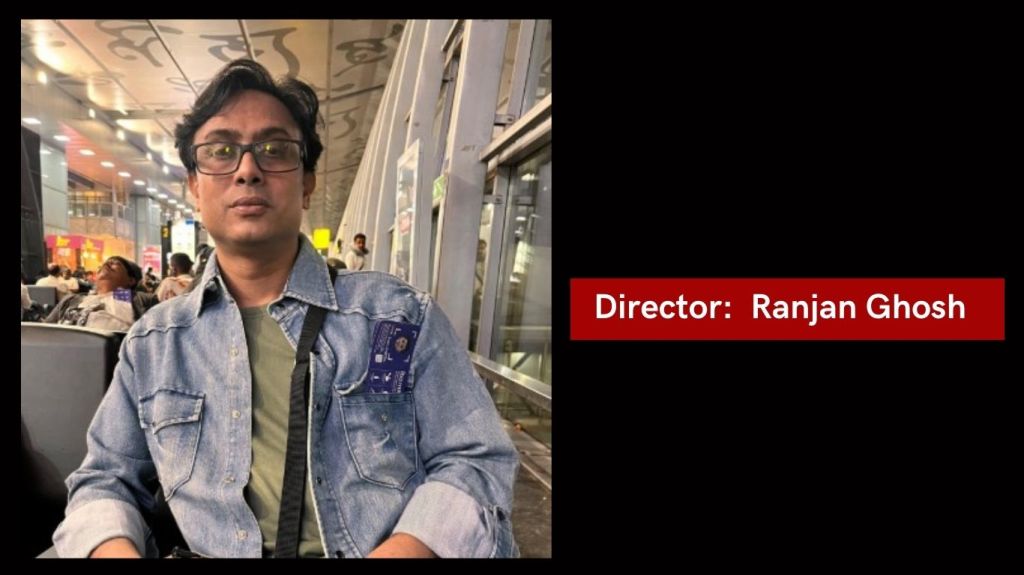
Seen against this backdrop, Adamya feels like the culmination of a long creative journey. The film carries forward Ghosh’s instinct for experimentation, both in content and form, but channels it with an urgency and clarity that give the narrative unusual force.
The premise of Adamya is deceptively simple. A political assassination attempt goes disastrously wrong. The lone assassin finds himself relentlessly hunted by the machinery of the state: police forces, the media and the shadowy ecosystem of hired muscle that inevitably emerges in such circumstances. Fleeing capture, he makes his way into the labyrinthine terrain of the Sundarbans, seeking refuge in a remote village hideout. From there unfolds a tense and increasingly introspective journey, one that becomes as much about survival as it is about the emotional and ideological burdens of rebellion.
The title of the film translates roughly as ‘indomitable’, and the word captures both the protagonist’s spirit and the film’s own defiant temperament. Ghosh constructs the narrative as a study of a rebel defining himself even as he is being torn apart by the consequences of his choices.
Much of the film’s power lies in its visual evocation of the Sundarbans landscape. The terrain – river channels, slushy mudbanks and dense jungle cover – is rendered with almost tactile immediacy. The dominant palette remains steeped in shades of grey, punctuated occasionally by flashes of moonlit or sunlit greenery that only sharpen the sense of foreboding. Cinematographer Arkaprabha Das maintains a close and watchful engagement with this environment, allowing the geography of the Sundarbans to shape the film’s emotional rhythms.
The fugitive’s journey through this terrain becomes an ordeal of both body and mind. At one point, the narrative erupts into a violent confrontation with a gang of local goons. The ensuing gunfight leaves two attackers dead and the protagonist once again on the run. Yet the rhythm of the film changes thereafter. The breathless urgency of pursuit momentarily loosens as the fugitive moves towards the open river and boards a trawler. Suddenly the visual field expands: sky and water stretch endlessly around him, transforming the film’s confined spaces into an elemental theatre of survival.
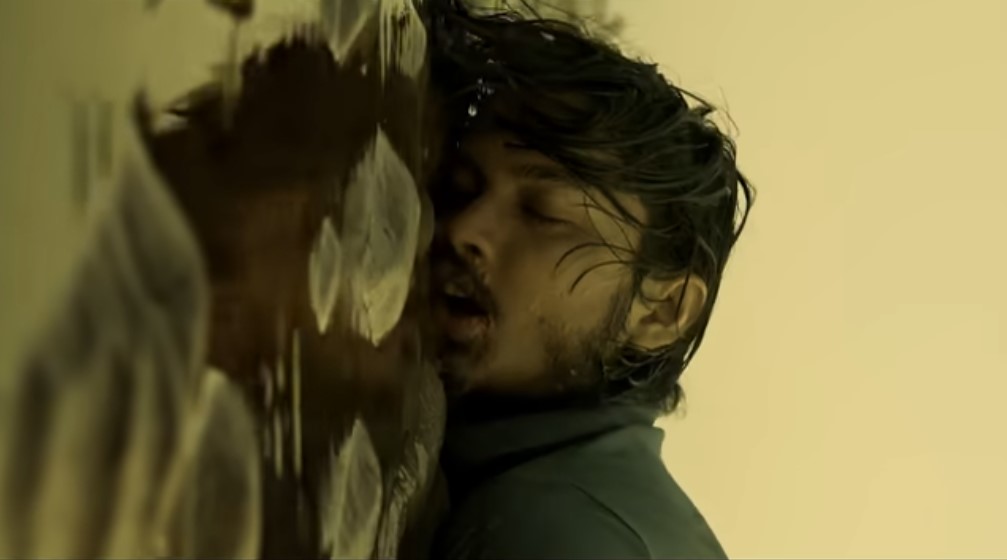
One of the most striking sequences involves the protagonist’s gruelling swim through swirling tidal waters and treacherous slush. Shot with brutal physical realism, the sequence feels less like spectacle and more like an existential passage. The desperate crossing leads briefly to a moment of fragile calm before the inevitable pursuit closes in once more and culminates in the grim finality of an ‘encounter killing’.
Dialogue throughout the film is sparse and economical. Conversations are brief, clipped and often charged with what remains unsaid. This sparseness heightens the sense of loneliness and precarity that surrounds the protagonist. Aryuun Ghosh, who plays the fugitive, carries the film almost single-handedly for long stretches. His performance possesses a restless physical intensity that anchors the narrative. In addition to acting, Aryuun assisted the director and handled elements of the film’s costume and art design, and he even breaks into a startling rap rendition of a Sukanta Bhattacharya poem – an explosive moment that tears through the film’s silence and underlines the rebellious energy simmering beneath the character’s surface.
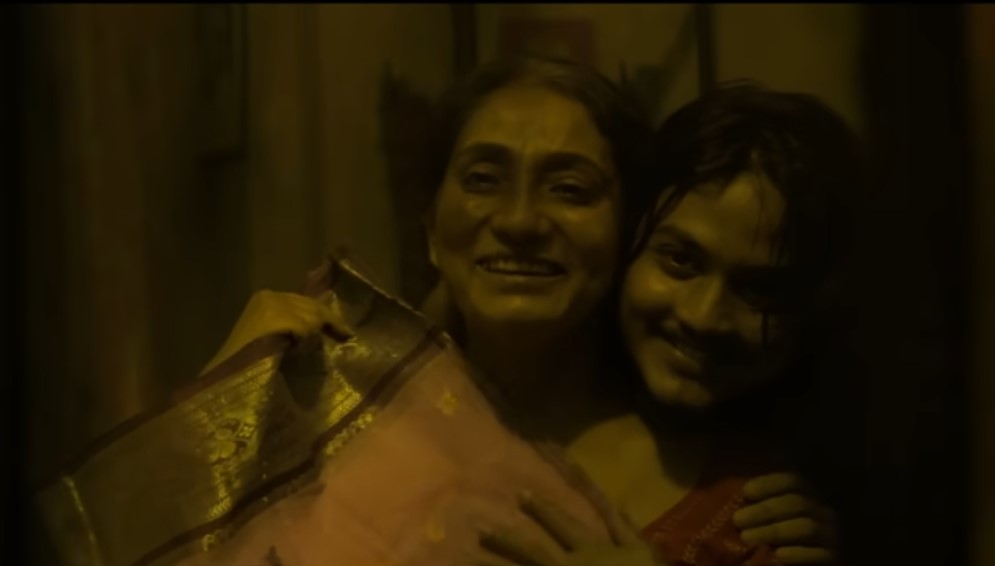
Yet despite the film’s stark minimalism, fragments of emotional life surface with quiet poignancy. The protagonist’s relationship with his single mother lingers through symbolic gestures, most memorably through a handkerchief that carries the faint scent of home. Such details prevent the character from becoming a mere ideological abstraction. They restore him to the fragile world of human attachments that continue to haunt him even as he remains on the run.
The film’s visual language also makes striking use of aerial imagery. Drone shots glide across the Sundarbans landscape, but unlike the ornamental aerial views that have become fashionable in contemporary film-making, these images serve a deeper narrative purpose. They situate the solitary fugitive against vast and indifferent horizons, reinforcing the existential loneliness of his struggle and hinting at a larger crisis of democratic ideals.
What is most remarkable about Adamya is how organically its technical sophistication merges with its narrative purpose. The cinematography, sound design, editing and production design work together with rare coherence. At no point do they appear as displays of virtuosity meant to call attention to themselves. Instead, they form an integrated cinematic language that deepens the emotional and political textures of the story.
This achievement becomes even more striking when viewed against the challenges of independent film-making in Bengal. Limited budgets, uncertain distribution networks and the overwhelming dominance of formula-driven cinema often discourage experimentation. Yet Ghosh has persisted with a stubborn creative curiosity, repeatedly choosing the harder path. In that sense, the title Adamya may also be read as a quiet self-description. There is something indomitable about the persistence with which Ghosh has continued to pursue his cinematic vision, film after film.
Even in the rough cut I saw months ago, the film possessed a clarity of intent that was impossible to ignore. The emotional trajectory was already firmly etched, the political undertones unmistakable. When the final encounter arrives – grim, inevitable and devastating – it leaves behind not merely the story of a rebel’s death but the lingering echo of an unbroken spirit. At a time when some voices in global cinema suggest that film-makers should keep away from politics, Adamya stands as a quietly defiant reminder that cinema has always been intertwined with the moral and political anxieties of its time.
I still await the opportunity to experience the finished film in a theatre, where its visual and sonic architecture will undoubtedly achieve its fullest resonance. But even from that early private screening in my living room, one thing was unmistakably clear: Adamya is not merely another entry in Ranjan Ghosh’s filmography.
It is the work of a film-maker who refuses to surrender his belief in the indomitable possibilities of cinema itself.
 Shantanu Ray Chaudhuri
Leave a comment