Released at a turning point in Hindi cinema, Kalicharan (1976) marked Shatrughan Sinha’s decisive emergence as a mass hero. As it celebrates its fiftieth anniversary, I look at how Subhash Ghai’s directorial debut fused vigilante morality, star reinvention, and Ajit’s immortal ‘LOIN’ dialogue to capture the anxieties, energies, and pop-cultural afterlife of the 1970s.
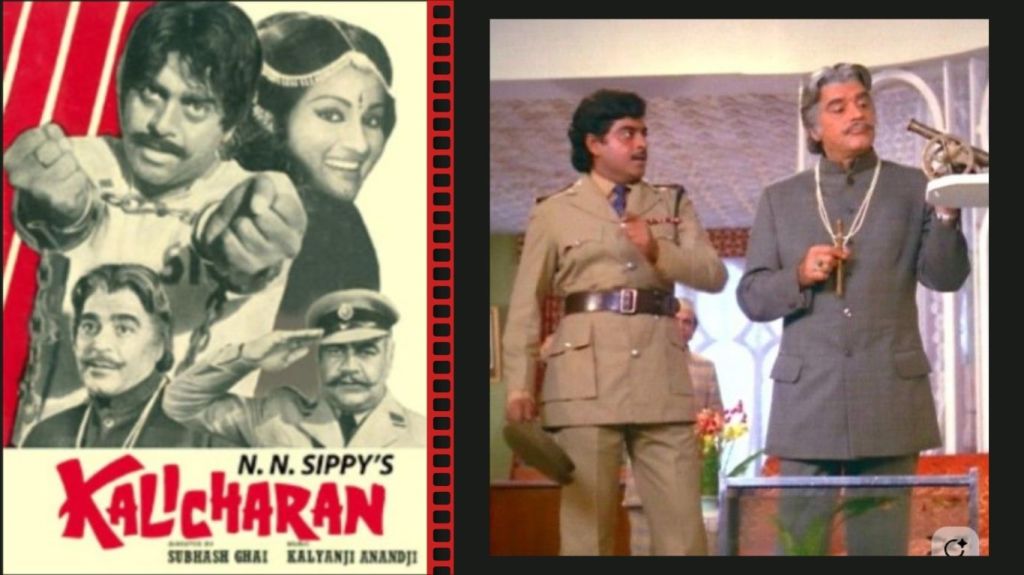
By the mid-1970s, Hindi cinema was undergoing a decisive shift. The polished romantic hero was giving way to the rough-edged avenger, a man shaped by injustice rather than poetry. Kalicharan (1976), directed by Subhash Ghai and produced by N.N. Sippy, arrived squarely at this moment of transition, and in doing so, altered the trajectory of Shatrughan Sinha’s career. He had made a deep impression playing villains and morally ambiguous characters in his early years.
Scarf around his neck, hand caressing the throat as he burned his adversary with an insouciant gaze and the hint of a mocking smile, Shatrughan Sinha was, in his early days as an actor, that rare entity: a ‘villain’ who stole the limelight from the hero. Cast by Dev Anand in a small role in Gambler, he had the audience eating out of his hands with his dialogues and mannerisms. He lent even an everyday line like ‘Mera haath jalaa hua hain, Your Honour’ a charge that had viewers applauding him. Or for that matter, ‘Sharafat se mere saath Bambai bhaag chalo, top ki heroine bana doonga’ in Khilona (1970).
He even made a ten-minute appearance in B.R. Ishara’s Chetna memorable with his dialogue ‘Umar badti hai to daam ghadta hai, bachche’, establishing his ability to create magic with dialogue delivery. There were also the mannerisms he made part of his characters. In Raampur Ka Lakshman, for example, when he beat up someone, he looked at his watch to see if it was still working.
No wonder then that his face made its way on hoardings along with that of the hero and the heroine, leading Khushwant Singh to write, ‘Shatrughan Sinha is the first villain in the history of Hindi cinema to have created a romantic aura around him.’ When film-maker S.D. Narang’s Babul Ki Galiyan (1972) with Hema Malini and Sanjay Khan was released, the biggest cardboard standee that was displayed at the entrance of various theatres was that of the villain and not the lead pair.
‘If there was a 6-foot cut-out of Hema Malini and a 5-foot cut-out of Sanjay Khan, there was a 25-foot cut-out of mine with the line, “Shotgun Sinha in Babul Ki Galiyan,”’ Shatrughan told his biographer Bharthi S. Pradhan. “I was not the hero of the film. I was a mere villain with a price tag of only Rs 25,000 but was considered the main draw according to trade experts … I was the first villain who was invited to Sophia College (an all-women’s college in South Mumbai) as their chief guest. I must be the first villain who was asked to solve women’s emotional problems in Eve’s Weekly, in an Agony Aunt sort of column.’
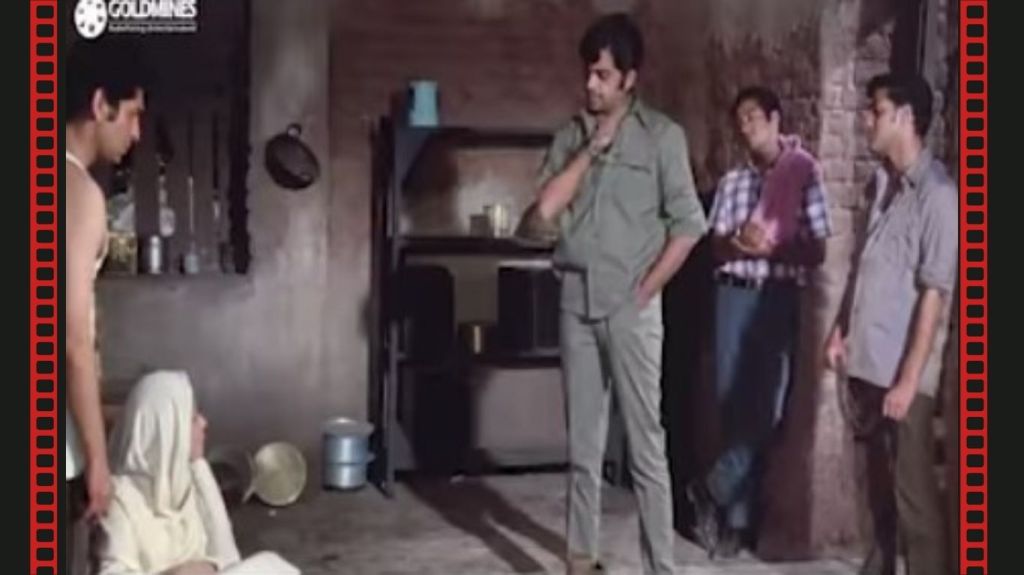
Of these negative roles, the one that played the definitive role in his career is Gulzar’s Mere Apne. Though Vinod Khanna was clearly the director’s favourite and had the author-backed role, it was Shatrughan Sinha who walked away with the honours as the uncouth Chhenu. Audiences went crazy with every appearance he made in the film and it is reported that when he delivered the iconic line ‘Aaye toh keh dena Chhenu aaya tha’, the applause in the theatres used to be deafening. Mere Apne made a star of Shatrughan Sinha and it was only a matter of time that he would make the transition to playing the hero. As Bharathi S. Pradhan writes, ‘By the time Heera (1973) and Blackmail (1973), his last two films as villain, rolled along, distributors were demanding that his character be given some sort of redemption at the end. People had grown too fond of this villain to accept him as completely black.’ With Kalicharan, Sinha finally stepped into the centre of the frame as a hero audiences could cheer without hesitation.
At its heart, Kalicharan is a familiar 1970s morality tale: corruption hidden behind respectability, lawmen betrayed by the very system they serve, and redemption wrested violently from a cruel world. Yet the film’s enduring appeal lies not merely in its plot mechanics but in the performances, dialogues, and the confident manner in which it crystallised popular themes of the era.
The film’s central villain, Deendayal, is among Hindi cinema’s most memorable embodiments of duplicity. To society, he is the very picture of virtue – wealthy, charitable, upright, and trusted. Beneath this façade, however, lies Lion, the unseen kingpin under whom black-marketing, smuggling, and organised crime flourish. No one suspects him, not even his close friend, Inspector General Khanna (played with panache by Premnath), who is genuinely anguished at the collapse of law and order in the city.
Enter Inspector Prabhakar, the incorruptible cop recalled to the city at Khanna’s request. A widower raising two children, Prabhakar is as upright as they come, wielding the law with an iron hand. His relationship with Khanna is almost familial; the IG treats him like a son and his children like grandchildren. Predictably, Prabhakar’s honesty makes him a marked man. As he closes in on Deendayal’s secret life, he is brutally murdered. His death is not merely an emotional turning point but a symbolic one, proof that righteousness alone is no longer enough.
Before dying, Prabhakar leaves behind a cryptic clue meant to expose his killer. The police fail to decipher it, and Khanna, devastated, begins to lose faith. It is at this juncture that Kalicharan pivots into its most intriguing device: the double.
Khanna learns of a ferocious prisoner named Kalicharan who bears an uncanny resemblance to the dead inspector. What he encounters in jail is no noble substitute but a beastly, volatile man shaped by rage and suffering. Kalicharan is no criminal by instinct; his violence stems from a brutal past. He is imprisoned for murdering those who raped his sister, and he still seeks the main culprit, Shetty, a former circus colleague who tried to exploit Kalicharan’s sharpshooting skills for contract killings.
In a move that typifies the moral ambiguity of 1970s cinema, Khanna secures Kalicharan’s release, not out of faith in the law, but out of desperation. He takes him to a hill station, attempting to civilise and reform him, to mould him into Prabhakar’s replacement. Kalicharan resists at every step. Redemption does not come easily; it must be fought for.
The emotional breakthrough arrives through human connection. Prabhakar’s sister slowly reaches the man beneath the scars, and Kalicharan begins to shed his ferocity. His transformation is gradual and convincing, aided by his growing bond with Sapna (Reena Roy) and the eventual acceptance of Prabhakar’s children, who come to see him as a father figure. This arc, from outlaw to protector, forms the emotional spine of the film.
Shatrughan Sinha’s performance is central to why Kalicharan works as more than a routine revenge drama. Sinha had already made his mark playing villains with charisma and menace, but here he fuses brutality with vulnerability. His Kalicharan is not softened for audience comfort; the anger remains close to the surface. Yet Sinha allows space for tenderness, humour, and moral awakening, signalling his arrival as a leading man capable of carrying complex roles.
If Sinha provided the film with its moral centre, Ajit ensured its immortality in popular culture. As Deendayal/Lion, Ajit delivered one of the most iconic lines in Hindi cinema history: ‘Saara shehar mujhe LOIN ke naam se jaanta hai.’ The dialogue, changing lion to loin, delivered with silken menace, transcended the film itself. Decades later, it continues to inspire memes, parodies, and affectionate tributes, becoming shorthand for exaggerated self-importance and theatrical villainy. Long before the internet canonised it, audiences were already repeating the line in college hostels and street corners. Ajit’s performance, cool, composed, and lethal, stands as a masterclass in suave, understated villainy.
What also makes Kalicharan memorable is its assured direction. Subhash Ghai, making his directorial debut after a string of failures as an actor, demonstrated a keen understanding of mass cinema: tight pacing, emotional clarity, and a balance between action and sentiment. Interestingly, producer N.N. Sippy initially wanted Rajesh Khanna for the title role. Ghai overruled him, choosing the then less popular Shatrughan Sinha. His reasoning was simple and prescient: Kalicharan required not a star but an actor apt for the character. History vindicated that choice.
The film also reflects the anxieties of its time. The Emergency-era distrust of authority, the fear of invisible power structures, and the longing for a strongman who could restore moral order all find expression here. Yet Kalicharan does not glorify vigilantism blindly; it frames violence as tragic necessity rather than triumph.
By the time Kalicharan unmasks Deendayal, defeats Shetty, and brings Lion to justice, the film has completed its moral circle. The law, corrupted and broken, is restored through an outsider who earns legitimacy through personal transformation rather than institutional sanction.
Nearly five decades on, Kalicharan endures not just as a hit film but as a film that defined the era. It made a hero of Shatrughan Sinha, gifted Hindi cinema one of its most quoted dialogues, and captured the restless spirit of an era searching for justice in uncertain times. In doing so, it proved that sometimes, to uphold the law, one must first walk outside it.
 Shantanu Ray Chaudhuri
Leave a comment