With Sarla Maheshwari’s passing, an era of Indian television recedes further into memory, a time when Doordarshan’s measured voices gathered a nation in shared attention. In black-and-white living rooms, news was delivered with composure and trust, reminding us that information once arrived without spectacle, and authority spoke softly.
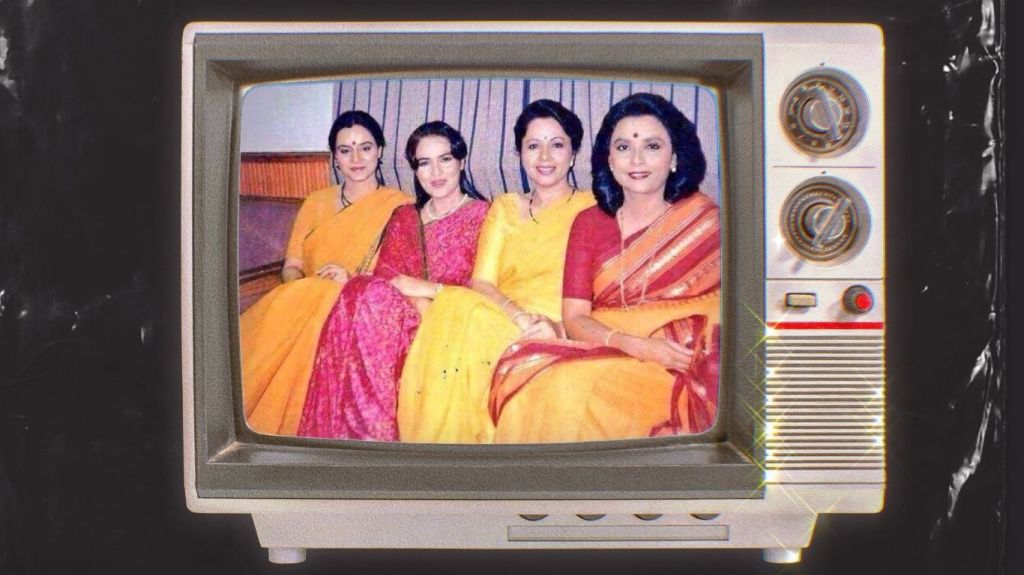
A world in black and white. Even when colour television arrived, memory insists on monochrome. A single channel. No remote control. Only a stubborn knob that had to be turned with intent. No scrolling grid of options, no frantic surfing. If the picture blurred, someone was dispatched to the terrace to adjust the antenna, shouting down instructions: ‘Thoda aur left! Bas, bas, wahan!’ While the rest of the family squinted at the screen below. The television set sat like a piece of furniture, often encased in polished wood and crowned with a lace cover. It was not background noise; it was an event.
There was a time in India when the nation gathered not around outrage, but around a voice. The Doordarshan signature tune floated into living rooms across the country, solemn, almost ceremonial. The television set, occasionally revived with a gentle thump on its side, flickered to life. Families assembled. Conversations hushed. And then, in crisp, unhurried diction, the news began.
For those of us who came of age in the 1980s, the news had a face, and more important, a temperament. J.V. Raman. Minu Talwar. Sheila Chaman. Tejeshwar Singh. Sarla Maheshwari. Salma Sultan. Rini Simon. Geetanjali Iyer. They were not celebrities in the modern sense. They did not trend. They did not opine. They did not interrupt one another. They simply read the news. And in doing so, they became icons.
The passing of Sarla Maheshwari feels like the dimming of a certain light from that era. Not merely because she was a familiar face on our screens, but because she belonged to a generation of broadcasters who practised a form of journalism that now seems almost antique: measured, composed, restrained. I had hoped to see her once, years later. When Om Books International published Sheila Chaman’s memoir, Doordarshan Diaries, Sheila had promised to take me to meet Sarla Maheshwari and present her with a copy. By then Sarla was unwell; too frail, too tired to receive visitors. The meeting never happened. In a curious way, I am grateful. I have preserved the image I carried all my life: the upright figure behind the desk, the precise diction, the calm gaze into the camera. Not the diminished body illness would have imposed upon that memory. Some icons we meet in person; others we protect in recollection.
It was an era before ‘breaking news’ became a graphic assault. In those days, the breaking of world-changing events happened in even tones. Assassinations, elections, wars, economic upheavals – everything was conveyed with a steadiness that suggested not indifference but responsibility. The newsreader was not the story. The news was.
When Indira Gandhi was assassinated in 1984, the nation heard the confirmation in the same calm cadence that had announced agricultural reforms and cultural festivals. That composure did not lessen the gravity; if anything, it heightened it. The steadiness of the voice allowed the enormity of the event to settle upon us without theatrics. There was a kind of moral contract at play. The newsreader would not inflame your emotions; you were trusted to respond with your own. In that space of restraint, viewers processed grief, shock, pride, or hope without being told how to feel.
Salma Sultan, with her trademark rose tucked into her hair, brought a grace that felt almost poetic. Years later, at book events, I would see her in person, still dignified, still self-contained, and feel a faint, almost childlike awe. Here was the face that had once entered our living room every evening. The distance between screen and spectator collapsed, but the aura remained.
Minu Talwar offered another glimpse behind that composed façade when I met her in conversation for a book titled Romancing the 80s. She spoke of fan mail – reams of letters arriving from across the country, some earnest, some eccentric, some bordering on the surreal. In a pre-social media age, admiration travelled by post. The envelope was the notification bell. There was something touching about that slower, stranger world of connection, where viewers poured out their feelings in ink and awaited a reply that might never come.
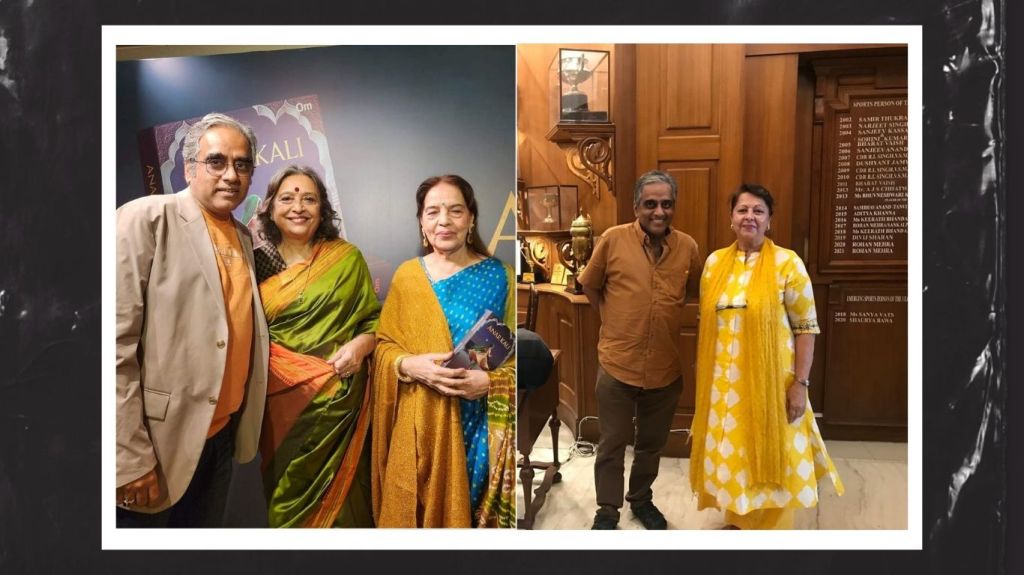
Sheila Chaman, too, became more than a face on a screen when I worked with her on Doordarshan Diaries. Editing her memoir, hearing about studio protocols, rehearsals, last-minute script changes, one realised how much discipline underpinned that apparent ease. They were trained to enunciate, to pause correctly, to respect punctuation. The camera did not zoom dramatically; the graphics did not flash in alarming reds. A simple desk. A neutral backdrop. A sheaf of papers. Occasionally, a still photograph or a brief film clip. The emphasis was on clarity, not spectacle.
And yet, do not mistake composure for blandness. The 1980s tested India profoundly. Political turbulence, insurgencies, assassinations, communal tensions, technological shifts. Through it all, these newsreaders remained steady conduits. J.V. Raman and Tejeshwar Singh carried a quiet gravitas; their baritones suggested institutions that would endure beyond immediate crises. Tejeshwar Singh memorably went on to star as a villain in Pankaj Parashar’s Jalwa (1987). His name in the film? What else, but DD!
Geetanjali Iyer combined elegance with impeccable diction, her delivery so precise it could have been used as a textbook. Rini Simon had a warmth that did not dilute her authority. Minu Talwar and Sheila Chaman projected clarity and confidence at a time when women on television were still negotiating a public space shaped largely by men. Sarla Maheshwari, poised and precise, was part of that reassuring nightly ritual.
Part of what made them iconic was scarcity. Doordarshan was the sole broadcaster for most of the decade. When the news came on, millions were watching the same bulletin at the same time. There was a collective rhythm to the evening. The news was not consumed individually on handheld devices but communally, often with three generations in the room. Children absorbed cadence and vocabulary; elders nodded at familiar references; parents occasionally silenced anyone who dared to speak over the bulletin. Language mattered. Pronunciation mattered. These newsreaders became inadvertent teachers. For many in small towns, their English and Hindi set benchmarks. There was no rush to outpace a rival channel. There was only the script, the camera, and the responsibility to get it right.
Contrast that with today’s decibel-driven landscape. News anchors perform. They provoke. They prosecute. Panels shout. Graphics explode. Silence is treated as failure. In the 1980s, silence was respect. A pause after a sentence could carry as much weight as the sentence itself. The 1980s newsreader did not compete with the story. There was no raised eyebrow to suggest scepticism, no smirk to imply superiority, no rhetorical flourish to provoke outrage. The neutrality, sometimes criticised as stiffness, was, in retrospect, a form of respect for the viewer’s intelligence. A refusal to convert information into spectacle.
It would be naïve to romanticise the era entirely. Doordarshan operated within governmental structures; editorial independence was not absolute. Access to diverse perspectives was limited. It was state-run, certainly, and not free from criticism about its proximity to power. Yet within that framework, the newsreaders cultivated a professionalism that transcended ideology. They were not there to editorialise. Their task was to inform. What we have arguably lost in our multiplicity of voices is a certain civility of tone.
When we recall these names, we remember not just faces but feelings: reassurance, steadiness, trust. They entered our homes without clamour and left without theatrics. Their celebrity was quiet, almost reluctant. They did not cultivate brands; they cultivated credibility. And they looked the part. Not in the stylised, hyper-curated manner of contemporary television, but with an understated dignity. Crisp saris. Simple suits. Minimal makeup. No dramatic gestures. The authority emanated from their bearing. They sat upright, looked directly into the camera, and spoke as if addressing each household personally.
Sarla Maheshwari belonged to that school of presentation. Those who worked with her often speak of meticulous preparation and quiet commitment. It was a job treated as a vocation. The bulletin was not an opportunity for self-branding but an obligation to accuracy and decorum. The passing of Sarla Maheshwari is not merely the loss of an individual but the fading of a generation that believed news could be firm without being ferocious, serious without being shrill. For those of us who grew up adjusting antennas on terraces and waiting for that solemn signature tune, their voices still echo: calm, deliberate, dignified.
In a time of perpetual noise, that echo feels less like nostalgia and more like a benchmark. Today, as bulletins fracture into hashtags and headlines morph by the minute, one sometimes longs for that old Doordarshan tune and the composed face that followed it. Not because the past was perfect, but because it was measured. Because it believed that information need not be delivered at fever pitch to matter. A reminder that once upon a not-so-distant time, a nation gathered in living rooms, not to be inflamed, but to be informed. And that a single, steady voice was enough.
 Shantanu Ray Chaudhuri
Leave a comment