From matka-lined beaches to mustard fields, from tulip dreams to middle-class terraces, here’s Hindi cinema’s ten most successful screen couples – pairs that shaped stardom, stirred gossip, rewrote box-office history and defined how generations imagined love. Plus, a Bengali bonus that towers above them all.
10. Jeetendra-Sridevi
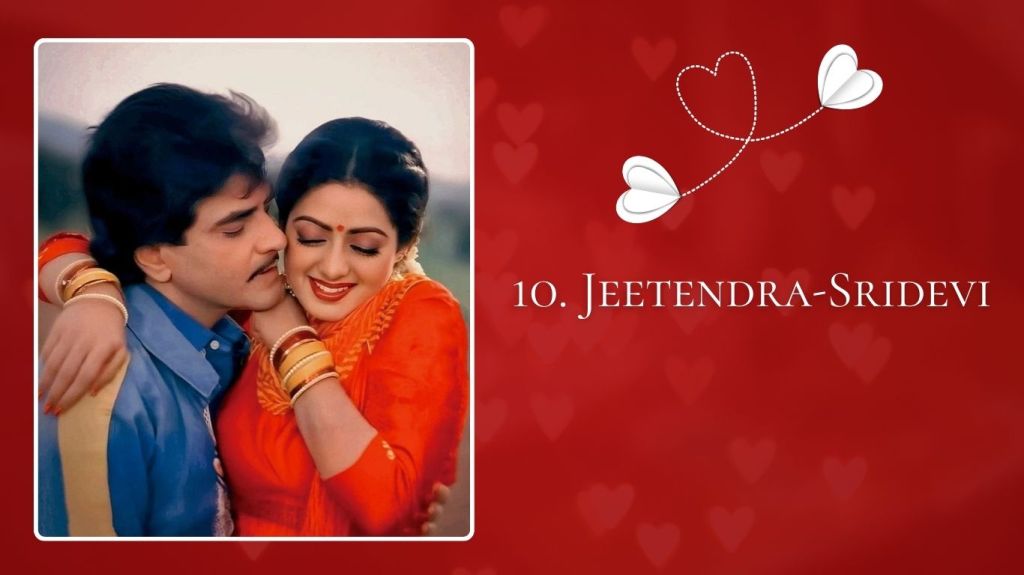
Go ahead, snigger all you can. Shake your head in disbelief. Scoff at my lack of aesthetic sense. Get on your high horse as connoisseurs of good cinema. But for those who came of age in the 1980s, there was no getting away from Jeetendra and Sridevi. Between Himmatwala in 1983 and Sone Pe Suhaga in 1988, they did a whopping sixteen films together, with only three of them failing at the box office. Jeetendra would go on to call Sridevi and Jaya Prada (cast in many of these films) as his bread and butter. Riding as much on the much-reviled music of Bappi Lahiri, these films were game changers that set new standards in garish costumes and ushered in new trends in choreography (rows upon rows of matkas on beaches) and music. For those who dismiss these films for everything they symbolized, remember that from the ridiculous (‘Ui amma, ui amma’ in Maawali) to the retro chic (‘Ooh la la’ in The Dirty Picture) is just a matter of a generation or two.
9. Mithun Chakraborty-Ranjeeta / Mithun Chakraborty-Sridevi
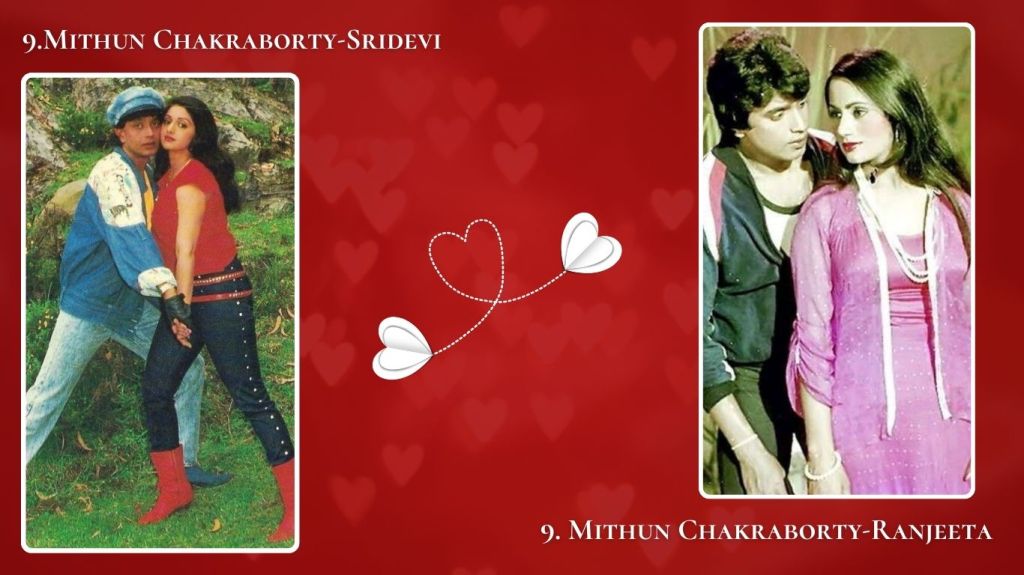
In the early days before he hit it big with Disco Dancer, Mithun Chakraborty and Ranjeeta made quite a winning combination in a series of films, mostly from the Rajshri/Tarachand Barjatya stable. Though most of these have little popular recall anymore, for those belonging to the era, films like Tarana, Ustadi Ustad Se and Sun Sajna might evoke memories of a simpler time with melodies like ‘Gunche lage hai kahne’ and ‘Saathi teray naam’ still capable of tugging at the heartstrings. There were also the B-grade ‘classics’ directed by Ravikanth Nagaich – Surakksha and Laparwah among them – that had some foot-stomping music by Bappi Lahiri that made this couple a favourite among the audience.
The Mithun-Sridevi combination was another matter altogether. Only four films together, three of them of abysmal quality, eminently forgettable masala potboilers – their only film that had some aesthetic pretensions was Jaag Utha Insaan, directed by K. Viswanath who passed away recently – and yet the rumour mills, speculating on the couple’s real-life equation, have been on overdrive for over forty years. Onscreen they were at best the poor man’s Amitabh-Rekha, with very little of their alleged off-screen chemistry making it to the films they were part of. Three of their four films were hugely successful (the cringeworthy Watan Ke Rakhwale was among the top ten money spinners of the year while Guru had the biggest opening for a film of the era) before they suddenly stopped appearing together.
8. Shah Rukh Khan-Kajol / Aamir Khan-Juhi Chawla
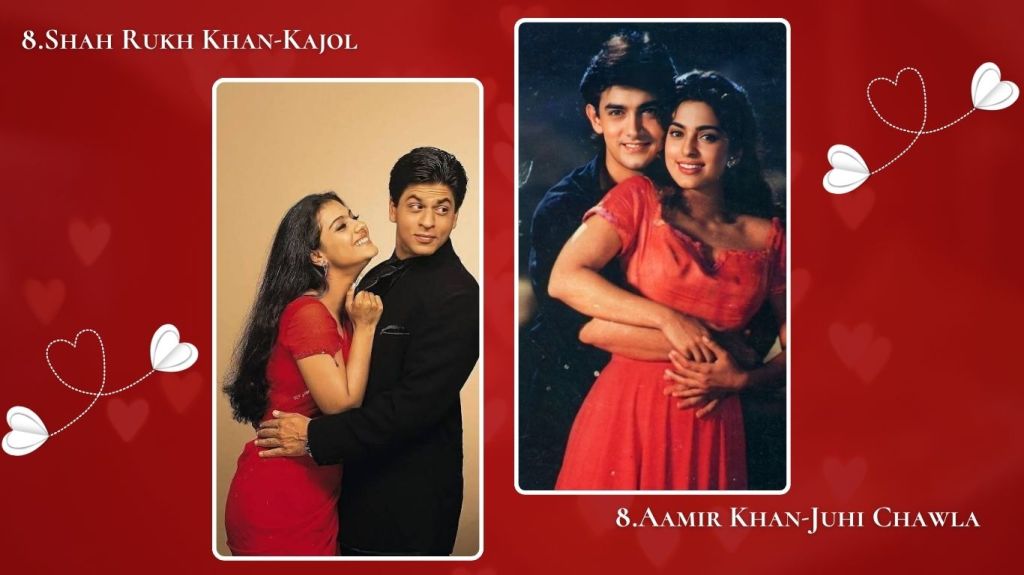
The power couples who ushered in a new look and feel to Hindi cinema in the 1990s. This foursome made Bollywood what it is today. Aamir Khan and Juhi Chawla were first off the block with Qayamat Se Qayamat Tak, which changed the course of the industry floundering in the late 1980s. Despite clangers like Love Love Love and Tum Meray Ho, the bubbly couple have endured in public memory with hits like Hum Hai Rahi Pyaar Ke. Juhi Chawla made a successful combination with Shah Rukh Khan too in Yes Boss, Raju Bann Gaya Gentleman and the film that catapulted SRK to superstardom, Darr.
SRK and Kajol went on to become the hottest onscreen couple with Dilwale Dulhania Le Jayenge which almost single-handedly rewrote the demographic of the Hindi film audience. Before that there was of course Baazigar which proved a turning point in SRK’s career. Films like Karan Arjun, Kuch Kuch Hota Hai and Kabhi Khushi Kabhi Gham cemented their reputation as one of Bollywood’s most successful onscreen pairs, though none of these appealed to me personally. Which explains why I have this couple at number 8.
7. Raj Kapoor-Nargis
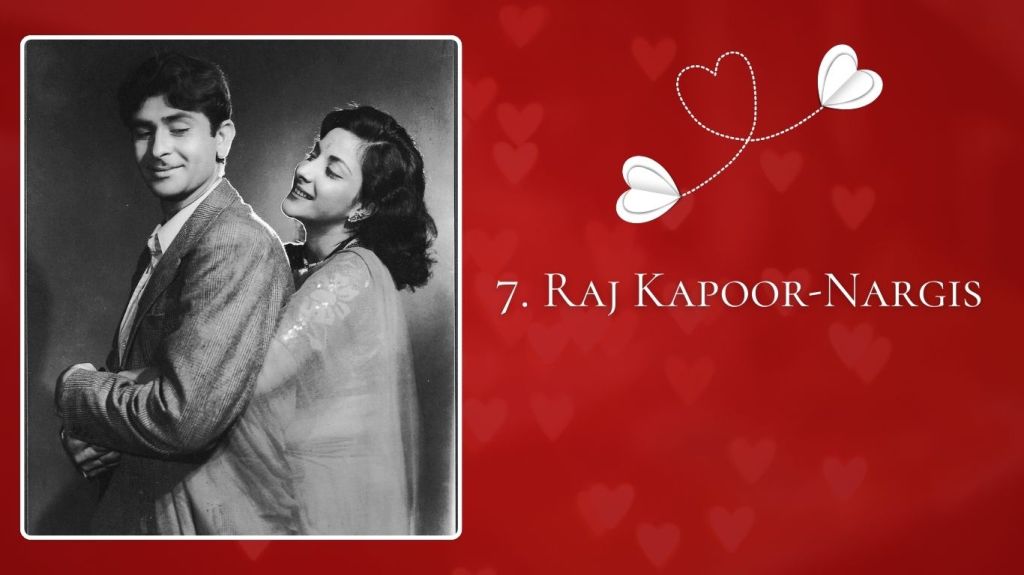
Sixteen films together over a period of ten years, most of them celebrated as classics of Indian cinema. For purists and apologists of the ‘golden era’ of Hindi cinema, people who swear by the films of the 1950s, Raj Kapoor and Nargis at number 7 might well count as blasphemy. Popular opinion will most likely aver that this is the greatest of all romantic couples in Hindi cinema, largely driven by their real-life romance which played out in full public view. There is no doubt whatsoever about the cinematic brilliance of Awara and Shree 420 or the status of Barsaat as a ground-breaking film when it comes to the music and the studio and team it created. There are also striking visual elements that have been endlessly discussed – Raj Kapoor’s caveman approach to love in the way he handles Nargis is Awara, or the unforgettable shot accompanying the line ‘Main na rahungi, tum na rahoge, phir bhi rahengi nishaniyan’ in ‘Pyar hua ikraar hua’ in Shree 420. However, to me at a personal level, Raj Kapoor and Nargis never quite came across as ‘authentic’, if that is the word I am looking for. There’s a word in Bengali that’s almost impossible to translate – nyaka. Poulomi Das describes ‘nyakami’ as pretend coyness. I have never been able to watch a Raj Kapoor and Nargis film – barring Mehboob Khan’s Andaz – without that word cropping up in my mind. No wonder then that their best films came without each other – Nargis in Mother India and Raat Aur Din, Raj Kapoor in Jagte Raho (where Nargis makes a last-scene appearance with him), Phir Subah Hogi and Teesri Kasam.
6. Rajesh Khanna-Sharmila Tagore / Rajesh Khanna-Mumtaz
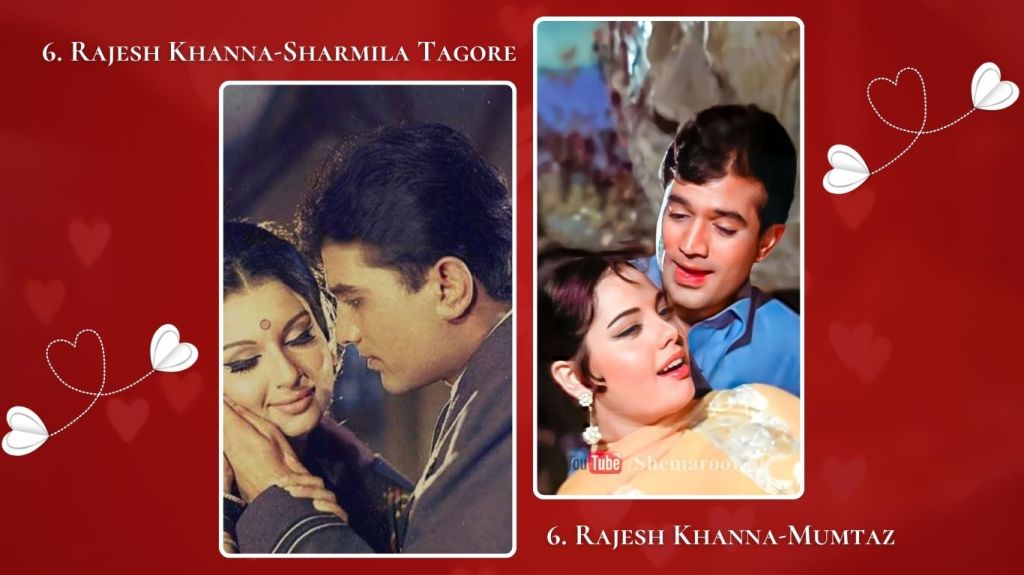
If Rajesh Khanna ruled Hindi cinema in the early 1970s, it was in no small measure due to his partnerships with two of the most successful actresses of the era. Both exuded a sensuality, markedly different from each other, in their films with Rajesh Khanna. If Sharmila Tagore scorched the screen with ‘Roop tera mastana’ (Aradhana), Mumtaz was at her flirtatious best with ‘Bindiya chamkegi’ (Do Raaste), two films that played an integral part in the creation of Rajesh Khanna the superstar. The two collaborations catered to two different demographics. If Rajesh Khanna and Sharmila Tagore oozed class in Amar Prem, Aavishkar, Safar and Daag, Mumtaz and Rajesh Khanna – their work together boasted a 100 per cent success rate at the box office – were the favourite of the masses in Sachhaa Jhootha, Dushman, Apna Desh and Roti. Between them, they accounted for fifteen of the superstar’s biggest hits in the purple patch he hit between 1969 and 1974, and were instrumental in creating the cult that was Rajesh Khanna.
5. Dharmendra-Hema Malini
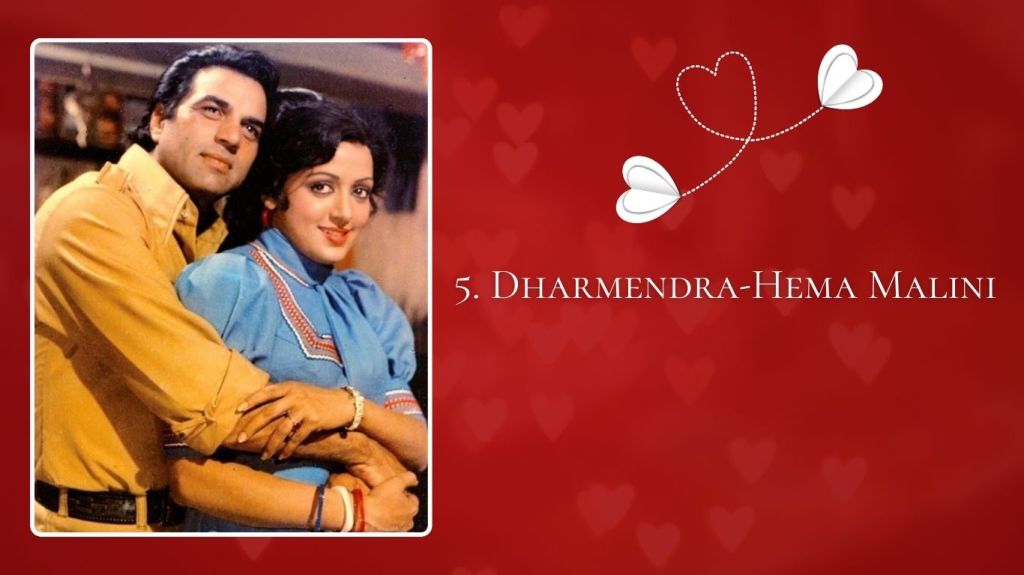
Arguably the most enduring and most successful onscreen couple in Hindi cinema, with thirty-four films together. From Sharafat in 1970 to Alibaba Aur Chalis Chor in 1980, they had an enviable track record of hits that defined the mainstream cinema of the decade – films like Sholay, Charas, Azaad, Jugnu, Chacha Bhatija, Partiggya, Raja Jani, among others. A run interrupted only when they tried their hands at something less ‘commercial’, for example, Naya Zamana or Dillagi (incidentally my favourite film starring the duo). Not for them the coyness or juvenility that marked a majority of romantic tracks in Hindi cinema of the era. Also missing was a chartbusting soundtrack – although a song or two would invariably scale the charts, I am hard-pressed to remember a true-blue love song or album featuring the two – that was a sine qua non for romantic leads of the era. The vibes between them were palpable, and mature. These were lovers supremely confident of themselves, helped no doubt by the fact that Hema Malini was a superstar in her own right, a rare leading lady who could carry a film on her shoulders, as was the case with Seeta Aur Geeta or Dream Girl (both films starring Dharmendra but with Hema Malini getting top billing).
4. Dilip Kumar-Vyjayanthimala
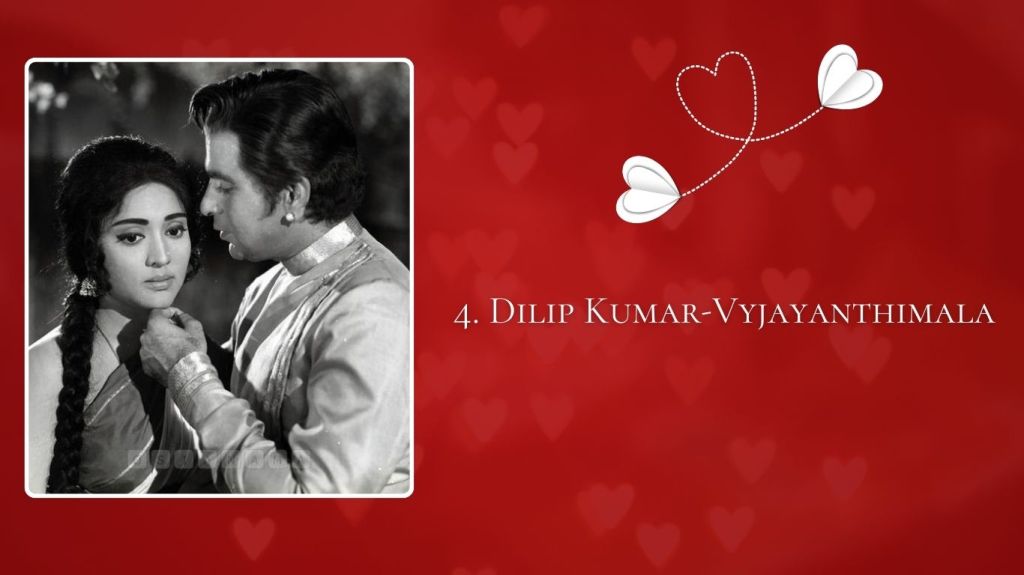
Though it is Madhubala who will forever remained hyphenated with Dilip Kumar in the popular imagination (thanks primarily to Mughal-e-Azam and their real-life romance), it is with Vyjayanthimala that Dilip Kumar has a more important body of work. Starting with Bimal Roy’s Devdas in 1955 (the definitive film version of the Saratchandra Chatterjee classic), the duo delivered a string of commercially successful and critically acclaimed films. It is remarkable how many of the films featuring them together rank among the finest of Indian films, as pioneering works of cinema. These include Madhumati, Naya Daur, Gunga Jumna, Paigham and Sunghursh, with only Leader coming a cropper both financially and critically. Though the duo co-starred in only a handful of films, the quality these offer make Dilip Kumar and Vyjayanthimala one of the best onscreen couples in Hindi cinema.
3. Amitabh Bachchan-Rekha

The biggest star of Indian cinema, Amitabh Bachchan, had several popular leading ladies starring opposite him. Jaya Bhaduri in the early phase of his career (Ek Nazar, Bansi Birju, Zanjeer, Abhimaan and Mili, among others), when no one wanted to be cast opposite the struggler. Zeenat Aman had blockbusters like Don, Laawaris, Dostana, Mahaan and The Great Gambler. Parveen Babi starred in the big box-office successes Deewaar, Amar Akbar Anthony, Majboor, Kaalia and Shaan. There was Raakhee with the mature romances of Kabhi Kabhie, Bemisaal, Jurmana and Kala Pathar. And Hema Malini with the fun and folic of Naseeb and Satte Pe Satta.
But there was something about the equation between Rekha and Amitabh Bachchan that spelt magic like no one else did. Starting off with Do Anjaane, where they play a bickering couple, they enchanted audiences with their chemistry in films like Khoon Pasina and Mr Natwarlal (sample the exchanges between the two in these two films – which star Rekha in diametrically opposite roles, a tough-as-nails belle with a mind of her own in the former and a rather slow-witted one in the latter – for sheer chutzpah). For those who love their romances serious and intense, there was Muqaddar Ka Sikandar with its exquisite ‘Salaam-e-ishq meri jaan’ and my personal favourite, Alaap, one of the biggest flops of Amitabh Bachchan’s career. And tulips have never looked lovelier or romance appeared as alluring as when Amitabh and Rekha crooned ‘Dekha ek khwab toh yeh silsile hue’, setting in motion a million silsilas of love. It is one of the tragedies of Hindi cinema that Yash Chopra’s dream of remaking The Bridges of Madison County with Amitabh and Rekha never got off the ground.
2. Rishi Kapoor-Neetu Singh
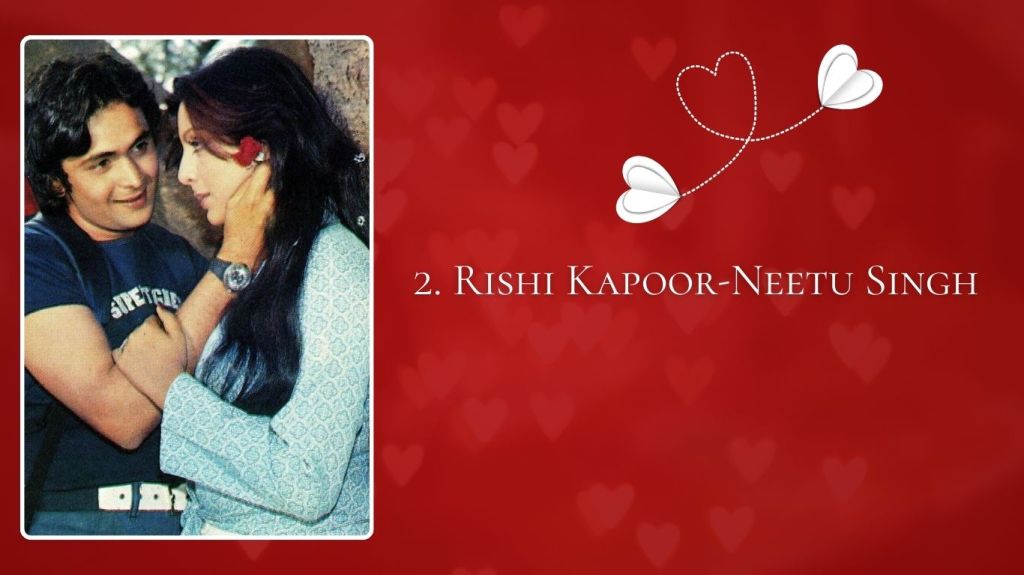
No other actor duo exemplified the joie de vivre, the ecstasy of being young and in love as well as Rishi Kapoor and Neetu Singh. Powered by some of the most loved songs in Hindi cinema – sample Doosra Aadmi and Jhootha Kahin Ka, for example – they epitomized youthfulness like no other. Even close to fifty years after Khel Khel Mein was made, its songs ‘Ek main aur ek tu’ and ‘Khullam khulla pyar karenge’ remain the last word in cool and trendy. In multi-starrers like Amar Akbar Anthony and Kabhi Kabhie, they not only managed to hold their own, but their romantic tracks, and the songs they romanced to, gave the bigger stars a run for their money. And forty years after Neetu Singh opted out of films with Dhan Daulat, the couple reunited with the bitter-sweet Do Dooni Char and the outrageous Besharam where their turns as the middle-class Punjabi couple, the Duggals, and as the Haryanvi cops Chulbul and Bulbul Chautala, respectively, proved that the chemistry had survived the four-decade-long hiatus.
1. Farooq Shaikh-Deepti Naval
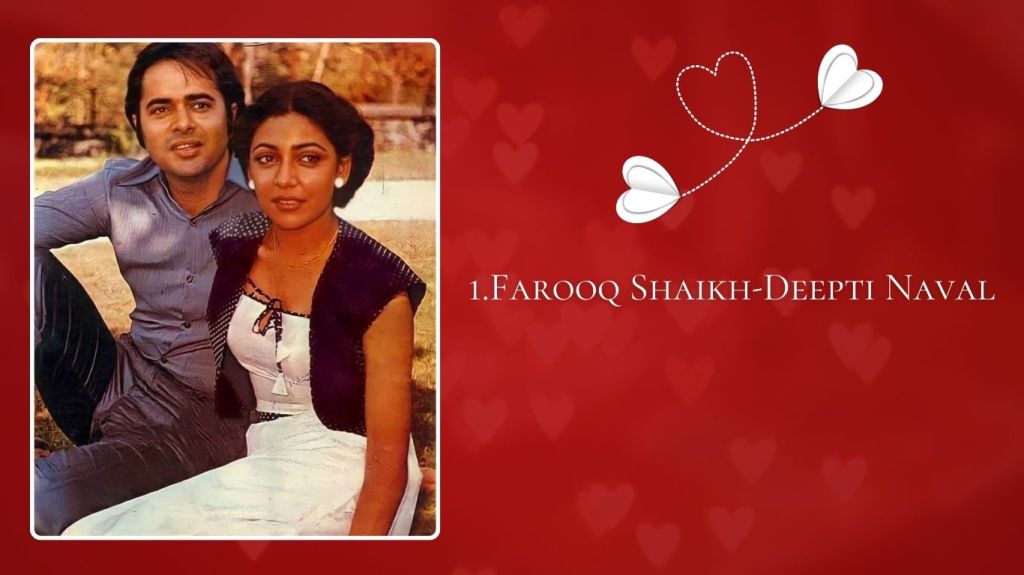
‘Tumko dekha toh yeh khayal aaya’ – the longing that marks Farooq Shaikh’s visage and the radiance on Deepti Naval’s. Even if the two actors had not done anything else, this song, and this film, Saath Saath, would have been enough for them to top this list. Not to mention that they also gave us pure joy in Chashme Buddoor, Katha, Rang Birangi, Kisise Na Kehna – films that made the last of what came to be called ‘middle-of-the-road cinema’. The others in this list might have more successful films, they may have had a larger fan following, bigger chartbusters, but no one conveyed the sheer innocence of being in love onscreen better. ‘Love is not merely looking at each other, but looking in the same direction … together’, the end title card of Saath Saath says. And no other onscreen couple made love so desirable, so attainable as Farooq Shaikh and Deepti Naval.
PS: The Bonus
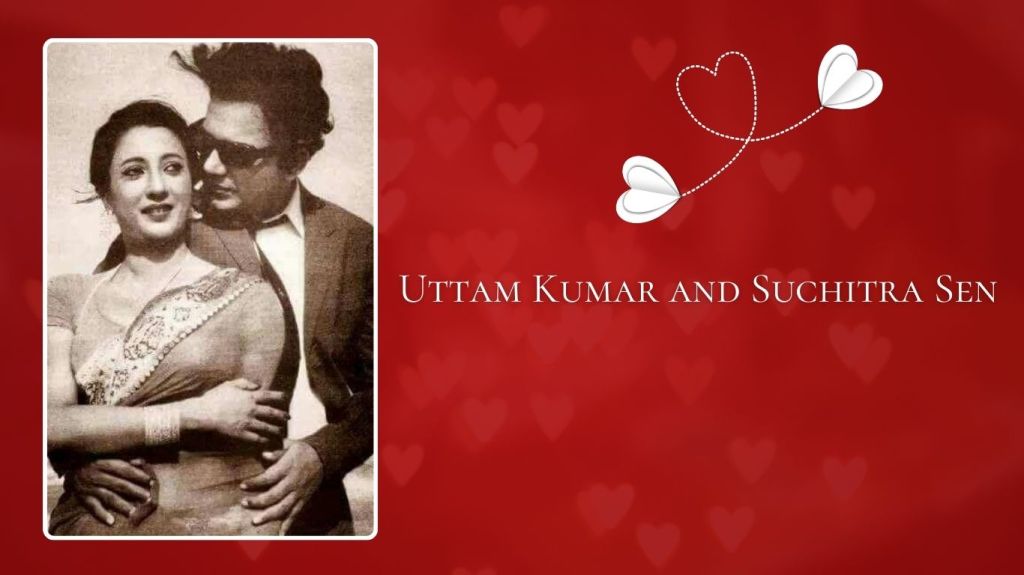
Being a Bengali, I cannot but help include this one couple. And rank them as the best across languages. Both acted in Hindi films, though never together, mercifully because their combined accents would have made it tough to endure. But what Uttam Kumar and Suchitra Sen achieved in Bengali cinema is the stuff of legends. This was a couple who revived an industry severely affected by the partition and facing a crisis of confidence. Starting with the romantic comedy Saare Chuattar in 1953, followed by Agni Pariksha the next year, going up to Grihadaha in 1967 and Haar Maana Haar in 1972 and Priyo Bandhobi in 1975, their last film together, they starred in thirty films opposite each other with 90 per cent of these being massive hits, as Maitreyee B. Chowdhury, author of Uttam Kumar and Suchitra Sen: Bengali Cinema’s First Couple, points out. Their films – including classics like Harano Sur, Saptapadi, Indrani and Sagarika – revolutionized romance in Bengali cinema, and even fifty years after their last film together, the consensus is: there is no other star couple who epitomized love better. As Maitreyee B. Chowdhury says, ‘They were definitely the most loved. More than the ones you have mentioned. All the other iconic pairs were famous, yes, talked about, gossiped about. But I doubt if any other pair commanded the mass frenzy that Uttam and Suchitra did. In that they were unique.’ If romance in cinema has a face it is that of Uttam and Suchitra.
 Shantanu Ray Chaudhuri
Leave a comment