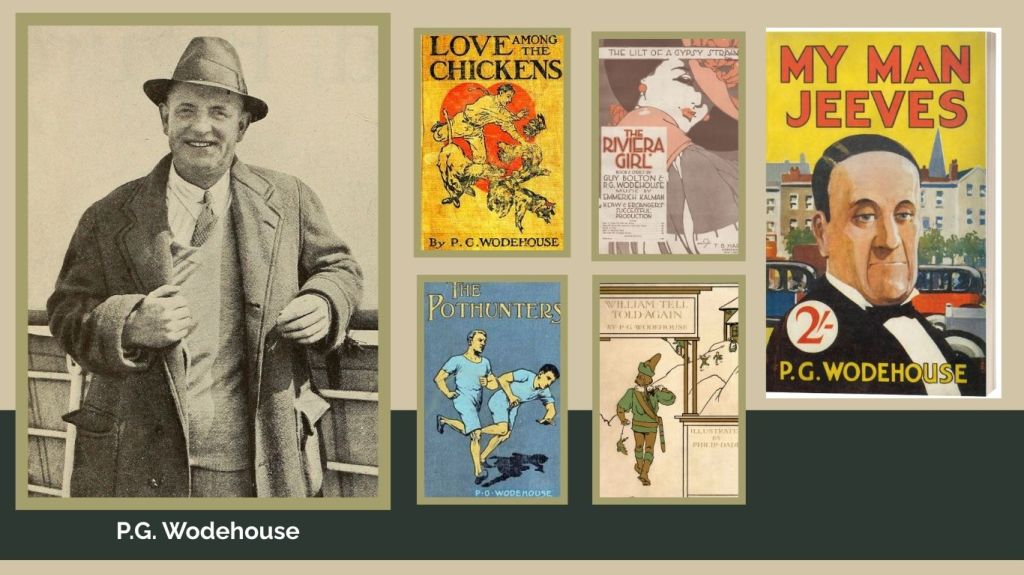
‘I believe there are two ways of writing novels. One is mine, making a sort of musical comedy without music and ignoring real life altogether; the other is going right deep down into life and not caring a damn…’ P.G. Wodehouse wrote in his introduction to Life with Jeeves. And it is this aspect of ‘not caring a damn’ that makes reading Wodehouse so pleasurable.
*
‘I could see that, if not actually disgruntled, he was far from being gruntled.’ – The Code of the Woosters
*
‘What ho!’ I said.
‘What ho!’ said Motty.
‘What ho! What ho!’
‘What ho! What ho! What ho!’
After that it seemed rather difficult to go on with the conversation.’ – My Man Jeeves
*
‘It was one of those cases where you approve the broad, general principle of an idea but can’t help being in a bit of a twitter at the prospect of putting it into practical effect. I explained this to Jeeves, and he said much the same thing had bothered Hamlet.’ – Jeeves in the Morning
*
I came to Wodehouse in my early twenties, at precisely the age when life begins to feel unnecessarily earnest. Careers were to be chosen, convictions defended, futures fretted over, and into this tightening world drifted a voice that treated seriousness as a mild social faux pas. I don’t remember which book it was, only the sensation of relief. Here was a writer who could diagnose a mood with a single word: ‘if not actually disgruntled, he was far from being gruntled’, and, in doing so, make the very act of feeling lighter. His characters conversed not to exchange information but to delight in the absurdity of speech itself: ‘What ho!’ answered by another ‘What ho!’, until language politely gave up and sat down. And then there was Wodehouse’s supreme trick: taking the great anxieties of literature and gently puncturing them. When Jeeves remarks that Hamlet was troubled by much the same hesitation about putting ideas into practice, the canon wobbles and the world suddenly seems survivable.
Thirty years on, the affair has not cooled. Few pleasures are more reliably pleasurable than reading a few pages of Wodehouse before sleep. The mind loosens, the day’s solemnities retreat, and you find yourself smiling, quietly, gratefully, to yourself.
Does reading for pleasure still matter? In a culture saturated by screens, governed by algorithms, and trained to skim rather than dwell, the question can sound faintly antiquarian. And yet reading remains one of the most intimate and sustaining human practices, not merely a vehicle for information or instruction, but a means of shaping inner life. While reading undertaken for work or study continues to command respect, recreational reading is often treated as inconsequential: a private indulgence, aesthetically neutral and ethically weightless.
Where does that place P.G. Wodehouse? In an era where business books, self-help and fitness books rule the charts, how does one account for the sheer joy of the Wodehousian la la land? Yet, what we read for pleasure matters profoundly. It trains attention, calibrates emotional response, and quietly forms sensibility. Few writers make this clearer, or more joyfully, than P.G. Wodehouse, whose comic fiction offers not escape so much as restoration.
The place of recreation within a good life has long occupied philosophers. Aristotle, writing on happiness and human flourishing, dismissed the notion that amusement could be life’s final goal. To live only for pleasure, he thought, was a childish error. Yet he was equally clear that rest and diversion are necessary to sustain serious activity. Without intervals of refreshment, the mind falters; without pleasure, effort curdles. Recreation, properly understood, is not an alternative to work or thought but a condition that makes both possible. The real question, then, is not whether one should read for pleasure, but what kind of pleasure renews rather than depletes.
The word ‘recreation’ itself points to renewal. Reading chosen freely and read attentively can restore mental balance, allowing one to return to obligation and reflection with greater steadiness. But not all pleasure functions this way. Some books overstimulate, some deaden, others leave behind a residue of fatigue. Early twentieth-century writers on the intellectual life, most notably Antoine-Gilbert Sertillanges, insisted that even reading meant for relaxation required discrimination. True rest, he argued, is inseparable from joy, and joy emerges only when pleasure remains in harmony with intelligence, imagination, and moral temper.
By that measure, Wodehouse’s fiction occupies a distinctive and enviable position. Across more than seventy years, he produced a vast body of work – novels, short stories, plays, lyrics – that has never fallen out of circulation. His admirers range from high modernists to popular entertainers, from T.S. Eliot to Evelyn Waugh to Salman Rushdie. Such longevity is not accidental. It suggests that Wodehouse offers a form of pleasure that does not exhaust itself, a delight that can be returned to without diminishing returns.
Wodehouse famously described his novels as ‘musical comedies without music’, and the description is exact. His fictional universe, loosely anchored in Edwardian and interwar England, with occasional transatlantic detours, is governed by its own rules of proportion and benevolence. Country houses, gentlemen’s clubs, market towns, pubs, and golf courses recur with ritual regularity, populated by a cast of figures at once extravagantly comic and deeply familiar. This is a world in which inconvenience, embarrassment, and emotional distress abound, but catastrophe never quite arrives.
Blandings Castle stands at the centre of this universe. Presided over by the absent-minded Lord Emsworth, whose chief loyalties are to his garden and his prize pig, Blandings is a haven of pastoral absurdity. Emsworth is endlessly harried by sisters, secretaries, impostors, and schemers, yet he remains curiously unruffled. His stubborn devotion to leisure, far from being a moral failing, emerges as a quiet resistance to the tyranny of urgency. In Wodehouse’s hands, contentment becomes a virtue, not triumphant or heroic, but gently insistent.
Other sequences elaborate the same comic philosophy. The Mulliner stories, narrated in a country pub, transform family genealogy into an inexhaustible engine of farce. The golf stories told by the ‘Oldest Member’ elevate sporting humiliation into something approaching metaphysics. In these tales, ambition is intense, rivalry is fierce, and vanity is rampant, yet the consequences never exceed the comic scale. The stakes are serious enough to engage attention, never grave enough to wound. It is this precise calibration that makes the pleasure durable.
Most beloved, of course, are the stories of the Drones Club and the partnership between Bertie Wooster and his valet, Jeeves. Bertie, amiable, well-intentioned, and spectacularly dim, drifts into social calamity with unfailing regularity: ill-advised engagements, catastrophic fancy-dress costumes, ill-considered promises to terrifying aunts. Jeeves, urbane and omniscient, restores order with tact, foresight, and an encyclopaedic grasp of human weakness. Their relationship is not merely comic but oddly civilized: intelligence serves kindness, and superiority expresses itself through discretion rather than domination.
Beyond Bertie, Jeeves, and the rest of the inner circle, Wodehouse populated his universe with a deliriously assorted supporting cast, each seemingly designed to make life more complicated and infinitely more amusing.
There is Psmith – monocled, mellifluous, and magnificently unflappable – gliding through adversity like a well-dressed philosopher-adventurer; Uncle Fred, Lord Ickenham, whose benevolent mania for practical jokes turns respectable households into zones of cheerful anarchy; and poor Bingo Little, forever tumbling headlong into love and debt with equal enthusiasm.
Gussie Fink-Nottle, the shy newt-fancier, trembles through life with a valedictorian’s terror, while Aunt Dahlia barrels through it on horseback, swearing affectionately, running Milady’s Boudoir, and presiding over the culinary miracles of Anatole, whose sauces can cause grown men to weep.
Looming in darker corners are Roderick Spode, absurdly fascist and genuinely alarming, and Rupert Baxter, the hawk-eyed secretary whose devotion to efficiency makes him the natural enemy of joy at Blandings. Add to this Madeline Bassett with her cosmic similes, Freddie Threepwood and his eternally disastrous ‘business ideas’, Lord Tilbury’s newspaperman ruthlessness, and the gloriously trouble-prone Bobbie Wickham, and you have a world where menace is always comic, romance always inconvenient, and happiness forever one misunderstanding away.
Taken together, these figures form a comic ecosystem in perfect balance, where every attempt at order invites glorious disorder. It is this teeming, affectionate profusion of humanity – ridiculous, recognizable, and somehow indestructible – that gives Wodehouse’s world its inexhaustible charm and its enduring hold on the reader.
Much of the pleasure of Wodehouse lies in the architecture of his plots. These are works of extraordinary mechanical elegance, constructed from misunderstandings that pile up with mathematical precision. Each new complication appears to close off every route to resolution, yet the final chapters re-establish harmony with almost miraculous inevitability. The reader’s pleasure arises not only from laughter but from suspense, from the assurance that chaos will be transmuted into order without cruelty or moral abrasion.
Language, however, is Wodehouse’s supreme instrument. His prose sparkles with similes that collapse the distance between the lofty and the ludicrous. Emotional states are rendered through images drawn from zoology, meteorology, classical myth, and popular culture. Social embarrassment swells to epic proportions; minor shocks assume the force of natural disasters. These figures are not ornamental flourishes but engines of perception. They teach the reader how to see, how to savour, how to attend.
This verbal pleasure carries an intellectual charge. Wodehouse rewards alert reading. His sentences are rhythmically exact, his vocabulary expansive and mischievous. Classical references rub shoulders with slang; technical terms appear where least expected. One often pauses mid-paragraph, not out of confusion, but out of appreciation. Delight and attentiveness converge, reminding the reader that pleasure need not be mindless to be restorative.
The familiar objection is that Wodehouse is escapist, disengaged from social reality, indifferent to moral seriousness. But this criticism mistakes exclusion for evasion. Wodehouse does not deny difficulty; he sets it aside to illuminate something else. His world operates according to a moral logic in which bullying is deflated, pomposity punctured, and kindness quietly vindicated. Happy endings are not arbitrary consolations; they are the natural outcome of ingenuity, loyalty, and a willingness to recognise one’s own limitations.
As he himself made light of a critic in his own inimitable way: ‘A certain critic – for such men, I regret to say, do exist – made the nasty remark about my last novel that it contained “all the old Wodehouse characters under different names”. He has probably by now been eaten by bears, like the children who made mock of the prophet Elisha: but if he still survives he will not be able to make a similar charge against Summer Lightning. With my superior intelligence, I have out-generalled the man this time by putting in [in my new work] all the old Wodehouse characters under the same names. Pretty silly it will make him feel, I rather fancy.’
Crucially, Wodehouse’s comedy depends on recognition rather than ridicule. His characters are absurd because they are exaggerated versions of ourselves, our anxieties, self-deceptions, and petty ambitions made visible. Laughter, here, is not corrosive. It carries a tincture of self-knowledge. To laugh at Bertie Wooster is also to laugh at one’s own evasions and confusions, and such laughter has a bracing, humbling effect.
From a moral perspective, this matters. Pleasure rooted in affectionate understanding, rather than scorn, aligns closely with the kind of rest that renews rather than dissipates. Wodehouse’s humour is almost entirely free of malice. Even antagonists are ridiculous before they are reprehensible, and their defeat produces relief rather than vindictive satisfaction. Balance is restored, not imposed. His books distract without stupefying, delight without agitating, amuse without coarsening. They polish the ear, stretch the imagination, and quietly instruct through example. One finishes them lighter, not emptied; refreshed, not numbed.
That this pleasure has endured for over a century suggests it answers something durable in human nature. In periods of strain, overload, or fatigue, Wodehouse offers a form of consolation that avoids both sentimentality and despair. His fiction reassures us that experience remains intelligible, that disorder can be resolved, that human effort, however muddled, retains its comic dignity. This is no small gift.
To read Wodehouse, then, is not simply to fill idle hours. It is to engage with a tradition that treats wit as intelligence, laughter as insight, and pleasure as a companion to virtue. In a culture uneasy with joy and impatient with lightness, such reading performs a quietly civilizing function. It reminds us that happiness need not be frantic, that excellence can be graceful, and that recreation, properly chosen, sustains rather than undermines the serious business of living.
The pleasures of P.G. Wodehouse are inseparable from their restorative power. They re-create the reader, by easing tension, sharpening language, and illuminating folly without bitterness. If recreation is meant to ready us for life rather than distract us from it, few writers have accomplished that task with such consistency, elegance, and humane intelligence.
 Shantanu Ray Chaudhuri
Leave a comment