She remains the only actor to have worked with Satyajit Ray, Mrinal Sen, and Ritwik Ghatak, alongside masters such as Tapan Sinha and Tarun Majumdar. This essay turns the spotlight away from the canon to rediscover the films that slipped through the cracks, culminating in a sustained engagement with Dibaratrir Kabya, one of Indian cinema’s most exquisite performances, and one of its most unjustly forgotten, as also a film that needs to be rediscovered.
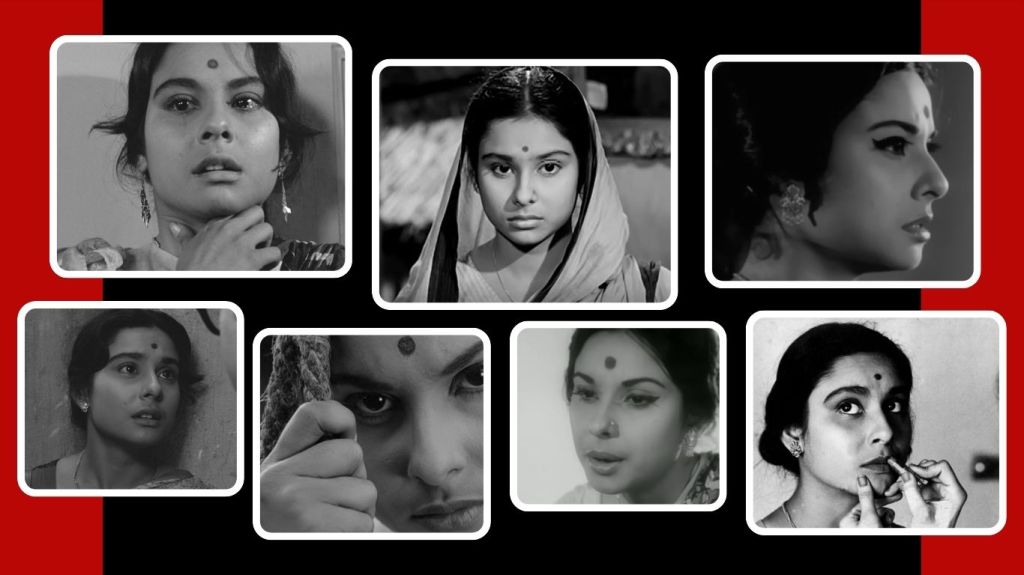
Ask any contemporary actor about her favourite role, the one she would give an arm and a leg to do, chances are it will either be Rina Brown (Saptapadi) or Charu (Charulata). The shadow Charulata has cast on popular imagination has arguably prevented a fuller appreciation of many of Madhabi Mukherjee’s other performances, including the one that fetched the actor her only National Award, Dibaratrir Kabya, not to mention Baishey Shravana, Kapurush, Mahanagar and Subarnarekha.
The one aspect that defines the best of Madhabi Mukherjee’s performances is the interiority that she brings to her characters, best articulated in the intensity of her eyes, in the frown that creases her brows, the gaze, more than anything extraordinary about her appearance, often unsettling the viewer. As Andrew Robinson has said: ‘… in Mahanagar [she is] all natural grace and intelligence; in Charulata [she] is so finely tuned that we can enter her every thought and feeling. That, far more than her physical appearance, which can look quite ordinary, is what makes her profoundly beautiful.’ This aspect of the ‘ordinary’ was also echoed by Mrinal Sen when he described her appearance as ‘extraordinarily ordinary’. According to film scholar Chidananada Dasgupta, ‘As the traditional middle-class housewife … Madhabi Mukherjee is the perfect embodiment of the woman torn between self-abnegation and self-respect … Even her looks are of the housewife lost in her chores who has secretly, in her somewhere, all the enticing mystery of woman.’
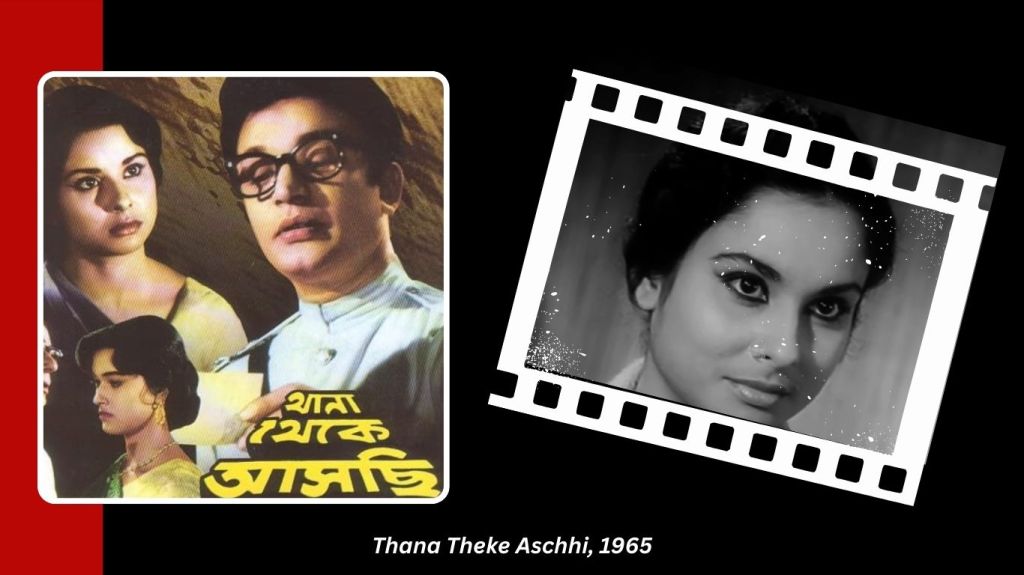
Thana Theke Aschhi, 1965
One of the things I have always admired about Madhabi is her ability to leave a mark in the smallest of roles. Take, for example, Agnishwar, an out-and-out Uttam Kumar vehicle (and a favourite Uttam performance). She barely has fifteen-odd minutes in the film, but it’s she who gives the film its redolent pathos. In Hiren Nag’s Thana Theke Aschhi, Madhabi appears only intermittently and has barely a couple of dialogues. In fact, till about the seventy-five-minute mark of this 100-minute film, she does not speak at all. Her eyes say it all, accusing, laying bare the hypocrisy of a morally corrupt society. It’s a virtuoso act, in the face of the remarkable line-up of actors she is ranged against: Uttam Kumar (though she does not have a scene with him), Kamal Mitra, Chhaya Devi and Anjana Bhowmik (just watch the subtle hint of a smile on Madhabi’s lips as Anjana tries on an ill-fitting coat – you can’t make out if she is being scornful, or whether she is smiling at all). Brilliantly adapted from J.B. Priestley’s An Inspector Calls, a biting comment on selfishness and avarice, couched as a mystery involving an unnatural death, Thana Theke Aschhi is a solid psychological drama that derives its strength from Madhabi’s haunting, silent portrayal.
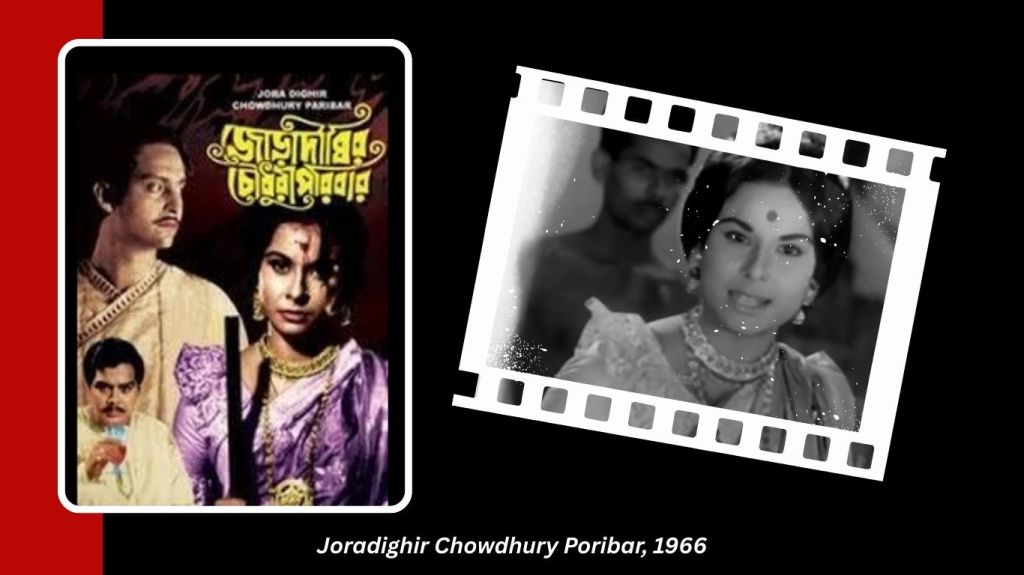
Joradighir Chowdhury Poribar, 1966
Based on a novel by novel by Pramathanath Bishi, with a screenplay by Mrinal Sen, this one is a strange beast. A credit title card mentions the Chowdhurys of Joradighi as having descended from a line of dacoits – ‘like any other profession, this too is one’, the card cheekily tells us. In the film’s prologue, we see one of the ancestors mistakenly killing his son-in-law, and that, another title card informs us, was the last of the Chowdhury dacoits, as the family evolved into zamindars. Its present scion is Dadababu (Soumitra Chatterjee), as he is referred to by his subjects. He, like his ancestors, loves musical soirees and hunting, but, as he tells his grandfather (wonderfully played by Kali Banerjee – the relationship between the two is a major highlight), hates the loot and plunder that is so much a part of the zamindari ethos. He is in love with and engaged to marry Indrani (Madhabi Mukherjee), the princess of the neighbouring zamindari, Raktadaha, with whom Joradighi has had a feuding relationship for generations. A twist of fate forces Soumitra to marry Banalata (Sabitri Chatterjee), whom he rescues from the clutches of evil zamindar Parantap Ray (Tarun Kumar), thus reigniting the old hostility with Raktadaha.
Indrani swears vengeance at what she perceives as betrayal. Dismissing suggestions that they put off the wedding date, she says, steel in her voice, ‘Kaaj jemon cholchhe cholbe’ (the arrangements will go on as decided), ‘we will show them what we are made of, how can we tolerate this humiliation.’ The very picture of a woman scorned she makes the extraordinary decision of marrying Parantap to spite her ex-lover. And on her own terms, with him living as ‘ghar jamai’. She rebuffs his advances on their wedding night, telling him clearly that she hates him, but silently acquiesces as he frames new rules of engagement with Joradighi that leads the two zamindaris towards a bloodbath.
Madhabi is a revelation as she, first, picks up the gun against her husband, then shames her subjects and exhorts them to ‘be men’ and fight the advancing Joradighi army. Imperious, she opens the Raktadaha gates to face the enemy and confronts her ex-lover, the prince of Joradighi, gun in hand. One seldom sees women in films taking up arms, and as essayed by Madhabi, Indrani joining the fight, taking control, is a startling, welcome contrast. This is one woman of steel, proud, not willing to be cowed into submission.
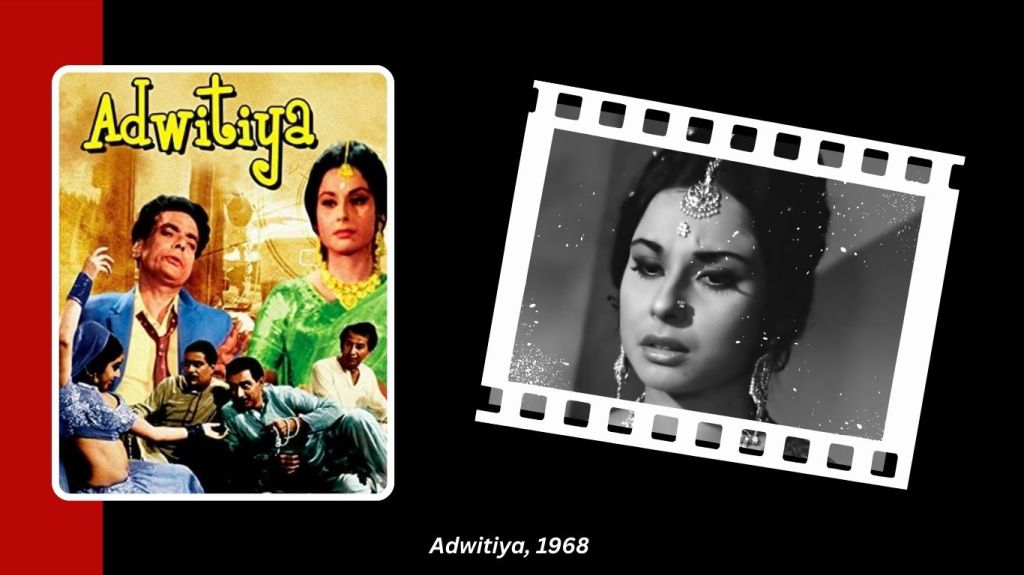
Adwitiya, 1968
Well before Nabyendu Chatterjee, debuting as a director with the Jeetendra starrer Naya Rasta (1966), gained national recognition in the late 1980s with arthouse works like Chopper (1987), Sarisreep (1987, arguably Dhritiman Chaterji’s finest performance, at par with the more celebrated Pratidwandi) and Parashuramer Kuthar (1989), he made Adwitiya, which boasts one of Madhabi’s most nuanced performances.
Her first appearance, the regal bearing, takes your breath away. Lokkhi has been in Darjeeling for a month on a change – ‘not of the mind,’ she tells her new acquaintance Rajeev rather cryptically. They do the usual touristy rounds of Tiger Hill at sunrise and a bond develops between the two, even though a letter from his mother informs them that she has selected a girl for his marriage. He falls grievously ill and she nurses him back to health before leaving Darjeeling suddenly, writing him a note that has no forwarding address. As she says in the note, she is one of no fixed address.
Back in Kolkata, Rajeev marries Ratna (a glowing Lily Chakraborty). Immediately afterwards, he comes across Lokkhi and discovers her profession as a baiji, all decked up, entertaining customers. The relationship picks up from where it left off in Darjeeling, as the narrative inexorably moves towards its inevitable climax, leaving in its wake lives and relationships destroyed.
Though cast in the hoary tradition of the courtesan with a golden heart, Madhabi gives the clichéd character a spin of her own. There’s something about her eyes that is mildly disconcerting and infinitely sad. There is no sense of the maudlin in her portrayal. Just watch her stomp off to rebuke the customers waiting for her and in almost the same breath returning, smiling demurely, hopelessly in love, to her room where Rajeev is waiting. For the large part a one-woman show, she has admirable support from Bikash Ray, playing her husband, who has forced her into the profession. If no one quite conveys pain through her eyes like Madhabi does, no one dangles a cigarette from the corner of his mouth like Bikash Ray. And the two of them make this Nabyendu Chatterjee directorial a cut above the rest.
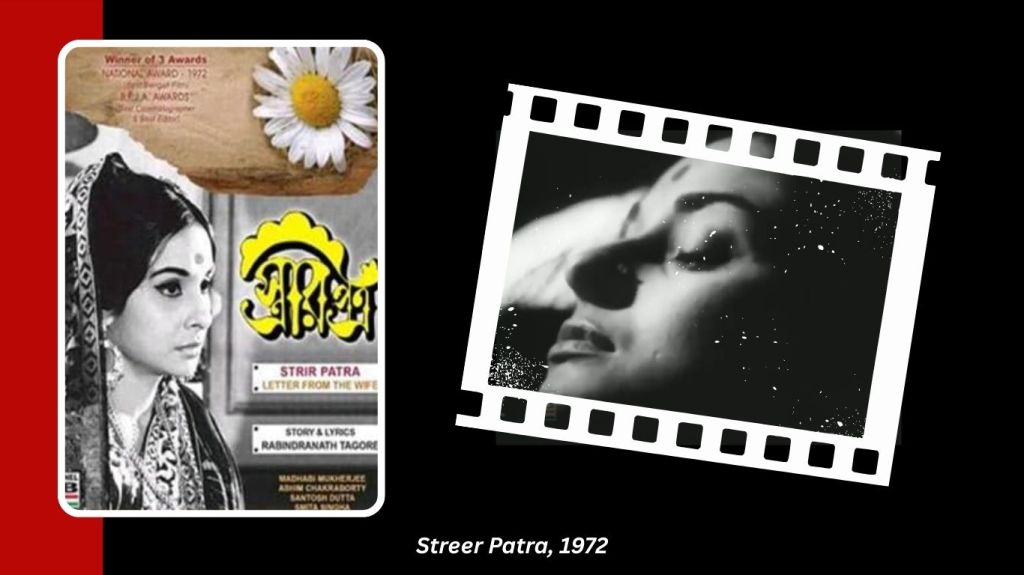
Streer Patra, 1972
Tagore’s path-breaking short story was heavily criticized when it first came out in 1913, for its harsh denouncement of the male-dominated society of the era. Written in the form of a letter that a wife pens to her husband – beginning with the commonly used word honorific ‘Sricharankamaleshu’(at your lotus-like feet) and ending with the ironic ‘Charanatalashraychhinna’ (separated from your lotus-like feet), signifying her rejection of everything she is expected to do for the sake of her relationships – Tagore’s revolutionary and forward-looking text gets the class treatment in Purnendu Pattrea’s adaptation. The works of this poet, writer, illustrator and artist have never received the attention they deserve, maybe because his filmography is limited to only a handful of films, three of which star Madhabi. And in the actor, who made the perfect Charu eight years earlier, Purnendu Pattrea has just the right Mrinal.
Madhabi is in her element as the quintessential upper middle-class wife, with a poetic sensibility, who over time learns to think about and question the roles she has been asked to play. And the climactic realization, standing on the seashore, her mind made up to never go back, looking to start afresh with dignity and freedom, is as good as anything the actor has put across in her career. This is again largely a one-woman show, and Madhabi does not put a foot wrong. The film justifiably won the National Award for Best Bengali Film and the Best Director Award at the Tashkent Film Festival.
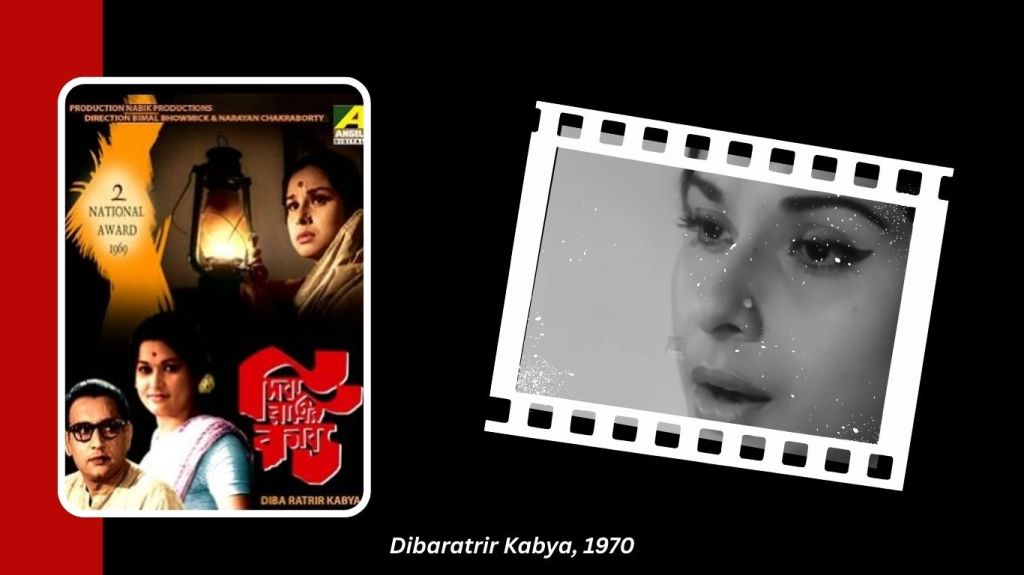
Dibaratrir Kabya, 1970: Supriya as an Ode to Female Desire
‘Aami meye manush – oto udaar hote chaaina’ – I am a woman … I do not want to be generous. In the light of how leading ladies in popular Indian cinema have generally been represented, particularly if they play the wife, it is quite an extraordinary statement for a woman to make. But then Dibaratrir Kabya (1970) is no ordinary film and its troika of women characters, led by Supriya (Madhabi Mukherjee), make for a fascinating study.
Though the comments by Andrew Robinson and Chidananda Dasgupta on her interiority that I began the essay with all pertain to Madhabi Mukherjee’s more celebrated acts in the Ray films, the ‘flutter of a searching mind’, the ‘enticing mystery of woman’ that comes through strongly in the performance that fetched the actress her only National Award, in a film that has received scant mention despite its many merits: Dibaratrir Kabya. The two mentions I have seen online refer to her character, Supriya, as one who ‘not only ruins her life but everybody else’s around her’, which is like dismissing Emma Bovary as a dreamy romantic.
What’s significant about Dibaratrir Kabya is the way it keeps subverting the accepted notions of a woman’s place in family and society through a story driven primarily by the existential crisis of its male protagonist Heramba (Basanta Choudhury). Though others call him a ‘poet’, Heramba insists he is not and that he only ‘teaches bad poems of great poets’. We meet him at the outset through his own voiceover articulating the death of his wife by suicide – ‘Uma is dead … what can I do if someone hangs herself if I speak the truth … we live because there’s no other way … we dream because that’s the only escape we have’. In a monologue that sets up the film and his character, he admits to being devoid of passion, of feelings, that it is he who has killed his wife through his coldness. The monologue ends with Heramba asking himself: ‘Am I sick?’ The film proceeds to explore through his journey if it is he who is sick or is it everyone around him – is this the human condition then that we have to live with?
His first port of call is Supriya who lives in a remote village near Hazaribagh. Married to a police officer, Ashok, she is the very picture of domesticity (montages of her everyday chores echoing Charu). However, it is apparent that there’s a history between Heramba and Supriya whose embers still smoulder in her. And she is never at pains to hide it – on the contrary she flaunts her feelings and questions Heramba time and again. It is interesting that Heramba addresses her as ‘tui’ while for her she is always ‘apni’ – which provides another beguiling aspect of the ‘inequal’ nature of their relationship (‘Did you bring me here to be just a wife to a policeman … I have been married six years, why do you treat me like a child still?’ she says, her face a picture of unfulfilled passion.)
Their exchanges are charged with a subtle eroticism in which the idea comes through that, as a commentator wrote about Charu, ‘a woman could rightly want and need more than tending to house and home’. She has no hesitation in approaching Heramba’s bed in the dead of night, seeking an answer regarding her future, even as her husband has passed out after a drinking session with Heramba in the adjoining room. When Heramba chides Supriya for still nurturing the immature notions she had when she was fifteen – one, of being independent after getting an education, and, two, the impossible imagination (which is never spelt out but whose subtext is apparent in the way Supriya looks at Heramba) – she retorts, ‘Why impossible?’, her eyes flashing indignation, her face ready to crumble with pent-up desire.
A little later, when she makes peace with him and is back to her ‘normal’ sprightly self, he asks for a cup of tea. As she gets ready to oblige, he cannot help but taunt her: ‘You are the very ideal of womanhood that God intended for the purpose of making home.’ Supriya stops short. Madhabi here is a class-act as she turns around and asks Heramba if he would prefer a drink over tea and then goes on to describe her experience of passing out the last time she imbibed alcohol. Heramba is flustered enough to be put off and it is clear that Supriya knows exactly what will needle him. Later that night, as she serves both her husband and Heramba the liquor, she for once cannot help but taunt him about his wife’s suicide.
Underlining this subdued passion-play between Heramba and Supriya, to which the husband is a mere onlooker, is the case that the husband is handling: a tribal, Birsa, has murdered his wife because of her infidelity, a killing he admits to with a primeval rage and righteousness. It provides the relationship between Heramba, Supriya and Ashok with a delectable spin even as the two men argue about love, Heramba insisting on its absence, on the ice-cold nature of our existence where we only parrot about love without being capable of feeling any of it, ending with a question that no one has an answer for: why do we keep insisting on love, why can’t we say that we don’t love. The exchange is too much for Supriya, who has been listening in, her face a canvas of flickering emotions in the light of the hurricane lamp, and she passes out (that she is prone to fits has already been referred to – interestingly enough, the author on whose work the film is based, Manik Bandopadhyay, had a history of epileptic fits).
This marks the end of Act One as Heramba moves on. We next see him on the beaches of Puri, where he comes across his old teacher Mastermoshai (Kanu Bandopadhyay – Harihar of Pather Panchali fame). This introduces us to two other characters who drive the film’s narrative in important ways: Mastermoshai’s wife Malati and their daughter Ananda. Though the teacher is now beset with a strange lassitude, it turns out that his youth had been one of passion, in the throes of which he had run away with and married one of his students, Malati (Anubha Gupta, in another of the film’s notable performances). Nothing remains of that now as he asks Heramba: How does man live devoid of shackles?
Malati has for all practical purposes accepted her husband’s resigned attitude to life and given up on all passions, though she does ask: Am I old just because no one looks at me? And in a wonderful sequence compares happiness to ‘shutki maach’, advocating the need to fill oneself with love any which way we can: ‘Jeev ke chhotolok na korle saadh meley na.’ (Impossible to translate with any degree of authenticity, but approximates to the need to plumb any depths necessary to experience pleasure.)
Soon enough, Heramba and Ananda (Anjana Bhowmik, the third of the telling female acts in the film), an aspiring dancer, enter into a relationship, one that is more openly sensual than Heramba’s with Supriya, symbolized by the erotic sculptures of Konark which form the backdrop to an allusive dance sequence. There is something about Heramba that makes him attractive to women despite his lack of emotions and his propensity for indifference as soon as a relationship begins to build, which is true even for his bond with Ananda. As she senses a certain cooling off on his part, he rationalizes: ‘Would love have any value if it lingered … flowers bloom only to wither, do we grieve for them?’
Meanwhile, Supriya arrives in Puri and before long Heramba and Ananda run into her. The meeting is fraught as Supriya knows instinctively that there’s something brewing between Heramba and Ananda, and the stage is set for a classic confrontation between the two women vying for the affection of someone who has probably already moved on.
This segment yet again provides an insight into how different Supriya is from the run-of-the-mill ‘good’ wife we are accustomed to in our films. Though she is in Puri with her husband who is recuperating from an illness, Supriya has no qualms in abandoning him to go on outings with Heramba. In fact she tells Heramba: ‘It’s not child’s play to be with someone, attend to someone twenty-four hours … is love and affection the same thing?’ Instead of nursing her sick husband, Supriya seems more concerned about winning back Heramba from Ananda. And is more than a tad relieved when her husband’s relatives arrive – she can leave him to their care now without having to worry. The nonchalance with which Madhabi imbues the desires that haunt Supriya renders any judgement about the character immaterial. She creates her own agency, and provides her character with a dignity and depth that the object of her affection does not have the wherewithal to fathom.
In a series of startling sequences – a frustrated Ashok, so far effete, dragging Supriya up to the terrace of their lodge and forcing himself on her, Mastermoshai abandoning Malati and Ananda, followed by a distraught Malati too leaving – the film reaches its strangely affecting climax, as Ananda dances around a fire and offers herself to Heramba, taking off one garment at a time and consigning it to the flames, before running off to the sea in the dead of night.
The next morning, Heramba emerges from the sea to find Supriya at the beach in widow’s white. As the waves wash over the shore, the realization dawns on Supriya that Heramba is incapable of love, and the film leaves the viewer with her question to Heramba: Can you tell me what do I do now?
Looking at it almost fifty years after it was made, I cannot help but wonder how ahead of its time Dibaratrir Kabya was. What the film lacks in terms of the visual innovativeness that Bengali cinema of the era had come to embody in the works of Ray, Ghatak and Sen, it more than makes up for with the honesty of the narrative – which is not surprising given that it is based on a novel by Manik Bandopadhyay, known for his unflinching take on the human condition (other films inspired by his works include a segment in Mrinal Sen’s Calcutta 71, Nabyendu Chatterjee’s Sarisreep and Goutam Ghose’s Padma Nadir Majhi). Amazingly enough, the novel it is based on was written in 1936, one of the master storyteller’s earliest works. Above all, in Madhabi Mukherjee’s delineation of the yearnings that impel Supriya, we have one of the great characters of Bengali cinema. About Emma’s character in Madame Bovary, it has been said, ‘Emma’s drama is the gap between illusion and reality, the distance between desire and its fulfilment’ and shows ‘the first signs of alienation that will take hold of men and women in industrial societies’. That rings true for Supriya too.
 Shantanu Ray Chaudhuri
Leave a comment