These poems arrive charged with linguistic restlessness and moral nerve, moving fluidly between intimacy and indictment, wit and unease. Naisha Chawla writes from the pressure points of language, identity, age, nation, and inheritance, attentive to what is gained and lost in speech, love, and belonging. Her voice is at once precocious and unsparing, capable of lyric tenderness and sharp cultural satire, often within the same breath. Whether addressing exile from the mother tongue, the exhaustion of youth, or the seductions of power and place, these poems resist consolation. They ask instead for alertness – to language’s betrayals, to memory’s costs, and to the unfinished self that speaks.
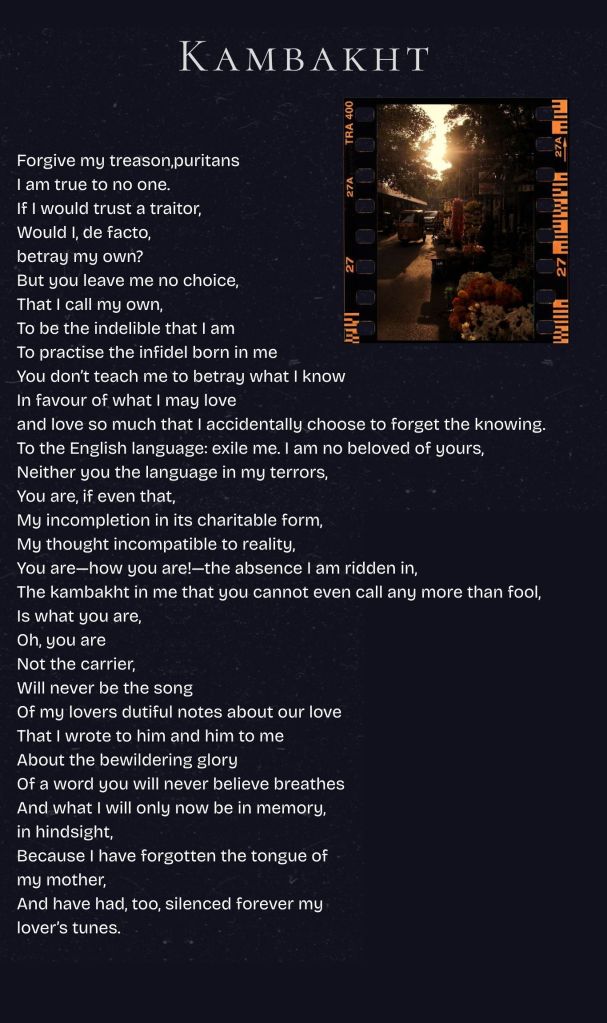
A yearning for the rich relationship one has with their mother tongue when they are children expressed through the allegory of a bygone love affair. The idea behind it was to draw a parallel between the scorn one may feel towards their present reality in favour of something they can only now relish, which, when seen through the lens of the languages, is a resentment expressed towards the fabric of the poem—in English itself—and how, no matter how expressive, the secondary language will always feign inferior in comparison. In a literal sense, the word Kambakht has no direct translation in English, thereby declaring the language a fool for thinking it is any match and the narrator a fool by association as they boast of their love and yet are writing and speaking in English, whether they like it or not.
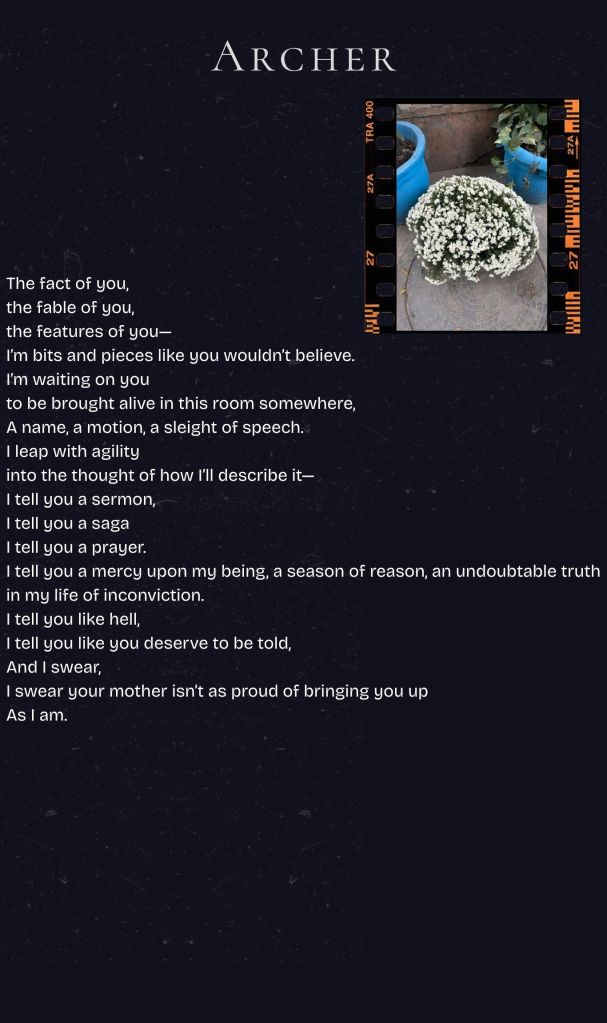
A sense of restless admiration, an impatience in infatuation was intended in the poem. The narrator is not speaking to, rather admonishing someone they fancy as they are frustrated with how deep their fascination is and reproach their beloved listener to notice how they are constantly awaiting for someone to speak of them. The narrator “[tells them] a prayer” and “a saga”, i.e., describes their beloved as a priest or bard would deliver a sermon or an epic tale. The concluding line is meant to be playful wordplay about their mother’s pride in raising them up and the narrator’s pride in raising their name in conversation, which is what they pine to do all along.
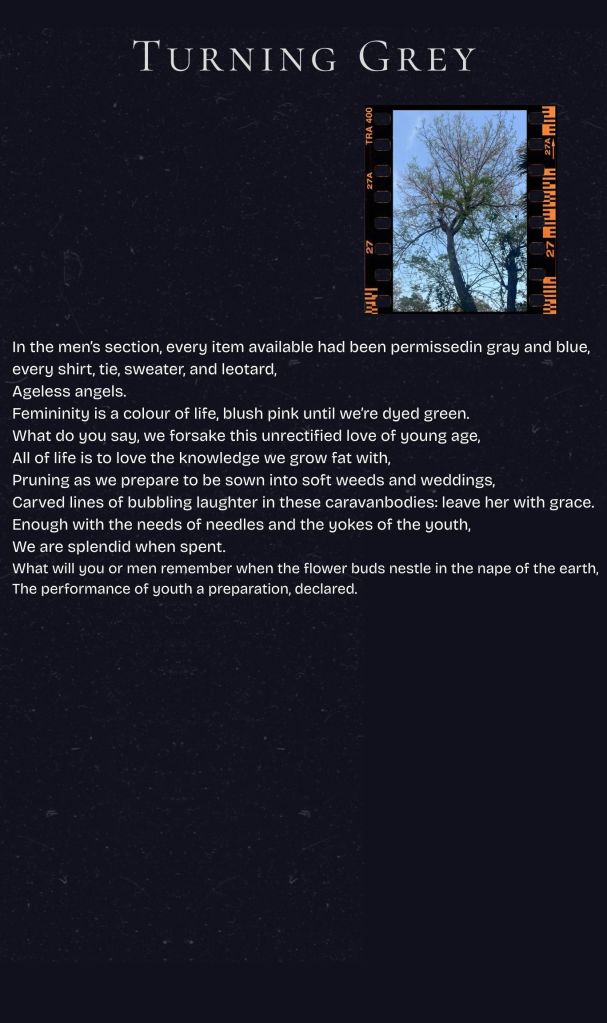
The poem intends to dispel the fear of age, moreover of aging and the gendered aspect of it. The tone is deliberately declarative and self-confident to express how the performance of beauty and youth is another moment of preparation in the continuity of life, less worth fretting over the details of but much better assumed as a lesson in the grander scheme of things.
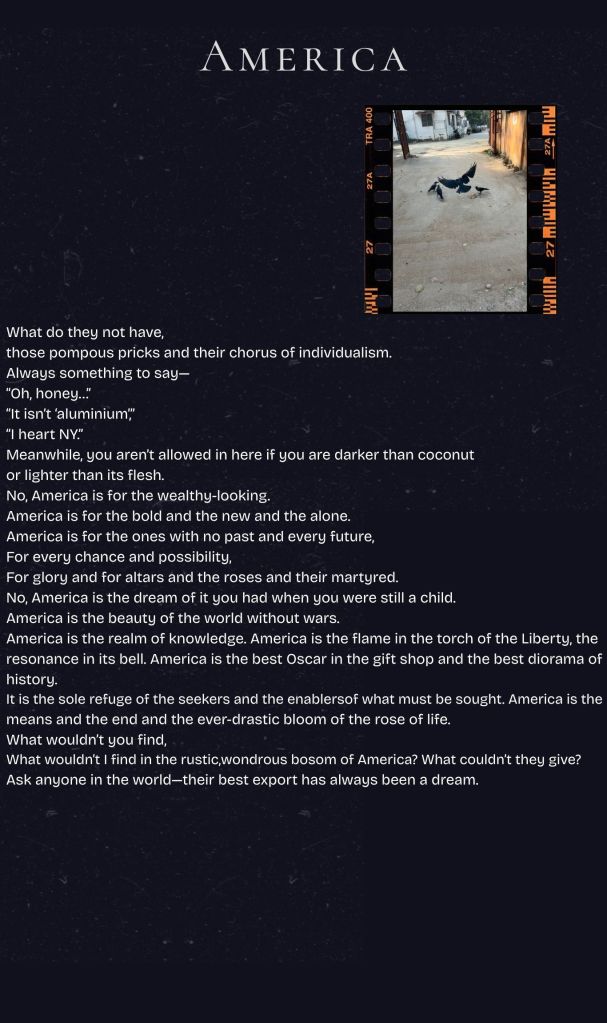
It’s a comment on the excessive and gaudy life the institution of the American nation has usurped, largely post-Cold War, and the multilayered perception of it that exists. No matter how many skeletons flow out of its closet, a person’s primary idea of America is usually idealistic, hopeful, aspirational, though many of its realities are the farthest from it. Of every ideology, commodity, and prejudice they may be able to sell to us, the most successful one will always be the indelible American Dream.
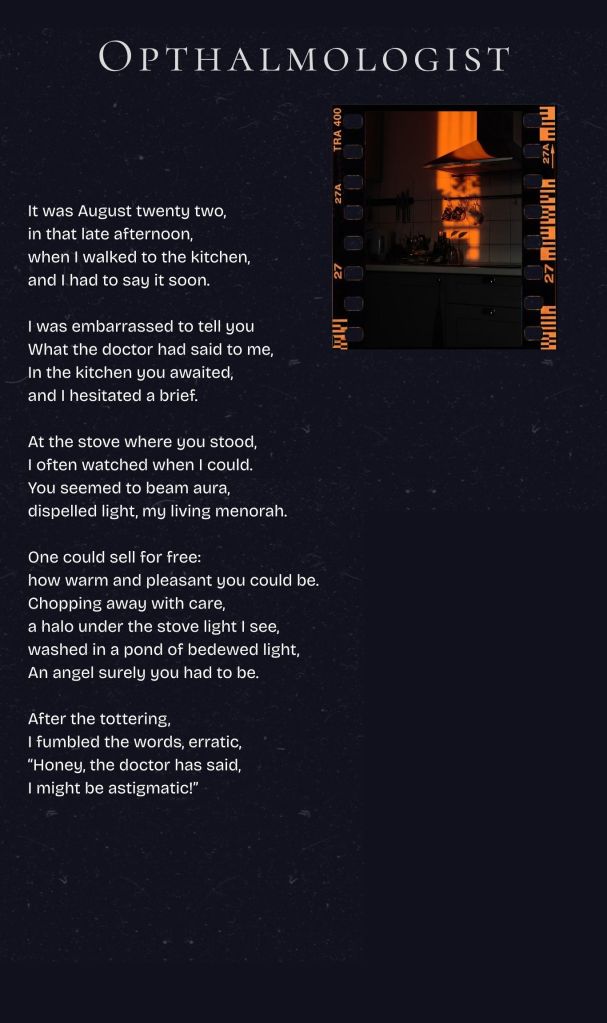
Light-hearted in tone and content, it’s another poem of an overwhelming infatuation, with the beloved subject of the narrator being a spouse by whom they are enchanted, as though they are a celestial being. In reality, the domesticity and overly flowery image happens to be a mere physiological illusion imagined by the narrator who has developed a literal eye condition.
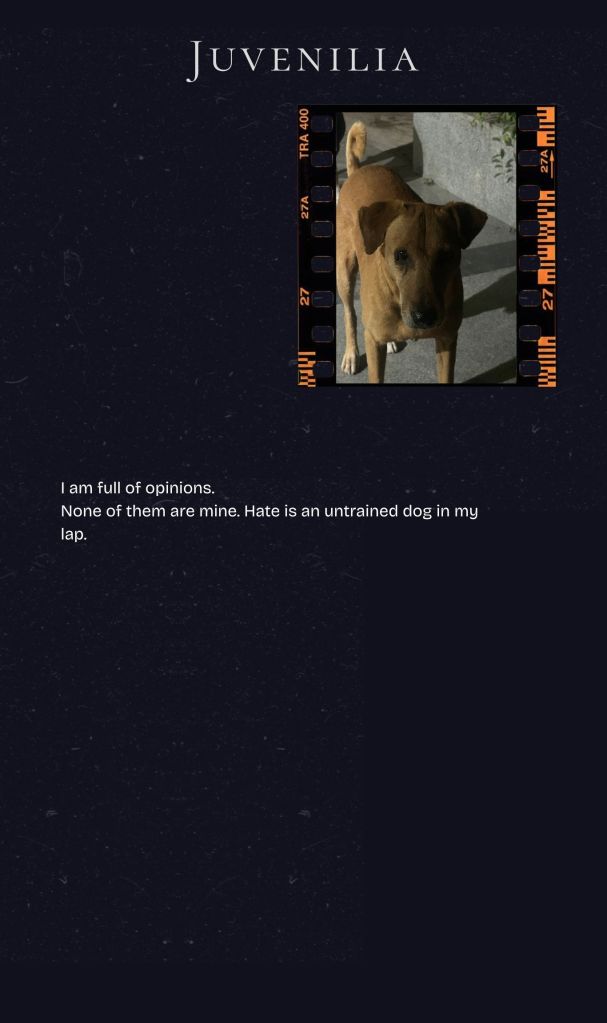
Its short structure and reclusive tone is supposed to act as a deterrent, an indication of the quality of the narrator. It deals with how disdain and hatred are as commonplace to encounter as joy or grief but can be very confounding to deal with as it increasingly builds up while one finds it difficult to express hatred in any socially acceptable way. We are often at the mercy of our own baser instincts.
A tête-à-tête on Poetry
Shantanu Ray Chaudhuri (SRC): In an era where poems can be generated instantly through technology, what do you believe gives poetry its soul?
Naisha Chawla (NC): The historic insatiable need to profess something, a voice in one’s head that refuses to be silenced, “a lump in the throat,” as Frost calls it. Secondly, a fear that one has had an epiphany and a succinct awareness that you are to step up to the occasion of seizing its brevity. Often, a poem is a crumb of the curiosity arising from a constant, lifelong failure to articulate an indigestible feeling that one stands before every time they attempt to write or express an idea, whittling at the mammoth one word at a time. The curious person exists solely as a channel for the truth a poem delivers. The poem is itself a soul that finds form in words and in the absence of the deep and transformative conversation that transpires in a poet’s mind, the poem exists as a decoy, untruthful and second-rate. While many who don’t bat an eye to poetry may boast of generative AI’s hollow, bitter fruit, no poet or reader identifies with the ‘poems’ technology can produce because it is striving for nothing but obedient compliance with an order. A poem cannot be written by a machine because a machine does not write first to understand what it means second.
SRC: In a time when content is endlessly available, what makes a poem worth returning to?
NC: The proficiency of poems at recognition. The chorus of consumption that has us spellbound affords us a negligible sense of individuality, a singularity of experience, something only loneliness seems to be resigned to as of late. A poem can find and present before us what we would never in waking thought dare to admit. The character a poet assumes in a poem is not subject to our morality, preferences or conceivable reality. It is the freedom a poem has to be—albeit subjectively—‘good’ or ‘bad,’ ‘profound’ or ‘surface-level’ which provides a reader the stage to build an opinion, and thereby develop a personal connection to it, to recognise not only what the poem is for what it seems but also to allow the poem to recognise who the reader is, and is capable of being thenceforth.
SRC: What is lost when we stop reading poetry and what is it that returns when we come back to it?
NC: In Lawrence Ferlinghetti’s poem I Am Waiting, he repeats the phrase ‘a rebirth of wonder’, essentially signalling a return to the joy of discovery and, as an extension, of moving forth from a prior state of darkness and lack of knowledge or meaning. Reading poetry is a continuous study, merely interrupted at moments when life forces us to look up from endstops. Every poem one reads the brain documents like an ever-awake stenographer, inundating the creative mind with chits and letters and ink blots of inspiration, typing up a one-of-a-kind super-poem which is a result of one’s passion and love for discovery. We find, upon returning to poetry, that we are picking up where we had left off with it—whether days, weeks or years ago. Poetry does everything but forsakes.
SRC: How did poetry first find you?
NC: Poetry found me in my innocence and in my arrogance, when I was young enough to write with confidence and old enough to decide poetry will have to do as the titular genre of what it is that I make. It was as early as middle school that I lauded poems as fantastic messengers—pithy and precise—until my late pre-teens arrived, one fine day of which I typed away a tiny paragraph about an umbrella as an allegory for solace, which would become the first poem I ever wrote. Ever since, I’ve spent countless nights, every emotion on the conceivable spectrum of them by my side, picking and prodding and pulling at my poems to resemble even a shadow of what some of my favourite poems have been able to do for me. While an immense challenge to be writing in the current climate of constant denigration of the humanities in the public domain, I’m nothing short of lucky to be sharing in the company of literature students, professors and readers across professions who ensure that the need for literature remains timeless across even our barren, listless age of technocracy. Poetry found me before I knew I would need it and even in my most desolate of times ‘never, in extremity, it asked a crumb of me’.
SRC: What would you like to tell readers of your generation about staying connected to real poetry?
NC: The only piece of advice I would have for a young reader with a penchant for poetry would be to have an unshakable sense of almost-arrogant self-belief. Believe that the poems you read are also borne in a mind like yours, that you too are capable of sharing in the company of the writers who are sophisticated and polished by posterity but skeletally shared that same flicker as you do now. Read a poem before dismissing it, try and understand what its strengths and flaws seem to be, rely on your instinct to identify and absorb accurately and extensively, and do not stop reading because the more you read poems the wider a catalogue you will curate to subject to your spectrum of preference. Take your fear of failure as a challenge. Fall face first into dumbfounding confusion and start again from the top. Take pleasure in slowly reading a poem that makes no sense to you, word by confusing word. Don’t be intimidated by the classics. While classical for good reason, you are by no means obliged to be compelled by them all. If you read poetry, allow it to question you, boldly—possibly offensively—as it often will. If you also write poetry, become okay with rhyming ‘sad’ with ‘mad’ and ‘be’ with ‘me’, be shameless and vulnerable and allow creativity to humble you. Read again and again what you don’t understand in your first try, remember that poets often strive for scarcity, every word and symbol before you is intended. Allow a poem to pierce through the many layers that your barest tenets exist underneath and pay attention to what a poem says. Listen when the poem speaks and go forth into its quietness.
ABOUT THE POET
Naisha Chawla is a first-year student of English Literature at Jesus and Mary College, University of Delhi. Having begun her writing journey at twelve, she published her first anthology of poems at fifteen, titled The Grants of Calliope, and has since had her work published in various reputed journals such as The Borderless Journal, The Bangalore Literary Review, and Indus Scrolls. She finds her inspiration in writers and poets spanning all ages, periods and geographies, a few to name are: Auden, Brodsky, Plath, Frost, Rilke, and O’Hara. Having experimented briefly with short stories and a play, she hopes to expand her knowledge to long-form as well, with a hopeful excursion into play or screenwriting.
 Shantanu Ray Chaudhuri
Leave a comment