On Rekha Bhardwaj’s birthday, a listening against the grain: two songs that sit outside her most celebrated hits, yet reveal her voice at its most intimate. ‘Ek woh din bhi thay’ and ‘Ek ghadi’ reward the listener drawn to the rare, the hushed, and the almost-forgotten.
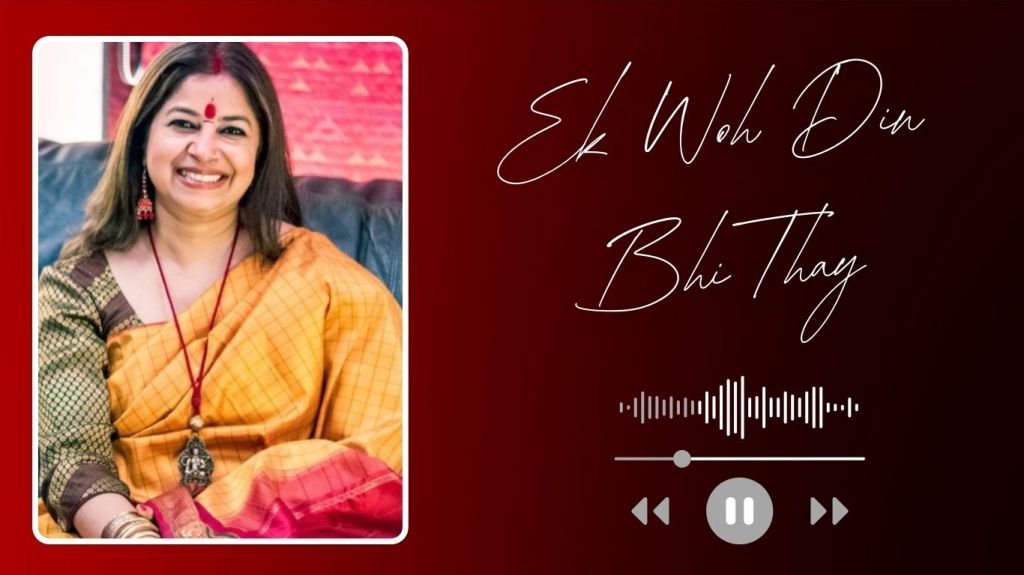
‘Ek Woh Din Bhi Thay’ (Chachi 420, 1997)
‘Ek Woh Din Bhi Thay’ is that rare song where a voice becomes the experience itself. Vishal Bhardwaj composes, Gulzar writes, but it is Rekha Bhardwaj’s voice that enters the bloodstream, slowly, insistently, like the afternoon sun on a winter’s day: gentle, golden, deceptively intoxicating. It doesn’t announce itself; it seeps in. You don’t even realise when the chill inside you has eased and a strange, golden languor has taken over. That’s Rekha for you. No vocal acrobatics, no showy flourish, bas ek nasha, quiet and persistent.
What gives this song an added, almost accidental poignancy is that it was Rekha Bhardwaj’s maiden playback song. Her voice here has not yet acquired the knowing sauciness or playful abrasiveness that would later become part of her signature in songs like ‘Namak ishq ka’ or ‘Sasural genda phool’. Instead, what we hear is something purer, more unguarded, a voice still discovering its own emotional authority. There is no performance of seduction here, no conscious roughening of tone. The huskiness feels natural, almost inadvertent, as if emotion has worn the voice thin rather than style shaping it. That innocence, if one can call it that, deepens the song’s ache. It feels less like a singer interpreting memory, and more like memory finding its first voice.
What makes her rendition so devastating is the grain of that voice. It carries a faint roughness, like fabric worn thin by time, or an old letter handled too often. That huskiness is not affectation; it sounds lived-in, seasoned by experience, even though the career around it was just beginning. When she sings ‘Ek woh din bhi thay … ek yeh din bhi hain’, there’s no attempt at nostalgia as performance. It feels like memory speaking to itself. The voice neither mourns nor celebrates; it simply remembers, as if resigned to the fact that time moves on whether we like it or not.
Rekha Bhardwaj does not sing this song as much as she inhabits it. Her voice arrives already carrying memory, weariness, and a strange, tender calm. There is a huskiness to her timbre, but it is not rough; it is warm, burnished, almost tactile. You can feel it on the skin. Each line seems to emerge from a lived interior, as if she is not recalling the past but standing inside it, letting it pass through her breath. The repetition, ‘Ek woh din bhi thay … ek yeh din bhi hain’, in her rendition does not feel circular or static. With every return, the words age slightly, deepen, acquire another layer of acceptance.
What makes Rekha Bhardwaj’s voice so intoxicating here is her control over restraint. She resists drama. There are no vocal flourishes demanding attention, no crescendos seeking release. Instead, she lets the song hover in a half-light of remembrance. The notes feel held back, as if emotion is deliberately kept from spilling over. That held-back quality is precisely what creates the ache. Like winter sunlight, it does not scorch; it seeps in slowly, warming you without announcing itself, until you realize you have been sitting in it far longer than intended.
Gulzar’s lyrics are steeped in transience: days turning into days, nights dissolving into sleep, memories thinning into mist. Rekha Bhardwaj understands this impermanence instinctively. When she sings ‘Raat yeh bhi guzar jaayegi’, it is not consolation, nor is it despair. It is a statement uttered with quiet inevitability. Her voice carries a weary wisdom, the kind that does not rebel against loss but recognizes its rhythm. The wistfulness she evokes is not sharp grief; it is the softer sorrow of acceptance, of knowing that even longing will eventually fade.
Vishal Bhardwaj’s composition gives her exactly the space she needs. The melody is sparse, almost skeletal, refusing to distract from the emotional weight of the words. Vishal has always known how to write for Rekha – not just for her range, but for her temperament. The tune moves in small arcs, looping back on itself, mirroring memory’s circular nature. Nothing swells unnecessarily; everything stays inward, contemplative. Low-key, but solid. The arrangement never crowds her. It understands that the emotional centre of the song resides not in instrumentation but in the grain of Rekha Bhardwaj’s voice. Her phrasing stretches time; a single syllable can seem to linger in the air, suspended between memory and forgetting.
There is something profoundly intimate about the way she sings ‘Koi aata hai palkon pe chalta hua’. It feels whispered inward, as though meant only for oneself. By the time she reaches ‘Neend aa jaayegi’, her voice has softened into near surrender. Not defeat, but rest.
In this song, Rekha Bhardwaj does what very few singers can: she makes wistfulness feel inhabitable. You don’t merely listen – you drift, you warm yourself briefly in its glow, knowing even as you do that, like the day and the night she sings of, this feeling too will pass. And perhaps that is the song’s deepest intoxication.
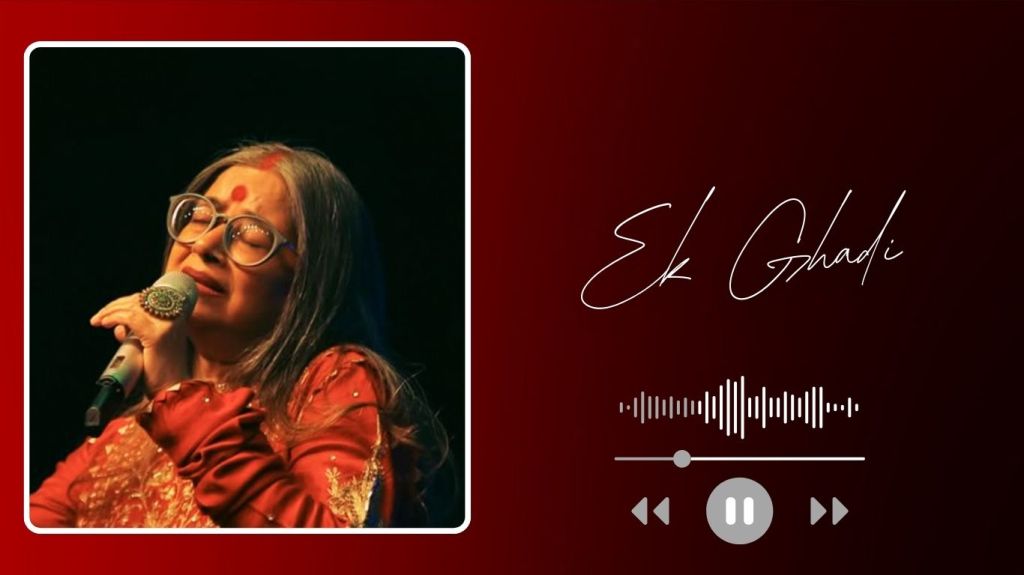
‘Ek Ghadi’ (D-Day, 2013)
In ‘Ek ghadi’, sorrow does not plead; it lingers. It asks for time not in desperation but in quiet insistence. What makes it extraordinary is the tension at its heart: a lyric soaked in loss and reckoning, set to a composition that refuses melodrama, and rendered by a voice that introduces an unexpected, almost unsettling sensuality into grief. Rekha Bhardwaj does not sing this song as a lament alone; she inhabits it as a body still warm with life, even as everything around it edges towards extinction.
Rekha Bhardwaj’s voice has always carried grain, an earthiness that resists polish. Here, that grain becomes tactile. She stretches syllables just enough to make them ache, but never enough to break their restraint. The sensuality she brings is not ornamental; it arises from breath. When she sings ‘Tere lab pe mere hone ka nishaan baaqi hai’, there is a faint tremor that suggests intimacy remembered. It is the sensuality of touch recalled rather than touch demanded. This is what makes her rendition rare: she locates desire not as erotic assertion but as residue, something that clings even after love has been wounded, perhaps beyond repair.
What is remarkable is how she refuses to overplay the agony. Many singers might lean into vocal cracks or overt sobs. Rekha does the opposite. Her control sharpens the pain. Each phrase feels weighed before being released, as if the singer herself is deciding whether the emotion can be afforded another breath. That deliberation mirrors the song’s central plea, ‘ek ghadi aur’, just one more moment. Time itself becomes sensual in her singing, thickened by breath and hesitation.
Niranjan Iyengar’s lyrics are central to this effect. They are steeped in classical imagery – night turning towards dawn, flowers blooming only to reveal another truth, the stain of henna lingering on empty hands – but they are never ornamental. Each image carries moral weight. Lines like ‘Abhi haathon se tere jurm o gunaah baaqi hai’ are devastating not because they accuse, but because they implicate both lover and beloved in a shared, unfinished reckoning. Love here is not innocence lost; it is responsibility deferred. Iyengar repeatedly returns to what remains, baaqi hai, and that insistence on residue becomes the song’s emotional engine. Even when the relationship is broken (‘meri maang ujdi hai’), even when eyes are emptied of companionship, something refuses erasure.
Shankar-Ehsan-Loy’s composition understands this emotional grammar perfectly. While the base is Raga Bhupali, there’s also the imperceptible trace of Raga Yaman. There is a particular hush that arrives at dusk, a moment of lucidity before darkness settles in. It is into this suspended quiet that Bhupali steps, opening up a whole universe of stillness, poise, and quiet astonishment. Bhupali, that luminous pentatonic raga of the Hindustani tradition, can seem almost austere in its economy. Yet within these its five swaras resides an astonishing depth. Yaman traditionally evokes devotion and calm yearning, and here it does something subtler: it sanctifies waiting. The melody carries the ragas’ inherent luminosity, a suggestion of evening light, of transition rather than closure. The composition moves languidly, almost as if time itself has slowed under the weight of what remains unsaid. There are no sharp crescendos, no dramatic orchestral surges. Instead, the arrangement breathes, allowing silences to speak as loudly as notes.
All this suits the song’s emotional condition: suspended between ending and continuation. The melody repeatedly circles back rather than moving forward, reinforcing the idea that the relationship has not concluded; it is merely paused in anguish. Shankar-Ehsan-Loy resist embellishment, trusting the raga’s architecture and Rekha’s voice to carry the emotional weight. The result is a soundscape that feels dusk-lit, neither dark nor bright, perfectly attuned to the lyric’s moral twilight.
Together, lyric, composition, and voice create a song where agony does not scream. It waits. Rekha Bhardwaj’s sensuality gives that waiting a body, Iyengar’s words give it conscience, and Shankar-Ehsan-Loy’s Yaman-based melody gives it time. ‘Ek ghadi’ does not ask for forgiveness or reunion; it asks for acknowledgement. That something lived. That something still lingers. That even in devastation, life, jaan, is not yet done speaking.
 Shantanu Ray Chaudhuri
Leave a comment