Better known for his novel, The Exorcist, and his screenplay of the memorable film, Peter Blatty’s directorial debut is today almost forgotten. A film that disguises its deepest questions as lunatic comedy, The Ninth Configuration (1980) remains, The Exorcist notwithstanding, his most daring work: part war film, part theological debate, part existential cry. On the writer-film-maker’s birth anniversary, here’s a look at his bruised, unsettling meditation on faith, madness, and the cost of goodness.
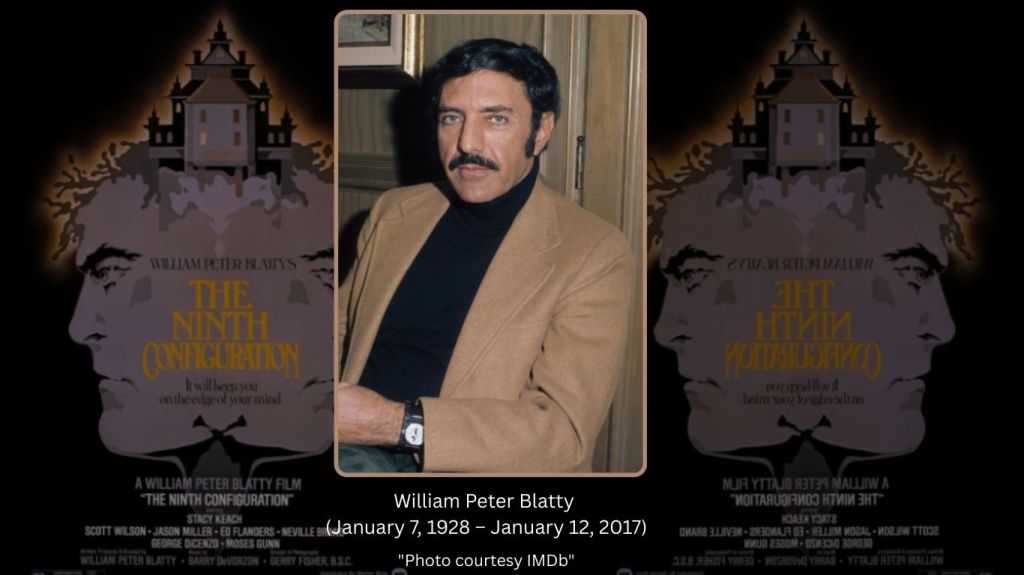
William Peter Blatty’s The Ninth Configuration is the kind of film that wrong-foots you almost immediately. For a good stretch, it plays like a cracked, anarchic comedy – men barking orders at dogs dressed as Shakespearean actors, patients spinning off into non sequiturs, authority figures indulging absurdity with a straight face. And then, without warning, it tightens the noose. What begins as lunacy hardens into anguish, and what seemed like eccentric humour detonates into something raw, violent, and spiritually devastating. Few films pivot so brutally, and so purposefully.
Set in the early 1970s, as the Vietnam War winds down into exhaustion and moral collapse, the film unfolds inside a remote castle that doubles as a military asylum. This gothic outpost, fog-bound and cut off from the world, houses soldiers deemed insane by the US Army, men whose minds have splintered under the pressure of war. Into this bizarre ecosystem arrives Colonel Vincent Kane (Stacy Keach), a Vietnam veteran himself, appointed to oversee the institution. From the outset, Kane is an oddity: soft-spoken, withdrawn, almost spectral. He speaks in a flat, affectless tone, rarely asserts authority, and seems more interested in listening than curing.
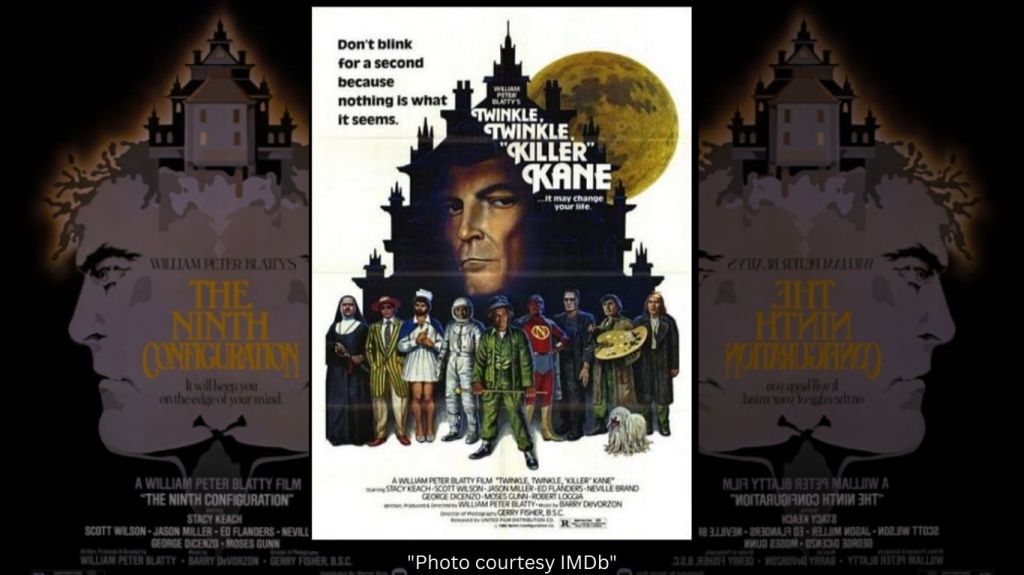
Gradually, unease seeps in. There are whispers of Kane’s past, rumours linking him to the mythical ‘Killer Kane’ of Vietnam lore, a figure associated with horrifying acts of violence. The suggestion lingers, unresolved, casting doubt on Kane’s composure. Is he the sanest man in the room, or the most dangerous? Blatty never rushes this ambiguity. Instead, he lets it throb beneath the film’s surface, destabilizing our assumptions about who belongs on which side of the asylum walls.
Kane indulges his patients’ eccentricities with near-messianic patience. He allows them to stage ridiculous experiments, indulge wild fantasies, and question everything, from military logic to metaphysical truth. Among them is Captain Billy Cutshaw (Scott Wilson), a former astronaut infamous for aborting a moon launch seconds before take-off. Cutshaw is volatile, profane, and intellectually ferocious. Beneath his manic energy lies a profound terror: the fear that existence itself is meaningless.
It is Cutshaw who becomes the film’s emotional and philosophical axis. His conversations with Kane – initially playful, then increasingly combative – spiral into debates about God, evolution, morality, and human goodness. Does selflessness exist at all, Cutshaw asks, or is it merely a biological trick? If there is a God, where is the evidence? Kane counters not with scripture but with a moral argument: that true goodness – acts of sacrifice with no expectation of reward – cannot be explained by evolution alone. They point, he suggests, to a divine order.
This is where The Ninth Configuration reveals its true ambition. It is not a psychiatric drama in any conventional sense, nor a war film dressed up as therapy-room allegory. It is, at heart, a theological film, one that stages its arguments not through sermons but through character, action, and consequence. Blatty, adapting his own novel and directing for the first time, constructs the film like a philosophical chamber piece disguised as black comedy. The tonal shifts are violent, sometimes deliberately disorienting, but never accidental. Sanity and madness, faith and despair, comedy and horror bleed into one another because, in Blatty’s worldview, they are inseparable.
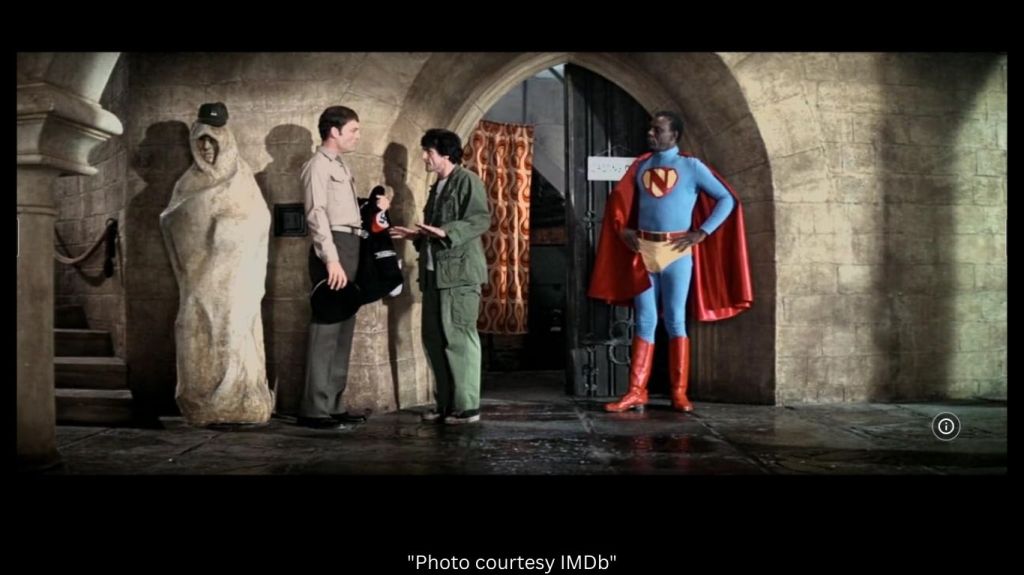
The film’s refusal to settle into a single genre may explain its marginal status. The Ninth Configuration is part war movie, part absurdist comedy, part spiritual parable, part psychological horror. It carries echoes of Catch-22 in its military absurdity, Dostoevsky in its moral inquiry, and Bergman in its metaphysical dread. Yet it belongs fully to none of these traditions. It is a deeply Catholic film, but one riddled with doubt, anguish, and intellectual ferocity. Faith here is not comforting; it is agonizing.
Midway through the film, this agony incarnates. Cutshaw escapes the asylum one night, fleeing into a world that proves no kinder than the one he left behind. Kane follows him to a bar frequented by Hell’s Angels. What unfolds is one of the film’s most shocking sequences: Cutshaw is brutalized, humiliated, pushed to the brink. Kane intervenes, and something inside him snaps. The gentle colonel erupts into ferocious violence, dispatching the bikers with a terrifying efficiency that confirms every rumour about ‘Killer Kane’.
The scene lands like a hammer blow. It shatters the film’s earlier levity and reframes everything we have seen. Kane is not merely humouring madness; he has been containing his own. Or has he? Blatty leaves the question deliberately open, forcing us to confront the uncomfortable overlap between moral conviction and pathological obsession.
The film’s final act transforms its philosophical debate into lived action. Kane, grievously wounded in the bar fight, returns to the castle. Offered medical help, he refuses it. He allows himself to bleed out quietly, alone. This is not suicide in any conventional sense, but an act of deliberate sacrifice. Earlier, Cutshaw had demanded proof of God. Not arguments, not abstractions, but evidence in the form of selfless goodness. Kane’s death becomes that proof. It is an act of Christ-like martyrdom, not staged or declared, but endured.
In this moment, the film reconfigures itself entirely. What once looked like war-induced madness reveals itself as a conscious offering. Kane’s apparent psychosis becomes a vehicle for redemption, not for himself alone, but for Cutshaw. The title, The Ninth Configuration, snaps into focus: the final alignment, the moment when chaos resolves into meaning.
Cutshaw’s transformation is equally striking. The man who sneered at faith and recoiled from human connection is, by the end, changed. He re-enlists in the military, not as a gesture of nationalism, but as a sign of renewed engagement with life. In the final scene, he discovers the Saint Christopher medal he once gave Kane, now inexplicably back in his possession. Whether this moment is supernatural or symbolic is left unresolved. Blatty is careful not to cheapen the film with certainty. What matters is the effect: the possibility of grace.
The performances anchor the film’s metaphysical ambition. Stacy Keach’s Kane is a masterclass in restraint. His stillness carries immense weight; his silences speak of unbearable guilt and buried trauma. Scott Wilson’s Cutshaw, all nervous energy and verbal aggression, is his perfect counterpoint. Together, they create a dynamic that transcends debate and becomes something more intimate: a fragile bond between two shattered men, each seeking absolution in the other.
That The Ninth Configuration failed on release is hardly surprising. Released at a time when American cinema was turning towards gritty realism and irony, Blatty’s earnest philosophical inquiry likely felt unfashionable, even embarrassing. It demanded patience, attention, and a willingness to engage with questions many viewers would rather avoid. It also suffered from the impossible burden of comparison with The Exorcist. Where that film externalized evil in demonic form, The Ninth Configuration internalizes it, locating horror in human cruelty, despair, and indifference.
Technically, the film is striking. Blatty uses the castle’s cavernous interiors to echo the characters’ fractured psyches. The fog-drenched exteriors lend the film a dreamlike, almost purgatorial atmosphere. Barry De Vorzon’s score is mournful and searching, underscoring the film’s spiritual restlessness.
But what ultimately sets The Ninth Configuration apart is its sincerity. In an age of cynicism, it dares to believe, tentatively, painfully, that goodness matters. It does not deny suffering or absurdity; it confronts them head-on. Yet it insists, quietly but stubbornly, that acts of selfless love are not meaningless.
Seen today, the film feels less like a relic and more like a challenge. In a world increasingly defined by nihilism, fragmentation, and moral fatigue, Blatty’s proposition feels almost radical: that goodness exists, that it may demand everything of us, and that it might still be enough. Forgotten for decades, The Ninth Configuration stands ready for rediscovery, not as a curiosity, but as one of the most bracing, hopeful films ever made about despair.
 Shantanu Ray Chaudhuri
Leave a comment