Chhoti Si Baat sits at the crossroads of Hindi cinema’s quietest revolutions, a gentle, observant romance that shaped Middle India’s cinematic heartbeat. Yet beneath its charm lies a disquieting truth that has long troubled me: the suggestion that gentleness must yield to swagger for love to be earned.
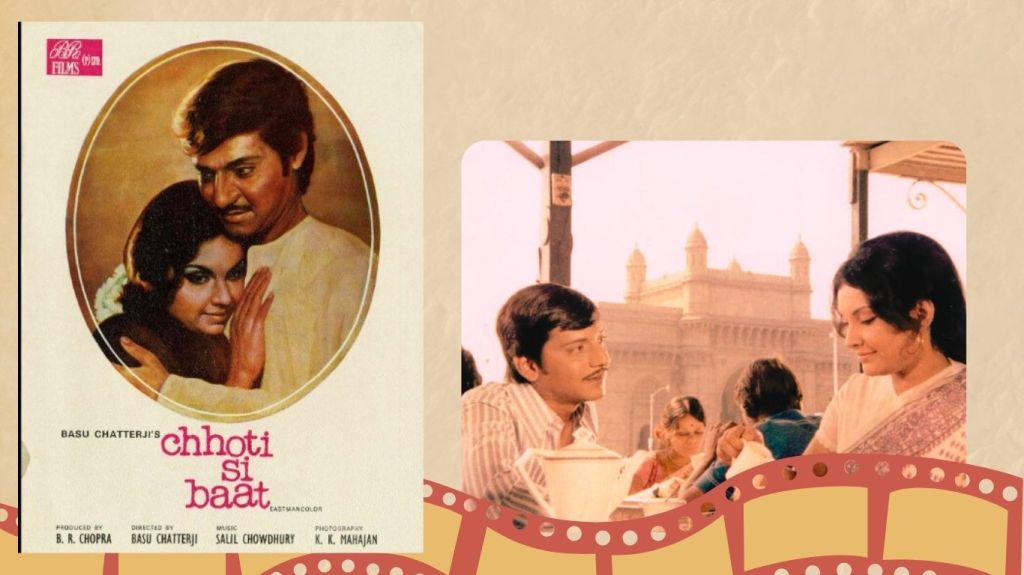
Few films from the 1970s occupy that rare intersection of charm, modesty and cultural longevity quite like Chhoti Si Baat. Released in 1975, at the cusp of the Angry Young Man era, Basu Chatterjee’s quiet romantic comedy was an antidote to the turbulence that dominated mainstream screens. Here was a film that breathed: unhurried, gentle, and steeped in the rhythms of an emerging middle class that was just beginning to understand its place in the expanding city. It was cinema that spoke the language of the bus stop rather than board rooms. With its soft humour, everyday settings and an unassuming protagonist, it captured a slice of Bombay before the city hardened into the frenzy it would eventually become.
Over the decades, the film has acquired the sheen of nostalgia, not merely for its depiction of a less crowded metropolis, but for its belief that small people with small dreams could carry a full-length feature on their shoulders. Chhoti Si Baat also cemented the reputations of Basu Chatterjee and Amol Palekar, whose collaboration would go on to shape an entire sub-genre: middle-of-the-road Hindi cinema. Not parallel cinema, not mainstream masala, something bridging both, with the intimacy of the former and the accessibility of the latter. It is a cinema that rarely screamed for attention yet stayed with viewers long after the credits rolled.
The Craft of Modesty
At the centre of Chhoti Si Baat is Arun Pradeep, played by Amol Palekar with the impeccable diffidence that would become his signature. Arun is the sort of man the city forgets even as it brushes past him: a mild, awkward, conflict-averse office-goer whose presence is more apologetic than assertive. He is the quintessential ‘common man’, the one who would rather forgo a seat in the bus than inconvenience a stranger.
This deliberate smallness is central to Chatterjee’s approach. The director’s gift was always his ability to find humour and pathos in the micro-gestures of everyday life. Much of Chhoti Si Baat unfolds in liminal spaces – the bus stop, the canteen, the street outside an office – that urban life forces strangers to share. In these shared spaces, Chatterjee locates the hesitation, embarrassment, pride and yearning that form the emotional texture of middle-class India.
The film’s modest budget becomes an aesthetic rather than a constraint. Sparse sets, real locations, and unobtrusive camerawork allow the viewer to inhabit Arun’s world without distraction. The comedy, too, is soft-edged, more observational than performative. Moments linger precisely because they feel lived rather than constructed.
The Triangular Tangle
Arun’s problem is simple and universally relatable: he is in love but cannot muster the courage to articulate it. Vidya Sinha’s Prabha is the object of his affection, gentle, graceful, intrigued by him but unwilling to do the work he cannot. When a more flamboyant colleague, Nagesh (played with mischievous bravado by Asrani), enters the picture, the triangle is complete. The rivalry between Arun and Nagesh is presented with Chatterjee’s characteristic lightness: humorous, slightly ridiculous, but rooted in an authentic emotional truth.
Nagesh becomes the embodiment of everything Arun is not: confident, bold, socially fluid, armed with a scooter and a flair for small gestures that win attention. He is not a villain in the traditional sense; he is simply the urban man playing a game whose rules Arun has never learned. And it is this gap, between who Arun is and who he believes he must become, that forms the film’s thematic crux.
When Self-improvement Turns Into Self-effacement
Despite its comic surface, Chhoti Si Baat hinges on a troubling narrative assumption: that goodness, sincerity and gentleness are inadequate in the pursuit of love. This has always been a bone of contention with me and has prevented me from taking to the film whole-heartedly. What Arun requires, the film suggests, is a personality transplant. He must shed his authentic self and acquire swagger, stylised confidence, strategic body language, even a certain degree of manipulation. Rajnigandha or Chitchor, in contrast, resonate more because the characters stay authentic to their inner selves even when the character arcs change.
This transformation is facilitated by Colonel Julius Nagendranath Wilfred Singh, played with delightful flamboyance by Ashok Kumar. The colonel’s Khandala retreat, a kind of finishing school for the romantically hapless, becomes the site where Arun’s natural softness is sanded down. The training sequences are humorous, staged with tongue in cheek, but they reinforce an uncomfortable idea: that the only way for an unassuming man to be ‘worthy’ of love is to become someone else.
Here lies the film’s most significant contradiction. While it celebrates the simplicity of its protagonist and the world he inhabits, it also insists that simplicity is weakness. Chatterjee’s narrative makes a case for self-improvement, but the version of improvement it endorses borders on artifice. Arun returns from Khandala not as a refined version of himself, but as a man performing confidence.
The problem is not with growth – every character arc demands it – but with the moral that underlies it. Why must tenderness be replaced rather than strengthened? Why can the good man not win simply by being more articulate, more open, more courageous as himself? In other words, Chhoti Si Baat participates in a broader cultural myth that equates masculinity with bravado. In attempting to empower Arun, it inadvertently erases the qualities that made him endearing in the first place.
The Comforting Embrace of Music
Counterbalancing these thematic tensions are the film’s exceptional musical contributions. Between the mid-1970s and early 1980s, Basu Chatterjee quietly reshaped the grammar of Hindi cinema. At a time when mainstream films were growing louder, larger and angrier, he turned his attention to the gentle upheavals of everyday life: small dilemmas, middle-class anxieties, hesitant romances. His films created a space where the ordinary person could breathe, falter, dream, and still hold the centre of the narrative.
Rajnigandha (1974) signalled the arrival of this sensibility with remarkable clarity. With Salil Chowdhury’s lilting score and Yogesh’s introspective lyrics, Chatterjee transformed a simple story of indecision into a study of emotional truth. The film’s success showed that audiences were more than ready for quieter storytelling built on moments rather than melodrama. The following year, Chhoti Si Baat broadened this world, placing its shy hero in the bustling microcosm of Bombay. Again, the palette was gentle: humour drawn from observation, music woven into mood, and characters who felt like people one might sit next to on a bus. Chatterjee’s cinema became synonymous with this mix of warmth and wryness. Then came Chitchor (1976), with Ravindra Jain’s radiant music and lyrics giving the film an almost pastoral purity. Here too, Chatterjee championed simplicity over spectacle, making small-town emotions feel universal.
Together, these films established a template for middle-of-the-road cinema: accessible, humane and deeply rooted in the lived experiences of India’s middle class. Basu Chatterjee didn’t just make films; he made the ordinary extraordinary.
The Salil Chowdhury–Yogesh partnership in Chhoti Si Baat yields songs that are not merely embellishments but emotional anchors. Salil Chowdhury, ever the craftsman of orchestral textures, infuses the film with melodies that feel both intimate and expansive. Yogesh, with his gift for quiet, contemplative lyricism, matches these compositions with words that flow like softened introspection.
‘Na jaane kyun’ is perhaps the best articulation of the human psyche: hesitant, hopeful, caught between revelation and restraint. The song’s wistfulness captures the emotional weather of the film better than any dialogue. It is music that lingers long after the story has moved on. It remains one of the most delicately crafted expressions of longing in Hindi cinema, an introspective sigh set to music. Salil Chowdhury’s composition moves with the ebb and flow of remembered emotion: a gentle, almost hesitant melody that never rises to dramatic peaks, mirroring the quiet ache that defines unspoken love. The arrangement is feather-light – strings that hover rather than soar, soft rhythmic accents that seem to tread on tiptoe, as if afraid to disturb the memories they evoke. It is music that breathes in pauses, in the half-finished phrases of the heart.
Yogesh’s lyrics deepen this atmosphere of introspection. He writes not of grand heartbreak but of the tiny tremors that disrupt the inner world, ‘chhoti chhoti si baat’, the small details that return unexpectedly, catching one off guard. The song’s emotional power lies precisely in its restraint. Yogesh captures a universal human truth: that absence amplifies presence, and once someone slips away, ordinary moments suddenly glow with significance. Those ‘anjan pal’, once casual and forgettable, turn over with new colour, tugging the mind back to what is lost.
The lines have the simplicity of everyday speech, yet they carry the weight of an internal monologue. Arun’s, certainly, but also that of anyone who has known hesitant, unexpressed affection. The path remains the same, the journey unchanged, but the companion is missing, and in that void the heart conducts its own search. The beating heart of the film, ‘Na jaane kyun’ captures the melancholy of what might have been, held gently between melody and memory. It is a timeless reminder that longing often whispers, never shouts.
‘Janeman janeman’, meanwhile, is playful, meta-cinematic and unforgettable. The cameo by Dharmendra and Hema Malini turns the song into a film-within-a-film, offering a burst of glamour in an otherwise ordinary world. Yet this glamour never overwhelms the story; it merely punctuates it.
‘Yeh din kya aaye’is one of those quietly luminous gems in Chhoti Si Baat that somehow slipped beneath the wider cultural radar, overshadowed by the film’s more prominently placed numbers. Yet it stands among the finest Yogesh–Salil Chowdhury collaborations, a song that distils wonder, renewal and the tremulous excitement of blossoming love with remarkable finesse.
Yogesh’s lyrics evoke a world subtly transformed by feeling: flowers beginning to ‘laugh’, mornings glowing like gold, evenings drenched in gulal. It’s the language of a gentle heart discovering colour for the first time, the metaphors tender and unforced. Salil’s arrangement mirrors this emotional shift with his characteristic lightness – breezy woodwinds, soft strings, and a rhythmic delicacy that feels like a shy spring wind gathering confidence.
And at its centre is Mukesh, who delivers the song with that unmistakable warmth and inwardness. He resists the temptation to soar; instead, he infuses each line with a quiet radiance, making the joy seem intimate, almost private. The result is a song that may not have attracted the limelight, unlike Rajnigandha’s Mukesh gem ‘Kai baar yunhi’, but remains a masterclass in understated beauty, perfectly attuned to the film’s world of modest emotions and hesitant transformations.
In many ways, Chowdhury and Yogesh elevate the film beyond its narrative limitations. Their work infuses Chhoti Si Baat with a tenderness and a timelessness that protect it from datedness. Even viewers who may question the story’s premise find themselves returning to the soundtrack with unwavering affection.
Basu Chatterjee’s Bombay
Another enduring aspect of the film is its portrait of Bombay. The city Chatterjee constructs is not a metropolis of ambition and scale; it is a network of manageable distances, where people recognise each other at bus stops and the rhythm of the workday structures romance itself. The city looks lived-in rather than monumental. Its charm lies in its ordinariness.
This Bombay is not aspiring to be a city of global dreams; it is content with the small victories of everyday life. In this setting, Arun’s diffidence feels culturally rooted. He is not merely personally shy; he is emblematic of a generation negotiating new social codes in a rapidly expanding urban world.
A Film of Its Time, and Yet…
Even with its problematic narrative assumption, Chhoti Si Baat remains a film that audiences hold close. Part of this devotion stems from the innocence that defines its emotional universe. The stakes are modest, the conflicts gentle. There is no villainy, no melodramatic twist, no moral sermonizing. It is a film that trusts small moments to carry weight.
And while the idea that Arun must acquire swagger to win Prabha may be flawed, it also reflects the anxieties of the era. The 1970s were a period of social transition: urban mobility, consumer aspirations and shifting gender equations had begun altering the romantic landscape. Arun’s transformation, therefore, mirrors a kind of cultural discomfort, an insistence on adopting modern ‘confidence’ even if it comes at the cost of authenticity.
Chhoti Si Baat endures because it is tender, humorous and profoundly human. It captures a world where small gestures matter, where romance unfolds in glances rather than declarations. Basu Chatterjee’s storytelling is gentle without being bland; Amol Palekar brings depth to diffidence; Vidya Sinha radiates quiet warmth. Salil Chowdhury and Yogesh gift the film its emotional bloodstream.
Yet beneath its sweetness lies a sting: the suggestion that goodness is not enough, that gentleness must be fortified with performance. This tension is what makes the film worthy of critical attention even today. It invites us to ask: must one hide one’s essential nature to be seen? Ultimately, Chhoti Si Baat succeeds not because it resolves this question convincingly, but because it articulates, with humour and heart, the insecurities of an entire generation navigating love in a changing city. It is a small film only in name; its emotional resonance is anything but.
 Shantanu Ray Chaudhuri
Leave a comment