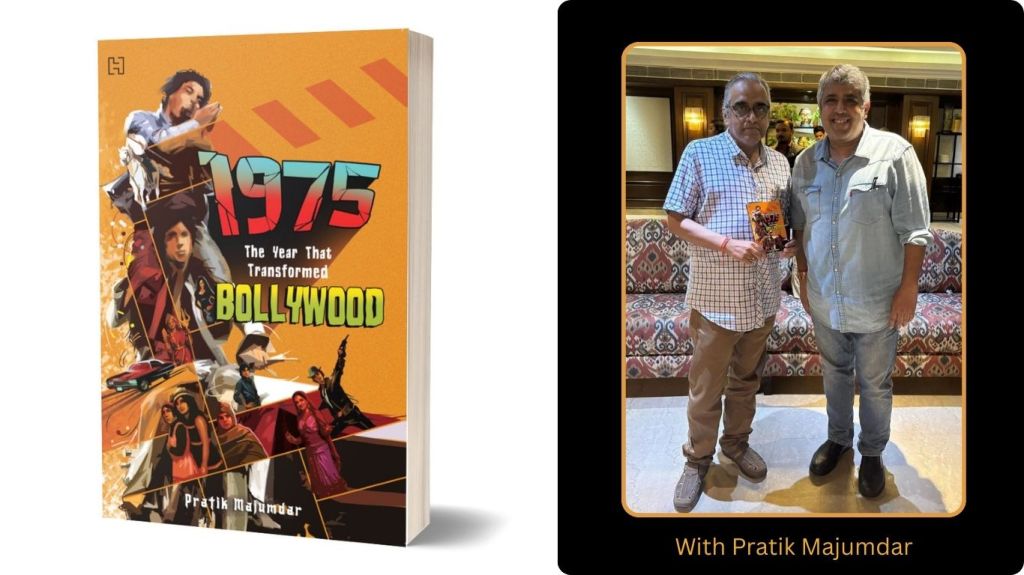
In this conversation, the author unpacks why 1975 stands apart as a singular turning point in Hindi cinema. Blending film history with the fevered socio-political climate of the Emergency era, he explores how an extraordinary convergence of artistic ambition, technical innovation and cultural upheaval reshaped the industry’s imagination. From the rise of Amitabh Bachchan and Gulzar’s unmatched creative peak to the underrated gems and unexpected discoveries that defined the year, this interview traces how 1975 became both a culmination of the 1970s and a blueprint for decades of popular Hindi cinema to follow.
Your book argues that 1975 stands uniquely apart in the history of Hindi cinema. What, in your view, made this year such a decisive hinge in the evolution of Hindi cinema; was it the films themselves, the cultural moment, or a convergence of both?
For me, 1975 marked a rare moment when film-makers and audiences were perfectly in step, the era’s charged socio-political atmosphere mirrored with striking clarity in the stories they brought to the screen. The year sat at the crossroads of two powerful forces … a slate of extraordinary films made by film-makers who were becoming more adventurous and technically savvy (both commercial cinema and arthouse cinema) and a nation undergoing a dramatic socio-political churn.
In tracing the story of 1975, you move fluidly between individual films and the larger social-political climate, including the Emergency. How did you decide on the balance between film analysis and socio-political commentary?
I don’t think it was a conscious decision to balance cinema-analysis and socio-political commentary. It just happened especially in the context of a few films which more overtly reflected the social landscape of the time.
1975 produced both blockbusters and intimate, nuanced films. What explains this astonishing stylistic and thematic range within a single year?
I think the entire decade (the ’70s) was a landmark decade in that sense … the birth of the first superstar, the birth of the angry young man, new wave cinema, all coexisting in harmony. 1975 was the year that this coexistence reached its crest.
Many works have written about the Emergency as a political chapter, but you explore its influence on cinematic imagination. What traces of the Emergency, direct or subliminal, did you find surfacing in Hindi films of 1975?
The atmosphere of administrative fear was evident in the changes imposed on several films during the Emergency. A few personalities – Dev Anand, Amol Palekar, Kishore Kumar among them – attempted to voice their dissent, but often paid a heavy price for doing so. Since cinema of that time was affected to a large degree by the emergency, I felt the book warranted a separate chapter on it.
Amitabh Bachchan’s rise, Gulzar’s creative peak, Dharmendra going strong as always – 1975 reshaped careers. How did the year redefine the idea of stardom and the role of the actor in Hindi cinema?
Amitabh Bachchan’s rise as the next superstar after Rajesh Khanna’s downslide went on to prove that the age of superstars had come to stay. This trend would continue to be a major factor in popular Hindi cinema for the next four decades but it was Mr Bachchan’s superstardom that proved Rajesh Khanna was not going to be the only superstar and that the trend of superstars was here to stay. Gulzar’s creative peak was perhaps that highpoint of any artist’s creative career when he/she couldn’t put a step wrong. Like Bob Dylan who made 1965 special with Bringing it All Back Home and Highway 61 Revisited, or the Beatles experiencing their peak with Rubber Soul, Help and Revolver over a few months, 1975 was that single year which found Gulzar at his best. One of those magical moments which every creative artist aspires for but only a few attain. Dharmendra’s was the case of the slow but always steady star, the only star to withstand the Rajesh Khanna wave in 1971-72. For a brief period, 1973-74, he was arguably the number one star, but once again in 1975 despite his steady flow of hits, he found himself just a step behind Amitabh Bachchan.
From Salim–Javed’s screenwriting to R.D. Burman’s soundscape and the editing patterns of the era, what innovations in craft do you think made 1975 such a fertile creative period?
For me personally, it was a magical year where the writing, direction, star-charisma, music and craftsmanship all came together to form a memorable year. Be it the dramatic writing skills of Salim-Javed to give anger and rebellion a new face and voice, or Pancham innovating with musical forms and instrumentations in films like Khushboo and Sholay, or the bold cinema of Shyam Benegal, 1975 was the year when it all came together.
While the year is dominated by iconic titles, your book also discusses lesser-talked-about films. Which overlooked film from 1975, in your opinion, most deserves rediscovery today, and why? Any serendipitous discoveries? At the same time, any film that you wanted to include but couldn’t?
Mili doesn’t get as much credit as it deserves. Right from the guts and belief of Hrishikesh Mukherjee to make another film on a terminally ill protagonist after the cult Anand to the performances of Amitabh Bachchan (what better example of a ‘different angry young man’, the sullen, brooding individual than Mili). Yes, Jaya Bhaduri had the main role and as always she excelled, but I feel Amitabh’s performance in Mili doesn’t get as much appreciation and recognition as I think it should. And the way Hrishikesh Mukherjee made Mili so different in its approach from Anand was so creditable and not fully appreciated by the audience and critics. I feel much more should be written about Mili than it has been.
Another film that doesn’t get the kind of appreciative nod it deserves is Khel Khel Mein. It was Ravi Tandon’s quiet tip of the hat to Vijay Anand’s iconic Teesri Manzil from the earlier decade, a perfect blend of a romantic musical with a thriller. And the youthful exuberance of Rishi-Neetu resonated with a younger set of audience who were watching Hindi films then. Then there was the music of course – all songs evergreen chartbusters. Khel Khel Mein remains greatly underrated, both in its ambition and in how assuredly it fulfils it.
A serendipitous discovery for me was Geet Gaata Chal. Having never seen it before, I watched the film only for the purpose of writing about it for the book. And it was one of my most joyous moments during the writing.
Some of the entries sort of raise an eyebrow – and feel like fillers: Warrant, Raftaar, even Uljhan. In a book that demonstrates what made 1975 the year that transformed Hindi cinema, do you really feel that these films did that in any way? All one remembers from each of these is a single song. What is it that drove the selection of these films?
Commercial success was one of the parameters why some films had to have their own essays. By no means, cinematic gems, their inclusion had largely to do with their performance at the box office. Sanyasi is perhaps one film I really struggled to write about in that aspect. Warrant was very comic-book-caper-like, a personal favourite. So, yes, personal choices did come into play. This was the year Vinod Mehra had his first two solo hits, Vardaan and Raftaar, and it was a case of choosing the lesser evil to put it mildly. Uljhan too was a conscious choice to showcase the successful works of someone like a Raghunath Jhalani who had been giving commercially successful films for years but never got spoken about much. Most people know his films … Aaya Saawan Jhoom Ke, Anamika, Badaltey Rishtay and so many more, but hardly anyone remembered his name.
Fifty years later, film-makers still invoke the films of 1975 as reference points. What do you think contemporary Hindi cinema continues to inherit from that year, consciously or otherwise?
The 1970s, and 1975 in particular, were marked by a striking boldness in Indian film-making. It was a moment when art took precedence, not because every film had to meet some unanimous standard of excellence, but because film-makers felt compelled to pursue their visions with conviction and self-belief. They dreamed freely and dared to put those dreams on screen. The impulse was to realize an idea rather than to calculate its returns. Cinema was still, to a large extent, driven by artistry rather than by the metrics and mindset of a business venture.
Finally, could we have avoided using the word Bollywood on the title – because 1975 is at least twenty years before Bollywood.
Well, yes and no. Personally, I prefer to call it popular Hindi cinema rather than use the term Bollywood. But I also had to ensure that the book carried a certain appeal and resonance for a younger audience beyond my own generation. Using Bollywood felt like a natural way to make the material more accessible and relatable to them.
 Shantanu Ray Chaudhuri
Leave a comment