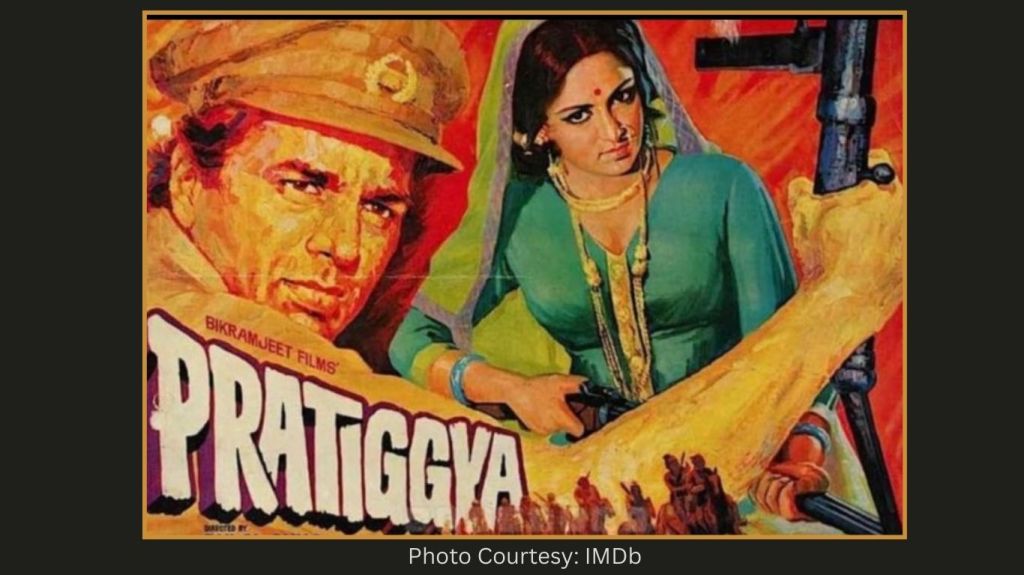
Pratigya (1975) stands as one of the year’s most spirited masala triumphs, released amid the creative churn of Sholay, Deewaar and Aandhi. Dulal Guha’s film, anchored by Dharmendra’s irresistible charm and Hema Malini’s sparkle, blends action, humour, romance and music into a joyous entertainer that, fifty years on, retains its exuberant appeal and cultural imprint.
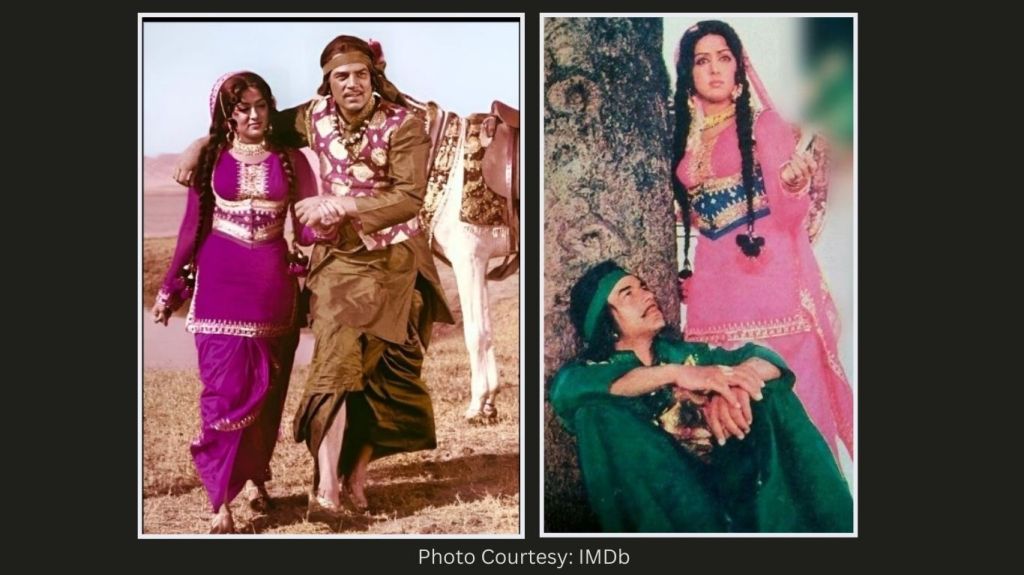
While Sholay, Deewaar, Chupke Chupke and Aandhi redefined genres and storytelling in 1975, in the middle of this cinematic ferment came Dulal Guha’s Pratigya, a rollicking, unabashed masala entertainer. Starring Dharmendra and Hema Malini, the film was a heady cocktail of action, comedy, music and melodrama, a quintessential 1970s potboiler that, fifty years later, retains its zest and charm.
If Sholay was Dharmendra’s claim as the dashing action-hero with comic flair, Pratigya had already showcased both sides of his persona earlier in the same year. It remains a landmark in his career not only for its success at the box office but also for giving him perhaps his most evergreen musical calling card: ‘Main jat yamla pagla deewana’. That song alone has ensured Pratigya an indelible place in the history of Hindi cinema.
Like most mainstream Hindi films of its era, Pratigya revels in the familiar tropes: lost families, dacoits, revenge, and a man taking on injustice. But Dulal Guha adds enough quirks to turn the predictable into a joyous romp. Ajit Singh (Dharmendra), a simple truck driver, discovers on his adoptive mother’s deathbed that his life is built on a hidden past. He is, she reveals, the lone surviving son of an upright police officer whose family was wiped out by the notorious dacoit Bharat Thakur (Ajit). That revelation becomes Ajit’s calling. He sets out to settle the score.
On the road to Dinapur, the bandit’s stronghold, Ajit encounters a gravely wounded Inspector D’Souza (Satyen Kappu). The officer, fiercely guarding a cache of weapons intended for a new police post in the village, dies after entrusting the arms to Ajit. With nothing but a vow and an unexpected armoury of guns and grenades, Ajit steps into the role fate seems to have chosen for him. He reaches Dinapur, passes himself off as a police officer, and, with the wary villagers slowly rallying behind him, establishes a makeshift police station.
The masquerade sets up some of the film’s funniest sequences – he must live up to his assumed identity without being caught, simultaneously juggling action, romance, and the occasional burst of song. This conceit, of a common man forced into the guise of authority, was not new, but here it works brilliantly because of Dharmendra’s comic timing and physicality. What follows is a tense battle of wits and willpower between Ajit Singh and Bharat Thakur, a fight that becomes not just about justice, but about fulfilling the solemn promise that gives the film its name.
Amid this brewing conflict is Radha (Hema Malini), the spirited village girl who wins Ajit’s heart. She also happens to be Bharat Thakur’s niece, though she despises her uncle’s tyranny and stands firmly with Ajit. Their chemistry, already celebrated in films like Seeta Aur Geeta and later immortalised in Sholay, sparkles here with playful banter, fights that dissolve into flirtation, and songs that throb with energy.
The narrative could have been dark and intense, but Guha and his writers, Nabendu Ghosh among them, inject a strong vein of comedy and situational humour, ensuring that even the revenge saga never turns grim.
Pratigya is very much a Dharmendra vehicle. By 1975, the star had perfected a persona that combined brawn with humour, a balance very few actors could manage. Unlike Amitabh Bachchan, whose ‘angry young man’ persona dominated the decade, Dharmendra’s charm lay in a lighter screen presence – strong but not quite brooding, masculine but always accessible.
In Pratigya, his comic timing is impeccable, particularly in sequences where he bluffs his way through ‘police work’. At the same time, his physicality anchors the film’s action. What is striking, looking back at Dharmendra’s 1975 output, is how his humour in Pratigya differs fundamentally from the finely tuned comic intelligence he displayed in Chupke Chupke the very same year. In Hrishikesh Mukherjee’s classic, his comedy is verbal, linguistic, almost scholarly in its playfulness. He revels in precise diction, mischievous wordplay, and a professor’s delight in semantic traps. The laughs arise from understatement, controlled mischief and a deliberate pricking of middle-class propriety. In Pratigya, however, his humour is rooted in physicality and bluff – broad, rustic, and delightfully unselfconscious. Here, the comedy comes from his blustering attempts to appear authoritative, his awkward swagger in a police uniform, and the sheer abandon with which he throws himself into situations he barely understands. If Chupke Chupke showcased Dharmendra the urbane comic craftsman, Pratigya celebrated Dharmendra the earthy entertainer, proving within the same year the astonishing range of his comedic instinct.
And then there is his effortless dancing and singing in ‘Main jat yamla pagla deewana’. It became more than just a song; it became Dharmendra’s unofficial anthem. Here was a star with the quintessential two left feet who couldn’t dance to save his life. And yet, his steps in this song have been imitated in countless films and by all who mimic the star. Even decades later, it would inspire titles of films (the Yamla Pagla Deewana series starring Dharmendra, Sunny, and Bobby Deol) and remain a shorthand for his screen persona – rustic, mischievous and irresistibly charming.
Mohammed Rafi’s exuberant rendition gave it an infectious energy. Watching Dharmendra cavort with abandon, one realises why he was among the most loved stars of the 1970s: he never took himself too seriously. He allowed his audience to laugh with him, and sometimes at him, without ever compromising his heroic stature. The music of Pratigya embodies the spirit of the 1970s masala entertainer: instantly hummable, situational and designed to please every section of the audience.
Director Dulal Guha may not be remembered today among the pantheon of auteurs, but in the ’70s, he had a string of successes with films like Dushman (1971), arguably among Rajesh Khanna’s finest hours on screen, Dost (1974) and Do Anjaane (1976). His craft lay in balancing melodrama with entertainment, ensuring his films appealed to both the masses and family audiences. In Pratigya, Guha ensures that the narrative never loses momentum. The revenge angle gives it structure, but he allows ample space for humour and romance. His staging of action sequences is rousing without being overly violent, keeping in line with the censor norms and audience expectations of the time. What stands out is his ability to maintain a tonal balance: despite deaths and oaths of revenge, the film never turns grim, which is why audiences flocked to it as a feel-good entertainer.
Hema Malini, by 1975, was firmly established as the ‘Dream Girl’. In Pratigya, she complements Dharmendra perfectly. Her Radha is spirited, quick with repartee, and refreshingly active in the narrative. She is not merely a decorative presence; she engages in the comedic set-ups and holds her own in romantic interludes. The supporting cast adds much flavour. Ajit, as the dacoit, brings his signature suave menace. Comedians like Johnny Walker, Jagdeep and Keshto Mukherjee (playing, what else, but the perpetually drunk Chandi, Bharat Daku’s mole in the village outpost) provide side-tracks of humour that, while digressive, align with the entertainment ethos of the film. Villagers, bandits, and side characters flesh out the masala world, where every few minutes something new happens – be it a song, a chase, or a comic misunderstanding.
Pratigya is a case study in the 1970s masala formula. A hero wronged by tragedy. A vow of revenge. A romance with a strong-willed heroine. A comic subplot to keep audiences laughing. A flamboyant villain and his gang. A soundtrack that offers both folk exuberance and filmi romance. A climactic showdown that restores order and justice. If this sounds predictable, it is precisely the predictability that audiences of the era cherished. The genius lay not in novelty of plot but in execution and star power. And here, Dulal Guha and Dharmendra delivered a package brimming with fun.
Half a century later, Pratigya deserves recognition not only as a commercial success but also as a snapshot of what made ’70s Hindi cinema so enjoyable. In an era often remembered for the rise of Amitabh Bachchan’s ‘angry young man’ persona, as also the Shyam Benegal school of New Wave cinema, Pratigya reminds us of the alternative strand of Hindi cinema: the fun-filled entertainer where action, comedy and music coexisted without self-consciousness.
For Dharmendra, the film remains a milestone. Even today, fans remember him breaking into ‘Main jat yamla pagla deewana’, a song that has transcended the film itself. The fact that his sons revived it decades later speaks to its enduring cultural resonance. For Hema Malini, the film added another hit to her vast filmography with Dharmendra, further strengthening their on-screen (and off-screen) partnership. Pratigya also reflects Dulal Guha’s skill in directing crowd-pleasers. While not often cited in serious histories of Hindi cinema, films like Pratigya demonstrate why Guha was a trusted name in the industry – his films worked with audiences.
As Pratigya turns fifty in 2025, it is worth celebrating as one of the decade’s wonderful entertainers, a film that embodies the colour, energy and unpretentious joy of 1970s Hindi cinema. It may not have the critical heft of Deewaar or the epic scale of Sholay, but it was never meant to. Its aim was to make audiences laugh, cheer, sing along, and leave the theatre satisfied. And that it did, spectacularly.
With Dharmendra at his charismatic best, Hema Malini lighting up the screen, Laxmikant-Pyarelal’s pulsating music, and Dulal Guha’s sure-handed direction, Pratigya remains a golden jubilee gem – a reminder of why we still return, fifty years later, to that unforgettable promise of fun, action, and ‘Yamla Pagla Deewana’ magic.
 Shantanu Ray Chaudhuri
Leave a comment