As we celebrate the Hindi publication of Pandit Amarnath’s monumental Hindustani Shastriya Sangeet ka Shabdkosh, a work that restores to our musical tradition its own living vocabulary, we also honour the lineage that shaped it. On this occasion, Rekha Bhardwaj will release a special pendrive featuring Pandit Amarnath’s compositions, a limited edition of 100 curated, on her music label VB Music. Together, the book and the music return us to the fullness of his legacy: a house of meaning where scholarship, sadhana and sound remain inseparably alive.

In the long arc of Hindustani classical music, scholarship often oscillates between the technical and the experiential, between the meticulously defined and the ineffably felt. Few musicians have been able to inhabit both worlds with the depth and grace that marked the life and work of Pandit Amarnath. A composer, teacher, thinker and spiritual practitioner, he carried forward the Indore gharana’s contemplative musicality even as he built new frameworks for how music might be understood, written about and transmitted. His Hindustani Shastriya Sangeet ka Shabdkosh, the Hindi translation of his seminal English work A Dictionary of Hindustani Classical Music, stands as one of the most significant contributions to contemporary music scholarship: not merely a glossary but a cultural instrument, a doorway into a living tradition where words are not definitions alone but pathways to sadhana, imagination and inner transformation.
The Shabdkosh emerges from a lineage of musicians for whom knowledge was never separate from practice. For Pandit Amarnath, music was ‘zinda’, alive, and therefore demanded a language supple enough to hold its multiplicity. The Hindi edition, arriving decades after the English original, answers a longstanding need in classical music studies. As Rekha Bhardwaj writes in her extended foreword, the book captures ‘the idioms, the sayings, the entire culture of music-making’, preserving not just the discipline’s technical vocabulary but the inner world of its practitioners. In a field where systematic reference works in Hindi are rare, it fills a crucial void.
But the Shabdkosh is also inseparable from the personality and pedagogy of the man who created it. Rekha Bhardwaj evokes her guru with an intimacy that becomes an extended meditation on the ethics and essence of music. The image that opens her foreword – ‘Guruji bargad ke ek ped ki tarah thay, jiske neeche hum sabko chhaav milti thi’ – sets the tone for the reverence with which countless students remember Pandit Amarnath. The metaphor is not ornamental; it reflects the deep sheltering presence he offered, the sense of being held within a vast tradition yet allowed the space to grow.
Her recollection of first seeing him – hands resting on the floor, eyes closed, absorbed in an inner sound – captures the spiritual grounding of his musical vision. ‘Main samajh hi nahin pa rahi thi, unko dekhun ya sunun,’ she writes, describing the moment she encountered him onstage as a child. This tension between sight and sound, between form and formlessness, runs like a subterranean current through the Shabdkosh itself. For if a dictionary is usually a fixed thing, here it becomes a breathing archive, shaped by a musician who insisted that music is not learned through instruction alone, but through attention, presence and surrender.
The pedagogical philosophy that shaped this dictionary was forged not in isolation but in the everyday encounters of guru and shishya. Bhardwaj remembers how he told her, during one of their quiet walks from Bharatiya Kala Kendra to the bus stop, ‘Shishya ka sahi samay par guru se milna aur guru ka sahi samay par sahi shishya se milna bahut durlabh hota hai. Ab jab yeh sanyog hua hai, to iska poora labh uthao.’ These words underscore a worldview in which learning is a sacred confluence, not a transaction. The Shabdkosh grows out of this same ethos: a belief that knowledge must be offered with clarity, humility and the joy of transmission.
A Vocabulary Rooted in Experience
Much of the book’s richness lies in its compilation of over 600 terms that span the technical, metaphorical and philosophical. But what distinguishes it is its grounding in lived musical reality. As Pandit Amarnath writes: The immense wealth of idiomatic expressions and vocabulary that Hindustani music holds is symbolic of its inner content … This collection brings together more than 600 such words, phrases and sayings that represent not only a great art tradition but the karmayoga, jnanayoga and bhaktiyoga embedded in it.’
This is not a dictionary designed merely for clarification; it is a map of the musician’s inner journey. Terms like chinkadaari, which Bhardwaj cites as her favourite, the ‘sweet sting’ or sudden shower of inspiration that descends upon the artist, could never be captured fully in literal translation. But placed within the context of practice, they reveal an entire emotional landscape.
Similarly, the famous explanation of the 22 shrutis, often reduced to an abstract technicality, comes alive through the analogy he offered a foreign student: ‘Jaise manav sharir ke pinjar mein baais haddiyan hoti hain, waise hi ek saptak mein baais vishisht shrutiyan gunjati hain.’ This was not a casual illustration but a philosophical insight into the mirroring of body and sound, microcosm and macrocosm. The accompanying verse, ‘Pinjar surmandal bhaya, surat surat ka mela’, turns theory into poetry, stitching physiology, acoustics and metaphysics into a seamless weave.
Such passages are emblematic of a musician who refused to separate the technical from the spiritual. In the Shabdkosh, therefore, definitions become doorways. They introduce the student not only to meanings but to ways of thinking, perceiving and imagining sound.
The Teacher’s Legacy
To understand the importance of this Shabdkosh, one must situate it within the broader context of Hindustani music pedagogy. The guru-shishya tradition, built on intimacy, devotion and immersion, is undergoing rapid transformation in modern institutions. The sense of shared time and presence has diminished; the oral transmission of nuance, metaphor and experiential knowledge, what might be called the ‘texture’ of learning, often gets lost.
Pandit Amarnath recognized this erosion early. His Shabdkosh is in many ways a response to it: an attempt to preserve the subtleties of a tradition that cannot be taught through notation or theory alone. As Bhardwaj notes, he was deeply aware of how ‘learning through companionship, sangati, was slowly disappearing’. By putting into print the expressions that carried centuries of musical wisdom, he sought to ensure that future generations could still access this lineage, even if the structures around them changed.
His teaching method, described vividly in Bhardwaj’s foreword, further illuminates the Shabdkosh’s foundations. He taught each student for only fifteen minutes at a time, insisting that the rest of one’s education lay in listening: listening to others, to oneself, to the space between sounds. ‘Sabse aham riyaz apne aapko gaate hue sunna hai,’ he told her. Inner listening, he believed, was the true gateway to sadhana. A dictionary shaped by such a teacher could never be a dry list of terms; it had to mirror this inwardness.
The Need for a Hindi Lexicon
The publication of the Shabdkosh in Hindi marks an important cultural moment. While Hindi is the primary language of instruction in many music universities, the availability of comprehensive resources has been limited. Students often oscillate between English texts, rich in content but culturally dissonant, and old-style Hindi treatises that lack systematic structure.
This dictionary bridges the gap. It speaks in the language of the tradition itself, preserving idioms whose texture would be lost in translation. It democratizes learning, enabling students who think, feel and practise in Hindi to approach the art form with ease and confidence. As Bhardwaj notes, it should be present ‘in every school, college, university library … and in every student’s private collection’.
Moreover, the Hindi edition includes not just terminology but also carefully notated compositions under Pandit Amarnath’s pen name, Miturang, offering readers a glimpse into the creative expression that shaped his pedagogy.
A Cultural and Historical Intervention
In the broader history of Indian classical music literature, this Shabdkosh occupies a unique place. Dictionaries or lexicons have existed before, but few have been as comprehensive, accessible or rooted in contemporary pedagogical needs. Most earlier works prioritized taxonomy over interpretation, placing terms in alphabetical order but offering little insight into their aesthetic or spiritual contexts.
Pandit Amarnath’s work, by contrast, stands at the intersection of scholarship and lived experience. It is grounded in performance, shaped by teaching, and guided by an inner philosophical compass that resisted the fragmentation of knowledge. By compiling a Shabdkosh in the late twentieth century, a moment of rapid cultural change, he was also making a statement about the enduring relevance of classical music and its conceptual world.
It is therefore no surprise that the work required decades of thought. As he writes: ‘After forty-five years of performances, writing, music-making, research and teaching, I realised the need to record my experiences in the language of Hindustani music itself.’ This decision, to trust the vocabulary of the tradition, to honour its ‘zinda bhaasha’, is a cultural intervention of lasting significance.

The Human Pulse behind the Work
To speak of the Shabdkosh is also to speak of the man who wrote it. Bhardwaj’s account reveals a figure whose musical wisdom was inseparable from his human presence: his humility, his humour, his ascetic temperament, his deep compassion for students. She recalls how “unka chehra yaad karti hoon to yaad aata hai woh tweed coat, woh muffler, aur unki zulfain jo kisi sultan ke taj jaisi lagti thi’, an image that carries both affection and awe.
But beneath this royal grace was a fakir-like stillness. He walked in rhythm, she writes, ‘as though offering a sur to the earth with every step’. Students experienced him not only as a teacher but as a field of energy, someone who could ‘see inside and outside us, from whom nothing could be hidden’. Such presence is rare in any era. That it lives on through a book of definitions is itself a testament to the depth with which he infused his work.
A Book That Becomes a Companion
Hindustani Shastriya Sangeet ka Shabdkosh is far more than a reference text. It is a house of meaning, a companion for students, teachers, performers and lovers of music. It brings together the technical precision of a scholar, the creative intuition of a composer, the spiritual insight of a seeker and the compassionate clarity of a guru.
In a time when classical music faces both challenges and renewed curiosity, this book becomes an anchor. It preserves the subtlety of a tradition whose vocabulary carries centuries of practice, metaphor and lived experience. It fills a gap long felt in Hindi-language music education. And it allows readers, whether novices or advanced practitioners, to enter the world of Hindustani music with both structure and wonder.
In the end, the Shabdkosh stands as an extension of Pandit Amarnath himself: a bargad tree offering cool shade and deep grounding to anyone who seeks it. For, as Bhardwaj writes, the seeds he planted ‘are now sprouting inside us’. This dictionary is one such seed, rooted in a lifetime of devotion, growing into a legacy that will nourish generations.
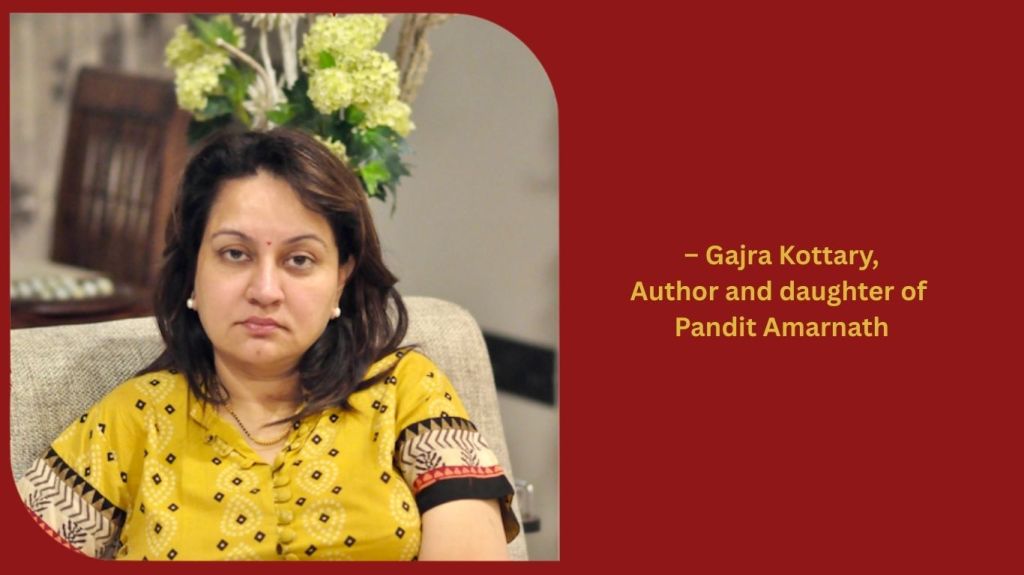
‘The publication of the Hindi translation of the Dictionary of Hindustani Classical Music by Rajkamal seems like a homecoming of sorts as far as I am concerned.
In March 1997, a year after my father had passed away, I had joined hands with Rajkamal Publishers to bring out my father’s book of poetry, Hansa Ke Bain. At a time when I knew little about how the publishing industry works, they were educative and supportive. Also, they are the best in Hindi mainstream publishing and a book like this actually has its best possible readership in Hindi, even more than in English. It will be of practical use to a much wider section of readers within the country and that’s a great source of satisfaction for me.
In the many intervening years between 1997 and 2025, nearly three decades, its publication by Penguin in 2020 thanks to Shantanu Ray Chaudhuri and now the translation by Rakesh Kumar Pathak, have all been facilitated by Rekha Bhardwaj, to whom I will always be hugely indebted.’
– Gajra Kottary, author and daughter of Pandit Amarnath
*
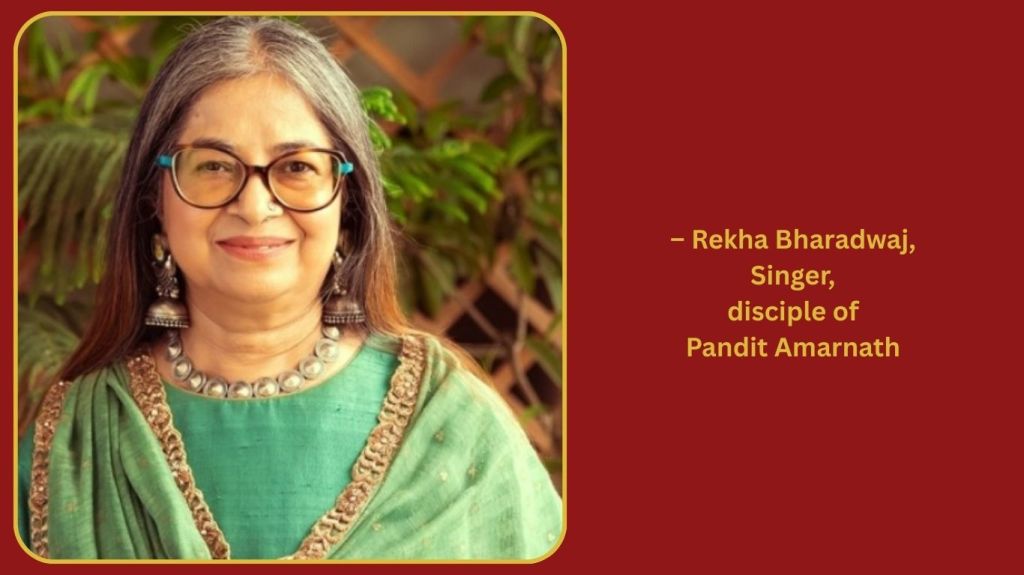
‘This Hindi translation of the Dictionary of Hindustani Classical Music is particularly special to me. The original dictionary, published in 1990, came out when my guruji, Pandit Amarnath, was still with us. Everything in that edition was created under his guidance, which made it both beautiful and extraordinary.
A new English edition was later brought out by Penguin in 2020, and that happened entirely because of Shantanu Ray Chaudhuri. I consider it my good fortune that I was invited to write the foreword for that edition. It gave me the opportunity to express my emotions and my deep respect for Guruji, and we were also able to add entries on a few more artists.
This new Hindi edition is even more meaningful. The translation has been done by Shri Rakesh Pathak, himself a trained classical singer and guru, someone who has seen Guruji, met him, and deeply loves his music. His translation has captured the essence of the original beautifully. For this edition, too, we have added short profiles of additional artists.
There is another special feature: the book includes the compositions and notations of three ragas written by Guruji. We have reproduced the handwritten notations exactly as they are, which adds a rare and personal touch. The foreword I wrote appears here in Hindi, allowing for a more poetic expression.
I am especially happy that the dictionary is now available in Hindi, because much of our music education, particularly in universities, is conducted in Hindi. Young artists, students, connoisseurs, and practitioners will find the Hindi edition far more accessible and useful. I believe its reach will grow significantly.
With this, a journey that began in 2018 and took shape with the first English edition in 2020 is coming full circle in 2025 with this Hindi edition published by Rajkamal. A great deal of credit goes to Satyanand Nirupam, the senior editor at Rajkamal, for making this possible.
An added joy on this occasion is that we are also releasing some of Guruji’s restored and remastered raga recordings under the VB Music label. As a gesture of gratitude, the first 80–85 buyers of the Hindi edition will receive a complimentary pendrive containing this music, beautifully designed and packaged. Both the book and the pendrive will be released on 26 November at the India International Centre (IIC). We look forward to sharing them with everyone who purchases the book that day.
– Rekha Bhardwaj, singer and disciple of Pandit Amarnath
 Shantanu Ray Chaudhuri
Leave a comment