Hindi film music has always offered more than melody; at its finest, it becomes a way of thinking about life itself. Across decades, its most reflective songs have distilled the truths of impermanence, longing, and acceptance into images that feel at once intimate and universal. It is within this lineage of quiet contemplation that ‘Hum chahein ya na chahein’ emerges, a song that turns life’s inevitabilities into something almost luminous.
Hindi film songs have long carried within them a quiet, unhurried philosophy of life. In their most enduring moments, they reflect on impermanence, resilience, and the delicate balance of joy and sorrow, often drawing on images of nature to illuminate inner truths. ‘Zindagi kaisi hai paheli’ponders life’s riddles with a childlike wonder. ‘Main zindagi ka saath nibhata chala gaya’ finds dignity in accepting whatever life has to offer. ‘Zindagi ka safar hain ye kaisa safar’ is probably the one song that says it all about the impossibility of finding meaning in life, while ‘Aadmi musafir hai’ is an ode to the man as a wanderer, reminding us that each of us is but a passing presence on the road, moving through the world with nothing more than the dust and the day for company.
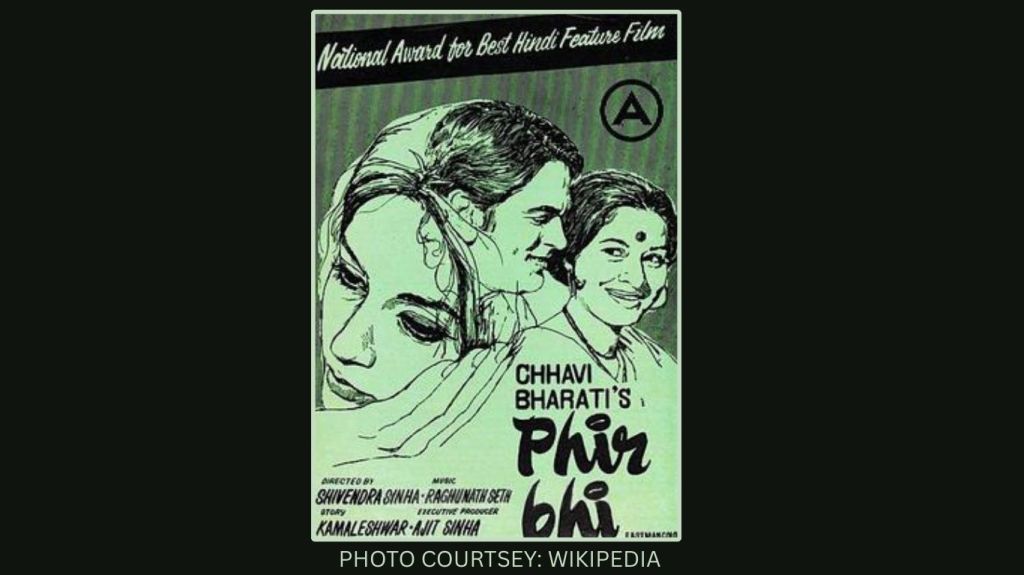
It is within this lineage of reflective, humane songwriting that ‘Hum chahein ya na chahein’ situates itself, offering its own meditation on choice, yearning, and the quiet inevitabilities that shape the human heart. Few opening lines in Hindi film music have captured the inevitability of life’s journey with such quiet grace. The song, from the little-remembered 1971 film Phir Bhi, is one of those rare creations that transcend their cinematic context. Though it fits the world of the film’s narrative effortlessly, like all great songs it resonates as much outside it, floating free of the film, becoming instead a philosophical reflection set to music, an aural meditation on destiny, time and acceptance.
Written with a spare poetic economy, the lyrics evoke an image of the human being as both participant and spectator in life’s great unfolding. The refrain – hum chahein ya na chahein – recurs like a mantra, each time deepening the sense of surrender. Life, the song seems to say, moves us along its mysterious paths whether or not we choose to walk them. The ‘rahein’ (paths) have their own will, their own flow, and we are borne upon them, a truth both humbling and liberating.
The Lyrical Imagination
At its heart, the lyric is an inquiry into the relationship between human will and cosmic design. In just a few lines, the lyricist, B.P. Narendra Sharma, creates an imagery that blends the material and the metaphysical with remarkable ease.
‘Yeh rahein kahan se aate
yeh rahein kahan le jaate
rahein dharti ke tan par
aakash ki phaili bahein…’
This is among the most exquisite expressions of wonder in Hindi film poetry. The roads, symbols of human striving and experience, are imagined as lying upon the earth’s body (dharti ke tan par), yet embraced by the vast arms of the sky (aakash ki phaili bahein). In one stroke, the lyric unites the tangible and the infinite: man’s small movement upon the planet and the cosmic vastness that holds it all.
The language is simple, yet the metaphors open up endless interpretive dimensions. The rahein could be literal – the roads we walk in pursuit of work, love, or destiny. But they are also metaphysical; the pathways of the soul, the unseen routes by which we move through birth, joy, loss and eventual dissolution. In the final stanza, the lyric moves towards spiritual resolution:
‘Utra aakash dhara par,
tann mann kar diya nichaavar,
jo phool khilana chahein
hans hans kar saath nibhahein…’
The image of the sky descending to the earth is a cosmic reconciliation – heaven meeting earth, the ideal merging with the real. The surrender of tann mann (body and mind) signifies acceptance, the offering of oneself to whatever the moment brings. The flowers that bloom thereafter, jo phool khilana chahein, are symbols of grace, of beauty arising naturally once one yields to the rhythm of life.
This progression – from questioning to acceptance, from human anxiety to cosmic harmony – gives the song its emotional architecture. The refrain ‘hum chahein ya na chahein’ is no longer a statement of helplessness by the end; it becomes a note of serenity, a recognition of the great pattern in which we are all participants.
The Quiet Brilliance of the Composition
Raghunath Seth’s composition is one of his most understated yet profound works. It unfolds in a raga-inspired melodic arc, though not rigidly bound to classical structure. The rhythm, unhurried, mirrors the contemplative pace of the lyrics. The orchestration is sparse: a soft string section, muted flute interludes, and occasional strokes of the sitar or guitar to underline transitions. There is none of the lush orchestral swell that defined much of Hindi film music in the 1960s and 1970s. Instead, the composer opts for translucence, allowing silence to be part of the song’s fabric. The pauses between phrases are not voids; they breathe.
Raghunath Seth’s genius as a composer, sadly underutilized in the Bombay film scene, often lay in his ability to make simplicity profound. Consider, for example, the Anuradha Paudwal–Bhupinder song ‘Yeh paudhe ye patte’ (Ek Baar Phir, 1981), a composition that so resonantly encapsulates the ambience of the words, conveying the quiet wonders of nature. There’s also the reflective ‘Jaane yeh mujhko kya ho raha hai’. Another personal romantic favourite is Bhupinder’s ‘Koi jab se sharik-e-karvaan’ (Kahan Tak Aasmaan Hai, 1984). The composition can almost make you visualize yourself being borne on the wings of love in the company of your beloved.
A pioneering flautist and exponent of Hindustani classical music, Pandit Raghunath Seth provided Bhupinder with quite a few songs that deserve to be on the playlist of everyone who loves soulful Hindi film music. His truly ‘hat-ke’ compositions include Bhupinder’s soulful ‘Do ghadi bahla gayi’ and yet another Anuradha Paudwal class-act ‘Maine ik geet likha hai’ in Yeh Nazdeekiyan (1982). In Aage Modh Hai (1987), Raghunath Seth composed the haunting ‘Door kahin raton ko’ for Bhupinder, an elegiac melody that makes you almost see yourself going back to memories of bygone days and wandering about, lost like a ruin.
Like these incorporeal melodies, ‘Hum chahein’ too seems to hover in a half-lit emotional space, neither fully joyous nor entirely sad. It is introspective music, meant to be lived with rather than merely heard. The tonal restraint makes each phrase resonate longer in the listener’s inner ear. One could imagine a lesser composer heightening the pathos with swelling violins or dramatic modulations. Raghunath Seth resists that. His melody is content to travel, like the rahein of the lyric, at its own meditative pace. The understated musical phrasing – particularly in the refrain, where the tune lingers delicately on ‘chahein’ – creates a sense of circularity, as though the song itself is tracing the endless loop of life’s journey.
The Voice as Vessel: Hemant Kumar the Singer
If the composition is the vessel, Hemant Kumar’s voice is its spirit. Few singers in Hindi cinema could convey stillness as eloquently as he could. His deep, velvety timbre, neither overtly masculine like Rafi’s nor overtly delicate like Talat’s, carries within it an autumnal warmth. It is a voice that suggests dusk rather than dawn, contemplation rather than excitement.
In ‘Hum chahein ya na chahein’, Hemant Kumar sings as though he were conversing with himself. The delivery is almost conversational, yet within that restraint lies an ocean of feeling. The diction is crystal clear, each consonant gently caressed, yet never forced. The vibrato is subtle, the modulation natural.
Listen to the way he stretches ‘jeevan ki rahein’; the tonal descent at the end of the phrase feels like a sigh of surrender. Or how he infuses ‘aakash ki phaili bahein’with an upward lift, musically embodying the image of the sky’s embrace. Every inflection feels organic, born from the words themselves.
Hemant Kumar was one of those rare singer-composers for whom melody and meaning were inseparable. His singing here has no performative display; it dissolves the ego of the artist into the spirit of the song. The effect is that of a prayer murmured rather than a performance staged. It is perhaps why his songs, even when heard decades later, seem to belong to the listener’s inner world rather than to a particular film or period.
Resonance and Philosophical Undertones
The song’s philosophical undertones resonate with a long tradition in Indian thought. From the Bhagavad Gita’s ideas of action without attachment to the Upanishadic vision of oneness between the self and the cosmos. ‘We may or may not desire,’ says the lyric, ‘but life carries us along.’ This is not fatalism; it is wisdom born of observation.
The rahein are the karma marga, the paths of action, while the sky and earth, in their embrace, symbolize the unity of the temporal and the eternal. The blooming flowers in the final verse are not merely botanical; they are metaphors for realization, the flowering of the spirit when resistance ceases.
In cinematic terms, the song stands apart from the melodramatic norm. It asks for stillness, not spectacle. Fittingly, the moment plays out against dry, dust-washed vistas, scrubby vegetation, and open skies, the two figures driving down an empty road, far from the claustrophobia of interiors. The visual minimalism matches the song’s inward journey.
The Song’s Place in Hemant Kumar’s Oeuvre
Phir Bhi never became a popular film, though it won two National Awards. The song, however, stands as one of Hemant Kumar’s most luminous late works. In the 1950s, he had already given Hindi cinema an unparalleled range of melodies, from ‘Yeh raat yeh chandni’ to ‘Hai apna dil to awara’. But by the 1970s, as musical tastes shifted towards the exuberance of R.D. Burman and the pop influence, Hemant retreated into quieter forms of expression, for example, in ‘Tum pukar lo’ (Khamoshi, 1970). ‘Hum chahein ya na chahein’ belongs to this phase, where his art turned inward, away from romantic flourish towards reflective depth.
In this sense, the song can be seen as a culmination, a statement of artistic and existential acceptance. The man who once sang of desire and longing now sings of surrender, of being carried along by the very roads he once sought to chart.
The Eternal Aftertaste
The power of ‘Hum chahein ya na chahein’ lies in what it leaves behind. When the last note fades, one is left not with a sense of conclusion but of continuation. The song seems to echo within, much like the lines of a contemplative poem that refuse to end with punctuation. It leaves the listener standing at a crossroads, watching the roads stretch infinitely under the embrace of the sky.
There are few songs in Hindi cinema that manage to hold together the lyrical, the philosophical, and the musical with such poise. Every element – Narendra Sharma’s minimal yet resonant words, Raghunath Seth’s delicate melodic phrasing, Hemant Kumar’s hushed baritone – contributes to a unity of feeling.
In the end, ‘Hum chahein ya na chahein’ is less a song and more an experience, a moment of stillness where art touches the edges of thought. It reminds us that we are all travellers, that life’s pathways claim us in ways beyond choice or resistance. And as Hemant Kumar’s voice fades into silence, we understand that acceptance is not defeat but grace – the grace of being carried, gently, by the music of existence.
Postscript: A Poem that Resonates with the Song
Dad with a Newspaper that Holds No Meaning for Him Anymore
Today I found him sitting in his old chair, the newspaper opened like a familiar doorway. His fingers worked the edges of the pages with the care of someone returning to a room they once knew by heart.
He turned each sheet slowly, eyes lingering on a headline as if waiting for the shapes to settle, for the world to speak to him in a language he still remembered.
Every now and then he glanced up, a quick, searching look, as though checking whether the gesture of reading still looked like reading.
And something in the room tightened, not with sorrow, but with the quiet dignity of a ritual held long after its meaning slips away, a mind frayed, a habit surviving.
Outside, the day went on as usual. Inside, he folded the paper with the same old precision, as if putting away a part of himself that still insists on staying.
 Shantanu Ray Chaudhuri
Leave a comment