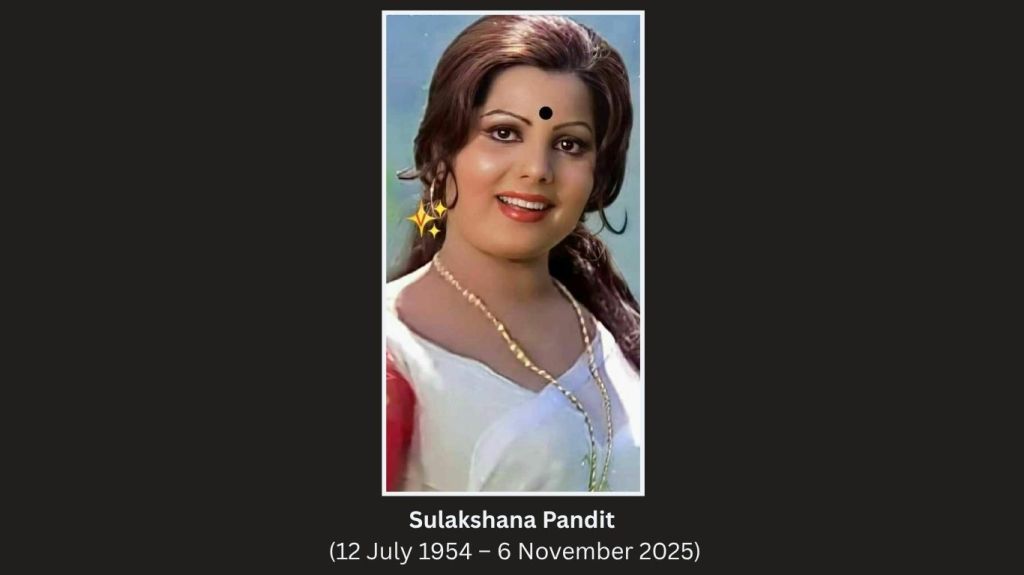
‘Beqaraar dil’ and ‘Jaana kahan hai’ – Two Songs that Keep Her Voice Alive in Our Hearts
There are artists whose names fade from marquee lights, yet whose voices never quite leave us. Sulakshana Pandit was one such presence, a singer who never scaled the peaks of fame but touched depths that only true feeling can reach. Her career may not have been long or glittering, but in two unforgettable songs, ‘Beqaraar dil tu gaaye jaa’ and ‘Jaana kahan hai’, she created a kind of eternity. These melodies, fragile and radiant, continue to hum within us like half-remembered dreams, testaments to a voice that made yearning sound pure and young love eternal.
‘BEQARAAR DIL TU GAAYE JAA’: THE TRANQUIL CALL OF A RESTLESS HEART
Some songs survive, outlive their time, the singer’s other professional achievements or failures, because they touch something deep within us, something that never seeks the limelight. ‘Beqaraar dil tu gaaye jaa’,from Kishore Kumar’s 1971 film Door Ka Rahi, belongs to that luminous category. It is a song that hovers like a sigh, asking the heart to keep singing through its restlessness. Though it is technically a duet with Kishore Kumar, the song belongs, wholly and hauntingly, to Sulakshana Pandit.
At the time, Sulakshana was at the beginning of her musical journey. Born into the illustrious Pandit family of classical musicians (her uncle being the great Pandit Jasraj), she carried the weight of lineage but also the gift of instinct. There was a silken restraint in her singing, a refusal to oversell emotion, a humility before the tune. ‘Beqaraar dil’ would be one of her earliest recordings, and in its shimmering fragility one can already hear what made her voice distinctive: it trembles without breaking, it reveals without pleading.
Kishore Kumar’s introspective side
Door Ka Rahi was one of Kishore Kumar’s most personal ventures. He wrote, directed, produced, composed, and sang for it, a creative outpouring from an artist often dismissed as eccentric but, in truth, deeply philosophical. Beneath the comic persona and yodelling exuberance, Kishore carried a contemplative streak, a belief in life’s essential impermanence. His music for Door Ka Rahi is suffused with that mood of inward journey.
Unlike the effervescent melodies of his mainstream work, the compositions here are simple, sparse, almost hesitant. ‘Beqaraar dil’ is built on a lilting, cyclical structure, its phrases rising and falling like breath. The orchestration never intrudes: soft strings, gentle piano, a discreet rhythm section that feels like the heartbeat of someone half-asleep, half-awake. Kishore’s own voice is like a murmur – earthy, human, introspective – but with Sulakshana joining in, the song acquires another dimension.
Her timbre has a glass-like clarity that catches light from within. Kishore’s voice grounds the melody; hers lets it float. The contrast is exquisite: his baritone warmth against her tremulous, silvery phrasing. The duet becomes not a dialogue but a meeting of two solitudes, both reaching for the same consolation: song as survival.
The poetry of endurance
In an album overflowing with gems, ‘Beqarar dil’ is the Kohinoor. The lyrics, by Irshad, carry the quiet wisdom of acceptance: ‘Beqaraar dil, tu gaaye jaa, khushiyon se bhare vo taraane / jinhe sun ke duniya jhum uthe, aur jhum uthe dil deewaane.’ On the surface, these are words of encouragement: keep singing happy songs. But the happiness invoked is aspirational, almost defiant. The poet is not naïvely optimistic; he is urging the restless heart (beqaraar dil) to create joy where none exists. There is something profoundly human about that gesture: the awareness that life is often barren, and yet the need to keep singing remains.
The subsequent verses turn the metaphor of music into a philosophy of being: ‘Raag ho koi milan kaa, sukh se bhari saragam kaa, yug-yug ke bandhan kaa…’ The language is of eternal unions, the imagery drawn from nature’s cycles. Each verse folds love and loss into a single breath. Even the final stanza, ‘Dard mein doobi dhun ho, seene mein ik sulagan ho…’refuses to romanticize pain. It merely acknowledges it as part of the rhythm of existence.
Sulakshana Pandit: the fragile radiance
Listening today, one cannot separate the song from Sulakshana Pandit’s later life. Her story, like that of so many gifted women in Hindi cinema, is tinged with melancholy. She would go on to sing for all the major composers of her era. Yet her career, either as an actor or a singer, never quite took off. In an industry that prizes volume and glamour, her gentleness was mistaken for timidity.
There was, too, the shadow of unfulfilled love – her long, unreciprocated affection for Sanjeev Kumar became one of the film world’s tragic whispers. It is supremely ironical that she too passed away on the same date as Sanjeev Kumar did: 6 November. Over time, as offers dwindled and she faced personal health issues, she withdrew into silence. But that silence was never emptiness; it was the echo of a voice that had once known how to make longing luminous. In ‘Beqaraar dil’, we hear the first stirrings of that luminosity. She phrases each line with the hesitancy of someone who knows that beauty can be broken by a breath. When she sings ‘Raat yun hi tham jaayegi, rut ye hasin muskaayegi’there’s a smile in her voice, but it’s a smile that trembles. It’s the sound of hope knowing its own fragility.
A conversation between two souls
What makes ‘Beqaraar dil’ extraordinary is how Kishore Kumar the composer allows the two singers to inhabit the song differently. His own rendition is steady, almost stoic, the voice of someone offering consolation. Sulakshana’s, in contrast, is all vulnerability, the sound of someone being consoled yet knowing that consolation is temporary. Their voices never quite merge; they circle each other like two planets, each lit by its own sorrow.
In that delicate interplay lies the song’s emotional truth. It is not a love duet in the traditional sense. It is a philosophical dialogue between endurance and yearning, between the masculine strength that urges one to keep going and the feminine sensitivity that feels every tremor of loss. Kishore’s composition gives both space to breathe, and in that balance the song finds its timelessness.
The film and its inward gaze
In Door Ka Rahi, Kishore Kumar played a wanderer, a man who travels from place to place spreading kindness, healing wounds, but never quite belonging anywhere. The film’s tone is reflective, almost spiritual, and ‘Beqaraar dil’ mirrors the protagonist’s inner state. The wandering heart is beqaraar not because it seeks love, but because it seeks meaning.
Every element of the song reinforces that thematic arc. The gentle lilt of the rhythm feels like footsteps on a long road. The melodic turns suggest movement and return, as though each refrain were a milestone passed and remembered. Even the orchestral silences feel like pauses in a solitary journey.
Legacy and afterlife
Over half a century later, ‘Beqaraar dil’ endures as one of Hindi cinema’s most quietly profound songs. It lacks the grandeur of a hit number, the lush orchestration of a chart-topper, but it possesses something rarer: intimacy. It feels sung directly into the listener’s ear, as if the heart were whispering to itself.
For Sulakshana Pandit, this song stands as a miniature of her artistic temperament: refined, reticent, incapable of artifice. Her later career as an actress never matched her musical gifts, and her eventual disappearance from the public eye only deepened the poignancy of that early promise. Yet, in the strange arithmetic of art, one moment of truth outweighs a lifetime of obscurity. In these four and a half minutes of ‘Beqaraar dil’she achieved what few ever do: she left behind a sound that feels eternal.
Listening now, in an age of digital perfection and instant noise, the song feels almost otherworldly. The little imperfections – the slight catch in her voice, the breath before a phrase – become the very marks of authenticity. Kishore Kumar’s melody, too, stands apart from the trends of its time: neither classical nor pop, neither filmi nor folk, but a personal utterance, like a letter written in solitude.
A song that keeps singing
Perhaps that is why the song still resonates. Its refrain is not merely addressed to the singer; it speaks to all of us. It tells us to sing, not because life is perfect, but because silence is unbearable. It tells us that joy is not the absence of pain but the courage to keep melody alive amid restlessness. Sulakshana Pandit’s voice carries that message with the purity of a prayer. Each time we hear her in this song, she seems to remind us of what music once meant: not performance, but communion; not glamour, but grace.
In the end, ‘Beqaraar dil’ becomes more than a duet, more than a film song. It becomes a metaphor for an artist’s life. The restless heart keeps singing, even when no one is listening. And in that act of quiet persistence lies the essence of Sulakshana Pandit’s legacy: a brittle, haunting, unforgettable voice that still floats somewhere between joy and sorrow, between distance and remembrance, between the door that never quite closes and the song that never quite ends.
‘JAANA KAHAN HAI’: THE BREEZE OF YOUNG LOVE
If there’s one song that makes you feel young every time you listen to it, it is this. A song that doesn’t simply recall youth but seems to recreate it in sound, light, and colour. Composed by Bappi Lahiri, written by Amit Khanna, and sung by Sulakshana Pandit and Bappi himself, it is one of those rare confluences in Hindi film music where melody, lyrics, and voice come together to form a single, shimmering mood – that of carefree, effervescent love under blue skies.
For Sulakshana Pandit, ‘Jaana kahan hai’ remains one of her most luminous moments on film, a song that encapsulates her soft, mellifluous timbre and the fragile optimism she brought to her singing. Listening to her voice here is like hearing sunlight through silk curtains – translucent, gentle, and trembling with emotion. If ‘Beqaraar dil’ is soaked in pathos, ‘Jaana kahan hai’ is an ode to the exuberance of youth.
The effervescence of the 1970s and Bappi Lahiri’s melody
Before Bappi Lahiri became the glittering ‘Disco King’ of the 1980s, he was, above all, a romantic. In the 1970s, his music bore the freshness of a morning breeze, melodies that carried a sense of innocence and joy. Chalte Chalte was one such album, filled with songs that seem to emerge from a place of spontaneous, heartfelt melody.
‘Jaana kahan hai’ opens with those unmistakable tu ru ru rurefrains – playful, lilting, almost childlike in their simplicity. They are not just filler syllables; they are the heartbeat of the song, the hum of life itself, an untranslatable expression of happiness too simple to be put into words. Bappi Lahiri’s own voice, surprisingly tender here, blends beautifully with Sulakshana’s, creating an aural image of two young lovers discovering love for the first time.
The composition is deceptively simple, a waltz-like rhythm that floats rather than marches, with soft guitars, airy strings, a melody that dances like sunlight on rippling water. There’s something in the tempo, unhurried yet buoyant, that captures the feeling of walking hand in hand with someone you love, without any destination in mind.
Bappi’s music here is not about grandeur; it’s about mood. Each stanza unfolds like a new view of the same day – a different angle of sunlight, a fresh gust of wind – yet the feeling remains constant: joy.
Amit Khanna’s lyrics: Blue skies and open hearts
Amit Khanna’s words match Bappi’s melody note for note in their simplicity and sincerity. His lyrics are not weighed down by metaphor or poetic flourish; they’re light, transparent, the language of lovers talking while walking through a park, heads tilted towards the sky.
‘Bahaar hi bahaar hai, mehka mehka poora chaman hai, kiska intezaar hai, dil beqaraar hai.’ The words evoke the fragrance of spring and the restlessness of a heart newly in love. The imagery – ‘bahaar,’ ‘chaman,’ ‘mehaka’ – belongs to an earlier, more innocent era of Hindi film poetry, yet Amit Khanna refreshes it with an unselfconscious naturalness. There’s no heavy symbolism here; he is content to let the world be what it is – bright, fragrant, and alive.
Then comes the refrain, ‘Jaana kahan hai, pyaar yahan hai…’, a line that sums up the entire philosophy of young love. The lovers do not know where they are going, and it doesn’t matter; love is here, now. The destination is meaningless because the journey itself, the togetherness, is the reward. It’s a sentiment that feels almost radical today, in an age of anxious goals and restless ambition: to simply be present in love.
The later stanzas extend this feeling into the elements – the wind, the light, the moon: ‘Chanchal aaj pawan hai, meethi meethi si chubhan hai…’ … ‘Ujaala hi ujaala, baadalon se phir aaj chaand ne munh nikaala…’
The language is that of wonder, of two people rediscovering nature because they have rediscovered each other. Even the smallest details, the ‘meethi chubhan’ of the breeze, the moon’s ‘chaandi ki maala’, feel tactile, sensual, alive. It’s the poetry of being in love with being alive.
Sulakshana Pandit: The voice of tender radiance
In ‘Jaana kahan hai’ Sulakshana Pandit is at her most evocative. Her voice, though trained in classical precision, never sounds rigid. There’s an ache beneath her sweetness, a tremor that hints at vulnerability even in happiness. Listen to the way she phrases ‘dilkash sama hai…’ – the notes hover for a second longer than expected, as though she doesn’t want the moment to end.
Sulakshana’s singing was always about more than melody; it was about emotion as texture. In this song, she sounds both assured and a little shy, as though smiling through a blush. It’s this combination of confidence and innocence that makes her rendition unforgettable. Bappi Lahiri, singing alongside her, provides a perfect foil – his inimitable tone grounding her airy delicacy. Together, they create a sonic portrait of young love in dialogue, his playfulness answering her tenderness, his laughter meeting her wonder.
A song of endless youth
‘Jaana kahan hai’ remains, even today, a capsule of youth. It doesn’t belong to any particular decade; it exists in that timeless realm where love is always new. The song could play in 1976, or in 2025, and it would still evoke the same feeling: the desire to step out into the sunlight, take someone’s hand, and walk without purpose.
Perhaps that’s why the song feels like a conversation between the past and the present, between the listeners we were and the people we’ve become. Each ‘tu ru ru ru’ seems to call us back to ourselves, to that version of us who believed that every breeze was singing for us, that every moonrise meant something. When Sulakshana sings ‘Pyaar yahan hai’ she isn’t just speaking to her beloved; she’s speaking to the listener. Love is here – in the song, in the voice, in the very act of listening.
The legacy
For Bappi Lahiri, Chalte Chalte marked one of the high points of his melodic career, an album that proved he could craft timeless romance as easily as he later created dance-floor anthems. For Amit Khanna, it was an affirmation of the beauty of simplicity in songwriting. But for Sulakshana Pandit, ‘Jaana Kahan Hai’ is perhaps more personal. It captures her artistry at its most luminous, a singer who could embody not just love, but the feeling of falling in love with life itself.
Listening to her today, fifty years later, one cannot help but feel the poignancy of time: how something so full of youth can remain ageless. ‘Jaana kahan hai’ is not just a love song. It is a reminder that no matter how far we travel, how much the world changes, there will always be a corner of our hearts where love feels like spring again, where the breeze is still playful, and where Sulakshana Pandit’s voice still hums, ‘Jaana kahan hai, pyaar yahan hai…’
Forever young. Forever new. Forever love.
 Shantanu Ray Chaudhuri
Leave a comment