
In the wake of Dad’s recent medical condition, I was reminded of the unsettling honesty of Camus’s Meursault and the quiet exposure it demands of me. His refusal to lie, to himself or the world, forces me to face the small deceptions that make my own life bearable. Between his searing clarity and my need for consolation, I find myself standing in that uncomfortable space between truth and tenderness, the inadequate witness to another man’s honesty.
‘Mother died today. Or maybe yesterday, I don’t know.’
It is astonishing how a sentence so bare can cleave your world open. The first time I read it, I put the book down after that single line. There was something in its calm indifference that felt like a rebuke. Not to anyone in particular, but to all the small lies by which I had come to live. That cool, factual tone – neither grief nor relief, simply a statement of being – unsettled me in a way no loud declaration ever could. It was as if Camus, through Meursault, had torn the comforting fabric of sentiment I had always wrapped myself in.
That single, dispassionate line, perhaps one of the most famous in all literature, was my initiation into Albert Camus’s The Outsider. I still remember the sense of quiet disorientation it provoked. Not outrage or disbelief, but a deep, almost physical stillness. I read the line again and again, sensing that behind its calm surface lay something raw and immense, like a wound so old it no longer bled. From that first sentence, Meursault, the novel’s narrator and antihero, seemed to stand at an unbridgeable distance from the world, and yet, in some strange way, he felt closer to the truth than anyone I had ever encountered in fiction.
When I first read The Outsider, I was struck not by its philosophy, but by its simplicity. The prose is stripped of adornment, each sentence a clean incision into the fabric of reality. Yet beneath that clarity lurks something profoundly unsettling. Meursault is a man who refuses to pretend, who will not dress his feelings, his apathy, or his desires in the comforting lies that sustain social life. He is, in a word, honest. And it was this unflinching honesty that both drew me to him and made me feel deeply inadequate.
Most of us are conditioned, from early on, to conceal ourselves behind gestures of convention. We learn the right responses: to mourn in public, to show enthusiasm where it is expected, to say ‘I’m fine’ when we are not. Meursault does none of this. When his mother dies, he feels nothing. He does not invent grief to satisfy others. He merely acknowledges the fact of her death and the discomfort of the funeral heat. Here is a man who refuses to speak the language of false feeling. It is terrifying, this purity. Reading him, I felt as though I were being stripped of all my justifications, all the small hypocrisies I had come to depend upon.
I had encountered characters who lied, who struggled, who redeemed themselves. But here was a man who did not even try to explain. Who would not disguise the absence of feeling with the expected mask of sorrow. Mother died today. Nothing more. I remember feeling as if I were being silently judged by that line. Meursault’s honesty, unembellished and indifferent, made me feel suddenly inadequate; not morally, but existentially. I realised I could never be that honest.
For what is honesty, really? We call ourselves honest when we refrain from telling deliberate lies. But Meursault’s honesty is of a different order: an elemental truthfulness, a refusal to decorate reality. It isn’t ethical; it’s ontological. He will not pretend to feel what he does not feel, will not ascribe meaning where none exists. I, who spend my days arranging words to make life seem coherent, felt stripped bare by that refusal.
The first half of The Outsider reads like the record of a man living moment to moment, detached but alert. The light, the sea, the warmth of Marie’s skin, the smell of salt and coffee – Meursault notices everything, yet feels nothing beyond the present instant. His existence is a series of sensory flashes, unanchored by narrative or morality. When Marie asks if he loves her, he says, ‘It doesn’t mean anything, but I don’t think so.’ The line, so simple, so cruelly lucid, makes me flinch every time I read it. I envy that clarity even as I shrink from it.
We live our lives weighted with expectations. Of how to behave, what to feel, how to grieve. Even our sadness is shaped by what we think others expect of us. I remember the day a friend died, years ago. I wept, but somewhere inside, a part of me was aware that I ought to weep. I recall a professor once telling me about a colleague’s death, and how he delayed visiting the bereaved family until he had procured a proper white kurta-pajama. The mourning wasn’t spontaneous; it had to conform to ritual. There was comfort in the ritual of mourning, but also deceit. Meursault would have refused that comfort. He would have sat quietly and smoked a cigarette. And that is what makes him terrifying: not his indifference, but his refusal to lie, even to himself.
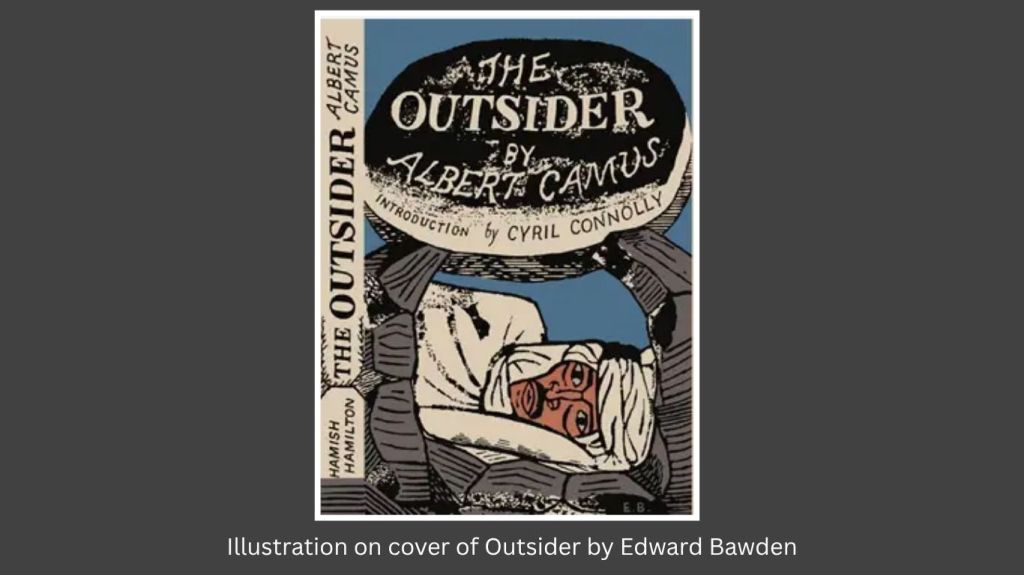
Reading The Outsider, I felt as though Camus had written not a character but a mirror, one that reflected all the hidden evasions of my own life. I have often thought of Meursault’s crime, the killing of the Arab on the beach. It happens almost as an accident, born out of the sun’s blinding glare, the unbearable heat, the white violence of noon. It is an act both senseless and inevitable, born not out of malice or hatred, but because the sun’s heat and light have overwhelmed his senses. In that moment, he becomes the embodiment of Camus’s absurd man: one who recognizes the meaninglessness of existence yet continues to act, to live, to choose. The absurdity of it chilled me. It was as if the act itself, emptied of meaning, were a metaphor for existence: we act, we choose, we live, and the reasons come later, if at all.
What unnerved me most was how the world responds to him. Meursault is not condemned for killing a man; he is judged for not pretending to be human in the socially approved way. His crime, in the eyes of society, is not murder but sincerity. The courtroom scenes are a grotesque theatre of moral outrage: the prosecutor speaks of his mother’s funeral, his failure to cry, his love affair the next day. As if those were the true sins. What continues to haunt me about The Outsider is the moral vertigo it induces. Meursault is denounced not for his crime but for his indifference. His refusal to play by society’s emotional script, his lack of remorse, his calm admission that he feels nothing at his mother’s funeral, offend the social order more deeply than the murder itself. When the prosecutor calls him a ‘monster’, it is not because he has killed, but because he does not lie about what he feels. And so, in a perverse inversion, the honest man is condemned while the hypocrites judge him. The absurdity of it all struck me with sudden clarity: we are not punished for our crimes, but for our honesty about them.
It made me wonder how much of my own life was performance – the polite lies, the cultivated empathy, the practised smile of sympathy. I realized with something like shame that I depend on these illusions. They make me bearable to others, and others bearable to me. Meursault, who refuses to play the part, stands outside it all. Condemned not because he is heartless, but because he is transparent.
There’s a kind of tragic beauty in that.
Camus called Meursault ‘a man who refuses to lie’, and that description has stayed with me for years. What would it mean to live like that? To refuse every false comfort, every sentimental gloss, every moral pretence? I cannot imagine it. It would mean living without narrative, without consolation, facing the raw absurdity of existence unblinking. Meursault’s clarity is a light so harsh, it blinds. I have never possessed the courage to stand fully in that glare.
And yet, paradoxically, The Outsider is one of the most life-affirming novels I know. I always pause when Meursault, awaiting execution, looks up at the night sky and feels the ‘benign indifference of the world’. He is no longer seeking meaning; he has accepted its absence. In that acceptance, he feels a sudden, immense joy. ‘I had been happy,’ he says, ‘and I was happy again.’ Few lines in literature move me as that one does. To be at peace not because life has meaning, but because it does not. That is a freedom beyond despair. Camus achieves something extraordinary here: he transforms nihilism into tenderness. There is no God, no meaning, no justice. Yet the very act of acknowledging that absence becomes an act of affirmation. Meursault’s peace at the end, his acceptance of death, is not resignation but clarity. He has stripped life down to its essence, and in that bareness he finds freedom.
There are days when I find solace in that idea. When the world seems senseless, when everything I’ve built feels transient, I remember Meursault’s quiet revelation. To live without illusion is not to live without beauty. It’s a way of seeing the world as it is, unadorned, luminous in its futility. The sunlight, the sea, the body, the cigarette smoke curling in the heat: these are enough.
Even now, years later, that first line follows me. Mother died today. It is no longer indifference I hear in it, but honesty, the honesty of one who refuses to dress the wound of existence in sentiment. I have begun to understand that Meursault’s detachment is not a lack of feeling, but a kind of reverence: for the world as it is, not as we wish it to be.
My father’s recent condition, after surgery for a malignant brain tumour that has left him stripped of most of his senses, brought all of this sharply to the surface. In a moment of despair, watching him struggle to form a sentence or read a line, I told my family that I would rather end his suffering than prolong this indignity. Naturally, my words found no sympathy. To anyone who knows me, they must have sounded monstrous. How could a son think such a thing, instead of fighting for his father’s life? Yet, for that one instant, I felt brutally honest with myself. I wanted to remember him as the man he was. This shell he had become was robbing him of his dignity. But, of course, the moment passed. Because I am not Meursault.
Camus wrote The Outsider in the shadow of war, but its moral terrain feels timeless. It is not simply a novel about alienation or absurdity; it is a parable about the cost of truth. Every time I return to the book, I feel both chastened and consoled. It reminds me how much of life is spent in evasion, in assigning meaning to the meaningless, in seeking patterns where there are none. Meursault reminds me that clarity is costly, that truth often isolates. But he also reminds me that there is beauty in standing alone, face turned towards the indifferent sun, without apology.
I could never measure up to that honesty. I know this. Honesty of that order is a form of exposure, a laying bare of the self so complete that it becomes almost inhuman. I will always reach for stories to soften the world, to make grief and joy intelligible. And yet, each time I open The Outsider, I am tempted, just for a moment, to live as Meursault does: without justification, without disguise, utterly present. That temptation is both frightening and pure. To live like Meursault is to reject the consolations of meaning, to accept that the universe is indifferent, that life is no more than the sum of its moments. It is a vision both liberating and annihilating.
Every time I revisit The Outsider, I am reminded of how difficult it is to live truthfully. The novel makes me uneasy because it reveals how much of my existence is founded on pretence. I tell myself that I am honest, that I prize authenticity, but I too depend on small lies: the social lubricants of empathy, the convenient omissions that make relationships possible. To live like Meursault would mean rejecting all that, embracing the void without seeking to fill it. It would mean confronting, each day, the unbearable brightness of the sun that drives him to murder. I cannot do it. I lack the strength.
And yet, that very inadequacy is what keeps drawing me back. Meursault’s honesty is like a moral horizon: unreachable but necessary. He reminds me that truth is not comfortable, that meaning is not given but made, moment by moment. His detachment is not apathy but integrity, a refusal to falsify experience. When he says that the universe’s indifference is benign, he is not despairing; he is free.
In the years since I first read The Outsider, I have come to see it less as a story about alienation and more as a meditation on authenticity. Meursault is not a model to emulate but a measure against which our own evasions are revealed. He forces us to ask: what does it mean to live without lying? What would it cost to be fully awake in a world that demands comfort over clarity?
Whenever I return to that opening line, I feel the same chill, the same shock of recognition. It is not indifference that I read there now, but lucidity. The world is uncertain, shifting, absurd. Meursault names that uncertainty without apology. I, on the other hand, still seek to soften it, to make it bearable. And so, I remain what I was when I first closed the book: the inadequate witness to another man’s honesty, awed and unsettled by the clarity of his gaze.
However, in the end, I read The Outsider not to imitate Meursault, but to remember what I have lost. Every time I close the book, I am reminded of just one thing: I could never be that honest. Not because I didn’t want to be, but because I lacked the courage. The courage to see the world without story. He remains, for me, not a hero, not even a companion, but a fixed point of moral light in the distance. I move towards it, knowing I will never arrive. Perhaps that, too, is a kind of honesty.
 Shantanu Ray Chaudhuri
Leave a comment