A strange thing happened in the aftermath of Zubeen Garg’s tragic death. As I kept receiving notifications on his many hits, one song piqued my interest. A song from my childhood in Assam. I had no idea Zubeen had rendered it. Hearing it in his voice took me on a trip down memory lane to those days, 50 years ago, when the song blared from every loudspeaker at every event in Bokajan, Assam, where we lived.
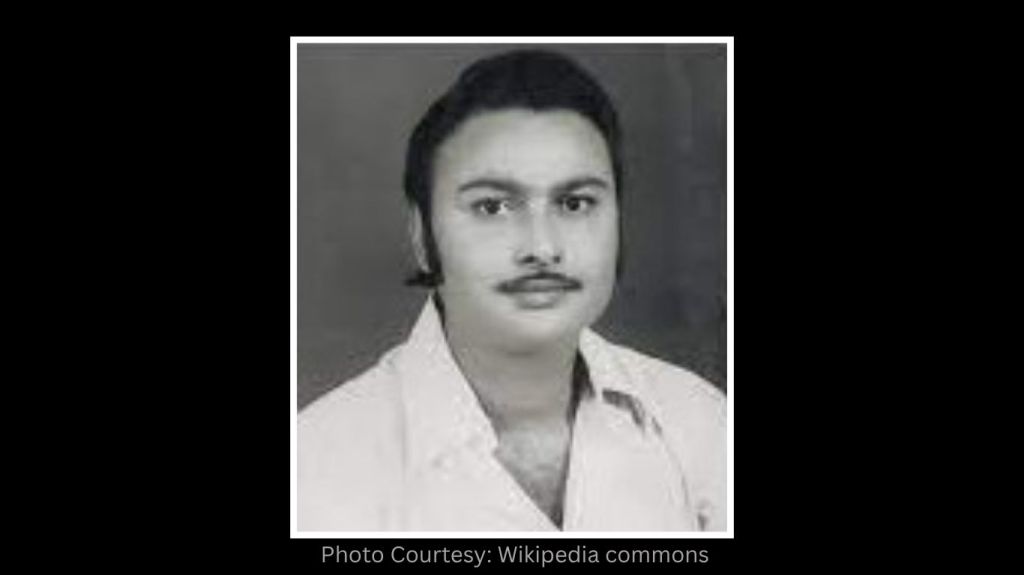
There are songs that exist beyond time, songs that breathe not merely as compositions, but as distilled moments of memory and tenderness. ‘O Xoru Bhoniti’, written by Dwijendra Mohan Sharma and sung in its most cherished version by Ridip Dutta, is one such creation. It belongs to that luminous world of Assamese melody where simplicity is not lack, but fullness, where the very lightness of touch becomes a form of grace. Listening to this song today feels like looking into an old photograph: familiar, faded at the edges, yet carrying the warmth of life that refuses to fade.
‘O Xoru Bhoniti’, literally, O Little Sister, begins in the tenderest of invocations. The singer addresses the young woman with the affectionate diminutive ‘bhoniti’, evoking a bond that is at once familial, friendly and poetic. The song’s opening image is instantly evocative:
‘O little sister,
you’ve draped yourself in Muga Riha –
you’ve tucked a Kopou flower in your hair.’
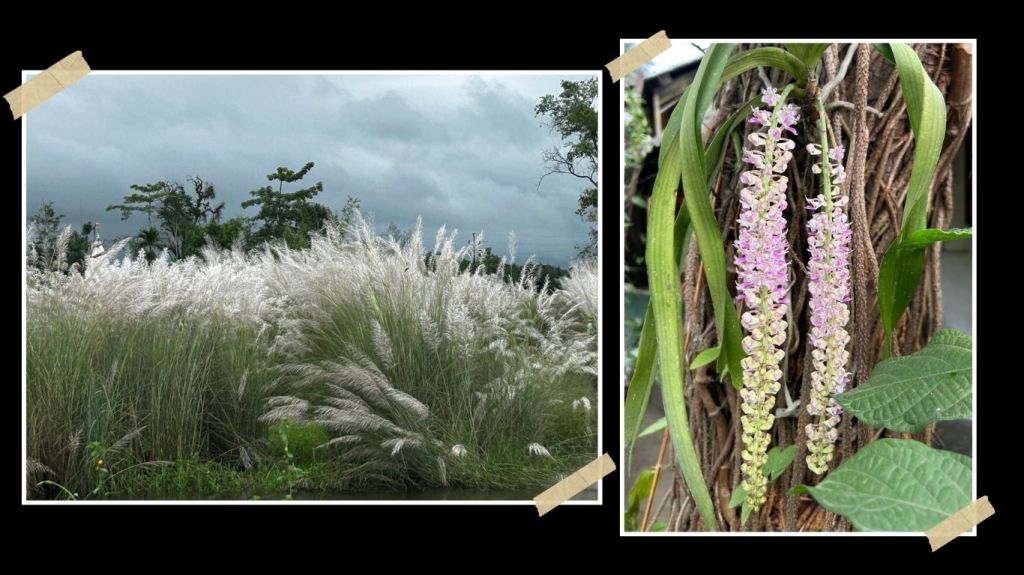
In but three lines, a world comes alive. The Muga Riha, the gleaming golden wrap that defines Assamese femininity, and the Kopou phool, the foxtail orchid that blooms during Bihu – these are not mere ornaments. They are carriers of identity and season, embodiments of Assamese spring itself. The little sister, adorned in these emblems, becomes both a person and a symbol – of beauty, renewal and the quiet continuity of tradition.
The lines that follow carry the pulse of nature: Kohuwa fulise (the fluffy white flowers that signify the onset of autumn), Pepati bajise (the flute sounds in the fields). Dwijendra Mohan Sharma’s lyricism lies in how effortlessly he fuses the human and the natural – the blooming of flowers and the stirring of the heart are the same phenomenon. It is this delicate fusion that gives Assamese folk poetry its charm: the girl in her golden Riha is not apart from the landscape; she is the landscape – the blossoming of the fields, the shimmer of the sky, the sound of the pepa carried by the wind.
The Evocative Simplicity of Expression
There is an unmistakable innocence that runs through the song, an innocence that is emotional, linguistic and musical. Dwijendra Mohan Sharma’s words are simple, almost conversational, but within them is a well of tenderness. The repeated line ‘Dekhi morom lagi jai’ – ‘seeing you, my heart fills with affection’ – becomes a refrain that encapsulates the song’s entire mood. There is no declaration of passion or grand sentiment, only this quiet overflowing of morom (love, affection, endearment), the Assamese word that itself feels gentler than love.
The structure of the lyrics mirrors the rhythm of memory. Lines and stanzas recur, slightly varied, like ripples on a river. The imagery – fields, rivers, flowers, sky – circles back, creating an emotional geography where love and landscape intertwine. When the singer says, ‘O’ Lihiri Gogonai, Tuke Oi Ringiyai’, it’s less an act of praise than a sigh of wonder. As if the singer cannot separate the radiance of the sky from the radiance of the beloved.
And yet, beneath the serenity lies a subtle ache. The song moves from wonder to yearning. The singer speaks of swimming across the Dikhou, wandering along Dihing and Dipang, but ‘still could not find you’. The innocence of affection meets the inevitability of absence. The rivers, so often symbols of life and movement, here also signify the flow of time, carrying away what was once near and known.
Ridip Dutta’s Voice: A Music of Memory
What gives ‘O Xoru Bhoniti’ its lingering power is not just the words, but the voice that carries them. Ridip Dutta’s rendition is a masterclass in restraint. His voice has that rare clarity: unadorned, unhurried, transparent like a morning breeze over the fields. It is the kind of singing that seems to emerge not from training but from the very rhythm of life, the voice of someone who belongs to the song rather than performs it.
There are no vocal flourishes, no dramatic highs and lows. Instead, there is an almost childlike directness, as if the singer is speaking to someone across a courtyard, or recalling a face that once smiled in sunlight. It is this plainness that transforms the song into something pure. Ridip Dutta’s tone carries both the wonder of seeing and the ache of remembering. Each repetition of ‘O Xoru Bhoniti’ feels like a call across time – to a person, to a past, to a lost simplicity.
Zubeen Garg’s later rendition, while polished and technically more expansive, retains this emotional spine. He sings it not as a reinterpretation but as homage, a gesture of gratitude to a song that shaped the sensibility of a generation. Yet it is Ridip Dutta’s version, sparse and unadorned, that remains etched in memory, much like Hemanta Mukherjee’s earliest recordings in Bengali, where emotion lives in restraint, not excess.
Dwijendra Mohan Sharma’s Lyricism
Dwijendra Mohan Sharma, called ‘the man with melody in his pen’, one of Assam’s most beloved lyric poets, had an unmatched gift for transforming everyday imagery into poetry without losing its rootedness. His language never distances itself from life. The world of ‘O Xoru Bhoniti’ is the Assamese countryside in spring, the fields where pepati and pepa resound, the rivers that flow past villages, the scent of kohuwa in bloom. But within this folk simplicity lies an emotional universality.
The ‘little sister’ may be an actual person – a beloved, a younger sibling, a figure from youth – but she is also the embodiment of time’s fleeting innocence. She is the moment before desire becomes loss. That is why the song, for all its sweetness, ends in yearning. The singer crosses rivers, traverses the landscape, seeks her endlessly, but she remains beyond reach. It is the eternal search for purity, beauty, and connection in a world that keeps moving.
The Melody: A Landscape of Emotion
The melody of ‘O Xoru Bhoniti’ is among the most exquisite examples of Assamese adhunik songwriting, a tune that echoes the folk idiom with a modern sensibility. Its charm lies in the seamless blend of simplicity and sophistication, creating a soundscape that feels both rooted and timeless. It stands as a quintessential expression of the Bihu folk tradition, its melody deeply rooted in the musical soil of Assam. The song carries within it the rustic vitality of the Bihu festivals – songs of love, youth and spring – where music and rhythm merge with dance and communal joy.
At its heart lies a deceptively simple yet expressive tune. Bright, fluid and instantly memorable. It unfolds with an unforced grace, the kind that arises from oral folk traditions rather than formal composition. The melodic contour evokes the rise and fall of a dancer’s steps, balancing repetition with subtle variation, ensuring it lingers long after it ends. The rhythmic foundation is buoyant and celebratory, propelled by the characteristic Bihu pulse that invites movement. Even when adapted for modern arrangements, that rhythmic liveliness, so inseparable from the spirit of the festival, remains intact.
Traditionally, the song would be accompanied by the distinctive ensemble of Bihu instruments: the pepa, with its piercing horn call; the gogona, adding a buzzing percussive shimmer; and the dhol, whose earthy beats drive the energy forward. Together, they create a soundscape both festive and pastoral. Over the years, artists like Ridip Dutta and Zubeen Garg have reimagined the song with contemporary textures and instrumentation. Yet beneath every reinterpretation flows the same timeless melody, a folk inheritance that continues to speak in its original cadence, carrying the breath of Assam’s fields, rivers and spring winds.
What makes the tune captivating even today is its restrained emotional intelligence. It does not seek to overwhelm; it invites quiet immersion. The melody’s grace lies in its asymmetry, the small hesitations, the pauses that hold breath between notes. In an age of overstated sentiment, it endures because it speaks through nuance – a melody that whispers its beauty rather than declares it.
‘O Xoru Bhoniti’ belongs to that Assamese tradition where the natural and the emotional landscapes are indistinguishable. Like many of Bhupen Hazarika’s songs, it transforms the local into the universal. When the singer says he swims across the Dikhou, it is both a literal and a metaphorical crossing. An act of devotion, of longing, of reaching for something that time or fate has taken away.
There’s also a profound sense of cultural rootedness. The Muga Riha and Kopou Phool are not just aesthetic details. They are codes of Assamese identity. They recall the festival of Bihu, the rhythms of village life, the connection between beauty and earth. Even the soundscape, the pepa echoing across fields, evokes the communal heart of Assam, where celebration and nostalgia are always intertwined.
What keeps ‘O Xoru Bhoniti’ timeless is precisely its refusal to be grand. It does not attempt to dramatize emotion; it allows emotion to emerge through detail, through a piece of silk, a flower, a river, a name. It is the kind of song that seems to exist outside the commerce of music, born not in studios but in hearts and courtyards.
Its melody flows like a folk tune, with a lilt that mirrors the cadences of speech. The rhythm is gentle, circular, echoing the way memory itself moves, returning again and again to what was once beautiful. When the refrain comes, ‘Dekhi morom lagi jai’, it is less a statement than a sigh, a small exhalation of love in its purest form.
When I first heard it, a child of seven or eight, the morom, the love the song breathed, was beyond my grasp. The world it spoke of was beyond my comprehension. Its meaning slipped past my understanding, yet something unnamed in it stirred the small, unknowing heart. Decades later, with the gathered wisdom of fifty springs and more, its mystery remains undiminished. The song still speaks to me as it did then, its beauty as ineffable, its emotion as hauntingly familiar.
A Song That Remembers
Today, when one listens to ‘O Xoru Bhoniti’, especially Ridip Dutta’s version, one feels a pang of nostalgia not just for the person the song addresses, but for a whole era – a time when Assamese music still carried the innocence of the fields, when the language of affection was unselfconscious, when love could be spoken in whispers rather than declarations.
It is a song that remembers. Remembers a time, a place, a tenderness. It reminds us that beauty often lies in the smallest gestures: a silk draped carefully, a flower in the hair, a voice calling softly, ‘O Xoru Bhoniti…’ And in that call lingers the soul of Assam itself. Golden as Muga, fragrant as Kopou, flowing forever like the Dikhou in spring.
O Little Sister
(my free-flowing translation)
O little sister,
draped in silk of molten gold,
your Muga Riha gleams
like dawn upon the fields.
A Kopou flower sleeps
in your dark, fragrant hair,
its blush of purple whispering
the secret of spring.
I see you
and my heart ripples,
soft as wind over rice stalks.
In the shifting sandbank of my mind,
the Kohuwa blossoms tremble,
and far across the meadow
a pepa sighs, calling,
calling home the scent of earth.
The sky bends low,
a tender blue,
and you,
you glimmer beneath it,
as though the clouds
were learning how to smile.
My precious one,
no dream outshines you.
Across the distant fields,
someone plays the pepa,
someone wakes the festival wind.
Girls with birdlike hearts
spin through the dust and light,
their anklets ringing
the song of the soil.
And I,
I swim the Dikhou’s gentle curve,
I cross the Dihing and Dipang,
chasing the shimmer of your laughter.
In the feast of love,
I open my arms like wings,
and still, I do not find you.
O little sister,
wear your golden Riha,
tuck the orchid in your hair,
walk the earth as if it were song.
Each time I see you,
love unfurls again,
like Bihu dawn,
like the endless river’s sigh.
The Original Song
O’ Xoru Bhoniti Muga Riha Pindhili
Lahoti Khupate Kopou Phool Gujili
Dekhi Morom Lagi Jaai Haye
Dekhi Morom Lagi jaai
Monore Saporit
Kohuwa fulise
Bor Potharote Oi
Pepati Baajise
O’ Lihiri Gogonai
Tuke Oi Ringiyai
O’ Lihiri Gogonai
Tuke Oi Ringiyai
Senai Dhon Senai Dhon
Ture Maan Xuwoni Nai
Senai Dhon Senai Dhon
Ture Maan Xuwoni Nai
O’ Xoru Bhoniti Muga Riha Pindhili
Lahoti Khupate Kopou Phool Gujili
Dekhi Morom Lagi Jaai Haye
Dekhi Morom Lagi jaai
Dur Potharote Oi…
Kune Xinga Pepa Bojale
Kun Nu Bihuwai Oi…
Senai Ringa Ringa Korile
Gor Goya Nasonir Mon
Pakhi Loga Gabhorur Mon
Gor Goya Nasonir Mon
Pakhi Loga Gabhorur Mon
Moromor Dikhou Noi
Xaaturi Aahilu
Senehor Bhoge Doi
Dingora Melilu
Moromor Dikhou Noi
Xaaturi Aahilu
Senehor Bhoge Doi
Dingora Melilu
O’ Dihinge Dipange
Louri Furilu
O’ Dihinge Dipange
Louri Furilu
Senai Dhon Senai Dhon
Tothapi Nepalu Tuk
Senai Dhon Senai Dhon
Tothapi Nepalu Tuk
O’ Xoru Bhoniti Muga Riha Pindhili
Lahoti Khupate Kopou Phool Gujili
Dekhi Morom Lagi Jaai Haye
Dekhi Morom Lagi jaai
O’ Bhoni Oi
O’ Bhoni Oi
 Shantanu Ray Chaudhuri
Leave a comment