
My first glimpse of Satish Shah would not have prepared me in any way for the place he was to occupy only a couple of years later. He was part of the four goons who accost the Smita Patil character in a Mumbai local train in Ramesh Sippy’s Shakti, getting bashed up by Amitabh Bachchan. Who could have imagined then that the same face, lost in the crowd in that gritty moment, would soon become synonymous with laughter itself?
In the pantheon of Indian entertainment, few names summon as much unalloyed laughter as Satish Shah. For those who came of age in the 1980s, his was the face that made evenings sparkle and televisions come alive. His passing marks not just the end of an era, but the fading of a particular kind of laughter – gentle, inclusive, infectious – the kind that once made Indian living rooms hum in harmony.
Satish Shah was more than a comedian. He was a mood, a moment, an emotion, and to many of us, a comforting presence through a period when Indian television was still innocent and cinema still finding its new rhythms. In Yeh Jo Hai Zindagi, he became a one-man ensemble, the laughter tonic of our teens, our parents and our grandparents. And in Jaane Bhi Do Yaaro, as the incorrigibly corrupt municipal commissioner D’Mello, he achieved the impossible. He made us laugh long after his character had died.
The Miracle of Yeh Jo Hai Zindagi
Yeh Jo Hai Zindagi pioneered comedy on television. And over forty years later remains the gold standard for TV sitcoms. Directed by Kundan Shah and Manjul Sinha, written by the inimitable Sharad Joshi, it brought sitcom sensibilities to a nation that would soon become accustomed to mythologicals and melodramas. But what truly made it sing was Satish Shah.
Week after week, Shah appeared in new avatars – uncle, boss, neighbour, servant, salesman, father-in-law, policeman, philosopher, crook, clown – sometimes all rolled into one. Each episode gave him a new life, a new accent, a new swagger, over fifty guises in the sixty-odd episodes. And yet, each of his characters carried that unmistakable Shah spark: a glint in the eye that told you he was enjoying the absurdity of existence just as much as you were.
For a generation of young viewers in the 1980s, Shah’s ever-shifting disguises were the highlight of Friday nights. His ability to move between slapstick and satire, farce and feeling, was unmatched. He wasn’t playing caricatures; he was holding a mirror to the common Indian – our pomposities, our pretensions, our well-meaning follies – and doing so with such affection that even when he was poking fun, it felt like a warm pat on the back.
In retrospect, Yeh Jo Hai Zindagi was a celebration of everyday India – the upwardly mobile middle class, the rented flats, the nosy neighbours, the daily comic negotiations of marriage and modernity. Satish Shah was its everyman chameleon, the spirit of the show itself. Without him, its laughter would never have rung quite so true.
The Corpse Who Stole the Show
If Yeh Jo Hai Zindagi was his showcase for variety, Jaane Bhi Do Yaaro was his masterclass in restraint – or rather, in motionless genius. The film, now a cult classic, was a biting satire on corruption, bureaucracy and moral decay, directed again by Kundan Shah, who clearly knew how to harness Satish Shah’s unique gifts.
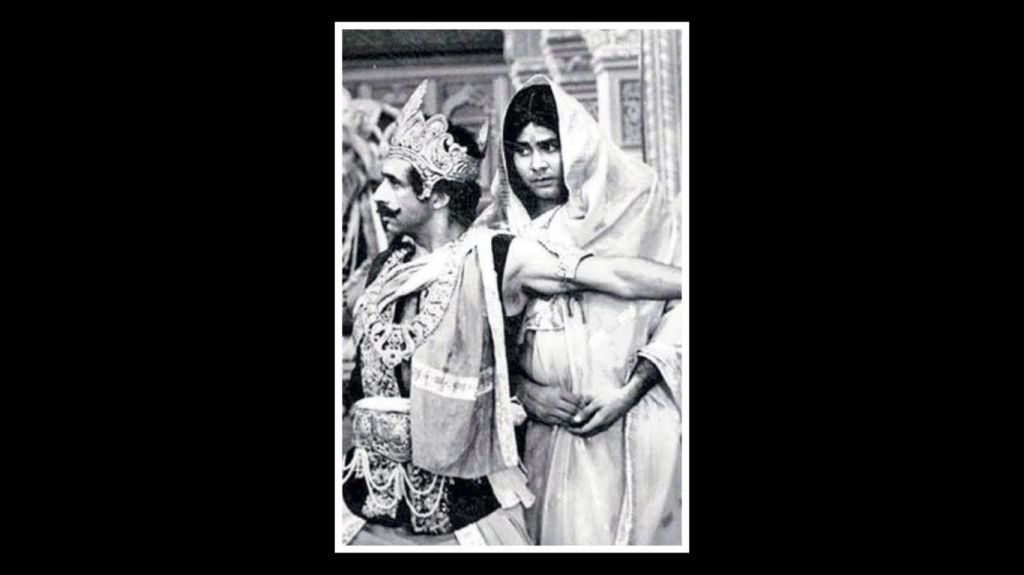
As Municipal Commissioner D’Mello, Shah had a brief but pivotal appearance. His character, a gluttonous (who can forget ‘thoda khao thoda pheko’) symbol of civic rot, dies midway through the film, only to become its most unforgettable presence. For the next hour, he is literally dead weight: a corpse hauled around by the hapless protagonists, Vinod (Naseeruddin Shah) and Sudhir (Ravi Baswani), through a series of deliriously comic situations.
It is one of cinema’s great paradoxes that Satish Shah gave one of the liveliest performances ever delivered by a dead man. His floppy body, the way it slumped, twisted and reanimated with comic timing that was both physical and metaphysical, remains an indelible image. The now-legendary Mahabharata climax, with D’Mello’s corpse playing Draupadi, is the stuff of film folklore, a scene that has survived in popular memory longer than many blockbusters.
Satish Shah’s D’Mello embodied the absurdity of India’s public life: a dead system being propped up and paraded as a living spectacle. Yet the brilliance lay in how he made even that metaphor funny, turning political despair into laughter that still resonates.
The Laughter That Lingers
Satish Shah’s alma mater, the Film and Television Institute of India, gave him the tools of craft, but his instinct was always for the human pulse. Long before ‘character actor’ became a cliché, he made it an art form. Even when he appeared in mainstream cinema surrounded by stars, Shah carried a self-contained luminosity. Consider the three films he was part of with the three Khans: Doctor Chacha in Hum Aapke Hai Kaun!, the music baron inspired by Gulshan Kumar in Akele Hum Akele Tum and the ‘spit’-fire in Main Hoon Na. He didn’t demand the spotlight; he illuminated it. His brand of humour was never cruel. It didn’t need volume or vulgarity. It came from understanding people – their contradictions, their anxieties, their ridiculousness – and from the quiet confidence of someone who didn’t need to overstate his brilliance. And yet, the fact that we struggle to recall many more shows or films that truly showcased him only underlines how the industry failed to create roles worthy of his extraordinary range.
His later work on television, from Filmi Chakkar to Sarabhai vs Sarabhai, reaffirmed his ability to evolve. As the befuddled Indravadan Sarabhai, he gave urban India one of its most beloved comic patriarchs, a man both absurd and lovable. In a sense, he bookended two golden eras of Indian television: one that began with Yeh Jo Hai Zindagi and another that peaked with Sarabhai vs Sarabhai. Few actors can claim to have defined the laughter of two generations.
Despite being an actor whose comic genius was widely acknowledged, he carried his fame lightly. There was no restlessness to ‘prove’ his range, no bitterness about being typecast (how many of us remember his early forays in the films of Saeed Akhtar Mirza, Arvind Desai Ki Ajeeb Dastan and Albert Pinto Ko Gussa Kyon Aata Hai?). He understood that humour, when done with sincerity, was the most serious of callings. In every chuckle he provoked, there was empathy; in every gesture, a deep awareness of life’s ironies.
In Yeh Jo Hai Zindagi, his characters reminded us not to take life too seriously. In Jaane Bhi Do Yaaro, he lay dead and yet made us laugh at death itself. In both roles, he taught us something profound about resilience. The ability to find humour in absurdity, to smile at our own misfortunes, to remain human in the face of the grotesque.
For those of us who first met him through the grainy black-and-white broadcasts of Doordarshan, Satish Shah will always be the laughter tonic of our youth, the Friday evening antidote to the daily humdrum of a less hurried time. His was a humour that didn’t divide or deride, that came not from superiority but from solidarity. He laughed with us, not at us.
As we scroll through his clips today – his multitude of faces in Yeh Jo Hai Zindagi, his corpse tumbling through Jaane Bhi Do Yaaro, his genial Indravadan Sarabhai – we are reminded that the best comedians never quite leave the stage. They take a bow, but the applause doesn’t stop. It carries on in the corners of memory, in the unguarded smiles that still appear when we think of them.
Satish Shah leaves behind a legacy that transcends time and technology: the gift of laughter untainted by cynicism. In an age when humour often divides, his brought us together. For that, and for every Friday night he made brighter, every scene he made unforgettable, we owe him more than gratitude. We owe him joy.
Satish Shah’s death feels, in a way, like the silencing of a familiar laughter track that had been playing in our lives for decades. But perhaps that’s not quite right. Because true laughter never really dies. It lingers, echoing in old dialogues, reruns and memories.
Goodbye, D’Mello. Goodbye, the man of a thousand faces. Thank you for the laughter, the warmth, and the reminder that ‘yeh jo hai zindagi’, this life, is best lived with a smile.
 Shantanu Ray Chaudhuri
Leave a comment