I still remember with incredible clarity the moment when someone, in the middle of a chaotic evening with friends, announced he was no more. But over 38 years later, I have come to realize, he never left, he could never leave. He was in me even before life began. I will carry him with me long after life ends.
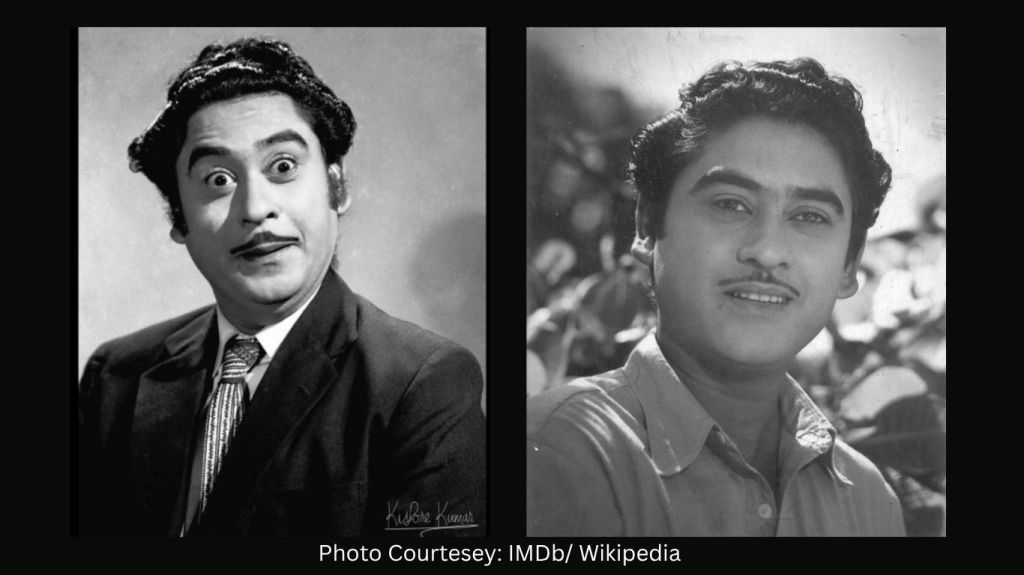
It is the Kishore Kumar I return to most often, the one behind the laughter, behind the mischief, behind the sunshine. It is the Kishore who sounds closest to life itself: unvarnished, weary, tender, still singing. In the first tired notes lies not just a song, but the truth of a man whose voice has carried me through every season of my own life. It is a song from a film that was never even released, as if it, too, was never meant for the world; only for those who needed to hear it. In it, Kishore Kumar’s voice feels stripped of performance, of polish, of pretence. It is not a hit song, not a memory shared by millions, but in its quiet exhaustion, it has become the most personal companion of all. In those first hushed words, Kishore Kumar sings not to entertain, but simply to be heard. It’s the song I return to when the noise fades and only truth remains.
It begins like a sigh, not a song. ‘Bahut raat hui… thak gaya hoon… mujhe sone do.’ Kishore Kumar’s voice doesn’t rise, it folds inward, like a weary traveller resting his head against the last milestone on an endless road. In these first words lies the exhaustion of an entire life – not just of a man who has walked too far, but of a soul who has seen every vista, endured every season, and found them all receding into the same darkness of night. Kishore was always celebrated for his playfulness, his ability to turn a tune into sunlight. But here, in this song, he becomes something else: a witness to time itself, a voice that carries the tremor of memory, the quiet ache of living too long and feeling too much.
This song does not plead; it resigns. The melody drifts like smoke over a dim landscape, and Gulzar’s words are simple, almost childlike in their honesty. He speaks to the moon, to the sun, to time itself, asking them to descend, to pass, to move on. There is no rebellion left, only fatigue. And yet, because it is Kishore, there is also a strange tenderness in that fatigue, a warmth that refuses to harden into bitterness. ‘Zindagi ke sabhi raste sard hain,’ he sings, and the line chills like a sudden wind across an empty field. Every road is cold. Every night, a stranger. Every memory, an ache. Still, he sings it softly, like one might stroke the edge of a wound.
Perhaps that is why the song grips me so completely. It is not merely about despair; it is about the strange intimacy of weariness. Kishore’s voice here feels like an old friend who has stopped pretending, who sits with you at the edge of the night and says, ‘Yes, it’s been long, hasn’t it? Yes, we’re tired.’ There is no performance in it, no heroism, no grand gesture; just a human being at the end of his rope, yet still capable of beauty. And in that beauty is an invitation, almost a permission, for the listener to feel their own exhaustion without shame.
The arrangement, too, amplifies this mood: the spare instrumentation, the deliberate pacing, the silences between the lines. You can almost hear the spaces of a life lived and lost in those pauses. Kishore Kumar does not rush through them; he lingers, as though turning over memories he no longer wants but cannot quite discard. By the time he repeats ‘thak gaya hoon… mujhe sone do’ at the end, the words are less a complaint and more a benediction – the soft closing of a door, the last ember going out.
And yet, for me, it is oddly comforting. Because in his voice, even at its most tired, there remains a trace of light. Proof that even weariness can sing.
I do not remember when it was that I first heard Kishore Kumar. Was it ‘Kasme vaade nibhayenge hum’ in 1977, when an uncle kept humming the song with a faraway air that made me pause, even as a child who barely knew what promises meant? Or was it the Bengali melody ‘Karo keu no go aami’ from Laal Kuthi, which floated into the house around the same time? I cannot say. What I know is that it feels like I have carried his voice with me from when time itself was born. As though before I had words, before I had longings, before I had sorrows, there was his voice, waiting.
And then came the first flush of youth. I was fourteen, trembling under the strange light of my first crush. I had no courage, no vocabulary for what I felt. But Kishore gave me the words. ‘Chhookar mere mann ko’ whispered the secret I could not share with anyone. ‘Dekha ek khwab’ became my private anthem, a dream I kept safe within myself. ‘Pal pal dil ke paas tum rehte ho – to a young teenager imagining himself in love, these words were like a secret heartbeat, a soft, constant presence of someone I dreamed about. The kind of love that lives quietly but intensely, as it can only when one is fourteen. Not loud or dramatic, just a quiet warmth that lingers in every thought, every moment, like a song playing in the background of one’s everyday life. It’s the feeling of discovering how deeply someone can matter, even if they’ve only existed in imagination so far. And when words failed entirely, ‘Phoolon ke rang se, dil ki kalam se’ painted emotions I didn’t yet understand, an impossibly tender love letter I never dared write, but always heard in my heart. Those songs were not just music – they were a diary in melody, written in his voice but lived in my heart.
And with youth came the first heartbreak. Suddenly, his voice, once a companion of innocence, was also a companion of pain. ‘O saathi re’ spoke to the emptiness that hollowed my evenings. ‘Meri bheegi bheegi si’ seemed to know exactly how it felt to stand bereft of the love you had thought was yours for keeps. The same voice that had celebrated love now held my hand through its breaking. Sometimes, when I could not even bring myself to speak of my grief, I would play ‘Koi hota jisko apna’ and feel understood without saying a word.
That was the first lesson Kishore Kumar taught me: that life is not divided between joy and sorrow. The same song can carry both. The same singer can make you laugh and cry in the same breath. He was both love and loss, both beginning and ending. He was the ecstasy of ‘Chal kahin door nikal jaaye’, the wide-eyed dream of escape from everything mundane. He was the sorrow of ‘Mere naina sawan bhadon’, the tears that came unbidden. He was the yearning of ‘Chingari koi bhadke’, where love was fire and ashes at once. He was the wistfulness of ‘Aa chal ke tujhe’, promising a world untouched by cruelty, a promise I wanted to believe even when I knew the world was otherwise, a hope I wanted to pass on to my child.
The Voice in My Everyday
There are voices you admire and there are voices you live with. Kishore’s was never just a singer’s voice for me. It was the background hum of life itself. It came to me in ways that were never planned. His voice wove itself into the fabric of ordinary days. I remember riding a bus on a sweltering afternoon, watching the dusty city roll by, and suddenly the radio blared ‘Zindagi ek safar hai suhana’. And for a few moments, everything was lighter. The sweat, the traffic, the fatigue, none of it mattered. It was as if Kishore had leaned into the bus and winked: ‘Take it easy.’
And then there were nights when I couldn’t sleep. The music system would keep me company, and inevitably his voice would arrive, perhaps with ‘O majhi re’, carrying me into a solitude I did not fear because he was in it too. Sometimes, it would be ‘Jaane kya sochkar nahin guzra’, that existential gem from Kinara, playing like a question I was afraid to ask myself. A song suspended in its own stillness, walking the fragile edge between longing and resignation. In those moments, the silence between the notes felt like it understood me better than any human voice ever could.
Why His Voice Was Different
I have loved many singers. Rafi’s velvet, Mukesh’s ache, Manna Dey’s depth. They were masters, each unforgettable. But Kishore was something else. His voice was never about perfection. It was about life itself, messy and glorious.
There was a grain to his voice, a texture that could be mischievous in one song and broken in another. He could laugh in the middle of a line and it didn’t break the song. It made it. He could draw out a single note until it became a sob. When he sang of desire, it was not crafted; it was raw, almost too close. When he sang of despair, it was never theatrical; it was as if he had known the ache personally.
I think what set him apart was spontaneity. His songs never felt rehearsed; they felt lived. You never sensed a singer interpreting lyrics; you sensed a man living through them in that moment. That immediacy is what made him impossible to resist.
A Companion through Time
Life moved on, and with it, so did the soundtrack. But Kishore was always there. Each stage of growing up seemed to have his voice already waiting for me, like a diary that had been written in advance.
What amazes me most is how he could be both jester and philosopher. He could sing ‘Khaike paan Banaraswala’ with unbridled mischief and, in the same breath, turn to ‘Kuchh toh log kahenge’, reminding us of the futility of caring about the world’s chatter. He could tease in ‘Ek ladki bheegi bhaagi si’ and weep in ‘Dil aisa kisi ne mera toda’. He could dream in ‘Phoolon ka taaron ka’ and despair in ‘Apne jeevan ki uljhan ko’. He could surprise you with the philosophical hush of ‘Jeevan se bhari teri aankhen’, where life itself seemed to pause in wonder.
He contained multitudes. And maybe that is why he became such a natural part of our lives. Because we too contain multitudes. We are never just one mood, one story, one note. And he gave us permission to be all of it at once.
Why He Stays: A Voice That Never Dies
It has been decades since Kishore left, but he has never really left. His songs still find me when I least expect them. On a random afternoon, ‘Rimjhim gire sawan’ can suddenly turn the world silver. In a cab on the way home, ‘Yeh jeevan hai’ can turn silence into companionship, making sense of the chaos that is this world – coaxing us to accept life; it is what is it, it is like this, it always was, it always will be. What is it about his voice that keeps it alive? I think it is because he sang life in all its fullness. He did not polish away the cracks – he sang through them. And so, when we listen, we do not hear a singer. We hear ourselves. Our longing, our laughter, our foolishness, our tears.
Today, as I mark the anniversary of his passing by listening once again – ‘Chhookar mere mann ko’, ‘Aaye tum yaad mujhe’, ‘Zindagi ke safar mein guzar jaate hai’ – I realize something. His passing is not just a date on the calendar. Every time his voice comes alive on the airwaves, it is as though he has returned.
I do not remember when I first heard him. But I know I will never stop hearing him. He has always been with me, from the beginning of time, and he will remain long after I am gone. Because some voices are not just voices. They are our lives, sung back to us.
 Shantanu Ray Chaudhuri
Leave a comment