Six Films. One Year. A Legend Is Born. Shantanu Ray Chaudhuri looks at the Year Hindi Cinema Changed Forever. And So Did Amitabh Bachchan…
The year 1975 stands as a watershed in the history of Hindi cinema – not just for the industry but also for one man whose meteoric rise redefined the contours of stardom. The year was notable for the wide range of films. Gulzar rocked the box office with three of his most memorable films Aandhi, Mausam and Khushboo, while also writing the hilarious Chupke Chupke. This was the year that a little-heralded Jai Santoshi Maa emerged as the film with the highest return on investment, beating even blockbusters like Sholay and Deewaar. This was the year Uttam Kumar had his only Hindi film hit, Amanush, the year of Feroze Khan’s Godfather adaptation Dharmatma and Ravi Tandon’s zany musical thriller Khel Khel Mein. Coexisting with Shyam Benegal’s Nishant was Joginder’s ‘cult’ Ranga Khush, while films like Zakhmee and Julie gave the industry its newest star composers in Bappi Lahiri and Rajesh Roshan.
However, if the year belonged to one star, it was Amitabh Bachchan. Between 1969, when he made his debut with Saat Hindustani, and 1973 when Zanjeer happened (closely followed by Namak Haraam, whose success was instrumental in cementing Bachchan’s superstardom in the wake of Zanjeer), the star had been navigating box office uncertainties. During this period he was part of as many as ten films that failed miserably at the turnstiles, with only Anand and Bombay to Goa finding commercial success, the former more of a Rajesh Khanna vehicle though Bachchan made his presence felt as an actor. Over the next couple of years the star found his footing with films like Majboor, Roti Kapda Aur Makaan and Benaam enjoying commercial success while Abhimaan and Saudagar proved his mettle as an actor in offbeat films which too worked at the box office.
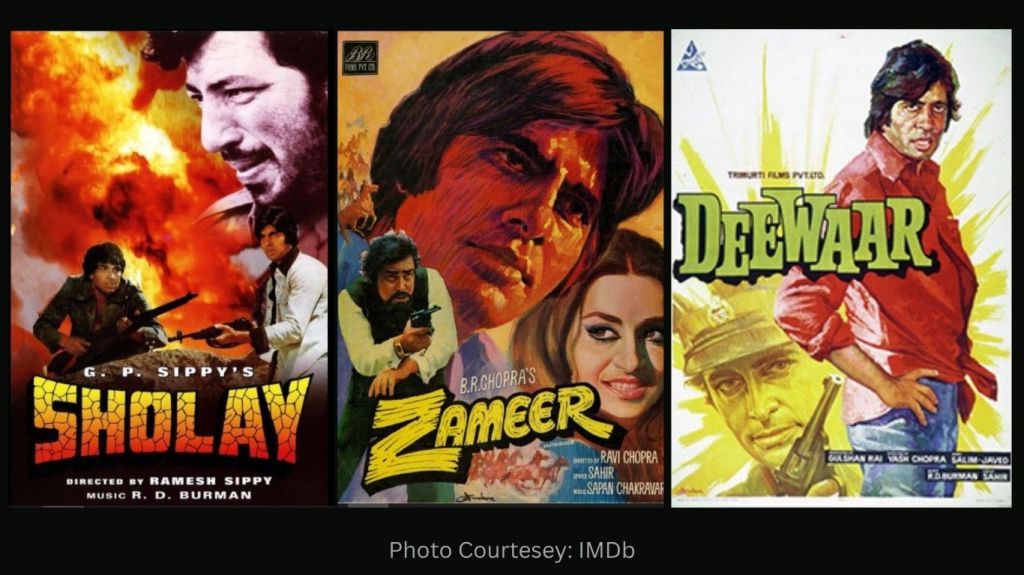
Bachchan truly arrived in 1975. With six releases. Each showcasing a different facet of his range as an actor. Looking back at the films today, it is surprising to see that though he would come to be designated the ‘Angry Young Man’, only one of these six films actually played overtly to that image. The films – Deewaar, Zameer, Sholay, Faraar, Chupke Chupke and Mili – formed a formidable canon that not only shaped Bachchan’s superstardom, marking him out as a phenomenon who would dominate Indian cinema for decades to come, but also changed the very idea of the Hindi film hero.
The Year’s Biggest Blockbusters: Deewaar and Sholay
Though it is Zanjeer that gave birth to Bachchan’s Angry Young Man image, Deewaar became its defining text. Deewaar marked a significant moment in Amitabh Bachchan’s career. Written by the screenwriting duo Salim–Javed and directed by Yash Chopra, the film became a critical and commercial landmark. As Vijay Verma, a dockworker who rises in the Bombay underworld, Bachchan delivered a performance that embodied rage, pain, and simmering intensity.
Deewaar was not just another crime drama – it was a social commentary, reflecting the disillusionment of the 1970s Indian youth. Its dialogues became iconic, symbolizing a man’s rebellion against the system and his estrangement from moral codes. The film drew heavily on post-Independence angst, and Bachchan became its living representation. His portrayal of a man torn between poverty, injustice and the desire for power resonated deeply. It was in Deewaar that the ‘Angry Young Man’ archetype fully matured – and Bachchan was now not just an actor but the voice of a generation.
Any actor who has a Deewaar in a year would have been assured of stardom. When you add Sholay to the mix, the superstardom goes through the stratosphere. Adoor Gopalakrishnan once said of Pather Panchali that Indian cinema could be seen in two distinct phases: before and after Pather Panchali. That could be said of Sholay too. There is Hindi cinema before Sholay and after Sholay. Even Satyajit Ray described it as ‘technically the best film India has produced’. In an interview, he said, ‘I saw it in Bombay, in the first week of its release. Very able, very competent film … In fact I took Amjad for Shatranj on the strength of his performance in Sholay … I thought if an actor could be so good and so rangy why not cast him against the grains and see how it works.’
If Deewaar established Amitabh Bachchan’s gravitas, Sholay turned him into a pop culture titan. Directed by Ramesh Sippy, Sholay was an epic action-adventure that fused the Western genre with Indian sensibilities. As Jai, one half of the Jai–Veeru duo, Bachchan delivered a remarkably understated and controlled performance.
While Dharmendra’s Veeru had the flamboyance, Jai’s quiet strength made him unforgettable. In a film brimming with unforgettable characters – from Gabbar Singh to Thakur – Bachchan’s presence is integral to the emotional core of the story. His scenes with Jaya Bhaduri are minimalistic but profound, and the climax left a lasting impact on audiences. It is his death scene that gives Sholay the sense of desolation that makes the film transcend its action and violent roots.
Sholay broke records, became a generational film, and gave India its first true ensemble blockbuster. Yet, Bachchan stood out, holding his own in a script that could have easily diluted individual performances. His Jai became immortal. Despite its reputation taking a hit in recent times with audiences pointing out how the film-makers and writers filched numerous scenes from Hollywood Westerns, Sholay remains one of the most important films in Indian cinematic history.
Different Strokes – The ‘Smaller’ Films: Zameer, Faraar, Chupke Chupke, Mili
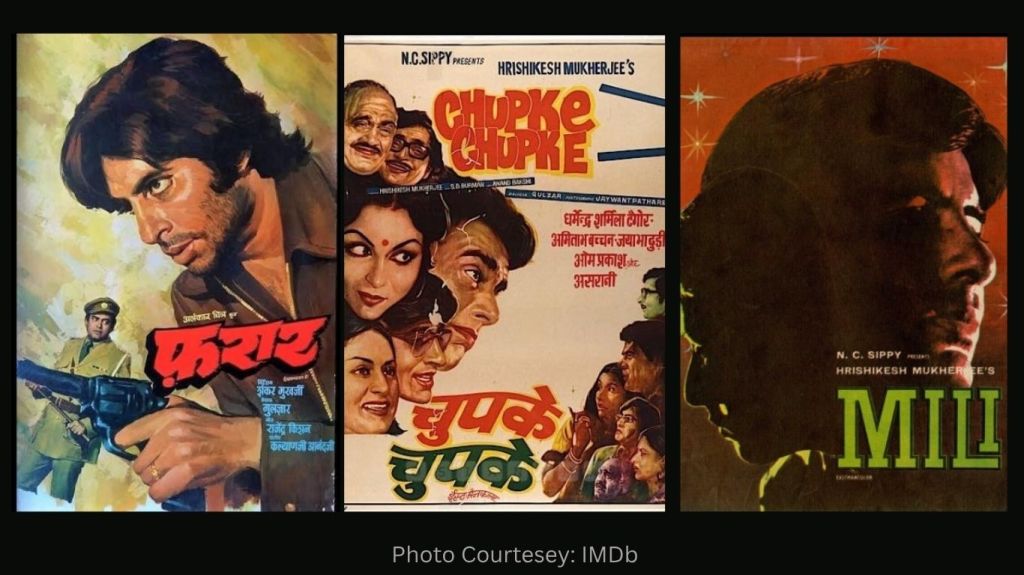
If Sholay and Deewaar gave Bachchan a larger-than-life persona, his other outings in the year brought to light a more vulnerable aspect to his image in films that cast him as the Everyman. Directed by Ravi Chopra, Zameer – based on O. Henry’s story ‘A Double-Dyed Deceiver’ and loosely remade from Raj Khosla’s 1960 classic Bambai Ka Babu – featured Amitabh Bachchan in a more traditional commercial setting. Co-starring Saira Banu and Shammi Kapoor, with a strong cameo by Vinod Khanna, the film is a melodramatic potboiler with tropes of lost-and-found, mistaken identities, and courtroom drama. Not to mention some unforgettable songs by Sahir, including ‘Tum bhi chalo’, clearly the film’s highlight, demonstrating Sahir Ludhianvi at his introspective and philosophical best.
The song is a meditation on the journey of life – not as a destination-driven pursuit, but as a shared, evolving experience. Sahir explores themes of companionship, impermanence and emotional vulnerability, subtly questioning the meaning of progress and togetherness. Kishore Kumar’s voice brings a serene, majestic grace to the verses, transforming the philosophical weight into soulful melody. The song’s essence lies in accepting life’s uncertainties with quiet dignity and shared resilience. It is both an invitation and a surrender, to walk, to feel and to simply be. And remains one of the reason the film still resonates in memory.
While Zameer was not a milestone in terms of critical acclaim, it demonstrated Bachchan’s versatility. His role as Badal, a horse thief mistaken for a long-lost son, required emotional vulnerability, humour and action – all of which Bachchan delivered with finesse. In the context of 1975, Zameer was part of the ecosystem that upheld his box office dominance. Even in a film of lesser substance, his star wattage ensured commercial viability. That was the power he had begun to wield.
Directed by Shanker Mukherjee, Faraar is a thriller in which Bachchan plays Rajesh, a man on the run after avenging his sister’s death. Scripted by Gulzar, the film has a strong emotional core, with a storyline that intertwines suspense with moral complexity. It gave Bachchan another opportunity to explore inner torment – a man pushed to crime by the system and personal tragedy. In Faraar, we see another shade of the ‘wronged man’ archetype. However, unlike Vijay in Deewaar, Rajesh is consumed by guilt and constantly evading law enforcement. What makes Faraar compelling is Bachchan’s portrayal of vulnerability under pressure. His scenes with Sanjeev Kumar, who plays the police inspector, added dramatic tension and showcased his ability to hold the frame even in confrontations with stalwarts.
Though not a runaway commercial hit like Deewaar or Sholay, Faraar contributed to the expanding spectrum of Bachchan’s stardom. He wasn’t confined to a single genre or emotional pitch.
In a year dominated by intense, brooding roles, Chupke Chupke was a delightful anomaly. Directed by Hrishikesh Mukherjee, the film is a comedy of errors, and Bachchan plays Professor Sukumar Sinha, a shy botany teacher roped into a prank. What Chupke Chupke revealed was Bachchan’s impeccable comic timing and his comfort in light-hearted fare – two years later another film would exploit his comic potential and make him the complete entertainer, putting him beyond all comparison: Amar Akbar Anthony.
His chemistry with Dharmendra and Jaya Bhaduri is infectious, and his low-key performance stands out in a film that thrives on ensemble harmony and situational humour. It also reminded audiences that Amitabh Bachchan was not just the brooding antihero – he was an actor of breadth. After watching him battle crime lords and moral dilemmas, Chupke Chupke allowed viewers to see his lighter, more charming persona, and his comfort in large ensemble settings.
Also directed by Hrishikesh Mukherjee, Mili, essentially a reworked version of Anand, is a gentle, emotional drama starring Jaya Bhaduri as a terminally ill woman and Bachchan as Shekhar, a reclusive alcoholic who learns to live and love again through her spirit.
Though it is tempting to say that Bachchan was cast against his 1975 archetype in Mili, a closer look will show that it is essentially a variation on his ‘angry young man’ image albeit on a scale that is more intimate. In fact, Hrishikesh Mukherjee, the director with whom Bachchan has the maximum number of films, provided viewers with a more nuanced take on Bachchan’s core image in films like Anand, Namak Haraam, Alaap, Bemisaal and Mili. In Mili, he is vulnerable, withdrawn and emotionally scarred. His chemistry with Jaya is tender and restrained, providing a contrast to their earlier collaborations. Bachchan’s performance is understated yet deeply moving, showing his willingness to play second fiddle to a strong female character – something that distinguished him from many of his contemporaries.
Though not a commercial blockbuster, Mili was critically appreciated and added another layer to the multifaceted persona he was building in 1975.
Beyond the Box Office: The Making of a Phenomenon
The diversity of these six films is crucial to understanding why 1975 was such a pivotal year for Amitabh Bachchan. From a smuggler in Deewaar, to a poetic outlaw in Faraar, to a comedy foil in Chupke Chupke, to a tragic lover in Mili, Bachchan not only conquered the box office, he proved himself as an artist capable of range, subtlety, and emotional depth.
This was also the year when his on-screen image began influencing fashion, dialogue delivery, and even political discourse. The knotted shirt, the deep baritone, the silences between lines – all became markers of the Bachchan phenomenon.
Moreover, these films showcased his ability to collaborate and not overshadow. Whether it was Dharmendra in Sholay, Shashi Kapoor in Deewaar, or Jaya Bhaduri in Mili, Bachchan’s performances were attuned to ensemble dynamics – a trait rare in superstars.
In hindsight, 1975 was more than just a successful year for Amitabh Bachchan – it was the crucible in which his superstardom was forged. He was no longer just a promising actor or a rising star; he was now the face of Indian cinema. His films that year combined commercial success with critical acclaim, popular appeal with artistic substance. The year did not merely reflect Amitabh Bachchan’s growth; it catalysed it. The six films collectively represented the emotional, ideological and cinematic spectrum of the time – and he stood tall in each. It is no exaggeration to say that the history of Bollywood can be divided into pre-1975 and post-1975 eras when it comes to stardom. And at the centre of this transformative moment stood one man: Amitabh Bachchan.
 Shantanu Ray Chaudhuri
Leave a comment