Released on 3 October 1975, Sanyasi Raja became the most successful Bengali film of the year, demonstrating Uttam Kumar’s enduring hold over the popular psyche. I look at where the film stands fifty years later, both in its own right and in comparison to Srijit Mukherji’s very different take on a timeless courtroom mystery in Ek Je Chhilo Raja…
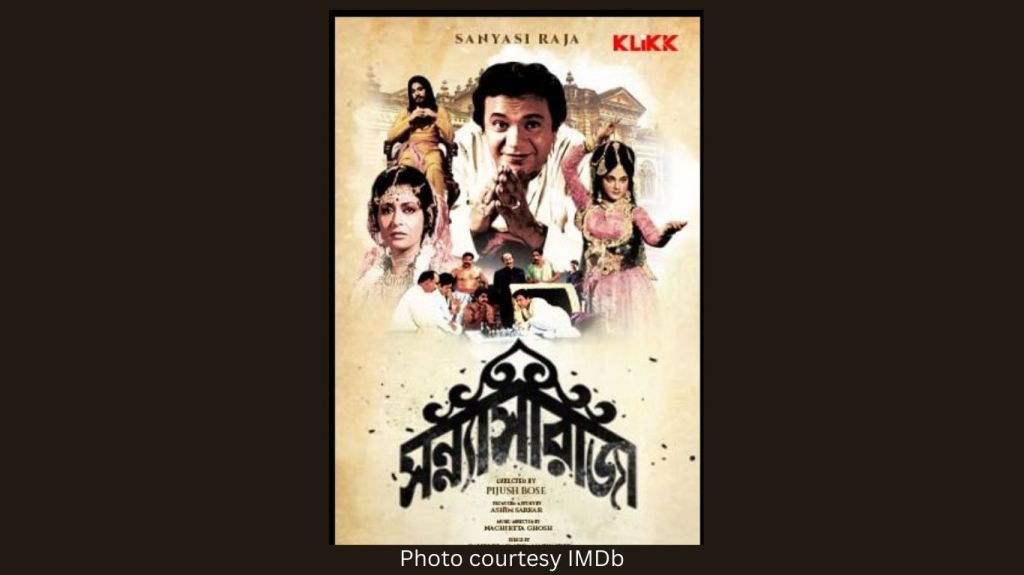
In 1975, just five years before Uttam Kumar’s untimely passing, Bengali cinema witnessed the release of Sanyasi Raja, a film that continues to occupy a hallowed place in the popular imagination even after fifty years. A lavish production mounted at a time when Bengali cinema was at a crossroads, caught between the artistic intensity of the so-called ‘parallel’ wave and the populist demands of mainstream audiences, Sanyasi Raja managed to bridge the gap. It told a tale at once historical and fantastical, inspired by one of the most extraordinary legal battles in Indian history: the Bhawal Sanyasi case. But more than the real-life courtroom intrigue, what sealed the film’s reputation was Uttam Kumar’s magnetic performance and one of the greatest soundtracks ever put together for a Bengali film.
To revisit Sanyasi Raja half a century later is to look not only at a cinematic landmark but also at the strange ways in which history, myth and stardom intersect. It is also to realize how a case that stretched across decades and continents found in popular cinema both its mythologization and, much later, in Srijit Mukherji’s Ek Je Chhilo Raja (2018), its more rigorous, epical retelling.
The Bhawal Sanyasi Case: History Stranger Than Fiction
The Bhawal Sanyasi case, which provides the broad contours of Sanyasi Raja, is one of the most famous identity trials in Indian – and indeed, global – legal history. The case began in the early twentieth century in Bengal’s Bhawal estate, where the young prince, Ramendra Narayan Roy (the second Kumar of Bhawal), was presumed dead of syphilis in Darjeeling in 1909. His body was cremated under mysterious circumstances, though rumours swirled that he had survived.
Almost twelve years later, in 1921, a wandering ascetic appeared in Dhaka, bearing a striking resemblance to the late prince. The sanyasi gradually attracted attention, especially from the local populace who believed him to be their long-lost landlord. His return sparked a sensational legal battle against his widow and the colonial establishment, who disputed his identity.
The trial lasted over a decade, spanning multiple courts from Dhaka to Calcutta to the Privy Council in London. Witnesses were brought from across continents, countless testimonies were recorded, and the proceedings became the stuff of folklore. Finally, in 1946, the Privy Council upheld the sanyasi’s claim, declaring him to be indeed the lost prince. By then, he had little time left to savour his victory; he reportedly suffered a stroke the same evening and died two days later.
This tale of death, resurrection, faith, betrayal and courtroom drama was irresistible to storytellers. For decades it seeped into Bengali cultural memory, retold in novels, plays and finally in cinema.
Sanyasi Raja: History through the Lens of Stardom
Sanyasi Raja was only loosely based on this extraordinary saga. Historical fidelity was never its intention; the film used the broad outlines of the case to craft a vehicle for Uttam Kumar, whose presence guaranteed both commercial success and emotional gravitas.
In fact, the film almost completely eschews the legal intricacies of the courtroom saga, keeping the narrative firmly rooted on the music-and-dance loving raja. And though it simply wouldn’t do to have the mahanayak shown as syphilis ridden or debauched in any way, Uttam is a revelation as temperamental zamindar Raja Suryo Kishore, aware of his vices and yet unable and unwilling to mend his ways. Engrossed in his musical soirees, he neglects his wife and estate. His family physician and friend, in league with his wife, plots to kill him and usurp his property. Suryo survives and returns to the estate as a sanyasi, the very antithesis of his earlier avatar.
Unlike the decades-long legal intricacies of the Bhawal case, the film compresses events into melodramatic confrontations and musical soirees. It is history repurposed into popular entertainment – lush, emotional, and designed to showcase Uttam Kumar’s versatility. And here lies the genius of Sanyasi Raja. Even when stripped of historical nuance, the story retained its primal power, and with Uttam Kumar at its centre, it acquired an aura larger than life.
Uttam Kumar’s Performance: A Masterclass in Star Power
By 1975, Uttam Kumar was already a legend, the face of Bengali popular cinema for two decades. By the turn of the 1970s, Uttam had started to venture more and more into character roles that often cast him in a negative light, of which Sanyasi Raja is one, though it is careful in not straying too far. Uttam breathes life into the character, scaling new heights, embodying both the mystique of the sanyasi and the authority of the royal heir.
What elevates the performance is Uttam Kumar’s ability to make the audience complicit. Viewers knew the film was more melodrama than history, yet Uttam’s magnetism ensured it did not matter. The very ambiguity of the Bhawal case – was he the prince or not? – is resolved not by evidence but by the charisma of Uttam Kumar. In popular memory, there could be no doubt: he was the raja.
Even today, the film is remembered as one of Uttam’s towering achievements, ranking alongside his many mainstream successes in showcasing his range.
The Music: Giving Voice to a Legend
If Sanyasi Raja endures in memory today, it owes as much to its soundtrack as to Uttam Kumar’s towering presence. Composed by Nachiketa Ghosh, with lyrics by Gauri Prasanna Majumdar (who won the BFJA Award for best lyricist), the music is a rare blend of lyrical richness, melodic variety and dramatic relevance. Almost every song is rendered by Manna Dey – twelve out of the thirteen numbers – making this one of the most significant collaborations between the singer and Bengali cinema. The lone exception, Hemanta Mukherjee’s ‘Ke tabo kanta’, is itself a gem, carrying the gravitas of devotional yearning.
What makes the album extraordinary is not just its sheer number of songs – few Bengali films have had such a rich bouquet – but the way they are woven into the texture of the narrative. The songs are not ornamental; they advance the story, express inner conflicts, and lend the film its enduring emotional resonance. One of the defining features of the songs lies in how most of them go against the grain of the regular film song. Instead of the standard 3-4 minutes a film song is expected to be, nine of the thirteen songs are barely a minute to ninety seconds long, serving more as conversations, taking the narrative forward.
‘Bhalobasar agun jwalao’ sets the tone, a stirring invocation of love, rendered with Manna Dey’s unmatched ability to combine classical finesse with emotional appeal. It carries both romantic ardour and a prophetic edge, foreshadowing the turmoil to come. ‘Thori bhiksha karke lana’ is a showcase of Dey’s virtuosity, drawing from the devotional and the folk idiom. ‘Ghar sansar sobai to chai’ is a brief interlude, but poignant, a domestic lament, capturing the tension between worldly desire and ascetic withdrawal. ‘Se kawtha ki jane Indu’ and ‘Puja ki go theme jay’ are miniature musical moments (barely a minute each), but they illustrate how even short refrains were crafted with precision, acting almost like leitmotifs that punctuate the story. ‘Kato rasik dekho bhagaban’ and ‘Karan sebay baran karo’ continue this pattern: short, classically tinged pieces that build the atmosphere of a feudal household caught in intrigue, prayer and performance. ‘Hujur bole selam kore’ and ‘Ogo beshi daam balo kar’ provide satirical, almost playful interludes, lightening the gravitas of the narrative with touches of irony and everyday banter.
‘Kaharba noy dadra bajao’ and ‘Ke tabo kanta’ are among the four songs that break the three-minute barrier. The former is probably the most musically sophisticated piece in the album. Dey revels in the rhythmic intricacies, making it both a performance song and a cultural marker of Bengal’s syncretic musical traditions. ‘Ke tabo kanta’ stands apart, with its devotional fervour and soulful depth framing the sanyasi’s journey in metaphysical terms, elevating the story beyond the legal and the familial into the spiritual.
What binds these songs together is their dual function. On the one hand, they are dramatic devices, carrying the story forward. On the other, they exist independently as musical masterpieces, each with a life of its own in Bengal’s cultural memory. Played endlessly on radio, performed in concerts, and cherished in private collections, they became part of the everyday soundscape of generations.
The concentration of Manna Dey’s voice across so many songs also gave the film a singular musical identity. His versatility allowed him to shift seamlessly between devotion, romance, satire and virtuosity, effectively becoming the singing voice of Uttam Kumar’s sanyasi-king. The collaboration stands as one of the pinnacles of Bengali playback history.
Fifty years later, these songs remain the living pulse of Sanyasi Raja. They are why the film is not remembered as a take-off on a courtroom drama, but as a musical epic that gave voice – literally and metaphorically – to one of Bengali cinema’s greatest myths.
A Landmark of Popular Bengali Cinema
The success of Sanyasi Raja lay in its ability to turn a complex historical-legal saga into an accessible, emotionally resonant narrative. For Bengali audiences of the mid-1970s, dealing with political turbulence and social change, the story of a lost king returning to reclaim his place must have carried particular resonance.
It offered the comfort of order restored, of truth emerging victorious, even if that truth was more cinematic than historical. The film’s lavish sets, strong supporting cast, and impeccable pacing made it one of the high points of popular Bengali cinema. Half a century later, it remains a staple of television reruns and streaming platforms, drawing new generations into its orbit.
Srijit Mukherji’s Ek Je Chhilo Raja: Returning to the Source
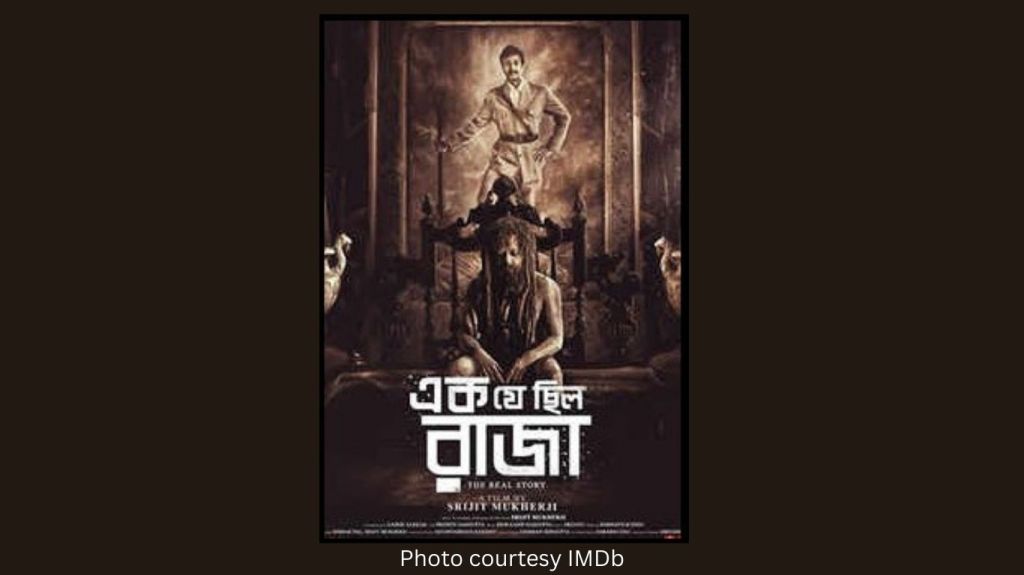
In 2018, more than four decades after Sanyasi Raja, director Srijit Mukherji revisited the Bhawal case in his magnum opus Ek Je Chhilo Raja, without doubt among the director’s finest works. Unlike the earlier film, Mukherji set out to tell the story in greater historical detail, drawing closely from court records, historical research and the social context of colonial Bengal.
Starring Jisshu Sengupta in the central role, the film paints a far more ambiguous, layered portrait of the ‘sanyasi prince’. Sengupta delivers a powerhouse performance – and though Bengali film lovers would never agree, he is as good, maybe even better than Uttam Kumar was in the central role – capturing the enigmatic mixture of vulnerability, authority and mystery. His physical transformation is as awe-inspiring as the emotional texture he brings to the character, with the make-up which transforms him across multiple stages of the narrative underscoring the film’s technical achievement.
Mukherji’s approach is less melodramatic, more investigative. He reconstructs the epic scale of the case, the years of trials, the conflicting testimonies, and the charged colonial atmosphere in which the story unfolded. The film does not provide easy answers but instead invites viewers to grapple with the central question: was he truly the prince, or an extraordinary imposter?
In doing so, Ek Je Chhilo Raja reclaims the historical roots of the saga, standing as a companion piece to the myth-making of Sanyasi Raja. If the latter immortalized the story through stardom and music, the former brought it back to history and ambiguity.
Legacy and Continuity
Together, Sanyasi Raja and Ek Je Chhilo Raja represent two poles of Bengali cinema’s engagement with history. One privileges the aura of the star and the demands of popular entertainment; the other insists on fidelity, detail and nuance. Both, however, testify to the enduring fascination of the Bhawal Sanyasi case.
For Bengali audiences, the tale continues to resonate because it is ultimately about identity, memory and belief – questions that remain perennially relevant. Was the sanyasi truly the lost prince? Or was he a stranger onto whom people projected their hopes and nostalgia?
Fifty years after Sanyasi Raja, and a century after the sanyasi first appeared, these questions remain unresolved. But cinema, in its different avatars, has ensured that the story lives on.
Sanyasi Raja remains, fifty years on, a jewel of Bengali popular cinema. It may not be a faithful historical document, but it is a deeply moving cultural artefact, one that fused myth and stardom into an unforgettable whole. Uttam Kumar’s performance, the unforgettable soundtrack, and the film’s sheer dramatic sweep secure its place in the canon. At the same time, Srijit Mukherji’s Ek Je Chhilo Raja demonstrates how the same story can be retold with very different priorities: historical authenticity, layered ambiguity and epic scale.
Between these two films lies the full spectrum of Bengali cinema’s engagement with its past: from myth to history, from melodrama to realism, from star power to ensemble craft. And at the centre of it all remains the Bhawal Sanyasi, a figure who, in death and resurrection, continues to haunt our cultural memory.
 Shantanu Ray Chaudhuri
Leave a comment