I first stumbled upon Robert Redford not in the hushed dark of a cinema hall but in the dimly-lit, labyrinthine lanes of Palika Bazaar in the 1980s, where pirated videocassettes promised entry into another world. For a teenager growing up in a city where English films were a rarity on the big screen, save for the occasional revival at Archana or Chanakya, Palika became an underground film school. From its shelves I first discovered De Niro, Pacino, and a host of Hollywood greats, each tape a contraband passport into a universe far beyond Delhi. It was here that I picked up a cassette of Butch Cassidy and the Sundance Kid, and was instantly converted to the charm of Robert Redford and Paul Newman. The film’s philosophy, best captured in the insouciant optimism of ‘Raindrops Keep Fallin’ on My Head’, touched a chord and made their roguish defiance irresistible. They were tricksters, dreamers and outlaws with laughter on their side. Almost immediately after I chanced upon a cassette of The Sting, another buddy caper, and from then on Redford and Newman became inseparable in my imagination: twin stars whose light seemed to burn brighter in each other’s company.
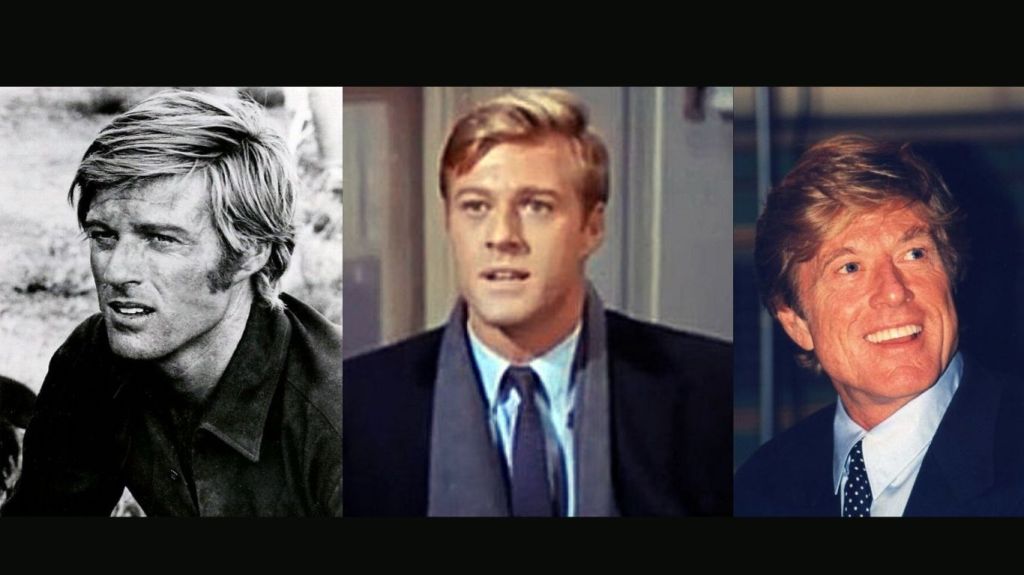
When news came of Robert Redford’s passing late on the afternoon of 16 September 2025, it felt less like the departure of a celebrity and more like the fading of a particular kind of light. Few actors in the second half of the twentieth century embodied American cinema with such quiet authority, such understated grace, such paradoxical unease with the very notion of stardom. He was golden in every sense – his hair, his aura, his seeming inevitability as a screen idol. And yet, for much of his career, Robert Redford wrestled with the burden of that glow, determined to prove he was more than the prettiest man in the room.
It is one of the fascinating contradictions of Redford’s career: he was perhaps too handsome to be taken seriously, too blessed by the gods to convince the critics that beneath the good looks lay a searching, serious actor. In an era defined by the Method revolution, by Robert De Niro’s volatility, Al Pacino’s feral intensity, Dustin Hoffman’s neurotic energy, Gene Hackman’s bulldog grit, Redford stood apart. He was cooler, more restrained, less inclined to explode. Where his contemporaries thrived on transformation, Redford’s art was in continuity. He played men not by vanishing into them but by lending them his stillness, his decency, his measured gaze.
For most of the world, Redford’s legend began with Butch Cassidy and the Sundance Kid (1969). Paired with Paul Newman, Redford was half of a partnership that redefined the buddy film. If Newman’s Cassidy was all winks and grins, Redford’s Sundance Kid was a taut bowstring, coiled and precise. Alongside Paul Newman, he turned the outlaw Sundance into an emblem of charm, camaraderie and loss. Their chemistry, breezy yet melancholic, remains one of cinema’s enduring friendships. The film was a smash, a cultural event, and it made Redford not just a star but an idea: the Sundance Kid as outlaw, trickster, reluctant hero.
That idea carried him into The Sting (1973), again with Newman, this time in a story of con men where Redford’s natural charm became his greatest weapon. It was a lighter film, more fun, but together the two movies sealed Redford’s status as the man who could balance seriousness with lightness, craft with charisma.
Then came the 1970s, the decade of his most politically engaged work. Three Days of the Condor (1975) remains a model of the paranoid thriller: Redford as a CIA analyst on the run, suddenly aware that the very government he serves is trying to kill him. There was something about Redford’s cool exterior that made him perfect for paranoia. He could play a man calculating, watchful, moving silently in a world that had turned on him.
And of course, All the President’s Men (1976). As Bob Woodward, opposite Dustin Hoffman’s Carl Bernstein, Redford turned investigative journalism into cinematic drama. The film’s power lay in its understatement, and Redford’s performance was its anchor: steady, serious, propelled not by ego but by a conviction that truth mattered. In an age of Watergate disillusionment, Redford gave us a different kind of hero: not a gunslinger or a rebel but a reporter, someone who fought corruption with patience and persistence.
These roles made him part of the great tapestry of 1970s American cinema, but oddly, Redford was never quite admitted into the pantheon of that era’s ‘great actors’. He was there, he was essential, and yet he was always somehow excluded from the conversations around De Niro, Pacino, Hoffman, and Hackman. Perhaps it was because he lacked their explosiveness, their willingness to embrace ugliness. Redford, even when dishevelled, remained somehow composed.
The 1980s brought him his most commercially successful film, Out of Africa (1985). Paired with Meryl Streep in Sydney Pollack’s lush epic, Redford played Denys Finch Hatton, the hunter and lover who embodied romantic colonial fantasy. The film was adored, showered with Oscars, and remains one of his most iconic roles. And yet – for me, and for many – it was a role I never quite took to. Redford, with his restraint and refusal to yield to the overtly dramatic, seemed miscast in a film that demanded grand gestures and high romance. The famous scene of him shampooing Meryl Streep’s hair, meant to be erotic and tender, always felt faintly awkward. Perhaps it was my own prejudice against the film’s sweeping sentimentality, but Out of Africa seemed to swallow Redford whole. It was a performance that highlighted the paradox of his career: he could dominate with understatement, but in a film built on spectacle, his quietness risked looking like absence.
Ironically, just as his acting was being typecast by his looks, Redford turned to directing, and there, he revealed depths few had suspected. Ordinary People (1980), his debut, was a quiet revolution. A suburban family drama about grief and alienation, it won four Oscars, including Best Picture and Best Director. Redford had made a film that was everything his image was not: modest, unshowy, rooted in pain and silence. It was proof that he was not just a star but a serious artist.
He would go on to direct other films – A River Runs Through It (1992), Quiz Show (1994), The Horse Whisperer (1998) – all of them marked by restraint, by a refusal to bludgeon the viewer with sentiment or spectacle. They were, in a sense, cinematic echoes of his acting style: precise, understated, quietly humane.
And of course, there was Sundance. What began as a small festival in Utah became, under his stewardship, the beating heart of American independent cinema. If Redford’s acting and directing careers had not already secured his place in history, Sundance would have. He opened the doors for new voices, new styles, new generations.
The Forgotten Films
To look only at Redford’s big titles is to miss some of his richest work. In The Chase (1966), he was already stretching against type, playing a convict in a film bristling with racial and sexual tension. Matching Marlon Brando step for step. In Downhill Racer (1969), he played a driven, arrogant skier, a role that allowed him to explore ambition and self-destruction with a sharpness rare in his early career. The Candidate (1972) remains one of the most biting satires of American politics, with Redford as the idealistic lawyer corrupted by the machinery of campaigning. These were not easy films; they were often small, prickly, unwilling to flatter either their subject or their star. But they showed Redford’s seriousness, his refusal to coast on charm.
Zen Z might be aware of the star thanks to his Alexander Pierce in the Marvel Cinematic Universe. He appeared in Captain America: The Winter Soldier (2014) and briefly in Avengers: Endgame (2019). Though he had little of his craft to contribute to the franchise, as a high-ranking S.H.I.E.L.D. official secretly aligned with Hydra, Redford brought gravitas and political intrigue to the role, enhancing the franchise’s dramatic depth. And then, in the final decade of his career, came two performances that belong to the very best of his life’s work.
All Is Lost (2013) is a film of astonishing audacity: a one-man survival drama with almost no dialogue. Redford plays ‘Our Man’, an unnamed sailor whose yacht collides with a shipping container in the Indian Ocean. The film is stripped bare of exposition, psychology, or backstory. It is simply Redford, the sea, and the gradual erosion of hope.
To watch him there, weathered and solitary, was to see Redford both as man and myth. He carried six decades of stardom into that role, and you felt all of it etched on his face. Every glance, every tightening of the jaw, every weary gesture conveyed volumes. There are only a handful of actors who could sustain a film of such silence, and Redford did so by allowing the camera to rest on his stillness, his endurance.
What struck me most was how All Is Lost became a metaphor for his career. Here was an actor who had always been underestimated for being too composed, too reticent – and now that very quality was the performance. He turned minimalism into grandeur. The beauty of All Is Lost was not in heroism but in survival. Redford gave us a man facing death with dignity, rage, exhaustion, and, at last, acceptance. It was, for me, the crowning achievement of his acting life.
Five years later came The Old Man and the Gun (2018), which he announced would be his final acting role. It was, in a sense, his farewell to the screen, and he chose it wisely: a gentle, elegiac tale of an aging bank robber who robs not out of need but out of love for the act itself. Redford played it with twinkling charm, a nod to his Sundance Kid past, but with a wistfulness that only age can bring. The performance was a self-portrait, a summing-up, and it left audiences smiling through tears.
The Reluctant Icon
So where does Robert Redford stand in the pantheon? He was never quite a De Niro or a Pacino, never as transformative as Hoffman, never as forceful as Hackman. He was something else: a star who mistrusted stardom, an actor who could disappear in plain sight. His great gift was subtlety, a refusal to impose. He let the audience do the work.
If his beauty kept him from being fully appreciated in his prime, time has corrected that. We can now see that his restraint was its own kind of courage, his stillness its own form of eloquence. He was, in his best moments, an actor of rare honesty. Robert Redford leaves behind not just a body of films but a way of being in cinema. He was the Sundance Kid, the con man, the reporter, the sailor, the outlaw, the old man with the gun. He was also the director who made us weep for ordinary people and the mentor who gave independent film-makers a stage.
He always belonged in that quieter place where integrity matters more than intensity, where understatement becomes unforgettable, where the actor’s presence is less about what he does than about what he allows us to feel. Robert Redford never needed to shout. He was the silence we leaned in to hear. He was a star who mistrusted stardom, an actor underestimated because he made it look effortless, and a director who showed that ‘ordinary people’ contain extraordinary depths.
In the end, perhaps Redford didn’t belong to the pantheon. He built his own.
 Shantanu Ray Chaudhuri
Leave a comment